What Is zkTLS? Privacy and Reputation for DeFi Explained
— By Whatsertrade in Tutorials

Learn what zkTLS is, how it proves off-chain data without exposing private details, and why it matters for DeFi reputation, lending, and on-chain identity.
This page explains what zkTLS is and why it matters for private proof of reputation and data. It is a privacy-tech explainer, not a wallet-security checklist.
In the crypto world, identity has always been a puzzling problem. DeFi protocols primarily have access to wallet activity, token balances, liquidations, trading history, and on-chain behavior. What these systems often lack is insight into trusted real-world context. Here enters zkTLS, a technology that could be a game-changer for the digital finance space.
Your crypto wallet might belong to an experienced trader, a verified company, a long-standing customer, or a user with off-chain credentials of value. However, bringing such information on-chain poses a significant privacy challenge. No one wants their personal data exposed publicly just to secure a better lending rate, qualify for an airdrop, or establish a trustworthy reputation.
zkTLS steps in to potentially resolve this issue.
An Introduction to zkTLS
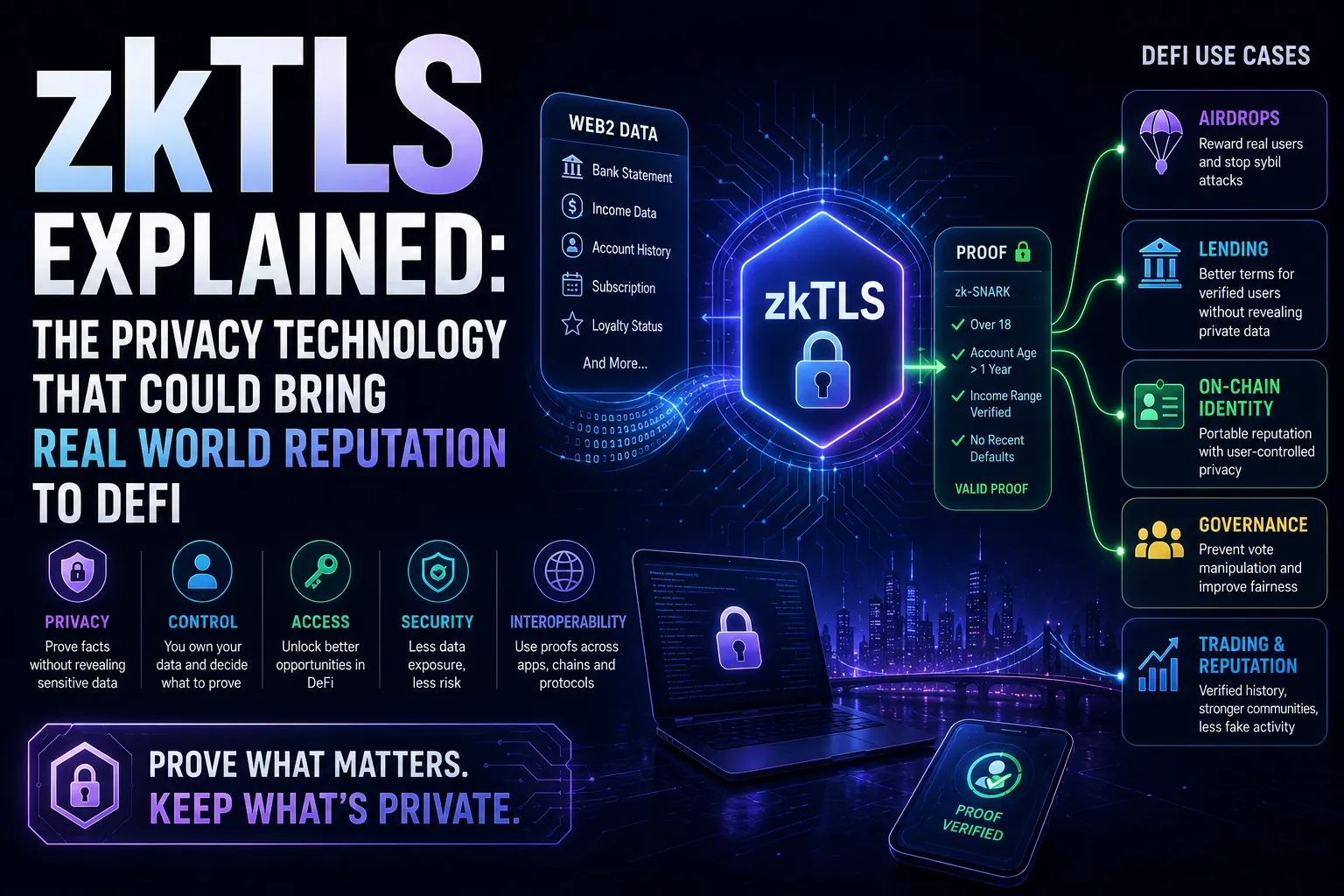
zkTLS stands as a privacy-preserving technology, enabling users to substantiate facts about web data without exposing the complete dataset. It marries concepts from secure web connections and zero-knowledge proofs.
Put simply, zkTLS allows a user to confirm that information from a website is truthful without divulging sensitive details. A user might validate their account status, transaction history, income range, subscription level, or loyalty record without exposing their full login details, identity, or private records.
This technology is potent for crypto as it connects the dots between Web2 data and Web3 applications, offering a profound advantage.
The Importance of Enhanced Reputation in DeFi
Why Better Reputation Matters
Typical DeFi systems treat every wallet as if it were a distinct unknown entity. While beneficial for openness, it limits what protocols can effectively provide.
Consider lending. Anonymity usually necessitates heavy collateral, rendering DeFi capital inefficient. Airdrops face challenges in distinguishing between genuine users and bots. Token launches can fall prey to sybil farms that seize reward campaigns. In governance, a single individual might manipulate numerous wallets. Trading communities find it easy to fabricate fake reputations.
On-Chain History: Helpful But Incomplete
Though on-chain history fills part of this gap, it is far from comprehensive. A wallet might be newly minted. A user might change addresses frequently. Bots can mimic regular activity seamlessly. And having an abundant wallet balance doesn't immediately equate to being a trustworthy wallet.
zkTLS provides an opportunity to incorporate verifiable context without coercing users into full disclosure.
The Functionality of zkTLS within the Crypto Sphere
Enhancing DeFi Lending Dynamics
Visualize a scenario where a DeFi lending protocol aims to offer users with provable income stability better terms. Presently, this would require either centralized identity checks or higher collateral. With zkTLS, users could substantiate limited claims about their income from a trustworthy source without revealing the full document.
Transforming Airdrop Campaigns
Imagine revamping an airdrop campaign to reward actual users rather than bot farms. zkTLS could facilitate users in proving unique activity across external platforms, past account age, or membership status while protecting private account details.
Cultivating Trust in Trading Platforms
Envision a trading platform aspiring to develop reputation scores. Users, through zkTLS, could affirm histories from centralized exchanges, analytics platforms, or payment services while safeguarding sensitive details.
The essence lies in selective disclosure users disclose only what's necessary.
zkTLS and Airdrop Farming Challenges
Airdrop exploitation is a prime example. Projects aim to reward genuine users, yet airdrop farming has become excessively industrialized. Bots mass-produce wallets, simulate activities, and grab rewards.
Traditional anti-sybil strategies often infringe on privacy or unfairly penalize legitimate users. Social logins, KYC checks, and centralized verifications often create friction. Pure on-chain analysis might overlook authentic identity patterns.
zkTLS introduces a balanced approach. Users could demonstrate they meet specific criteria without revealing their full identity. Projects could request proof of account age, platform membership, past activity, or real user signals from external data sources.
While this wouldn't wholly eradicate sybil attacks, it could heighten the barriers to fake participation.
Revamping DeFi Lending via zkTLS
Lending represents another substantial opening. Currently, most DeFi lending is overcollateralized due to anonymity; hence users deposit more than they borrow as protocols lack assurance of repayment ability.
Integrating real-world credit data on-chain is challenging due to privacy and regulatory constraints. zkTLS could allow users to verify limited credit-related details without compromising personal records.
Consider a borrower endorsing they meet an income threshold, have avoided recent defaults, or maintain a verified business account. Protocols might adjust collateral requirements, borrowing limits, or risk scores based on such verifications.
This could enhance DeFi lending's capital efficiency while ensuring user privacy remains intact.
zkTLS and On-Chain Identity Evolution
On-chain identity doesn't imply public identity application. The future may witness private, user-controlled credentials flourishing. zkTLS can help architect this future, turning off-chain data into proofs adaptable across Web3.
A user, using zkTLS, might form a portable reputation profile built on verified facts, potentially including trading history, account age, professional credentials, customer status, or community involvement. Importantly, the public chain need not archive the raw data.
This development could refine governance, token launches, rewards, lending, insurance, and social applications.
User Benefits of Adopting zkTLS
Prioritizing Privacy
The foremost benefit is privacy. Users are able to demonstrate eligibility or reputation without laying bare unnecessary information.
Maintaining User Control
Secondly, users retain control over their identity data proofs, moving them seamlessly between applications instead of platforms dictating control.
Enhanced Financial Access
The third advantage is improved access. Superior proofs can unlock more lucrative financial products, equitable airdrops, and more reliable participation.
Strengthened Security
Finally, reduced storage of raw personal data by applications translates to fewer centralized hacking targets.
Navigating zkTLS Adoption Challenges
Despite its promise, zkTLS remains intricate. Users require intuitive interfaces. Developers need robust tools. Protocols must determine trustworthy data sources. Wallets should render proofs easily understandable.
The journey also includes social and regulatory considerations. Even privacy-focused proofs could lead to sensitive outcomes if misapplied. Protocols must avoid fostering hidden discrimination, obscure scoring practices, or excessive identity prerequisites.
The astute application of zkTLS shouldn't make DeFi less open-it should empower users to substantiate trust when they opt to.
The significance of zkTLS as a privacy enabler in Web3 might lie in its unique ability to connect real-world data with on-chain applications sans unnecessary exposure. For DeFi, it signals potential improvements in airdrop procedures, reputation establishment, lending conditions, and identity management. For users, it offers a harmonious blend of privacy and trust. For protocols, it provides an ingenious strategy to counteract bots and enhance risk models without necessitating universal public identity disclosures.
The forthcoming era of crypto identity might not revolve around unveiling your full identity but, intriguingly, around proving only what's relevant.
How to Bridge Crypto Between Chains: Complete Cross-Chain Tutorial 2026 How to Use 1inch: Complete DEX Aggregator Swap Tutorial (2026) How to Use OKX Web3 Wallet: Multi-Chain DeFi Hub Guide (2026)Frequently Asked Questions
What is zkTLS?
zkTLS is a privacy-preserving protocol that allows users to prove facts about their web browsing sessions without revealing the full content of those sessions. It uses zero-knowledge proofs to verify information from TLS-encrypted connections.
How does zkTLS enhance privacy?
zkTLS allows users to selectively disclose information from their web interactions. Instead of sharing raw data, users can prove specific attributes (e.g., "I visited a certain website") without revealing the URL or other sensitive details.
What problem does zkTLS solve in DeFi?
In DeFi, zkTLS addresses the challenge of reputation and identity verification while maintaining user privacy. It enables users to prove past interactions or qualifications (like being a long-term holder) without exposing their entire transaction history.
What are some potential use cases for zkTLS?
Potential use cases include privacy-preserving credit scoring, Sybil resistance for DAOs, proving eligibility for airdrops or whitelists, and creating verifiable on-chain reputation without doxing users.
Is zkTLS a new blockchain or cryptocurrency?
No, zkTLS is a protocol that can be integrated with existing blockchains and web technologies. It's a tool for privacy and verifiable computation, not a standalone blockchain or token.
Related Guides
- What Is Railgun? The On-Chain Privacy Protocol for EVM DeFi Explained in 2026
- How Bonding Curves Price Tokens on Pump.fun and Friend.tech (2026)
- What Is Zcash (ZEC)? The Privacy Cryptocurrency Powered by zk-SNARKs Explained in 2026
- What Is Monero (XMR): Complete Privacy Coin Guide (2026)
- What Is Aleo? The Zero-Knowledge Privacy Layer 1 Blockchain Explained in 2026