What Is Railgun? The On-Chain Privacy Protocol for EVM DeFi Explained in 2026
— By Tony Rabbit in Tutorials
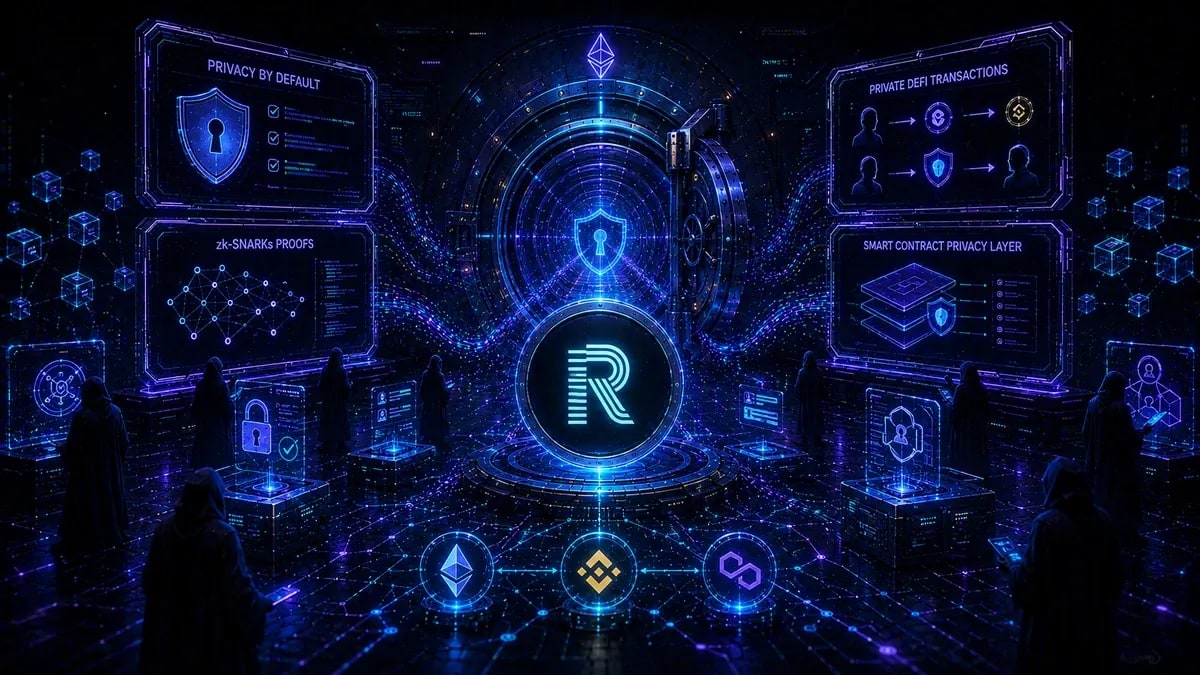
Railgun is the zk-SNARK privacy system that shields ERC-20 balances on Ethereum, Polygon, BNB Chain and Arbitrum without bridging. Discover how Proof of Innocence, Adapt contracts and the Railway wallet make private DeFi work in 2026, with the Vitalik Buterin endorsement that put RAIL on the map.
What Is Railgun? The On-Chain Privacy Protocol for EVM DeFi Explained in 2026
Every public blockchain comes with the same uncomfortable secret. The transparency that lets anyone audit a smart contract also lets anyone with a block explorer pull up your entire financial life. Wallet balance, every counterparty you have traded against, the exchange you off-ramp to, the losses you would rather not put on a tax return. By 2026 the average crypto user finally understands that pseudonymity is not the same as privacy. The address that received your last paycheck in USDC is one Etherscan lookup away from being doxxed forever.
The historical answer was a mixer. Tornado Cash spent years as the canonical on-chain privacy tool until OFAC sanctions in August 2022 turned its contracts into a legal radioactive waste site. Aztec Network built a more ambitious shielded rollup, then announced its sunset in 2024. Zcash remains the gold-standard privacy cryptocurrency but lives on its own chain with no access to the Ethereum DeFi stack. The gap that opened in the middle is where Railgun has spent three years building the most credible answer.
Railgun is a smart-contract privacy system that lives directly on Ethereum, Polygon, BNB Chain and Arbitrum. It does not run on its own L1, does not require wrapping or bridging, and applies zk-SNARK cryptography on top of the tokens you already hold. It even composes with existing DeFi protocols through Adapt contracts. Vitalik Buterin co-authored the Proof of Innocence framework Railgun pioneered, and has publicly recommended Railgun as the privacy tool he uses personally. This guide walks through how it works, POI, Adapt contracts, the Railway wallet, the RAIL token, the regulatory context and an honest list of risks.
FEATURED SNIPPET
Railgun is a zero-knowledge privacy system that operates as a set of smart contracts on Ethereum, Polygon, BNB Chain and Arbitrum. It uses zk-SNARKs to shield wallet balances and transactions on existing ERC-20 tokens without wrapping or bridging, supports private DeFi composability through Adapt contracts, and includes a Proof of Innocence (POI) mechanism that lets honest users cryptographically prove their funds did not come from sanctioned sources. The protocol is governed by RAIL token holders, was co-designed with research input from Vitalik Buterin, and is accessed through the Railway browser wallet. Founders Kieran Mesquita and Alan Scott launched the public mainnet in early 2022.
What Is Railgun in Plain English
Strip away the cryptography terminology and Railgun is a privacy layer that sits on top of the Ethereum Virtual Machine. Instead of moving assets to a separate privacy chain, Railgun lets you deposit ETH, USDC, DAI, WBTC and thousands of other ERC-20s into a smart contract that holds them inside a shielded pool. Once inside, your balance is no longer visible on the public chain. You can send funds, swap, or interact with DeFi without revealing who you are, how much you hold, or which counterparties you are touching.
The cryptographic engine is the same family of zero-knowledge proofs that power Zcash, the original privacy cryptocurrency that introduced zk-SNARKs in 2016. A zk-SNARK lets you prove a statement is true without revealing why. In Railgun's case the statement is something like "I own enough shielded balance to send 100 USDC, and I am not double-spending." The contract verifies the proof, executes the transfer inside the shielded set, and updates an encrypted note only you and the recipient can read. Outside observers see a transaction touching the Railgun contract but cannot tell who sent what to whom.
The crucial difference between Railgun and earlier mixers is that Railgun is not a mixer in the traditional sense. A mixer pools deposits and lets you withdraw a different but identical-amount deposit later. Railgun requires no waiting period and does not shuffle fixed denominations. It is a fully shielded balance system where the pool itself never reveals which inputs map to which outputs. That makes Railgun architecturally closer to a private bank account than to a coin tumbler, which is part of why regulators have treated the two very differently.
The Privacy Problem on EVM Chains
Every transaction on Ethereum, Polygon, BNB Chain or Arbitrum is broadcast publicly and stored forever in a globally replicated ledger. That is by design and makes the chains auditable. But it also means the moment your address is linked to any real-world identity, whether through a CEX withdrawal, an ENS name, an NFT purchase tied to your social profile, or a leaked KYC database, your entire financial history becomes a permanent open book.
The consequences compound over time. Targeted phishing attacks become trivially easy when an attacker can identify your counterparties and impersonate them. Physical security risks rise sharply when on-chain net worth becomes public. MEV searchers can frontrun trades they can see in advance. Even paying a contractor in stablecoins becomes uncomfortable when the contractor can see every other client you pay and the rhythm of your cash flow.
Traditional finance handles this through bank secrecy by default. Crypto, in its original 2009 form, was supposed to offer the same discretion through pseudonymous addresses. In practice the explosion of chain-analytics firms like Chainalysis, TRM Labs and Elliptic turned that pseudonymity into a thin fig leaf. By 2024 it was widely accepted that any address linked to a CEX withdrawal was effectively non-private. Railgun's bet is that smart-contract level privacy on the chains users already use is the only path that scales.
The Founders: Kieran Mesquita and Alan Scott
Railgun is the product of the Railgun Privacy Project, a developer collective formed in 2021 around the technical lead of Kieran Mesquita and contributor Alan Scott. Mesquita came from a background in zero-knowledge cryptography and previously worked on privacy-focused Ethereum research before deciding the existing toolset was not enough. The thesis was that privacy needed to be a property of the assets themselves, not a separate destination, and that the same zk-SNARK math powering Zcash could be adapted to work on top of any EVM token.
Scott joined as a co-architect and helped drive the protocol's design through the Ethereum mainnet deployment in January 2022. From the start the team took an unusually principled position on the regulatory question. Rather than building a pure mixer and hoping the legal weather held, they explicitly designed Railgun to support cryptographic proofs that funds inside the shielded set were not derived from sanctioned or stolen sources. That choice eventually became the Proof of Innocence framework, co-developed with research input from Vitalik Buterin in 2023.
The project is now governed by RAIL token holders through the Railgun DAO, which funds development, audits and community grants. There is no corporate entity controlling the protocol, no centralized server, and no admin key that can pause the shielded pools. Mesquita and Scott have repeatedly emphasized that a privacy protocol with a kill switch is not really a privacy protocol, because the existence of the switch makes it a legal target. Railgun is designed to outlive its founders.
Railgun Timeline: From Research to Multi-Chain Privacy Standard
Railgun's story spans a five-year window that maps almost exactly to the broader collapse and rebirth of on-chain privacy infrastructure on EVM.
The Railgun Privacy Project forms around Kieran Mesquita and a small group of zk researchers, focused on adapting zk-SNARK constructions for arbitrary ERC-20 balances rather than a single native coin.
Railgun goes live on Ethereum mainnet with the first shielded contract supporting ETH and a curated list of major ERC-20s. The Railway browser wallet ships in the same window as the primary user interface.
Railgun deploys to Polygon and BNB Chain, becoming the first protocol with unified shielded balances across multiple EVM chains. RAIL governance launches alongside the DAO.
OFAC sanctions Tornado Cash and adds its contract addresses to the SDN list. The shock reshapes the EVM privacy landscape and validates Railgun's decision to build compliance proofs into the protocol from day one.
Adapt contracts ship, enabling private interactions with DeFi protocols like Uniswap and 0x without breaking the shielded set. Vitalik Buterin co-authors the Privacy Pools paper formalizing the POI concept Railgun later implements.
Vitalik Buterin publicly confirms he uses Railgun for personal Ethereum privacy and endorses the design. The endorsement triggers mainstream coverage and a sharp uptick in shielded TVL.
Railgun launches POI v2 with active rejection of known illicit funds at the relayer level. Arbitrum support ships, bringing the supported chain count to four. Aztec Network announces its sunset, leaving Railgun as the dominant shielded smart-contract option on EVM.
Railway ships major UX upgrades including integrated private swap routing through Adapt contracts and one-click bridging into shielded balances from major exchanges. Cumulative shielded volume crosses multi-billion dollar lifetime totals.
Railgun stands as the canonical zk privacy layer for EVM chains, with active integrations across major DeFi venues and a POI framework that has become a reference design for the next generation of privacy protocols.

How Shielded Balances Work: The Core Architecture
The technical core of Railgun is a smart contract holding a Merkle tree of encrypted notes, each representing a balance of some ERC-20 token. Deposits create a new note in the tree encoding the token type, amount, and a commitment that links cryptographically to your shielded address without revealing those details on chain. Outside observers see a stream of opaque commitments and cannot tell which belongs to whom or how much it is worth.
To spend a shielded balance, you generate a zk-SNARK proof that demonstrates three things at once: that you control the private key for the note, that the note has not already been spent, and that the new output notes add up to the same total as the inputs minus fees. The contract verifies the proof, marks consumed notes as spent in a nullifier set, and writes the new output notes to the tree. None of the underlying values, addresses or counterparties are visible to anyone except the transaction parties.
This is structurally identical to Zcash's shielded pool with one critical extension. Zcash works for a single native asset. Railgun's contracts are token-agnostic, so the same architecture holds ETH, USDC, DAI, WBTC, LINK and every other supported ERC-20 in the same proof system on the same chain. That is harder than it sounds, because the system must handle balance accounting across thousands of asset types without leaking which assets dominate the pool. Pulling that off across four EVM chains is the accomplishment that earned the protocol its reputation.
For deeper context on the underlying math, our zero-knowledge proofs explainer walks through how zk-SNARKs let you prove a statement without revealing inputs. The same primitive powers zkEVM rollups and privacy-first L1s like our Aleo guide documents. Railgun's innovation is applying that math to existing EVM tokens rather than to a brand-new chain.
The Shielding and Unshielding Flow
Users interact with Railgun through three core operations: shielding (deposits into the pool), private transfers (movements inside the pool), and unshielding (withdrawals back to public addresses). Each step uses different cryptographic structures, and understanding the flow makes it much easier to reason about what is and is not private.
STEP 1
Shield (deposit)
You send tokens from a public EVM address into the Railgun contract. The deposit is publicly visible (everyone sees that you put X amount of token Y into the shielded pool), but from this point onward those funds are no longer linked to any of your subsequent activity inside the pool. A new encrypted note is created in the Merkle tree representing your shielded balance.
STEP 2
Transact privately
Inside the shielded pool you can transfer tokens to other Railgun addresses, swap between assets through Adapt contracts, or interact with DeFi protocols, all while the amounts, counterparties and balances remain hidden. Each action submits a zk-SNARK proof that is verified by the contract and updates the encrypted note state.
STEP 3
Unshield (withdraw)
When you want to use funds outside the pool, you submit an unshielding proof that sends tokens to any public address of your choice. The destination address has no on-chain link to your original deposit address, which is exactly the privacy property the system is designed to provide. The unshielding event itself is publicly visible as a withdrawal from the Railgun contract.
The most important detail in this flow is that shielding and unshielding are visible events, while everything in between is private. The size of the shielded pool and rough activity volume are public record. What is not public is the mapping between specific deposits and specific withdrawals. Two transactions of identical size into and out of the pool cannot be linked on chain, because proofs verify validity, not provenance. The size of the anonymity set (total shielded notes in the pool) determines how strong that privacy guarantee is in practice.
Proof of Innocence: The Compliance Innovation
Proof of Innocence (POI) is the design innovation that most differentiates Railgun from earlier privacy protocols. The core idea is simple. When you unshield funds, you can attach a zero-knowledge proof demonstrating your funds were not deposited from any address on a curated blocklist of sanctioned or known-illicit sources. The proof does not reveal which specific deposit your funds came from. It only reveals that the deposit was not on the blocklist.
The intellectual lineage of POI traces back to a 2023 paper co-authored by Vitalik Buterin, Jacob Illum, Matthias Nadler, Fabian Schar and Ameen Soleimani, titled Blockchain Privacy and Regulatory Compliance: Towards a Practical Equilibrium. The paper formalized Privacy Pools, where users segment their privacy across association sets, associating with a clean set of depositors while still drawing privacy from the larger total pool. Railgun was already moving in this direction, and the POI framework that shipped in 2024 is the production implementation of that academic design.
POI has two main effects. First, it gives compliant users a way to interact with the regulated financial system after using Railgun. CEXes and OTC desks can accept funds with a POI proof attached, because the proof gives cryptographic certainty that the funds did not originate from a sanctioned address. Second, it raises the cost of using Railgun for illicit activity, because such users cannot generate valid POIs and have to unshield without one, creating a visible signal compliance-minded counterparties can avoid. The system is structurally hostile to abuse without compromising honest users. Our Tornado Cash explainer covers the sanctioned mixer for the full comparison context.
Adapt Contracts: Private DeFi Composability
The cleverest piece of engineering in the Railgun stack is the Adapt contract framework, which solves the hardest problem in shielded asset design: how do you interact with public DeFi without breaking the privacy of the pool? Naively, you would unshield, do the transaction publicly, and re-shield, leaking the size and nature of the activity. Adapt contracts make this entire flow happen inside a single shielded transaction.
An Adapt contract is a small, audited helper that wraps a specific DeFi action like a Uniswap swap or an Aave deposit. When you execute the action with shielded funds, the Railgun protocol temporarily releases input tokens to the Adapt contract, the contract performs the public DeFi interaction, and the output tokens are immediately re-shielded in the same atomic transaction. From the outside, the only visible event is a single transaction touching the Adapt contract. The amounts, the destination, and even which DeFi action took place are obscured behind the zk proof.
By 2026 supported Adapt contracts cover private swaps through Uniswap V3 and 0x routing, lending through Aave, liquid staking through Lido and Rocket Pool, and several other venues. New Adapt contracts go through community audit and governance approval before being whitelisted in Railway, which keeps the attack surface manageable. Our DeFi complete guide covers the underlying protocols Adapt contracts integrate with. By making composability first-class inside the shielded set, Railgun positions itself as a complete private financial layer rather than a payment-only mixer, which is the bet that distinguishes it from every prior attempt at smart-contract privacy on EVM.

The Railway Wallet: User Experience for Shielded Balances
All of Railgun's cryptography is invisible to users because the experience is mediated through the Railway browser wallet, available as a web app at railway.xyz and as a browser extension. Railway handles key management, proof generation, transaction submission and the Adapt contract routing that makes private DeFi feel like a normal wallet experience.
Functionally, Railway looks like a slightly more deliberate MetaMask. The interface shows your public balances on each supported chain, with a separate panel for shielded balances inside the Railgun pool. Sending a shielded transaction is a few clicks: pick the asset, enter the destination Railgun address (using a 0zk prefix to distinguish it from public addresses), confirm and submit. Railway generates the zk proof locally in your browser using a WebAssembly proof system, then routes it to a relayer that pays the gas in the chain's native asset.
The relayer architecture matters. Paying gas from your own public address would leak the link between that address and your shielded activity. Railway routes transactions through a decentralized relayer network that submits on your behalf and is paid in shielded tokens directly from the proof, so the gas economics never touch a public address you control. Relayers are run by independent operators and selected randomly per transaction, preventing any single relayer from building a profile of your activity.
Setup is straightforward: install the extension, generate a wallet (producing both a standard EVM key and a separate viewing key for shielded balances), back up the seed, and fund the wallet with a deposit. Once shielded, using DeFi feels similar to a normal wallet, with the only visible difference being 0zk-prefixed addresses for shielded counterparties alongside the standard 0x-prefixed addresses for public destinations.
Multi-Chain Support: Ethereum, Polygon, BNB Chain, Arbitrum
Railgun ships on multiple EVM chains rather than confining itself to Ethereum mainnet. As of 2026 the protocol is live on Ethereum, Polygon PoS, BNB Chain and Arbitrum One, each maintaining its own independent shielded pool. Funds are not bridged between pools, so your shielded ETH on Ethereum and your shielded USDC on Arbitrum exist as separate balances in separate Merkle trees. Each pool has its own anonymity set and its own list of supported ERC-20 tokens.
The reasoning is partly economic. Gas costs for zk proof verification on Ethereum mainnet are non-trivial, making small private transactions uneconomic. Polygon and BNB Chain offer dramatically cheaper verification, which makes Railgun usable for everyday payments. Arbitrum, as an L2 rollup that inherits Ethereum security, sits in a popular middle ground. Our Ethereum complete beginner guide covers the L1 and L2 distinction.
Strategically, multi-chain deployment is part of why Railgun has been hard to disrupt. A privacy protocol on a single chain is vulnerable if that chain gets compromised or outcompeted. By running parallel shielded pools across the four largest EVM environments, Railgun ensures private balances are portable across whichever chain dominates a given activity. Each supported token goes through a governance approval process and the curated list focuses on assets with deep liquidity and clear provenance: ETH, WETH, USDC, USDT, DAI, WBTC, LINK, UNI and the major liquid staking tokens. The list is conservative because adding a token with weak liquidity could create exit pressure that affects the entire pool's privacy guarantees.
RAIL Token: Governance and Tokenomics
RAIL is the native governance token of the Railgun protocol, an ERC-20 deployed on Ethereum mainnet with bridged versions on supported chains. RAIL holders vote on parameter changes, new chain deployments, Adapt contract additions and treasury allocations through the Railgun DAO. The treasury holds a significant pool of RAIL and partner assets that fund development, audits and ecosystem grants.
A small fee is charged on shielded transactions, denominated in the transacted asset, and a portion flows to the treasury for redistribution through governance. There is no automatic buyback or burn mechanism. The DAO has discretion over revenue deployment, which has historically included grants to Adapt contract developers, cryptographic audit funding, and direct token-holder distributions.
RAIL has a relatively modest market capitalization for the scale of what Railgun does, partly because privacy is a niche sector and partly because the token does not capture direct cash flow the way a real-yield DEX token does. RAIL is fundamentally a governance asset whose valuation tracks expectations of the future importance of EVM privacy. Our ERC-20 token standard guide covers the underlying mechanics. RAIL trades primarily on Uniswap V3 on Ethereum mainnet, with availability on a smaller number of CEXes that varies by jurisdiction.

Railgun vs Tornado Cash, Aztec and Zcash
Railgun's competitive landscape includes three other notable privacy systems, each handling the same problem differently. Understanding the comparison is the fastest way to grasp what makes Railgun's 2026 positioning unique.
Tornado Cash was the original. Launched in 2019 by Roman Semenov and Roman Storm, it became the canonical Ethereum mixer and processed billions in shielded volume before OFAC sanctioned the smart contracts in August 2022. The sanctions were unprecedented because they targeted code rather than people. Tornado Cash still exists as immutable contracts on Ethereum, but US persons interacting with it face sanctions risk, and major front-ends have stopped supporting it. The protocol had no compliance layer, making it impossible to differentiate honest privacy-seekers from sanctioned actors using the same pool.
Aztec Network built a dedicated zk-rollup with shielded execution as a first-class property. The architecture was technically ambitious and produced respected cryptography research. But the team announced the sunset of Aztec Connect in 2024, citing the difficulty of maintaining a privacy-specific rollup against broader L2 competition and changing regulatory pressures. That left a substantial gap that Railgun has largely filled.
Zcash remains the longest-running production privacy chain, with a continuous shielded pool dating to 2016. It is a separate L1 with its own native asset and offers the strongest single-coin privacy guarantees in production. The tradeoff is that Zcash is not part of the EVM ecosystem. You cannot directly hold private USDC, private ETH or private DeFi positions on Zcash. For users who want privacy as a property of their existing EVM assets, Zcash is not a substitute. Our Zcash explainer covers it in detail, and the Monero guide covers the other major standalone privacy coin.
Against this backdrop, Railgun's position is well-defined. It is the only major production privacy system that lives on existing EVM chains, supports a broad set of standard ERC-20 tokens, offers private DeFi composability through Adapt contracts, and ships with a built-in compliance mechanism through POI. Each competitor solves part of the same problem but misses one or more of those properties. For users who want privacy applied to the assets and protocols they already use without leaving EVM, Railgun is currently the only credible option.
The Vitalik Buterin Endorsement
No single event shaped Railgun's reputation more than Vitalik Buterin's public endorsement. In a 2023 Bankless podcast interview and subsequent written commentary, the Ethereum co-founder confirmed he personally uses Railgun for some Ethereum privacy needs and recommended it as one of the best EVM privacy tools in the post-Tornado-Cash environment. The endorsement carried unusual weight because Buterin is famously cautious about associating with specific protocols, and because the privacy sector was widely treated as legally dangerous.
The endorsement was not arbitrary. Buterin had spent years arguing that financial privacy on Ethereum was unsolved and had co-authored the Privacy Pools paper that became the academic foundation for the Proof of Innocence framework. His support was the natural product of intellectual alignment with the team's design choices, not a marketing partnership. The practical effect was a sustained increase in shielded TVL across all four Railgun chains and a boost in mainstream coverage. It also solidified the narrative that there is a meaningful distinction between Railgun and the sanctioned Tornado Cash, because if Buterin himself used Railgun, the implied legal risk to ordinary users was bounded.
Regulatory Context and Legal Risks
No honest discussion of Railgun in 2026 can avoid the regulatory question. The Tornado Cash sanctions in 2022 set a precedent that smart-contract code can be added to a sanctions list, and a 2024 federal court ruling later overturned parts of that precedent on First Amendment grounds. The legal landscape remains fluid.
As of this writing, using Railgun is legal in every major jurisdiction including the United States. The protocol is not on any sanctions list, and POI was explicitly designed to let users demonstrate AML compliance when they unshield. Users still bear responsibility for meeting applicable tax and regulatory obligations. Using Railgun for legitimate privacy is categorically different from using it to evade reporting on taxable gains, and the latter remains illegal regardless of which tool is used.
CEXes vary in their willingness to accept Railgun deposits. Some treat them like any other on-chain transaction, particularly with POI attached. Others apply enhanced due diligence or block them outright. Before unshielding to a CEX deposit address, check the exchange's current policy, because a rejected deposit can result in funds being frozen during compliance review. Privacy at the chain level also does not eliminate the obligation to report taxable events. Swaps and yield inside a shielded pool are taxable on the same basis as equivalent public transactions in most jurisdictions, so plan accordingly.
Risks Beyond Regulation
Regulatory exposure is the most discussed risk but not the only one. Railgun, like every smart-contract system, carries technical risks that deserve consideration.
Smart contract risk first. Railgun's contracts have been audited multiple times and the codebase has held up since 2022. But shielded pool contracts are unusually complex, and a subtle bug in proof verification could in principle allow an attacker to drain the pool. The probability is low after years of production exposure, but not zero.
Anonymity set risk. The privacy guarantee of any shielded pool is only as strong as its size and diversity. Shielding an unusual amount or pattern reduces your effective anonymity set even if the cryptography is sound. This is a behavioral risk you can mitigate with shielding best practices.
Key management risk. Losing the seed or viewing key means losing access to shielded balances permanently. There is no recovery mechanism because there cannot be one. Back up your seeds carefully, store them offline, and consider hardware wallets for the underlying key material.
Phishing and address poisoning. Privacy tools are high-value phishing targets because funds inside are outside the chain-analytics surveillance that would otherwise help recover stolen assets. Verify you are using the official Railway wallet at railway.xyz, never sign transactions from unsolicited links, and double-check Railgun addresses before sending. Our guide to avoiding crypto address poisoning covers the broader pattern. Finally, the decentralized relayer network is finite. If it becomes congested, transactions can take longer. You can act as your own relayer in a pinch, but doing so reduces your privacy because the gas-paying address becomes visible.
Railgun: Pros and Cons at a Glance
PROS
Privacy on existing EVM tokens, no wrapping needed
Multi-chain: Ethereum, Polygon, BNB Chain, Arbitrum
Proof of Innocence enables regulator-friendly use
Adapt contracts give private access to DeFi
Vitalik Buterin public endorsement and design input
No central admin key, contracts cannot be paused
Railway wallet provides a polished user experience
CONS
Regulatory environment around privacy is still evolving
Some CEX may reject Railgun-sourced deposits
Proof generation is slower than normal transactions
Privacy is only as strong as the anonymity set
Curated token list, not every ERC-20 is supported
Loss of seed phrase means permanent loss of funds
RAIL token has no direct cash flow accrual
Best Practices for Using Railgun Privately
Using Railgun effectively is not just a matter of installing the wallet and clicking shield. How you interact with the system has a major impact on the privacy you achieve.
Shield in non-round amounts and at non-deterministic times. Depositing exactly 10,000 USDC every Friday at 3pm gives chain-analytics firms a timing fingerprint to correlate shielding and unshielding events even without breaking the cryptography. Vary your amounts and timing to blend into the pool.
Hold shielded balances long enough for the pool to grow around you. The privacy of an unshielding event depends on how many other deposits could plausibly have funded it. Holding for days or weeks between shielding and unshielding allows your transaction to blend into a much larger pool. Same-block shield and unshield is the worst possible pattern.
Use Adapt contracts to stay inside the pool whenever possible. Performing a swap through an Adapt contract rather than unshielding to a public DEX and re-shielding preserves significantly more privacy.
Unshield to fresh public addresses, not your original deposit address. Unshielding back to the same address you shielded from undoes the whole point of the operation. Use a fresh, never-used public address, and attach POI proofs when sending to regulated counterparties. For on-chain analysis of tokens like RAIL, our DexTools complete guide walks through the workflow.
Who Should Actually Use Railgun
Railgun is not for everyone. Users with significant on-chain net worth who want to protect against targeted attacks, kidnapping risk or competitor surveillance are the natural fit. Same for DAO contributors and on-chain professionals whose stablecoin salaries would otherwise be visible to every counterparty. Journalists, activists and dissidents using crypto in hostile jurisdictions also benefit substantially, as does anyone handling client funds or wanting to keep business cash flow private.
Casual users with small balances and no specific threat model probably do not need Railgun. The proof generation overhead is not worth the friction for someone whose only activity is buying ETH on Coinbase and holding. And remember that privacy tools are not a substitute for operational security. Using Railgun while broadcasting your wallet on Twitter or reusing public addresses across services will leak privacy faster than the protocol can preserve it.
Frequently Asked Questions About Railgun
What is Railgun in one sentence?
Railgun is a zero-knowledge smart-contract privacy system that lets you shield ERC-20 balances and transact privately on Ethereum, Polygon, BNB Chain and Arbitrum without bridging assets to a separate privacy chain.
How does Railgun privacy actually work?
Railgun uses zk-SNARK proofs to hide the amounts, sender and recipient of transactions inside a shielded pool. Deposits create encrypted notes in a Merkle tree, and spending requires a proof of ownership without revealing which note is spent. The result is a private balance that no public observer can map to your identity.
What is Proof of Innocence?
Proof of Innocence (POI) is a zk-proof framework that lets users cryptographically prove their shielded funds did not originate from any address on a curated blocklist of sanctioned sources, without revealing the specific deposit. It was inspired by the Privacy Pools paper co-authored by Vitalik Buterin in 2023 and allows compliant users to interact with regulated counterparties after using Railgun.
What chains does Railgun support?
As of 2026, Railgun is live on Ethereum mainnet, Polygon PoS, BNB Chain and Arbitrum One. Each chain has its own independent shielded pool with its own anonymity set and supported token list. Additional EVM chains and L2s are evaluated by the Railgun DAO on an ongoing basis.
Did Vitalik Buterin really endorse Railgun?
Yes. In 2023 Vitalik Buterin stated that he personally uses Railgun for Ethereum privacy needs and recommended it as one of the best EVM privacy tools after the Tornado Cash sanctions. He also co-authored the Privacy Pools paper that inspired the Proof of Innocence framework Railgun later implemented.
What is the Railway wallet?
Railway is the canonical browser-based wallet for interacting with Railgun, available as a web app at railway.xyz and as a browser extension. It handles zk-proof generation locally in the browser, manages your shielded balances across supported chains, and routes transactions through a decentralized relayer network so gas costs never touch your public addresses.
How is Railgun different from Tornado Cash?
Tornado Cash was a fixed-denomination mixer with no compliance layer that was sanctioned by OFAC in 2022. Railgun is a fully shielded balance system with arbitrary amounts, multi-chain deployment, private DeFi composability through Adapt contracts, and a built-in Proof of Innocence framework for compliant unshielding.
What is the RAIL token?
RAIL is the governance token of the Railgun protocol, an ERC-20 deployed on Ethereum with bridged versions on the other supported chains. RAIL holders vote on parameter changes, treasury allocations, new chain deployments and Adapt contract additions through the Railgun DAO. The token does not have a direct cash flow accrual mechanism but participates in treasury decisions over protocol fees.
Is Railgun legal?
As of this writing, Railgun is legal in every major jurisdiction including the United States. The protocol is not on any sanctions list and was explicitly designed with Proof of Innocence to support AML compliance. Users remain responsible for meeting their own tax and regulatory obligations.
How do I use Railgun for private swaps?
Install the Railway wallet, shield your input asset, then use the in-wallet swap interface to execute the trade through an Adapt contract that integrates Uniswap or 0x routing. The swap happens inside the shielded pool with no public information about the pair, size or counterparty. The output appears as a shielded balance you can hold or unshield later.
What are the main risks of using Railgun?
Smart contract bugs (low after years of production but never zero), anonymity set size, key management (losing the seed means permanent loss), phishing targeting Railway users, evolving regulatory pressure on privacy tools, and the possibility that some CEXes refuse Railgun-sourced deposits even with POI attached.
Where can I buy RAIL?
RAIL trades primarily on Uniswap V3 on Ethereum mainnet, with availability on a smaller number of CEXes that varies by jurisdiction. Always verify the canonical RAIL contract address on Etherscan against the project's official channels before transacting on a DEX to avoid copycat tokens.
Closing Thoughts: Why Railgun Matters
Railgun occupies a strange and important place in the 2026 crypto landscape. It is the only production-grade smart-contract privacy system supporting the assets and DeFi protocols people actually use on the chains they actually use. It internalized the lessons of the Tornado Cash sanctions before they happened and engineered a compliance framework that satisfies both privacy-seekers and regulators. And it earned a direct endorsement from the Ethereum co-founder, which is an unusual signal that the engineering is sound.
None of that makes Railgun risk-free or the right choice for every user. Smart contract risk is real, the regulatory environment continues to evolve, and behavioral mistakes can leak more than the protocol can protect. But for users with a meaningful threat model, Railgun is currently the most credible answer on EVM.
Privacy without compliance leads to sanctions. Compliance without privacy leads to surveillance. The space between those two failure modes is where Railgun has spent five years building, and where the next decade of usable on-chain financial infrastructure will need to live.
Related Guides
- What Is Chainlist: Chain IDs, RPC URLs and EVM Network Setup (2026)
- How to Use Rabby Wallet: Complete Multi-Chain EVM Wallet Tutorial (2026)
- What Is zkTLS? Privacy and Reputation for DeFi Explained
- Top 5 Crypto Privacy Tools in 2026: Protecting Your On-Chain Anonymity
- Anubis Chain: Selective Privacy L1 with PLONK ZK Proofs