How Bonding Curves Price Tokens on Pump.fun and Friend.tech (2026)
— By Tony Rabbit in Tutorials
Learn how bonding curves price tokens in real time, how buy and sell pressure moves the curve, and why platforms like Pump.fun and Friend.tech use them.
Intent check: This page is the market-behavior explainer for bonding-curve pricing. If you want the deeper math guide on linear, exponential, and sigmoid curves, read Bonding Curve Math in Crypto.
If you have ever watched a token price rise automatically as more people buy, or drop as they sell, you have witnessed a bonding curve in action. Bonding curves are one of the most important innovations in decentralized finance, providing a mathematical formula that determines token prices based on supply. Unlike traditional order book exchanges, bonding curves eliminate the need for counterparties and create predictable, transparent pricing from the moment a token launches.
In 2024 and 2025, bonding curves went from a niche concept to one of the driving forces in crypto. Platforms like Pump.fun turned bonding curve token launches into a cultural phenomenon, enabling anyone to create and trade tokens with instant liquidity. Friend.tech used them to price social tokens based on creator popularity. But bonding curves are not just for meme coins. They underpin decentralized exchanges, fundraising mechanisms, and even protocol governance.
This guide breaks down everything you need to know about bonding curves in 2026: how the math works, which curve types exist, how platforms implement them, and how to evaluate whether a bonding curve token is worth your attention. Whether you are a developer building a token launch platform, a trader evaluating new tokens, or simply curious about how automated pricing works, this is the definitive resource.
What Is a Bonding Curve?
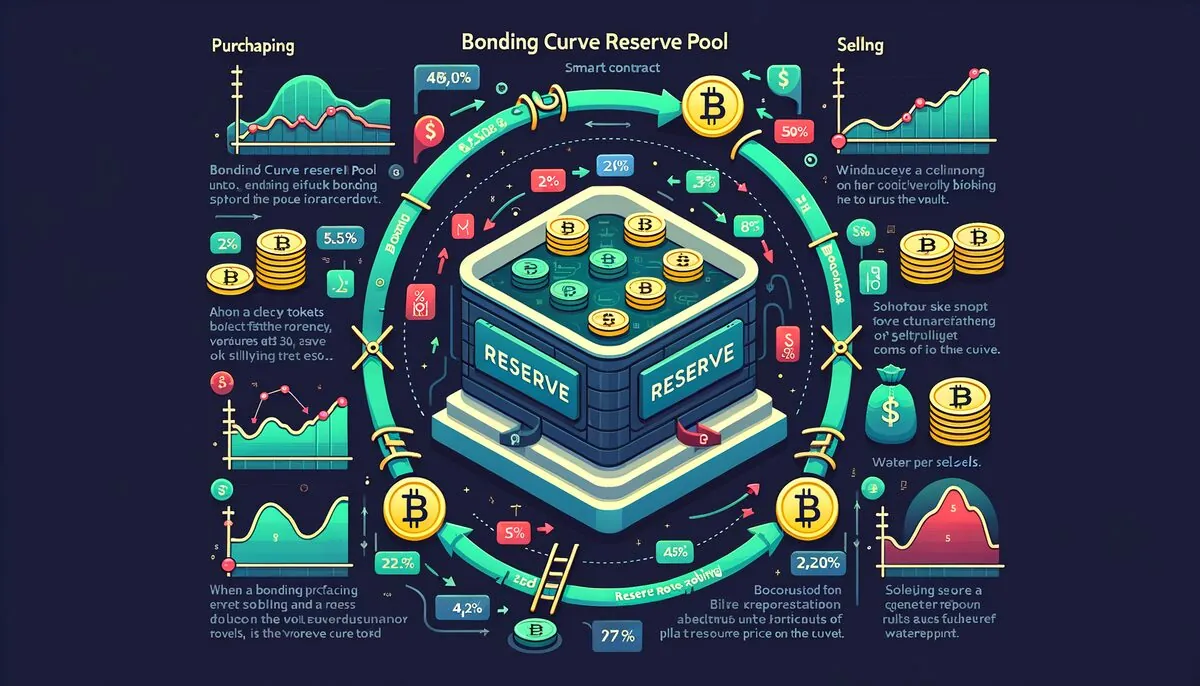
A bonding curve is a mathematical function encoded in a smart contract that defines the relationship between a token's price and its circulating supply. When someone buys tokens, new tokens are minted and the price increases along the curve. When someone sells, tokens are burned and the price decreases. The smart contract acts as an automated market maker, always ready to buy or sell at the price dictated by the formula.
The core idea is simple: price is a function of supply. As more tokens exist (because more people have bought them), the price per token goes up. As tokens are burned (because people sell back to the curve), the price goes down. There is no order book, no matching engine, and no need for a counterparty on the other side of the trade. The smart contract itself is the counterparty.
Key Concept: A bonding curve creates a direct, deterministic link between token supply and token price. Every purchase mints new tokens and moves the price up. Every sale burns tokens and moves the price down. The smart contract guarantees liquidity at every price point along the curve.
The term "bonding curve" comes from the idea that buyers "bond" capital to the curve. The funds paid for tokens are held in a reserve pool within the smart contract. This reserve serves as the liquidity that allows sellers to exit their positions at any time. The amount in the reserve is always mathematically tied to the current supply and price, ensuring the contract can always honor sell orders.
Bonding curves were first proposed by Simon de la Rouviere in 2017 as a mechanism for continuous token models. Since then, they have evolved from theoretical constructs into production systems handling billions of dollars in volume. The concept draws from economics (supply and demand curves), mathematics (integral calculus for reserve ratios), and computer science (smart contract automation).
How Bonding Curves Work: The Mathematical Foundation
Understanding bonding curves requires grasping the relationship between three variables: token supply (S), token price (P), and the reserve pool (R). The bonding curve function defines P as a function of S. The reserve is calculated as the integral (area under the curve) from zero to the current supply.
The Basic Formula
The simplest bonding curve is a linear function:
P(S) = m * S + b
Where P is the price, S is the current supply, m is the slope (how fast price increases), and b is the starting price (which can be zero). Every time a token is purchased, S increases by 1, and the price moves up by m. Every sale decreases S by 1, and the price drops by m.
For exponential curves, the formula becomes:
P(S) = a * Sn
Where a is a scaling coefficient and n is the exponent that controls curve steepness. When n = 2, you get a quadratic curve where the price increases slowly at first, then accelerates dramatically. When n = 3 or higher, early buyers get even more favorable pricing while late buyers pay exponentially more.
The Reserve Pool
The reserve pool is the total capital locked in the smart contract. It equals the area under the bonding curve from 0 to the current supply S. For a linear curve (P = m * S), the reserve is:
R(S) = (m * S2) / 2
For a power curve (P = a * Sn), the reserve is:
R(S) = (a * Sn+1) / (n + 1)
This means when you buy tokens, you pay the integral from the current supply to the new supply. The cost of purchasing is not just the current price multiplied by the quantity. It is the area under the curve between your entry and exit supply points. This is why larger purchases cause more slippage on bonding curves.
Important: The cost of buying tokens on a bonding curve is the integral of the price function over the supply range. This means buying 1,000 tokens costs more than 1,000 times the current spot price, because the price increases with each token minted during your purchase.
Reserve Ratio
The reserve ratio (also called the connector weight in Bancor's terminology) defines what fraction of the total token market cap is held in reserves. A reserve ratio of 50% means half the market cap is backed by actual capital. A ratio of 10% means the curve is steeper and more volatile. The reserve ratio can be expressed as:
Reserve Ratio = R / (S * P) = 1 / (n + 1)
For a linear curve (n = 1), the reserve ratio is 50%. For a quadratic curve (n = 2), it is 33%. For a cubic curve (n = 3), it is 25%. Lower reserve ratios mean higher volatility: a given percentage of supply being sold causes a larger percentage drop in price.
Types of Bonding Curves: Linear vs Exponential vs Sigmoid
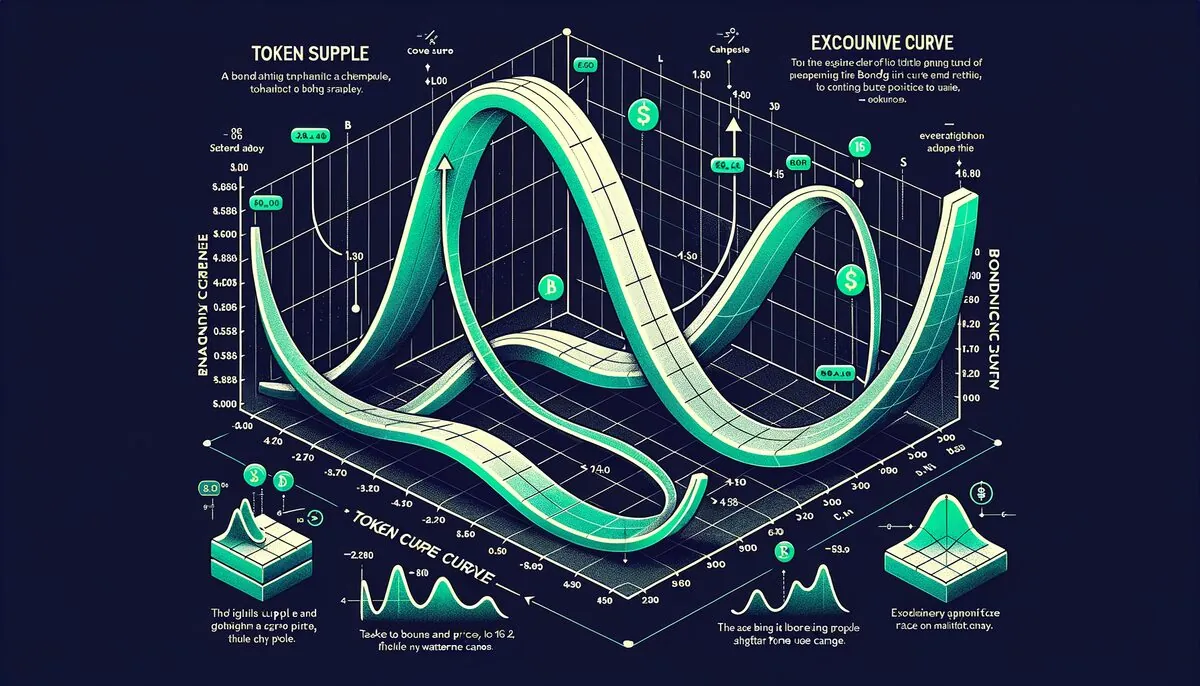
Not all bonding curves are created equal. The shape of the curve determines how prices behave at different stages of adoption. Choosing the right curve type is one of the most consequential design decisions for any token project. Here is a detailed comparison of the three primary curve types used in production systems.
Linear Bonding Curves
Linear curves (P = m * S) increase at a constant rate. The price goes up by the same amount for every token minted. This creates predictable, steady price growth. Linear curves are the easiest to understand and implement, making them popular for educational purposes and simple token systems. However, they do not incentivize early adoption as strongly as exponential curves, since the price advantage of buying early is proportional rather than dramatic.
Exponential (Power) Bonding Curves
Exponential curves (P = a * Sn) start with very low prices that accelerate rapidly as supply grows. Early buyers get tokens at a fraction of what later buyers pay. This creates a strong financial incentive to be an early adopter, which is why exponential curves are the most common type in token launch platforms. The steepness of the curve depends on the exponent n. Higher exponents mean sharper price increases and more reward for early participants.
Sigmoid (S-Curve) Bonding Curves
Sigmoid curves follow an S-shaped pattern: slow growth at the start, rapid growth in the middle, and flattening at the top. The price eventually approaches a ceiling, preventing runaway price increases. Sigmoid curves are well-suited for projects that want to encourage early adoption but also prevent late-stage speculation from pushing prices to unsustainable levels. They are more complex to implement but offer the most balanced incentive structure.
Bonding Curves in Practice: Real-World Implementations
Bonding curves have moved far beyond theoretical whitepapers. Several major platforms now use them as core infrastructure, each implementing the mechanism with different parameters, fee structures, and transition mechanics. Understanding these real-world implementations helps you see how the abstract math translates into actual trading systems.
Pump.fun: The Meme Coin Factory
Pump.fun became the most prominent bonding curve platform in 2024, processing hundreds of thousands of token launches on Solana. The platform allows anyone to create a token with zero upfront cost (beyond gas fees). Each new token starts on a bonding curve where the initial price is near zero, and the price increases as buyers accumulate tokens. When the bonding curve reaches a market cap threshold (approximately $69,000 at launch, though this has been adjusted), the liquidity is automatically migrated to Raydium, a traditional AMM-based decentralized exchange.
Pump.fun uses a steep exponential curve that heavily rewards the earliest buyers. A token's first buyer might pay fractions of a cent per token, while buyers near the migration threshold pay orders of magnitude more. This creates intense FOMO dynamics and rapid price action. The platform charges a 1% fee on each transaction during the bonding curve phase.
Friend.tech: Social Bonding Curves
Friend.tech applied bonding curves to social tokens (called "keys") on Base. Each user's keys were priced on a quadratic bonding curve (P = S2 / 16000), where S is the number of keys in circulation. This meant the price of the first key was essentially free, but the 100th key cost about $62.50, and the 200th key cost about $250. The steep curve created massive incentives to buy keys of accounts expected to grow in popularity.
Friend.tech demonstrated how bonding curves could be used beyond fungible token launches. By tying the curve to social influence rather than a project's utility, the platform created a speculative market for attention and reputation. At its peak, Friend.tech processed millions of dollars in daily volume.
Bancor: The Pioneer
Bancor was one of the first protocols to implement bonding curves at scale, introducing the concept of a "connector weight" (reserve ratio) in 2017. Bancor's smart tokens maintained a reserve of other tokens and used a bonding curve to price conversions. While Bancor later evolved its model toward impermanent loss protection and other features, its early implementation proved that bonding curves could work as practical AMM infrastructure.
Other Implementations
Numerous other platforms have adopted bonding curves for specific use cases. Decentralized applications use them for content curation markets, prediction markets, and continuous fundraising. Zora uses bonding curves for NFT pricing. Sound.xyz has experimented with them for music NFTs. The mechanism has proven flexible enough to adapt to nearly any context where automated, supply-responsive pricing is valuable.
How Pump.fun Uses Bonding Curves: A Deep Dive
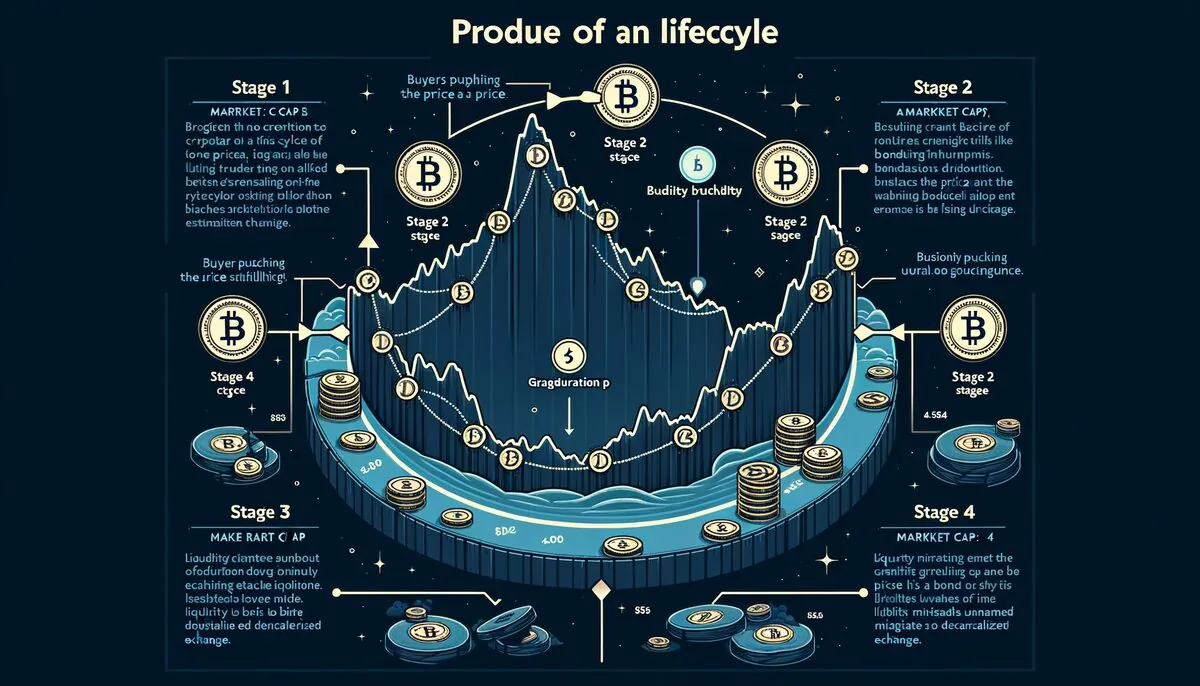
Because Pump.fun has become the most widely used bonding curve platform, understanding its specific implementation is valuable for anyone trading or building in this space. Here is how the system works at a technical level.
Token Creation
When a creator launches a token on Pump.fun, the platform deploys a smart contract (program) on Solana that implements the bonding curve. The total supply is typically set at 1 billion tokens. The creator does not receive any initial allocation. Instead, all tokens must be purchased through the bonding curve, including by the creator themselves. This is a deliberate design choice to prevent insider pre-allocations, although creators can still buy immediately after launch.
The Curve Mechanics
Pump.fun uses a virtual reserve model rather than a pure mathematical formula. The curve is initialized with virtual SOL reserves and virtual token reserves. As real SOL is deposited (buys), real tokens are released from the bonding curve supply. The pricing follows a constant product formula similar to Uniswap (x * y = k), but with virtual reserves that make the initial price very low and cause it to rise steeply.
The effective behavior is similar to an exponential bonding curve: the first tokens are extremely cheap, and the price increases more and more rapidly as the supply is purchased. This creates a dynamic where early buyers have a significant price advantage, but also bear the most risk since the token may never reach the migration threshold.
Migration to DEX
When approximately 80% of the bonding curve supply has been purchased (around 800 million tokens out of 1 billion), the bonding curve "graduates." The accumulated SOL in the reserve and the remaining tokens are deposited into a liquidity pool on Raydium. At this point, the bonding curve contract stops accepting trades, and all trading moves to the DEX liquidity pool where it functions like any other AMM token pair.
Note: Migration from a bonding curve to a traditional DEX pool is a critical transition. The token goes from a controlled, predictable pricing mechanism to an open market where large sells can cause significant price drops. Many tokens experience a sell-off immediately after migration as early buyers take profits.
Fee Structure
Pump.fun charges a 1% transaction fee on all buys and sells during the bonding curve phase. There is also a migration fee when the token graduates to Raydium. After migration, standard Raydium fees apply. The fee structure incentivizes the platform while keeping costs reasonable for traders. By comparison, flash loan protocols and other DeFi mechanisms often have more complex fee structures.
Advantages of Bonding Curves
Bonding curves solve several problems that have plagued token launches and decentralized trading since the earliest days of crypto. Here are the primary advantages that have driven their adoption.
Instant Liquidity
The most significant advantage of bonding curves is that they provide liquidity from the very first transaction. There is no need to raise capital for initial liquidity provision, no need to seed a liquidity pool, and no need to find market makers. The smart contract is always willing to buy and sell at the curve-determined price. This eliminates one of the biggest barriers to token launches: the chicken-and-egg problem of needing liquidity before anyone will trade, but needing trades before anyone will provide liquidity.
Transparent, Predictable Pricing
Because the price is determined by a mathematical formula, everyone can see exactly how the price will change with different levels of supply. There is no hidden order book, no market maker manipulation, and no opaque pricing algorithm. Anyone can verify the price by reading the smart contract. This transparency builds trust and allows participants to make informed decisions about when and how much to buy or sell.
No Counterparty Risk
Bonding curve trades happen directly with the smart contract, not with another trader. The reserve pool is locked in the contract and is always sufficient to buy back all outstanding tokens (at lower prices, following the curve). This eliminates counterparty risk and means you can always exit your position, even if no one else is actively trading. Compare this to traditional whale-dominated markets where liquidity can dry up without warning.
Fair Launch Mechanism
Bonding curves enable fair launches where no insider can pre-allocate tokens before the public sale. Everyone buys from the same curve at supply-determined prices. While early buyers get lower prices (which is a feature, not a bug, since they take on more risk), there are no private rounds, no VC allocations, and no team tokens minted for free. This aligns with crypto's decentralization ethos and has been a major selling point for platforms like Pump.fun.
Programmable Economics
The curve parameters can be tuned to create different economic behaviors. Want a token that rewards early adopters heavily? Use a steep exponential curve. Want stable, predictable growth? Use a linear curve. Want to cap the maximum price? Use a sigmoid curve. This programmability allows developers to design token economics that match their specific use case, whether that is a meme coin, a governance token, or a utility token.
Risks and Limitations of Bonding Curves
Despite their advantages, bonding curves come with significant risks that every participant should understand. The mechanism's mathematical properties create specific vulnerability patterns that are different from traditional market risks.
Front-Running and MEV
Bonding curves are deterministic: given the current supply, the exact price of the next purchase is known. This makes them vulnerable to front-running, where bots detect a pending buy transaction in the mempool and insert their own buy before it, profiting from the price increase caused by the original buyer's trade. On high-throughput chains like Solana, front-running (or sandwich attacks) on bonding curve trades is a significant issue. Traders lose value to MEV (Maximum Extractable Value) bots that exploit the predictable pricing.
Steep Curves Favor Insiders
While bonding curves are marketed as "fair launches," the reality is more nuanced. The creator of a token and their close network can buy tokens in the first seconds after launch, when prices are near zero. By the time the token is widely known, the price may have already risen 10x or 100x. This creates an information asymmetry that functions similarly to the insider advantages bonding curves claim to eliminate. Monitoring for airdrop-style distributions and creator wallets is important when evaluating bonding curve tokens.
Rug Pulls and Abandonment
While the bonding curve itself is trustless (the reserve cannot be drained by the creator), the transition from bonding curve to DEX introduces new risks. If the platform migrates liquidity to a DEX pool, the creator or other large holders can sell immediately after migration, crashing the price. Some implementations also allow creators to withdraw a portion of the reserve or liquidity, creating a direct rug pull vector.
Illiquidity at Scale
Bonding curves work well for small to medium market caps, but they do not scale well for large markets. The reserve pool must be large enough to handle sell pressure, and on steep curves, the reserve may not cover large sell orders without massive slippage. A whale selling a significant portion of the supply can crash the price far more dramatically on a bonding curve than on a deep DEX liquidity pool.
Regulatory Uncertainty
Bonding curve token launches exist in a regulatory gray area. The mechanism of minting tokens in exchange for capital, with the expectation that later buyers will push the price higher, shares characteristics with securities offerings. Regulators in various jurisdictions are examining whether bonding curve launches constitute unregistered securities offerings. Understanding the legal landscape is important, especially as enforcement actions increase in the evolving regulatory environment of 2026.
Bonding Curves vs Traditional Liquidity Models
To fully appreciate bonding curves, it helps to compare them with the other major liquidity mechanisms in crypto: order book exchanges and automated market makers (AMMs) like Uniswap. Each model has distinct properties that make it suitable for different use cases.
The key distinction is that bonding curves are designed for the initial phase of a token's life, when there is no existing market or liquidity. AMMs and order books are better suited for tokens that already have established demand and sufficient capital to maintain deep liquidity. Many successful tokens start on a bonding curve and transition to an AMM once they reach critical mass, combining the advantages of both models. Understanding these differences is essential, much like understanding the basics covered in our cryptocurrency fundamentals guide.
How to Evaluate a Bonding Curve Token
With thousands of tokens launching on bonding curves every day, knowing how to evaluate them separates informed participants from gamblers. Here is a systematic framework for assessing bonding curve tokens before buying.
1. Analyze the Curve Parameters
Look at the curve type and steepness. A very steep exponential curve means early buyers have an enormous advantage and late buyers face significant risk. Check the reserve ratio to understand how much of the market cap is actually backed by real capital. Lower reserve ratios mean higher volatility and more risk for sellers. Tools like blockchain explorers can help you inspect the smart contract parameters directly.
2. Check the Supply Distribution
Even on a "fair launch" bonding curve, supply can be concentrated. Check how many unique wallets hold the token, what percentage the top 10 holders control, and whether the creator bought a large allocation immediately after launch. Heavy concentration means a few sellers can crash the price. On-chain analysis is essential for this step.
3. Evaluate the Migration Threshold
For platforms like Pump.fun, understand where the migration threshold is and how close the token is to reaching it. Tokens near the migration threshold may experience a rush of buying (to push it over) or a rush of selling (to take profits before migration volatility). Also check what happens at migration: is liquidity locked? For how long? Can the creator withdraw it?
4. Assess the Smart Contract
Is the bonding curve smart contract audited? Is it a well-known, battle-tested implementation, or a custom contract? Custom contracts may contain backdoors, admin keys, or vulnerabilities that allow the creator to drain reserves or manipulate the curve. Established platforms like Pump.fun use standardized contracts that have been heavily scrutinized, reducing (but not eliminating) smart contract risk. Protecting your private keys and using proper wallet security practices are equally important when interacting with any smart contract.
5. Consider the Fee Structure
Transaction fees on bonding curves can significantly impact returns, especially for active traders. A 1% fee on both buy and sell means you need the price to increase by at least 2% just to break even. Some platforms charge higher fees or add hidden fees during migration. Always factor fees into your expected returns.
6. Look at Community and Narrative
For meme tokens on bonding curves, the community and narrative often matter more than technical fundamentals. Is there an active community behind the token? Is it trending on social platforms? Is there a compelling narrative? While these are not investment fundamentals, they are the primary drivers of demand for bonding curve tokens, and demand is what moves the price up the curve.
Advanced Bonding Curve Concepts
Beyond the basics, several advanced concepts are reshaping how bonding curves are designed and used in 2026.
Augmented Bonding Curves (ABCs)
Augmented bonding curves, popularized by the Commons Stack and Token Engineering Commons, add a "funding pool" alongside the reserve pool. A percentage of each purchase is directed to a funding pool controlled by a DAO, rather than going entirely into the reserve. This creates a continuous funding mechanism for public goods or project development while maintaining the core bonding curve properties. When tokens are sold, the seller receives only from the reserve pool, not the funding pool.
Dynamic Bonding Curves
Some implementations allow the curve parameters to change over time based on external conditions. For example, a curve might flatten as the token's market cap reaches certain milestones, or steepen during periods of high volatility. Dynamic curves require careful design to prevent manipulation but can create more adaptive pricing mechanisms.
Multi-Token Bonding Curves
Rather than pricing a single token against a single reserve asset (like ETH or SOL), multi-token bonding curves maintain reserves of multiple assets. This creates diversified reserves and can reduce the impact of volatility in any single reserve asset. Bancor's original design used this concept with "connector tokens," and newer implementations are exploring multi-collateral bonding curves for stablecoin applications.
Bonding Curves with Royalties
Some implementations direct a percentage of each transaction to the original creator or a treasury, similar to NFT royalties. This creates ongoing revenue for creators without requiring a pre-allocation of tokens. The royalty is typically taken from the transaction fee rather than from the reserve, ensuring the curve's mathematical properties remain intact. This model is particularly popular for social tokens and creator-economy applications, building on concepts from Web3 infrastructure.
The Future of Bonding Curves
Bonding curves are evolving rapidly, and several trends are shaping their future trajectory in 2026 and beyond.
Cross-Chain Bonding Curves
As cross-chain infrastructure matures, bonding curves that operate across multiple blockchains are becoming feasible. A single bonding curve could accept reserves in ETH, SOL, and other assets, minting tokens that are bridgeable across chains. This would solve the liquidity fragmentation problem that currently forces tokens to launch on a single chain and migrate or bridge later.
AI-Optimized Curve Parameters
Machine learning models are being used to optimize bonding curve parameters based on market conditions, token type, and historical performance data. Instead of choosing a fixed curve shape, creators can use AI tools to recommend the optimal curve steepness, reserve ratio, and migration threshold for their specific use case. This could lead to more sustainable token launches with better-calibrated pricing.
Regulatory Frameworks
As regulators catch up with DeFi innovation, clear frameworks for bonding curve token launches are likely to emerge. Some jurisdictions may classify bonding curves as a form of continuous offering, requiring registration or compliance with securities laws. Others may recognize them as a distinct mechanism that requires tailored regulation. The outcome will significantly impact how bonding curves are designed and deployed going forward.
Integration with Real-World Assets
Bonding curves are beginning to be explored for real-world asset tokenization. Rather than pricing speculative meme coins, bonding curves could be used to price fractional ownership of real estate, commodities, or other assets. The continuous pricing mechanism could make illiquid assets more accessible by providing always-available liquidity through the bonding curve reserve. This represents a significant expansion of the mechanism's utility beyond the crypto-native applications that dominate today.
Better Anti-Front-Running Mechanisms
New bonding curve implementations are incorporating commit-reveal schemes, batch auctions, and encrypted mempools to mitigate front-running. These mechanisms prevent bots from seeing pending transactions and inserting their own trades ahead. As MEV protection becomes more sophisticated, bonding curves will become fairer for regular participants. Platforms on chains with native MEV protection (like Solana's Jito) or using private transaction channels are leading this evolution.

Frequently Asked Questions
What is a bonding curve in simple terms?
A bonding curve is a smart contract that automatically sets the price of a token based on how many tokens exist. When people buy, new tokens are created and the price goes up. When people sell, tokens are destroyed and the price goes down. Think of it like a vending machine that raises its prices the more items are sold, and lowers them when items are returned. The key difference from a normal market is that there is no human setting prices. The math in the smart contract determines the price at every moment.
How does a bonding curve determine the price of a token?
The price is calculated by a mathematical formula that takes the current token supply as input. For a simple linear curve, the price equals the supply multiplied by a constant (P = m * S). For an exponential curve, the price equals the supply raised to a power (P = a * S^n). Every time someone buys, the supply increases and the formula produces a higher price. Every time someone sells, the supply decreases and the formula produces a lower price. The formula is fixed in the smart contract code and cannot be changed after deployment.
Are bonding curve tokens a good investment?
Bonding curve tokens are high-risk, high-reward instruments. Early buyers can see massive returns if a token gains traction, but the vast majority of bonding curve tokens (especially meme coins on platforms like Pump.fun) lose value or go to zero. The mathematical structure inherently benefits early buyers at the expense of late buyers. Only participate with funds you can afford to lose entirely, and treat bonding curve tokens as speculation, not investment. Do your own research on the specific token, its community, and the smart contract before buying.
What happens when a Pump.fun token reaches the bonding curve threshold?
When a token reaches the migration threshold on Pump.fun, the bonding curve "graduates." The SOL accumulated in the reserve pool and the remaining unminted tokens are automatically deposited into a liquidity pool on Raydium (a Solana-based DEX). After migration, the bonding curve stops functioning and all trading happens through the Raydium pool. This transition often causes significant price volatility as the pricing mechanism changes from a controlled curve to an open market. Early holders frequently sell at migration to lock in profits.
Can a bonding curve be manipulated?
While the bonding curve formula itself is tamper-proof (it is encoded in the smart contract), the market around it can be manipulated. Front-running bots can detect your buy transaction and buy before you, profiting from the price increase your trade causes. Creators can buy large allocations immediately at launch before anyone else knows about the token. Coordinated pump groups can create artificial demand to push the price up before dumping. The curve is mathematically honest, but the humans interacting with it may not be. Always check the holder distribution and transaction history before buying.
What is the difference between a bonding curve and a liquidity pool?
A bonding curve mints new tokens when people buy and burns them when people sell, changing the total supply. The price is set by a formula based on supply. A liquidity pool (like on Uniswap) holds a fixed amount of two tokens and adjusts the exchange rate based on the ratio between them (x * y = k). The total supply does not change. The key practical difference is that bonding curves do not require initial liquidity. They create a market from nothing. Liquidity pools require someone to deposit both tokens upfront. Many tokens start on a bonding curve and transition to a liquidity pool once they reach critical mass.
How do I protect myself from bonding curve scams?
To reduce your risk: (1) Use established platforms like Pump.fun that use audited, standardized contracts rather than custom bonding curve deployments. (2) Check the holder distribution before buying. If a few wallets hold most of the supply, the risk of a dump is high. (3) Verify the contract is not upgradeable and has no admin functions that could drain reserves. (4) Set reasonable slippage limits to avoid sandwich attacks. (5) Never invest more than you can afford to lose. (6) Be skeptical of tokens promoted by influencers or in group chats, as these are common distribution channels for coordinated pump-and-dump schemes. (7) Use a dedicated trading wallet rather than your main wallet.
Will bonding curves replace traditional token launches?
Bonding curves are unlikely to fully replace traditional token launches (ICOs, IDOs, venture rounds), but they have already become the dominant mechanism for community-driven and meme token launches. Their strength is in creating instant, permissionless markets for new tokens without requiring capital, infrastructure, or exchange listings. For serious protocol tokens that need long-term development funding, traditional fundraising models (potentially combined with bonding curves for initial distribution) will likely remain relevant. The trend in 2026 is toward hybrid models that use bonding curves for initial price discovery and distribution, then transition to AMM pools for long-term trading.
What chains support bonding curve token launches?
Bonding curves can be implemented on any blockchain that supports smart contracts. Currently, the most active bonding curve ecosystems are on Solana (Pump.fun, Moonshot), Base (Friend.tech, various launchers), and Ethereum (Zora, various custom implementations). BNB Chain, Avalanche, and other EVM-compatible chains also support bonding curve deployments. The choice of chain affects gas costs, transaction speed, and the available DEX infrastructure for post-curve trading. Solana is currently the most popular chain for bonding curve launches due to its low fees and high throughput.
Related Guides
- Bonding Curve Math in Crypto: Linear, Exponential and Sigmoid Models (2026)
- What Is Pump.fun: Complete Solana Memecoin Launchpad Guide (2026)
- Solana Memecoins: Complete 2026 Guide (Pump.fun + Top Tokens)
- Pump.fun Tutorial 2026: How to Launch & Trade Memecoins
- How to Create a Meme Coin on Solana: Pump.fun, Token-2022 and Launch Checklist (2026)
- Coinbase vs Binance Listing Effect
- Points Programs Explained
- The First Red Day
- What Is Token Burn in Crypto