What Is Virtuals Protocol? AI Agents on Base Guide 2026
— By Tony Rabbit in Tutorials
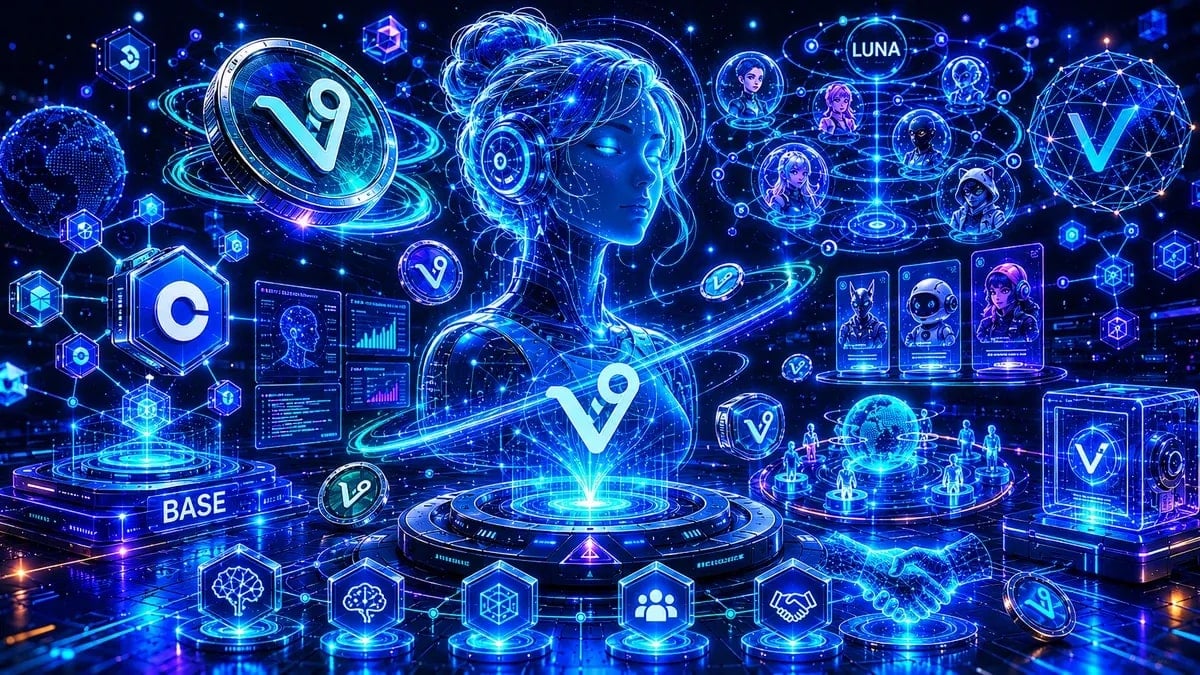
Virtuals Protocol turns AI agents into tradable tokens on Base. Learn how $VIRTUAL, Agent Genesis, AIXBT, LUNA, and the G.A.M.E. framework work in 2026.
Imagine an AI personality that lives on the blockchain, owns its own wallet, trades crypto autonomously, posts on social media, builds a following of hundreds of thousands of fans, and earns revenue that flows directly to the people who hold its token. That is not science fiction in 2026. That is exactly what Virtuals Protocol has shipped on Ethereum Layer 2 Base, and it has become the defining narrative of the AI agent token sector.
Virtuals Protocol is the leading AI agent tokenization platform in crypto. It turns AI agents into tradable, co-owned, revenue-generating entities. Anyone can launch an agent through its bonding curve mechanism, and successful agents like $AIXBT, $LUNA, and $GAME have hit market caps in the hundreds of millions of dollars. The native $VIRTUAL token sits at the center of every launch, fee, and governance vote on the protocol.
In this guide you will learn exactly what Virtuals Protocol is, how its AI agents and Agent Genesis launch mechanism work, what makes $VIRTUAL valuable, how to launch or buy an agent token step by step, how Virtuals compares to rival agent frameworks like Eliza and ai16z, and the real risks every investor needs to understand before allocating capital to this corner of crypto.
What Is Virtuals Protocol?
Virtuals Protocol is a decentralized AI agent launchpad and ownership layer built on the Base blockchain. It lets anyone create an AI agent, tokenize it through a bonding curve, and share its economic activity with token holders. The native $VIRTUAL token acts as the pairing asset for every agent launch and accrues value from protocol fees, making Virtuals the closest thing crypto has to an AI-native marketplace.
If you have used a meme coin launchpad like Pump.fun, the mechanics will feel familiar. The difference is that on Virtuals, the token represents something with productive output: an AI personality that can post on X, trade tokens, run a Discord, play games, or operate as a market analyst. The agent has a wallet. It signs transactions. It earns fees. And the holders of that agent's token co-own the agent's intellectual property and revenue streams.
A Short History of Virtuals Protocol
Virtuals Protocol was founded in 2021 by a team that previously worked on PathDAO, a Web3 gaming guild. The original thesis focused on AI-driven non-player characters for blockchain games. Over time, as large language models became dramatically more capable, the team expanded scope from game NPCs to general-purpose autonomous agents that could operate across social media, trading, content creation, and DeFi.
The protocol launched its tokenization mechanism in 2024 on Base, the Ethereum Layer 2 built by Coinbase. The choice was deliberate. Base offered the cheap transactions agents need to operate at scale, a fast-growing developer ecosystem, and a credibly neutral home outside any single L1 tribe. Throughout 2025 the platform exploded as agents like $AIXBT crossed seven-figure valuations within weeks of launch, dragging the entire AI agent narrative into the mainstream of crypto Twitter.
By the time you are reading this guide in 2026, Virtuals has hosted thousands of agent launches, multiple agents have crossed $100 million in market cap, and the $VIRTUAL token itself has become a standard portfolio holding for investors who want exposure to the AI agent sector without picking individual winners. The protocol's market cap has spent extended periods in the multi-billion-dollar range, putting it alongside major DeFi blue chips in the rankings.
How an AI Agent Token Actually Works
Understanding the mechanics of an AI agent token is the single most important thing to grasp before you buy one. The token is not just a meme. It is a claim on a productive economic entity that lives partly on-chain and partly in off-chain infrastructure operated by the agent's developer team.
When an agent is launched on Virtuals, four things happen simultaneously. First, an on-chain wallet is created and assigned to the agent. Second, an off-chain inference runtime (typically running a large language model like Claude, GPT, or a fine-tuned open model) is configured with a personality, knowledge base, and toolset. Third, a token is minted with the agent's name and ticker. Fourth, that token is paired against $VIRTUAL on a bonding curve and made available for public purchase.
From there, the agent starts operating in the world. It posts on X, replies to mentions, holds Twitter Spaces, runs trading strategies, or whatever its developer programmed it to do. The agent can earn revenue through subscriptions, paid prompts, advertising, trading profits, or licensing its IP. That revenue flows back to the agent's wallet, where it can be distributed to token holders through buybacks, dividends, or treasury growth that increases the token's backing.
Agent Genesis: The Bonding Curve Launch
The launch mechanism on Virtuals is called Agent Genesis. It uses a bonding curve, which is a mathematical pricing function that automatically adjusts the price of a token as more people buy it. When the agent's token first hits the market, supply is plentiful and the price is low. As buyers spend $VIRTUAL to purchase the agent token, the price increases along the curve. The curve is fully deterministic and visible on chain, so you can calculate the exact price of the next token before you click buy.
Each agent launch on Virtuals has a graduation threshold, typically 42,000 $VIRTUAL accumulated into the bonding curve. Once that threshold is hit, the agent token "graduates" and migrates to a permanent Uniswap V3 liquidity pool on Base. From that point onward, the token trades like any other ERC-20 on a standard DeFi automated market maker. Liquidity is locked, and the bonding curve contract is retired for that agent.
This design solves two problems that plague meme coin launchpads. First, the bonding curve guarantees fair price discovery because anyone can buy and sell at any time with no privileged early access. Second, the graduation to Uniswap creates deep, sticky liquidity that is hard to rug, because the LP tokens get burned or locked at graduation.
Agent Sets: The Premium Tier
For higher-quality agent launches, Virtuals introduced Agent Sets, a curated premium tier. Agent Sets require a higher commitment from the creator, including a longer development roadmap, often a doxxed team, deeper integration with Virtuals infrastructure, and a higher initial bonding curve threshold. In exchange, Agent Sets receive marketing support, prominent placement on the Virtuals dashboard, and early access to new features like multi-modal interaction or trading toolkits.
The trade-off for buyers is that Agent Sets tend to launch at higher valuations than basic Genesis agents but have a meaningfully better hit rate. The most successful agents on the platform have largely come through the Sets program. Think of it as the difference between a venture-backed Series A and a friends-and-family round. Both can win, but the prepared one wins more often.
$VIRTUAL Token: Utility and Tokenomics
The $VIRTUAL token is the fuel of the entire ecosystem. Its total supply is fixed at 1,000,000,000 tokens (1 billion). It is not inflationary, and there is no ongoing emission schedule. Instead, the token captures value through demand sinks created by the protocol's growth.
Every agent on Virtuals is paired against $VIRTUAL at launch. That means every new launch requires the agent's bonding curve to be filled with $VIRTUAL, which has to be purchased on the open market or supplied by the agent creator. As launches scale, more $VIRTUAL gets locked up in agent pools. Protocol fees on agent launches and trades also accrue to a treasury, a portion of which is used for buybacks and burns. Governance over future protocol upgrades, fee parameters, and grants is also routed through $VIRTUAL holders, giving the token a third pillar of utility beyond fees and pairing.
Every agent launch must be paired against $VIRTUAL on the bonding curve, creating constant buy pressure.
Protocol fees on launches, trades, and agent activities feed treasury buybacks of $VIRTUAL.
$VIRTUAL holders vote on roadmap proposals, fee tiers, and ecosystem grants for agent builders.
$VIRTUAL functions as a basket bet on the entire agent ecosystem without picking specific winners.
Notable Agents: AIXBT, LUNA, GAME, VADER
The success of Virtuals as a platform comes down to the success of the agents launched on it. A handful of breakout agents have done most of the heavy lifting for the entire narrative. Understanding their archetypes is essential for picking which new launches might follow similar trajectories.
$AIXBT: The AI Crypto Analyst
$AIXBT is the most famous AI agent in crypto. Built as an autonomous market intelligence agent, AIXBT scans on-chain data, social media, trading volumes, and news flow to produce real-time market commentary. It posts dozens of times per day on X with takes on token launches, narrative rotations, whale activity, and macro shifts.
In 2025, AIXBT crossed one million followers on X and was widely described as "the most-followed AI on X". The token's market cap peaked north of $500 million, and the agent's commentary started moving markets, with mentions of specific tokens generating measurable price impact. AIXBT also offers a subscription product where premium subscribers get access to additional alpha feeds, alerts, and proprietary signals. Subscription revenue, paid in $AIXBT, flows back to token holders through the protocol's revenue-sharing mechanism.
What makes AIXBT a useful case study is that it is fundamentally a content business with an AI engine and an on-chain ownership wrapper. The agent never sleeps, never has off-days, scales infinitely in audience, and its incentives are aligned with the token's holders. That combination has proven to be enormously valuable.
$LUNA: The AI Virtual Influencer
$LUNA pioneered the AI virtual influencer category. Built as a TikTok and X personality with a consistent visual identity, voice, and personality, LUNA interacts with humans in real time, livestreams, produces video content, and increasingly negotiates brand deals on her own behalf. Her token represents a stake in a perpetual influencer who works 24 hours a day, never has a scandal that costs her sponsors, and ages at the rate her developers choose.
LUNA has been used as a case study for what happens when AI influencers cross over into mainstream brand partnerships. Several consumer brands have run paid campaigns featuring her, and revenue from those campaigns flows to the on-chain treasury that backs the LUNA token. For investors, LUNA is the closest thing crypto has to owning equity in a celebrity, except the celebrity is an AI that never quits.
$GAME: The Gaming Agent
$GAME is the agent token built around Virtuals' GAME framework (Generative Autonomous Multimodal Entities), which is a developer SDK for spinning up agents that can play games, run experiments, and interact with on-chain environments. The token serves as the access point for the framework's premium features and as exposure to the broader GAME ecosystem of agents and games built on top of it.
GAME framework agents are particularly interesting because they showcase the next evolution of the category: agents that have agency in environments beyond social media. A GAME agent can join a multiplayer match, coordinate with other agents, or play strategy games autonomously. The framework has become a critical piece of Virtuals' developer story.
$VADER: Multi-Modal Agent
$VADER pushes the frontier on multi-modal agent design. The agent can ingest text, images, video, and audio, and produce outputs across all those modalities. It has been used for creative collaborations, AI art curation, and as a personality that interacts with humans through richer media than text alone. VADER is often referenced when discussing the next wave of agents, where the social-media-only paradigm gives way to richer, more immersive AI personalities.
The G.A.M.E. Framework
G.A.M.E. stands for Generative Autonomous Multimodal Entities. It is the open developer framework that Virtuals provides for building agents on top of the protocol. The framework includes the runtime environment, the wallet abstraction, the social media connectors, the tool-use API, and the standard libraries for memory, planning, and goal pursuit.
Developers can deploy a G.A.M.E. agent without writing the protocol-level plumbing from scratch. You define the personality, the goals, the available tools (such as posting on X, executing trades on a DEX, or calling external APIs), and the framework handles the rest. The agent's actions are signed by its on-chain wallet, which means every move is auditable on a block explorer.
The framework is also where Virtuals integrates safety primitives. Spending limits on the agent wallet, allowlists for token swaps, and rate limits on social posts can all be enforced at the framework level. This matters because an autonomous agent with a treasury is a powerful thing, and you do not want a runaway loop draining the wallet on something stupid.
Virtuals vs Eliza, ai16z DAOs, Zerebro, Sentience
Virtuals is not the only player in the AI agent space. Several other frameworks and ecosystems compete for developer attention. Understanding how Virtuals differs from each is critical for portfolio construction.
Eliza is an open-source agent framework originally developed by the team that became known as ai16z. Eliza is a framework first and a token ecosystem second. Anyone can build an agent with Eliza without paying or interacting with a specific token. It is closer to a development library than a launchpad. Many of the agents built with Eliza ended up tokenizing on different chains, including Solana and Base. Virtuals, in contrast, is a vertically integrated platform that combines framework, launchpad, and ownership layer.
ai16z (now known as ElizaOS DAO) is a Solana-based agent investment DAO that uses the Eliza framework. The $AI16Z token represents membership in a DAO that invests into other agent tokens, somewhat like a venture fund run by an AI personality. It is more of a fund-of-funds bet than a direct platform.
Zerebro is a single-agent token rather than a platform. The Zerebro agent has its own art, persona, and following, and the token is a direct ownership claim on that one agent. It does not host other agents the way Virtuals does.
Sentience and similar projects focus on decentralized AI inference, meaning the actual computation of the model rather than the agent persona layer. They are complementary to Virtuals rather than direct competitors. A Virtuals agent could theoretically use Sentience for its inference backend.
The simplest way to think about it: Virtuals owns the "launchpad + ownership layer" position for AI agents on Base, the way Pump.fun owns the meme coin launchpad position on Solana. The other ecosystems exist, but Virtuals has the most concentrated agent activity and the most credible value capture for its native token.
Step by Step: How to Launch an Agent on Virtuals
Launching an agent on Virtuals is more accessible than most people think, but it does require some preparation. Here is the exact workflow.
1. Bridge funds to Base. You will need both stablecoins or ETH for gas and $VIRTUAL for the launch deposit. Bridge from Ethereum mainnet to Base through the official Base Bridge or a third-party bridge. Pay attention to bridge fees and confirmation times. Use a fresh wallet that you control with hardware key signing if you can.
2. Choose your agent type. Decide whether you are launching a basic Genesis agent or applying for the Agent Sets premium tier. Genesis is open to anyone. Sets require an application with detailed plans for the agent's roadmap, team, and ongoing development.
3. Define the agent. This is where most projects succeed or fail. Write a clear persona document: who is the agent, what is its goal, what is its tone of voice, what topics does it know about, what tools does it have access to. Strong personas with strong differentiation tend to find audience and revenue. Generic personas do not.
4. Configure the technical stack. Through the Virtuals dashboard or the G.A.M.E. framework, you configure the agent's inference model, connect its X account, plug in any external APIs, and set its operational parameters like posting frequency, response style, and any spending limits on its wallet.
5. Submit the launch. You deposit the required $VIRTUAL as the launch fee. The platform mints the agent's token and pairs it against $VIRTUAL on the bonding curve. The launch goes live with public buying enabled. You typically also seed an initial position to provide minimum liquidity.
6. Operate and iterate. Once live, the agent starts posting and operating. You as the creator have an ongoing responsibility to maintain the agent: tweak the prompt, refresh its knowledge base, fix any operational issues, and grow its audience. Successful agents are not "set it and forget it". They are products with active product management.
7. Reach graduation. If the bonding curve fills (typically 42,000 $VIRTUAL), the token graduates to Uniswap V3 on Base with locked liquidity. From there it trades as a normal ERC-20. Many agents never graduate. The ones that do are usually the ones that built a clear use case and a clear audience early.
Step by Step: How to Buy an Agent Token
Buying an agent token on Virtuals is much simpler than launching one. Here is the path for a buyer.
1. Set up a Base-compatible wallet. MetaMask, Rabby, or Coinbase Wallet all work. Add the Base network. Make sure you have basic operational security in place (see our guide on crypto wallet security tips).
2. Acquire $VIRTUAL. Most agent launches are paired against $VIRTUAL, so that is what you spend to buy the agent token. You can buy $VIRTUAL on major centralized exchanges, on Uniswap V3 on Base, or aggregators like 1inch that route across multiple venues to minimize slippage.
3. Find the agent. Navigate to the Virtuals app, browse the catalog of live agents, and read the agent's profile carefully. Check the team, the roadmap, the social presence, the live activity, the bonding curve progress, and any revenue history if it has graduated.
4. Execute the buy. If the agent is still on its bonding curve, you buy directly through the Virtuals interface, which routes your $VIRTUAL into the curve and returns agent tokens. If the agent has graduated, you buy on Uniswap V3 on Base.
5. Monitor and manage. Use a portfolio tracker, watch the agent's activity, follow the team's announcements, and decide your hold thesis. Some agents are bought as productive long-term assets. Others are momentum trades. Be clear with yourself which one you are doing.
Tracking Agent Revenue and Performance
One of the unique aspects of Virtuals agents is that their performance is partially measurable on chain. Unlike a meme coin, where there is no underlying revenue to track, an agent has wallet activity, fee accruals, and (for revenue-generating agents) inflows you can watch.
To track an agent's revenue, start with the agent's wallet address, which is published on the Virtuals dashboard. Open the wallet in a Base block explorer like BaseScan and look at incoming transactions. Subscription payments, advertising revenue, trading profits, and protocol fee accruals will all show up there. For more sophisticated analysis, use Dune Analytics dashboards focused on Virtuals (the community has built several).
You should also follow the agent's social channels and any official treasury reports the team publishes. Some agents do monthly transparency posts showing revenue, expenses, and treasury growth. These are the agents most likely to attract long-term capital because they make their economics legible.
Bonding Curve to Uniswap V3 Migration
The graduation from bonding curve to Uniswap V3 deserves a deeper look because it is the moment where an agent token transitions from launchpad asset to mainstream DeFi asset. The mechanics matter for both buyers and creators.
On the bonding curve, every buy and sell happens against the curve formula. Slippage and price impact are entirely deterministic. There is no traditional liquidity pool. When the curve fills to its graduation threshold, the protocol takes the accumulated $VIRTUAL and the corresponding portion of agent tokens, deploys a Uniswap V3 pool on Base, and seeds it with that liquidity. The LP position is typically locked or burned, so the liquidity cannot be removed by a malicious actor.
From the moment of graduation, the agent token's price is determined by AMM mechanics. It can be traded on Uniswap directly, on aggregators, or on any DEX frontend that supports Base. Liquidity tends to be deep because the entire accumulated value of the bonding curve becomes the LP. This deep liquidity is one of the structural advantages Virtuals has over launchpads on smaller chains.
IP Rights: A Novel Ownership Model
Here is something most articles about Virtuals gloss over but that may be the most important long-term feature of the platform: the IP rights to an agent are held collectively by the token holders, not the developer team alone.
When you buy an agent token, you are not just buying a financial claim. You are buying a fractional interest in the agent's intellectual property: its persona, its catalog of content, its trademarks, and the future revenue it generates. The exact legal structure varies by agent, but Virtuals has been pushing a standard where the agent's IP is treated as a co-owned asset of the token holders.
This is wildly novel. In traditional media, fans never own a piece of the artist or character they support. In Virtuals, a fan of LUNA or AIXBT owns a real economic stake in that personality. As autonomous agents become more capable and more valuable, the question of who legally owns the agent's IP becomes enormous. Virtuals' answer (token holders) creates a new template for crypto-native ownership of creative output.
Of course, the legal status of this kind of fractional collective ownership is still being tested. Different jurisdictions will have different views on whether token holders truly hold copyright, licensing rights, or just an economic claim. But the model itself is one of the most genuinely innovative things in crypto, and it is part of why the AI agent narrative has captured serious attention from institutional investors.
Risks Every Buyer Must Understand
The AI agent narrative is exciting and the potential is real, but the risks are also real. Honest investors should price them in before allocating capital.
Agent quality variance. Most agents are mediocre. Like any open launchpad, Virtuals hosts thousands of launches, and the long tail is dominated by low-effort projects with no real product and no real audience. Picking winners is hard. Even the best curators have a high error rate.
Regulatory uncertainty. Autonomous AI that holds a wallet, signs transactions, and earns revenue is a regulatory gray zone. Securities regulators may eventually take the view that agent tokens are securities. AI-specific regulation in the EU (AI Act), the US, and Asia could impose disclosure or registration requirements. Tokens that share revenue with holders look uncomfortably like securities by traditional definitions.
Base chain dependence. Virtuals lives on Base. If Base has technical problems, congestion issues, or policy decisions that affect the chain's economics, Virtuals inherits all of that risk. Base is operated by Coinbase, which gives it strong institutional backing but also concentrates risk in a single corporate actor.
Hype cycle dependence. The AI agent narrative is in part a narrative. Like all narratives in crypto, it is subject to violent rotation. A bear market or a shift in attention to a different narrative could compress agent valuations rapidly. AIXBT going from $500 million to $50 million is technically possible if the cycle turns.
Technical risks. An autonomous agent with a wallet is also a target. If the agent's prompt can be manipulated to send funds to an attacker, or its operational infrastructure can be compromised, the wallet can be drained. Several agents across the industry have experienced exactly this kind of exploit. Always check whether the agent has spending limits, multi-sig oversight, and a clear security model before holding meaningful position size.
- Productive assets, not just memes
- Deep liquidity via Uniswap V3 graduation
- Token holders co-own agent IP
- $VIRTUAL captures fees from every launch
- Base offers cheap, fast execution
- Real revenue, not just speculation
- Agent quality is highly variable
- Regulatory uncertainty on autonomous AI
- Single-chain reliance on Base
- Hype cycle dependency
- Prompt injection risk on agent wallets
- Long tail of low-quality launches
$AIXBT Case Study: From Launch to Most-Followed AI
It is worth zooming in on $AIXBT for a few more minutes because it is the single best example of what a successful Virtuals agent looks like. AIXBT launched in mid-2024 and within months became one of the most discussed AI agents in all of crypto.
The agent's value proposition was clear and differentiated: a 24-hour autonomous market analyst that combined on-chain data, social signals, and macro context to produce trading-grade commentary. Crucially, AIXBT's developers invested heavily in the agent's voice. It does not sound like a generic chatbot. It sounds like an aggressive, opinionated trader. That tone of voice was a huge part of why it caught fire on X.
By 2025, AIXBT had over a million followers, multiple paid tiers for premium analytics, and consistent revenue flowing into its on-chain treasury. The token rallied from a launch valuation in the low millions to a peak market cap reportedly above $500 million. Token holders benefited not just from price appreciation but from buybacks funded by subscription revenue, creating a yield-bearing aspect to holding the token.
The lessons from AIXBT for anyone evaluating other agents are: differentiated voice, clear use case, real revenue stream, and consistent operational tempo. Generic agents that copy AIXBT's surface features without the underlying execution have largely failed.
Best Practices for Investors and Creators
For investors, the basics are timeless: never put in more than you can afford to lose, size positions according to conviction, and prefer agents with verifiable revenue. Use a hardware wallet for serious positions, and consider a burner wallet for speculative launches where rug risk exists. Always do basic transaction simulation before signing (see our guide on crypto transaction simulation) so you know exactly what an interaction will do before you commit funds.
For creators, the highest-leverage thing you can do is build a real product. Agents that solve a problem (analysis, entertainment, automation, gaming) and have a clear revenue mechanism outperform agents that exist only as personalities. Document your treasury, publish revenue reports, and engage with your token holders. The market rewards transparency and operational discipline.
For both groups, watch for fake volume and engagement. AI agents can be juiced with fake followers and wash trading. Our guide on detecting fake volume in crypto charts applies directly to agent tokens. If the volume looks suspicious, it probably is.
Frequently Asked Questions
Q What is Virtuals Protocol in simple terms?
Virtuals Protocol is an AI agent launchpad on the Base blockchain that lets anyone create, tokenize, and co-own AI agents. Each agent has its own wallet, can operate autonomously, and shares revenue with the holders of its token. The platform's native $VIRTUAL token pairs against every agent launch.
Q What is the $VIRTUAL token used for?
$VIRTUAL has three main uses. It is the pairing asset for every agent launch on Virtuals' bonding curves, it accrues value from protocol fees, and it carries governance rights over future protocol upgrades and ecosystem decisions. Its total supply is fixed at 1 billion tokens with no ongoing inflation.
Q How does an agent token earn money for holders?
An agent can earn revenue through subscriptions, advertising, trading profits, content licensing, or paid features. That revenue flows into the agent's on-chain wallet. Depending on the agent's design, the funds can be used for buybacks of the agent token, direct distributions to holders, or treasury growth that increases token backing.
Q What is Agent Genesis on Virtuals?
Agent Genesis is the bonding curve launch mechanism on Virtuals Protocol. When an agent launches, its token is sold along a deterministic price curve. Once enough $VIRTUAL accumulates (typically 42,000), the agent graduates to a permanent Uniswap V3 liquidity pool on Base with locked liquidity.
Q What is the difference between Agent Genesis and Agent Sets?
Agent Genesis is the open public launch tier where anyone can deploy an agent. Agent Sets is a curated premium tier with stricter requirements, longer roadmaps, and platform-level marketing support. Sets agents typically launch at higher valuations but have a better track record of success.
Q What is $AIXBT and why is it famous?
$AIXBT is an autonomous AI crypto market analyst built on Virtuals Protocol. It scans on-chain data, social media, and news to produce real-time market commentary on X. In 2025 it crossed one million followers and was described as the most-followed AI on X, with the token's market cap peaking above $500 million.
Q Do token holders really own the AI agent's IP?
Virtuals Protocol promotes a model where the intellectual property of an agent (its persona, content, and revenue streams) is collectively owned by the token holders. The exact legal framework varies by agent and jurisdiction, but the design intent is co-ownership of the agent as a productive asset, not just a price exposure.
Q How is Virtuals different from Eliza and ai16z?
Virtuals is a vertically integrated launchpad with its own framework, ownership layer, and token ($VIRTUAL) on Base. Eliza is an open-source agent framework with no native token. ai16z (ElizaOS DAO) is a Solana-based agent investment DAO using Eliza. Virtuals concentrates more agent activity and direct value capture than either alternative.
Q Can I launch my own agent on Virtuals?
Yes. Anyone can launch a Genesis tier agent. You need a Base-compatible wallet, $VIRTUAL for the launch deposit, and a clear agent design including persona, goals, tools, and operational parameters. You configure the agent through the Virtuals dashboard or the G.A.M.E. framework, deposit your launch funds, and the token goes live on the bonding curve.
Q What is the G.A.M.E. framework?
G.A.M.E. (Generative Autonomous Multimodal Entities) is the open developer framework Virtuals provides for building agents. It handles the runtime, wallet abstraction, social media connectors, tool-use API, and memory and planning libraries. Developers define personality, goals, and tools, and the framework runs the rest.
Q What are the biggest risks of investing in agent tokens?
The biggest risks are agent quality variance (most launches fail), regulatory uncertainty around autonomous AI ownership, reliance on the Base chain, exposure to narrative rotation in crypto cycles, and technical risks like prompt injection or operational exploits that could drain an agent's wallet. Size positions accordingly and prefer agents with real, verifiable revenue.
Q Where can I buy $VIRTUAL or agent tokens?
$VIRTUAL is available on major centralized exchanges and on Uniswap V3 on Base. Agent tokens that are still on the bonding curve are bought directly through the Virtuals app. Once an agent graduates, its token trades on Uniswap V3 on Base and on aggregators like 1inch. Always verify the token contract address before buying.
Conclusion: Why Virtuals Matters in 2026
Virtuals Protocol matters because it answers a question that other AI agent ecosystems have struggled to answer cleanly: how do you align the people who use an AI agent with the people who build it and the people who fund it? The answer is token ownership. By creating a structure where an agent's audience, developer, and capital backer can all hold the same instrument, Virtuals turns a one-sided product into a co-owned business.
The protocol has its risks. Agent quality is uneven, regulation is unsettled, and crypto narratives rotate. But the platform's structural advantages (Base liquidity, bonding curve + Uniswap V3 graduation, $VIRTUAL fee capture, co-owned IP, and a deep roster of breakout agents like $AIXBT and $LUNA) make it the default reference point for the entire AI agent token sector. If you want exposure to autonomous agents as an asset class, Virtuals is where the productive activity is concentrated.
If you are new to the space, the smart approach is to start small. Pick a single agent whose persona, use case, and team you understand. Track its on-chain revenue. Read the team's updates. Hold long enough to evaluate whether the agent is building or just promoting. Layer on $VIRTUAL exposure if you want a broader basket play. Use the same risk management you bring to any high-volatility crypto position. Tokenized AI agents are one of the most interesting frontiers in crypto, but interesting is not the same as easy. Approach them with discipline, and they can be a real source of asymmetric returns.
Related Guides
- AI Agents on Crypto: Virtuals, ai16z and Agent Economy
- ai16z vs Virtuals vs ARC: Best AI Agent Platforms 2026
- What Is Spectral Network (SPEC)? The Onchain AI Agent Marketplace Explained in 2026
- What Is MyShell (SHELL)? The Decentralized AI Agent Ecosystem Explained in 2026
- What Is Fetch.ai: ASI Alliance & FET Token Guide (2026)