1inch Explained: Pathfinder, Fusion and How the DEX Aggregator Works (2026)
— By Tony Rabbit in Tutorials
Learn what 1inch is, how Pathfinder routing and Fusion swaps work, where the 1INCH token fits, and why a DEX aggregator behaves differently from a single exchange.
Intent check: This page is the definition and architecture angle for 1inch. If you want the practical swap tutorial with Classic, Fusion, and Limit Orders, read How to Use 1inch.
If you have ever tried to swap a large amount of crypto on a single decentralized exchange, you have probably watched in horror as the price impact ate 2%, 3%, sometimes 5% of your trade. The problem is not the DEX itself. The problem is that you were trying to push too much liquidity through one pool. 1inch solved that problem in 2019 by becoming the first serious DEX aggregator, and seven years later it is still the benchmark every other aggregator measures itself against.
1inch is a decentralized exchange aggregator that splits your trade across dozens of liquidity sources at once. Instead of swapping 100 ETH on Uniswap and eating massive slippage, the Pathfinder algorithm routes 38% through Uniswap V4, 27% through Curve, 19% through Balancer, and the remainder through smaller venues to give you the best possible price. In 2026, the protocol has expanded far beyond simple aggregation into intent-based swaps, cross-chain execution, and a sophisticated MEV protection layer that has saved users tens of millions of dollars from sandwich attacks.
This guide covers everything you need to know about 1inch in 2026: how Pathfinder works under the hood, the differences between Classic Swap, Fusion, and Fusion+, the 1INCH token and unicorn power staking, comparisons against CoW Swap, UniswapX, and ParaSwap, and a step-by-step walkthrough of your first aggregated swap.
What Is 1inch?
1inch is a decentralized exchange aggregator that finds the best possible swap rate for any token pair by querying dozens of liquidity sources simultaneously and splitting your order across them. Rather than executing your trade on a single venue like Uniswap or Curve, 1inch acts as a smart routing layer that sits on top of the entire DeFi ecosystem, pulling liquidity from every major automated market maker, order book, and private maker simultaneously.
The core promise is simple: you should never pay more for a swap than is mathematically necessary. If three different DEXs have liquidity for the USDC to ETH pair, your trade should use all three in the exact proportions that minimize total slippage and fees. Doing this calculation by hand is impossible. Even doing it programmatically is a hard problem in graph theory and optimization. 1inch built an entire infrastructure around solving it, and the result is a product that on most large trades returns 0.1% to 2% more output than swapping directly on any single DEX.
Beyond pure aggregation, 1inch has grown into a full DeFi stack: an intent-based swap system called Fusion, a cross-chain variant called Fusion+, a Limit Order Protocol for conditional and TWAP orders, a self-custodial wallet, a portfolio tracker, and a governance system controlled by the 1INCH token. Together these products process several billion dollars in monthly volume across more than a dozen chains.
A Brief History: From Hackathon to DeFi Giant
1inch began as a hackathon project at ETHGlobal New York in May 2019. Founders Sergej Kunz and Anton Bukov spent the weekend building a prototype that compared swap rates across Kyber, Uniswap V1, and Bancor, and routed users to whichever offered the best price. The project won the hackathon and immediately attracted attention. The name comes from the Bruce Lee quote about the "one-inch punch", referring to the small distance between a trader and the best possible price.
By August 2019 the founders had launched a public version of the aggregator. The breakthrough came in 2020 when the team released the first version of the Pathfinder algorithm, which introduced trade splitting across multiple venues simultaneously. Large trades suddenly broke into pieces routed through the optimal combination of pools, saving meaningful amounts on every swap.
In December 2020 the 1INCH governance token launched and became one of the most distributed airdrops in DeFi history. The token unlocked staking, fee discounts, and the unicorn power system that powers governance today. By 2026, 1inch has processed over $1 trillion in cumulative volume.
The Pathfinder Algorithm Explained
The Pathfinder algorithm is the engine that makes 1inch work. Understanding it is the difference between treating 1inch as a black box and actually knowing why it consistently outperforms single-DEX swaps. At its core, Pathfinder is a graph search problem: given a starting token, a destination token, and an amount, find the path (or combination of paths) through the DeFi liquidity graph that maximizes the output amount net of all fees and gas costs.
The first version of Pathfinder, released in 2020, could split a trade across multiple DEXs but only along a single hop. Pathfinder V2 added multi-hop routing, meaning the algorithm could route a USDC to RARE swap through an intermediate token like ETH or WBTC if that produced a better result. Pathfinder V3, the current production version, operates on what 1inch calls a "weighted directed graph" with thousands of nodes (tokens) and tens of thousands of edges (liquidity pools). It can split a single trade across more than 60 venues simultaneously and route through multiple hops in parallel.
What makes Pathfinder genuinely impressive is how it handles non-linear price impact. Every AMM pool exhibits slippage that grows with trade size. The fifth ETH you buy on Uniswap costs slightly more than the first, and the fiftieth costs noticeably more. Pathfinder models this curve for every pool and uses convex optimization to find the exact split that equalizes the marginal price across all selected venues. When the algorithm gets it right, the marginal price you pay on the last unit through each route is identical, which is the mathematical definition of optimal execution.
Pathfinder also accounts for gas costs in its routing. Using six different DEXs might give a slightly better mid-price than three, but if the extra gas eats more than the saving, the algorithm uses fewer venues. On Ethereum mainnet this gas-aware routing matters enormously. On cheap L2s, Pathfinder can use more venues and squeeze out every basis point.
Classic Swap: The Original 1inch Product
Classic Swap is the original 1inch product and still the workhorse for most everyday trades. You connect a wallet, pick the input token and the output token, enter an amount, and 1inch returns a quote within a second. You hit swap, sign the transaction in your wallet, and the trade executes on-chain. Behind the scenes, the Aggregation Router smart contract receives your input tokens and, in a single atomic transaction, executes the entire split route across however many venues Pathfinder selected.
The user experience is identical to any single DEX. What changes is the result. On a $10,000 USDC swap to a mid-cap altcoin, Classic Swap typically returns 0.3% to 1.5% more output than Uniswap directly. On a $100,000 swap into a thin-liquidity token, the difference can exceed 5%. Same input, more output, identical execution time.
Classic Swap has one important characteristic to understand: it is gas-payer execution. You pay the gas, you sign the transaction, and the trade settles on-chain in your name. This means the transaction is public in the mempool before it confirms, which historically made large Classic Swaps vulnerable to MEV bots running sandwich attacks. The mitigation, which we cover below, is to route Classic Swap through a private RPC, but by default the trade is visible to searchers. For users who want guaranteed MEV protection without configuring anything, the answer is Fusion.
1inch Fusion: Intent-Based Swaps
1inch Fusion launched in December 2022 and fundamentally changed how the protocol executes large trades. The core idea is that instead of you signing a transaction that does a swap, you sign an intent: a structured message that says "I will give up X amount of token A in exchange for at least Y amount of token B before time T". You do not pay gas. You do not pick a route. You just sign the intent off-chain.
Your intent goes into a public order pool where a network of professional market makers (called resolvers) compete to fill it. A Dutch auction starts: the price the resolver must give you begins favorable and decays slowly toward your minimum acceptable price. The first resolver who finds the trade profitable at the current price submits it on-chain, fills your intent, and pockets whatever spread exists between what they sourced the tokens for and what they pay you. You receive your output tokens.
Fusion has three big advantages over Classic Swap. First, you do not pay gas. The resolver pays gas because they earn the spread. Second, you are protected from MEV by default because your intent never enters the mempool as a swap transaction. Resolvers can sandwich themselves, but they cannot sandwich you. Third, on illiquid pairs the Dutch auction often surfaces hidden liquidity from professional market makers who do not have on-chain pools, giving you better fills than any pure AMM route could produce.
The trade-off is speed and predictability. Classic Swap settles in one block. Fusion can take from a few seconds up to several minutes depending on how quickly a resolver finds the auction profitable. For most users on most trades, this delay is fine. For traders who absolutely need a fill within one block, Classic Swap remains the better choice. The 1inch interface lets you pick which mode to use for each trade.
1inch Fusion+: Cross-Chain Intents
Fusion+ is the cross-chain evolution of Fusion, released in late 2024 and expanded significantly through 2025 and 2026. It applies the same intent and resolver model to swaps that span two different blockchains. You sign an intent that says "give up 10,000 USDC on Ethereum, receive at least 9,990 USDC on Solana", and a resolver network handles the entire execution: they receive your tokens on the source chain, deliver tokens on the destination chain, and earn the spread.
What makes Fusion+ different from a bridge is that there is no synthetic asset, no liquidity pool waiting on the destination chain, and no multi-step user experience. You sign one off-chain message and your tokens appear on the other chain. The resolver assumes the bridging risk, handles the timing, and pays the gas on both sides. From the user's perspective it feels like a single instant swap that happens to cross chains.
Fusion+ has become important as multi-chain DeFi has grown. Users routinely hold positions across Ethereum, Arbitrum, Base, Optimism, Polygon, BNB Chain, Avalanche, and Solana. Moving liquidity between them used to require navigating bridges with very different security assumptions. Fusion+ abstracts that into a single signed intent, with resolvers competing on price.
The 1inch Limit Order Protocol
The Limit Order Protocol is a less-discussed but extremely powerful component of the 1inch stack. It lets users place gasless limit orders that execute only when market conditions match their criteria. Place an order to sell 1 ETH for 4,500 USDC, and that order sits off-chain until ETH crosses that price. When it does, anyone (a keeper or another user) can fill your order, executing the swap on-chain.
Beyond simple limit orders, the protocol supports stop losses, time-weighted average price (TWAP) orders, range orders, and conditional orders triggered by oracle prices. Because the orders are gasless until fill, you can place dozens of conditional orders without paying anything. You only pay gas when an order actually executes, and even then the filler often pays it as part of their fill economics.
The Limit Order Protocol powers a significant chunk of the order flow that resolvers in Fusion compete for. It also underlies many third-party DeFi products that need conditional execution: automated portfolio rebalancers, options-style payoffs, and TWAP execution bots all use the protocol as their settlement layer. It is one of the most quietly important pieces of infrastructure in the 1inch ecosystem.
Supported Chains in 2026
1inch started on Ethereum and was Ethereum-only for its first two years. Today it supports virtually every major EVM chain and has expanded into non-EVM ecosystems through Fusion+. As of 2026, the aggregator runs natively on Ethereum, Arbitrum, Optimism, Base, Polygon, BNB Chain, Avalanche, Gnosis Chain, Fantom (now Sonic), zkSync Era, Linea, Scroll, Mantle, Polygon zkEVM, and Aurora. Fusion+ extends settlement to Solana and several Cosmos chains through its resolver bridges.
Pathfinder maintains a separate liquidity graph for each chain, indexing every meaningful AMM, order book, and stableswap pool on that network. This is why a swap on Base might route through Aerodrome, Uniswap V4, and SushiSwap, while the same logical swap on Ethereum might route through Uniswap V4, Curve, and Balancer V3. The algorithm picks whatever combination is optimal on the specific chain you are using.
For traders who frequently move between chains, the 1inch interface makes it easy to switch networks and continue using the same aggregator with no learning curve. Combined with Fusion+ for cross-chain settlement, this gives users a unified swap experience across the entire multi-chain DeFi landscape, something that did not exist coherently before 1inch and its competitors built it.
MEV Protection: The Hidden Edge
One of the biggest reasons sophisticated traders use 1inch instead of swapping directly on a DEX is built-in MEV protection. When you swap on Uniswap directly, your transaction sits in the public mempool before it gets included in a block. MEV bots scan that mempool looking for trades large enough to sandwich profitably. They buy the same token just before your transaction, let your swap push the price up, and sell immediately after. You get a worse fill, and the difference becomes their profit.
1inch offers two layers of MEV protection. The first is the 1inch RPC, a private transaction submission endpoint that routes Classic Swap transactions directly to block builders without exposing them in the public mempool. Sandwich bots cannot see what they cannot scan, so they cannot front-run a transaction that goes straight from your wallet to a builder. You simply add the 1inch RPC URL to your wallet and toggle on the protection flag in the swap interface.
- Transaction visible in public mempool
- Vulnerable to sandwich attacks
- Single venue, full slippage
- User pays all the gas
- Avg. MEV tax on large swaps: 0.3-2%
- Intent signed off-chain, never in mempool
- Sandwich-resistant by design
- Resolvers split across 60+ venues
- Resolver pays gas, not user
- Avg. effective slippage: near-zero
The second and stronger layer is Fusion itself. Because Fusion intents are off-chain signed messages rather than swap transactions, sandwich bots have nothing to scan and nothing to front-run. The trade only appears on-chain at the moment a resolver settles it, by which point the resolver has already locked in the price they will pay you. There is no window in which an external party can insert themselves between your trade and the price you receive. This is genuine MEV protection at the protocol level, not an opt-in feature.
For traders moving meaningful size, the combined effect is significant. A trader doing $1M of monthly volume can easily save $3,000 to $20,000 per year by routing through 1inch with MEV protection versus swapping directly on DEXs. The math gets more compelling the larger you trade.
The 1INCH Token, Staking, and Unicorn Power
The 1INCH token is the governance and utility token of the 1inch Network. It launched in December 2020 with a maximum supply of 1.5 billion tokens, distributed across community airdrops, liquidity mining, the team, investors, and a long-term treasury. The token does several jobs: it controls protocol governance, captures value from resolver activity, powers fee discounts, and underlies the staking system that produces unicorn power.
The most interesting part of 1INCH tokenomics is the staking layer. Users lock 1INCH into the staking contract for a duration they choose, between one week and two years. They receive st1INCH in return, plus a quantity of unicorn power that depends on both the amount staked and the lock duration. Longer locks produce more unicorn power per token, which incentivizes long-term alignment with the protocol.
Unicorn power is the actual unit of governance. Holders use it to vote on protocol parameters, treasury spending, fee distribution, and changes to the resolver auction mechanics. Critically, unicorn power also routes a share of resolver fees back to stakers. As Fusion volume grows, fees collected from resolver auctions flow into the treasury, and unicorn power holders vote on how those fees are distributed. In practice, a portion has consistently been routed back to active stakers as protocol revenue.
Beyond staking, 1INCH holders can delegate their unicorn power to professional resolvers. Resolvers need unicorn power to participate in Fusion auctions, and the more delegated power they hold, the more order flow they can compete for. Delegators receive a share of the resolver's profits. This creates a two-sided market: token holders can earn yield by delegating to the best-performing resolvers, while resolvers compete for delegations by offering the most attractive terms.
The result is that the 1INCH token is meaningfully productive. Unlike many governance tokens that exist primarily for voting, 1INCH staking generates real cash flow tied to actual protocol usage. As Fusion and Fusion+ volume grow, the economic value flowing to stakers grows with it. This has made 1INCH one of the more defensible token designs in the aggregator space.
1inch Wallet vs 1inch Aggregator
One source of confusion for new users is the distinction between the 1inch Aggregator and the 1inch Wallet. These are two related but separate products. The Aggregator is the swap interface you access at app.1inch.io. You connect any wallet (MetaMask, Rabby, Trezor, Ledger) and use it to execute swaps. The Aggregator is wallet-agnostic and does not require any specific software.
The 1inch Wallet is a separate self-custodial mobile and desktop wallet built by the 1inch team. It supports the same set of chains as the Aggregator, integrates the Aggregator and Fusion natively, includes a portfolio tracker, and bundles fiat on-ramps. The Wallet is convenient for users who want everything in one app, but it is entirely optional. Power users typically prefer using Rabby or MetaMask with the Aggregator interface because those wallets have richer transaction simulation and security features.
There is also the 1inch Hardware Wallet, launched in 2024, which is the team's branded cold storage device. It works with the 1inch Wallet app and provides air-gapped key storage for users who want a hardware-backed setup that integrates cleanly with the 1inch ecosystem. Like the software wallet, it is optional. The Aggregator works fine with any major hardware wallet.
How to Use 1inch: Step-by-Step Walkthrough
Executing a swap on 1inch is straightforward, but a few configuration choices can meaningfully affect your result. Here is a complete walkthrough using the 1inch Aggregator on Ethereum mainnet.
Step 1: Connect your wallet. Go to app.1inch.io and click "Connect Wallet". Pick your wallet from the supported list. You will sign a small message to verify wallet ownership. No tokens leave your wallet at this step. Make sure you are on the correct network for the trade you intend to make.
Step 2: Select the tokens. Pick the token you are selling and the token you are buying. If you do not see a token, paste its contract address into the search field. Always double-check token contracts against a trusted source like CoinGecko or the project's official site to avoid swapping into a scam token with the same name.
Step 3: Enter the amount. Type how much you want to sell, or click "Max" to use your full balance. The interface immediately shows you the expected output, the route Pathfinder selected, and the price impact. Review the route. If you see your trade splitting across multiple venues, that is exactly what the algorithm is supposed to do on a meaningful trade size.
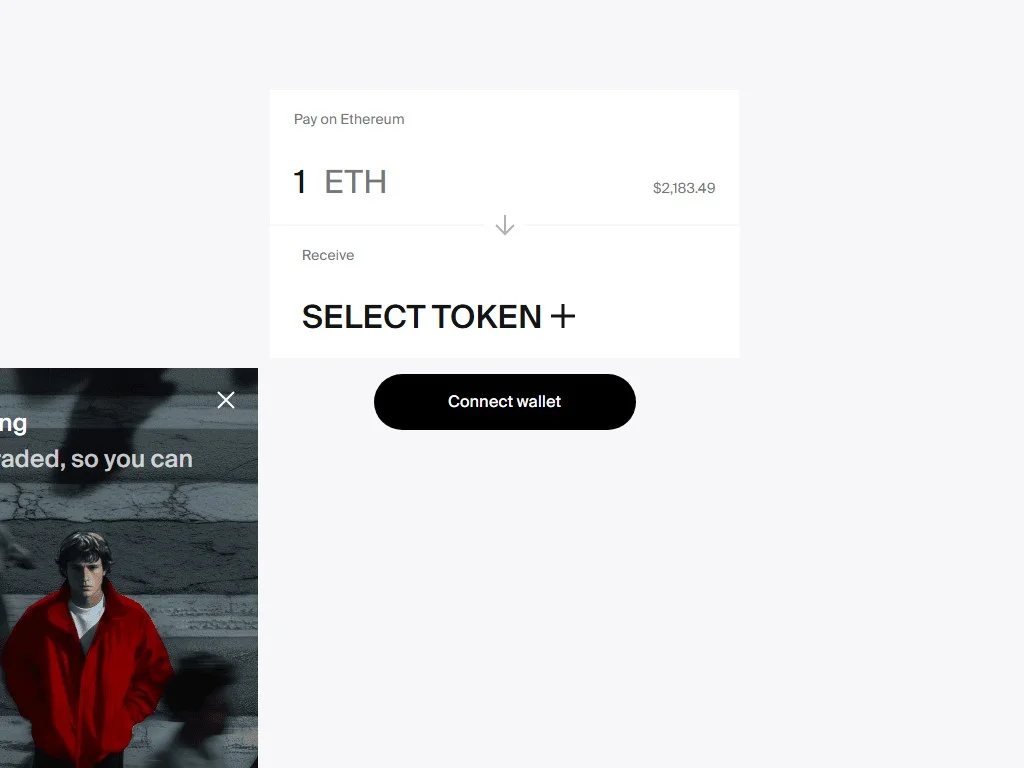
Step 4: Choose Classic or Fusion. The interface lets you toggle between Classic Swap and Fusion. Default is Fusion for most trades because it costs nothing in gas and protects you from MEV. Switch to Classic only if you need guaranteed one-block settlement or you are trading very small amounts where the gas cost is negligible.
Step 5: Configure slippage. Open the settings panel. Slippage tolerance defaults to "Auto" which is generally fine for liquid pairs. For thin tokens, set it manually. Setting it too low risks failed transactions. Setting it too high invites MEV on Classic Swap (Fusion already protects you). Read our slippage guide if you are not sure what to pick.
Step 6: Approve the token. On the first swap of any token, you must grant the 1inch router permission to spend it. Sign the approval transaction. This is a one-time event per token per chain. After this, future swaps of the same token will not require a separate approval. Some users prefer to approve only the exact amount being swapped for security reasons.
Step 7: Sign the swap. Click swap. Your wallet will display either a transaction (Classic) or a signed message (Fusion). Review the output amount and confirm. For Fusion, your intent is now posted to the resolver network and you will see the swap status update from "pending" to "filled" within seconds to minutes. For Classic, the transaction broadcasts to the network and settles in one block.
Step 8: Verify the result. After the trade completes, check your wallet balance. You should have the expected amount of output tokens. On 1inch you can click the transaction hash to view it on the relevant block explorer, where you can see exactly which routes were used.
Fees: What You Actually Pay
1inch is one of the few major DeFi protocols that does not charge a protocol fee on most swaps. On Classic Swap, you pay only the gas cost and the trading fees of the underlying DEXs that Pathfinder routes through (typically 0.01% to 0.3% per pool, blended across the route). 1inch itself takes nothing on top of that.
On Fusion, the economics are different because resolvers earn a spread between the price they fill you at and the price they source the liquidity for. This spread is typically a few basis points and is baked into the quoted output, so you see the all-in number before signing. A portion of the resolver's profit flows to the 1inch treasury and unicorn power stakers as fees, which is how the protocol monetizes Fusion volume without charging users directly.
For developers and integrators using the 1inch API to power their own products, there are tiered access levels with higher rate limits available for paid plans. Most users never touch the API directly. The bottom line for retail traders: the displayed output is what you get, with no hidden fees on top.
1inch vs CoW Swap vs UniswapX vs ParaSwap
The DEX aggregator space has consolidated around four major players in 2026. Each takes a different design approach, and understanding the differences helps you pick the right tool for the right trade.
1inch vs CoW Swap. CoW Swap pioneered the batch auction model and the "coincidence of wants" matching system, where two opposite trades within the same batch settle directly against each other at the spot price, completely bypassing AMMs. This produces excellent prices on common pairs. 1inch typically has broader chain coverage, more aggressive aggregation across long-tail liquidity, and stronger cross-chain support via Fusion+. For most large trades on ETH mainnet, both are excellent and worth quoting against each other.
1inch vs UniswapX. UniswapX is Uniswap's intent-based DEX system, launched as a direct response to Fusion and CoW Swap. It uses Dutch auctions with fillers and offers good MEV protection. The main difference is that UniswapX's liquidity sourcing is more tightly coupled to Uniswap V4 and the broader Uniswap ecosystem, while 1inch Fusion resolvers source from any DEX. For users who specifically want to support Uniswap, UniswapX is great. For users who want the most aggressive multi-venue routing, 1inch tends to win on trade output.
1inch vs ParaSwap. ParaSwap is the closest direct competitor to 1inch in the pure aggregation space. Both run multi-path routing across many DEXs, and both produce excellent quotes. ParaSwap has historically been slightly cheaper on certain niche pairs, while 1inch tends to have a small edge on the most common pairs and significantly stronger intent-based products through Fusion. ParaSwap's Delta product is its answer to Fusion but has not yet reached the same scale. For traders, the answer is simple: quote both and take the better number.
Risks and Things to Watch
1inch is a mature protocol with strong security history, but it is not risk-free. The Aggregation Router smart contract is one of the most heavily audited contracts in DeFi, but smart contract risk is never zero. A vulnerability in the router or in any of the underlying DEX integrations could theoretically result in user losses. The 1inch team maintains active bug bounty programs and regular audits to mitigate this.
On Fusion, you assume some counterparty assumptions about the resolver network. Resolvers are professional market makers, but they are still third parties. In practice, the off-chain intent design makes settlement either succeed or revert with your tokens intact, so the worst-case outcome is a slow fill or no fill, not loss of funds. Still, users should understand they are trusting the resolver network to behave honestly within the protocol's rules.
Token approvals deserve specific attention. When you approve the 1inch router to spend a token, you are granting it permission to move that token from your wallet. The default unlimited approval is convenient but means a future router vulnerability could expose all your balance of that token. Security-conscious users approve only the exact amount being swapped, and use tools like revoke.cash to revoke approvals on tokens they no longer trade.
Finally, watch out for fake 1inch tokens and phishing sites. The contract address for the real 1INCH token on Ethereum is well-documented on CoinGecko and CoinMarketCap. The official 1inch app lives at app.1inch.io. Anything else asking you to connect a wallet should be treated as suspicious. Scammers regularly clone the 1inch interface and trick users into signing malicious approvals.
Pros and Cons of 1inch
- Best aggregation across 60+ liquidity sources
- Fusion provides built-in MEV protection
- Fusion+ enables cross-chain intents
- No protocol fees on most swaps
- Supports 15+ EVM chains and Solana
- 1INCH staking with real fee share
- Smart contract risk on router approvals
- Fusion fills can take minutes on thin pairs
- Unlimited approvals expose full balance
- Many phishing clones targeting 1inch users
- Resolver counterparty assumptions on Fusion
- Complex token economics may confuse new users
Video: 1inch Explained
Visual walkthrough of how the 1inch aggregator and Fusion work end to end.

Frequently Asked Questions
Q What is 1inch in simple terms?
Q Is 1inch safe to use?
Q What is the difference between 1inch Classic Swap and Fusion?
Q What is the Pathfinder algorithm?
Q What is the 1INCH token used for?
Q What is unicorn power?
Q How does 1inch protect against MEV?
Q Which chains does 1inch support in 2026?
Q Does 1inch charge fees?
Q 1inch vs ParaSwap: which is better?
Q What is Fusion+?
Q Can I cancel a Fusion intent after signing it?
Q Is the 1inch Wallet required to use 1inch?
Conclusion
1inch was the first serious DEX aggregator, and seven years after its hackathon launch it remains the benchmark the entire category measures itself against. The Pathfinder algorithm continues to set the standard for routing depth and price quality. Fusion has redefined how large swaps execute, removing gas costs and MEV exposure for users while creating a real revenue stream for 1INCH stakers. Fusion+ extends that same intent model across chains, simplifying what used to be a painful multi-step bridging experience into a single signed message.
For most users, the decision is simple. If you trade anything more than trivial amounts in DeFi, you should default to 1inch (or one of its direct competitors) rather than swapping on a single DEX. The price improvement is real, the MEV protection is real, and the experience is identical to any other swap interface. The cost of not using an aggregator is paid silently in worse fills, and over time it adds up to meaningful money.
For users interested in the token side, 1INCH staking with longer locks remains one of the few governance tokens with real productive yield tied to genuine protocol revenue. Whether that yield is attractive enough to hold the token long-term depends on your view of how Fusion volume will grow and how the resolver economy will evolve. But the design is sound, the protocol is mature, and the team has consistently shipped meaningful improvements year after year. In a DeFi landscape full of churn and hype, that consistency matters.
Related Guides
- How to Use 1inch for Swaps: Classic, Fusion and Limit Orders (2026)
- What Is a DEX Aggregator: Complete Guide to 1inch, Jupiter and ParaSwap (2026)
- What Is Matcha? The 0x-Powered DEX Aggregator Explained (2026 Guide)
- What Is KyberSwap (KNC)? Multi-Chain DEX Aggregator Guide 2026
- Jupiter on Solana: Routing Engine, JLP and JUP Token Explained (2026)