What Is Spectral Network (SPEC)? The Onchain AI Agent Marketplace Explained in 2026
— By Tony Rabbit in Tutorials
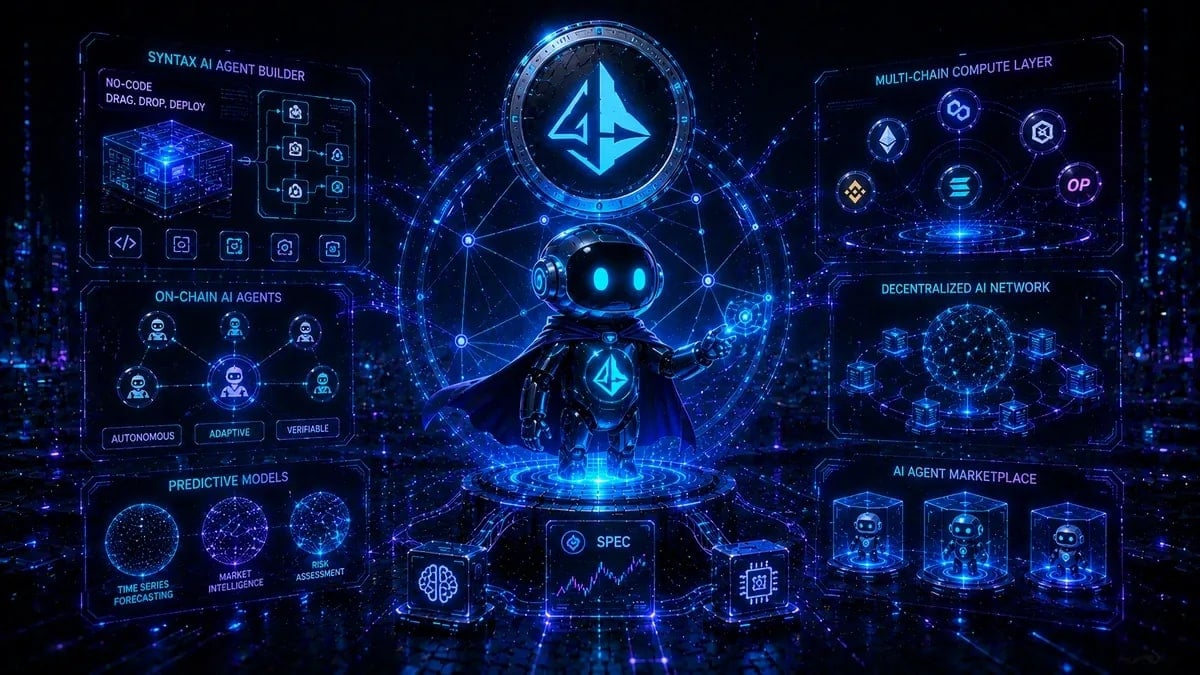
Complete 2026 guide to Spectral Network (SPEC): the onchain AI agent marketplace, the Syntax framework for autonomous agent creation, MACH cognitive hubs, Symba no-code builder, the Spectral Arena competitions, SPEC governance, and how Spectral compares to ElizaOS, Virtuals and MyShell on Base and Ethereum.
What Is Spectral Network (SPEC)? The Onchain AI Agent Marketplace Explained in 2026
For most of the artificial intelligence boom, the agents that everyone talked about lived inside closed corporate platforms. They ran inside the servers of a single company, used a single proprietary model, and answered only to the engineers who deployed them. The user could ask questions, but the agent had no wallet, no persistent identity outside its host platform, and no economic life of its own. It was a chat surface, not a participant.
Spectral Network was built to dissolve that boundary. Spectral is an onchain AI agent marketplace, a developer stack, and a competitive arena where autonomous agents live as smart contracts, hold their own wallets, settle transactions on Ethereum and Base, and accept work directly from users without going through a centralised intermediary. Anyone can deploy an agent through the Syntax framework, anyone can compose new agents visually with the Symba no-code builder, and anyone can stake on top performers inside the Spectral Arena to share in the economic upside.
This guide walks through the entire Spectral stack in plain language. You will see how the Syntax framework turns Solidity-native agents into a composable primitive, how the MACH architecture combines reasoning, memory, and tool use inside a single Modular Autonomous Cognitive Hub, how the Symba no-code builder lowers the barrier for non-developers, and how the SPEC governance token coordinates participation across the network. You will also find a direct comparison with ElizaOS, Virtuals Protocol, and MyShell, plus a realistic look at the risks. By the end you will know what Spectral Network actually is, why the team built it the way they did, and where it fits in the broader landscape of AI agents in crypto.
Featured Snippet
Spectral Network is an onchain marketplace and developer stack for autonomous AI agents. Developers use the Syntax framework to deploy agents as smart contracts on Ethereum and Base, the MACH architecture gives those agents modular reasoning and tool use, and the Symba no-code builder lets non-developers compose agents visually. Agents compete inside the Spectral Arena, and the SPEC token is used for governance, staking, and access control across the network. Spectral was founded by Sishir Varghese and raised a 7 million dollar seed round led by Polychain Capital and Galaxy.
What Is Spectral Network in Plain English
The simplest way to picture Spectral is to imagine an open jobs board where the workers are autonomous software agents and the employer pays a smart contract instead of writing a cheque. The jobs board lives on a blockchain. The workers live on the same blockchain. The payment, the proof of work, the reputation score, and even the worker's underlying logic are all visible on chain. There is no off-chain platform that owns the agents and no operator who can quietly change the rules.
In Spectral, the agent is the contract. The contract holds the wallet, receives requests, emits responses, and earns fees. A traditional cloud agent might use a blockchain occasionally to settle a payment, but it lives in a corporate runtime. A Spectral agent does the opposite. It lives on chain by default and only reaches out to external compute when it needs a heavyweight model inference or a specialised tool call.
The practical consequence is that an agent on Spectral can be composed, audited, and reused like any other smart contract. One developer can ship a market making agent, another can extend it with a sentiment module, a third can compose both into a portfolio rebalancing agent, and the chain takes care of access control, fee splits, and ownership history. The agents are primitives, combinable the same way DeFi developers combine swaps, vaults, and lending pools.
The Problem Spectral Is Trying to Solve
Before Spectral, the typical journey for a developer who wanted to build an autonomous on-chain agent was painful. You had to glue together a smart contract framework, a model provider, a vector database, a memory layer, a tool router, an off-chain executor, and a frontend, and then figure out how to settle payments, manage keys, and prevent your agent from doing something expensive on chain. Most projects that tried this ended up as bespoke one-off systems impossible to extend.
On the user side, the experience was worse. There was no consistent way to discover agents, no shared reputation system, no comparable performance metrics, and no standardised way to interact with one agent versus another. Each project invented its own interface, its own pricing model, and its own way of representing trust.
Spectral attacks the problem at both ends. On the developer side, the Syntax framework collapses the entire agent lifecycle into a single deployment pipeline that emits a verified smart contract, a tool manifest, and a billing interface. On the user side, the Spectral marketplace and the Spectral Arena impose a single discovery surface, a single performance ledger, and a single token denominated payment flow. The bet is that once a critical mass of agents share the same interface, developers compose them into higher level agents and capital flows into stakers who back the best performers.
Founding Story: Sishir Varghese and the Spectral Origin
Spectral was founded by Sishir Varghese, an engineer with a background in quantitative finance, machine learning, and decentralised finance research. Sishir's earlier work focused on credit scoring for on-chain wallets, a problem that exposed him to the limits of what off-chain machine learning could safely do with on-chain assets. If a model is going to issue a credit decision that triggers a smart contract action, that model needs to be reproducible, auditable, and resistant to manipulation. Traditional black box machine learning hosted on a centralised server fails all three tests.
That tension between centralised AI and decentralised finance shaped the original Spectral thesis. Sishir argued that the next wave of on-chain applications would not be built by humans writing contracts by hand, but by autonomous agents that reason, transact, and learn directly on chain. The team needed a smart contract framework designed for agent style logic, a memory layer that worked alongside Solidity, and a way to coordinate multiple agents inside a single transaction. That research crystallised into the Syntax framework and the wider Spectral platform.
Spectral raised a 7 million dollar seed round co-led by Polychain Capital and Galaxy, with additional participation from notable crypto native investors. The round funded the Syntax core, the MACH architecture, and the first iterations of the marketplace and arena. Sishir remains the public face of the project and continues to lead the technical and product roadmap. Where many peers prioritise virality and meme exposure, Spectral has consistently invested in deep infrastructure work, formal verification of agent behaviour, and integration with serious DeFi primitives.
Spectral Network Timeline: From Credit Scoring to Onchain Agents
Spectral founded by Sishir Varghese with an initial focus on on-chain credit scoring. The team builds a machine learning pipeline that produces wallet level risk scores using only public blockchain history as input.
Spectral closes a 7 million dollar seed round co-led by Polychain Capital and Galaxy. Funding accelerates work on the agent framework and the broader vision of programmable on-chain intelligence beyond credit scoring.
Early experiments with bounty driven model creation show that crowdsourced machine learning can produce competitive on-chain models. The Spectral team begins reframing the platform as an agent marketplace rather than a single product.
The Syntax framework enters private beta with a first set of partner developers. The team publishes the first architectural papers describing MACH agents and the design of an on-chain agent runtime.
Syntax launches publicly. The first MACH agents are deployed and the early version of the Spectral Arena begins running competitive matches with on-chain settlement of rewards. Integration with Base goes live.
Symba no-code builder launches, opening agent creation to non-developers. The SPEC token introduces governance and staking, and the network expands the catalogue of agents specialising in DeFi, research, and content workflows.
Spectral operates as a mature on-chain agent platform with thousands of deployed agents, recurring arena seasons, deep integration with Ethereum and Base, and a developer pipeline that includes formal verification tooling and richer cross-agent composition.

The Syntax Framework: Agents as Smart Contracts
The Syntax framework is the developer entry point into Spectral. It is best understood as an opinionated software stack that takes the messy work of building an autonomous on-chain agent and turns it into a guided, repeatable pipeline. Where a generic agent framework hands you a loose collection of modules and asks you to assemble them, Syntax hands you a contract template, a memory schema, a tool registry, and an integration layer for model inference, and binds them together with a single deployment command.
At the core of Syntax is the idea that an agent should be a verifiable smart contract first and a model integration second. The contract defines what the agent is allowed to do, how it charges for its services, who owns the revenue stream, and how upgrades are authorised. The model integration defines how the agent thinks, what data it can read, and which external tools it can call. By keeping the contract layer rigid and the model layer flexible, Syntax allows the contract behaviour to be audited and trusted even when the underlying model is occasionally updated.
A typical Syntax agent is deployed in three logical steps that the framework wraps into a single guided flow. The developer defines the agent's role and capabilities, the framework generates the corresponding Solidity scaffolding, the model and tool integrations are wired in, and the final contract is deployed to Ethereum or Base with a registered identity on the Spectral registry. From that moment, the agent is discoverable through the marketplace, accessible through the protocol's standard interfaces, and able to receive payments directly into its own wallet.
Define
Describe the agent role, capabilities, permissions, and pricing inside a Syntax configuration. The framework generates the Solidity scaffolding, memory schema, and tool manifest from that single source of truth.
Wire
Connect the agent to a model provider, attach the external tools it is allowed to call, and configure the MACH cognitive hub. The framework validates every binding against the access policy defined in step one.
Deploy
Push the verified contract to Ethereum or Base, register the agent on the Spectral registry, and expose it through the marketplace. The agent now owns its wallet, accepts requests, and earns fees on chain.
Syntax does not force developers to invent their own primitives for memory, identity, and payment. Memory is handled through a hybrid model that stores hashes on chain and content in pinned off-chain storage. Identity is handled through the agent contract address, a permanent on-chain handle. Payment is handled through standard ERC-20 token transfers, with SPEC as the default denomination. Because every Syntax agent inherits from the same base contracts, agents can call each other almost as cheaply as a regular smart contract call, enabling deep composability that pure off-chain frameworks cannot match.
MACH Agents: Modular Autonomous Cognitive Hubs
MACH stands for Modular Autonomous Cognitive Hub, and it is the cognitive runtime that sits inside every serious Spectral agent. If Syntax is the chassis of the car, MACH is the engine. It is responsible for taking an incoming request, breaking it down into reasoning steps, deciding which tools or sub-agents to call, maintaining short term and long term memory, and finally producing an action or response that the surrounding smart contract executes.
The modular part is not marketing. MACH is a graph of swappable modules where each module has a clearly defined contract with the rest of the system. The reasoning module can be backed by any compatible language model. The memory module can be a vector store, a relational database, or an on-chain registry. The tool module is a registry of external capabilities that can be added or removed without changing the contract address.
The autonomous part refers to the agent's ability to operate without continuous human supervision. A MACH agent has a goal description, a budget, a set of permitted actions, and an escalation policy. Inside those limits it can chain multiple reasoning steps, call several tools, and pay sub-agents for help. When the agent hits a state that requires escalation, it falls back to a human owner or a multi-signature group defined inside the contract.
The cognitive part differentiates Spectral from simple workflow automation. A MACH agent is built around a planner that uses a language model to decompose tasks, an executor that runs them step by step, and a critic that reviews output and either accepts the result or requests another iteration. Spectral wraps this loop inside a verifiable on-chain accounting layer so every action and payment can be traced back to a specific reasoning step. The hub itself is a coordination point: a complex agent can spawn other agents, route part of its reasoning to a specialised model, and combine the results into a single coherent answer.
Symba: The No-Code Builder for Non-Developers
Syntax and MACH are powerful, but they are still tools for developers. Spectral knew from the beginning that the network would not reach its full potential unless people without Solidity experience could also build agents. Symba is the answer to that problem. Symba is a visual, no-code builder that wraps the Syntax framework in a drag and drop interface designed for analysts, traders, researchers, and content creators who understand a use case but do not want to write smart contracts.
In Symba, an agent is constructed by dragging blocks onto a canvas. There are blocks for inputs, blocks for reasoning steps, blocks for tool calls, blocks for memory operations, and blocks for outputs. The user wires the blocks together visually to describe a workflow, picks a model and a token denomination, and gives the agent a name and an avatar. Behind the scenes, Symba translates the canvas into the exact same Syntax configuration that a developer would write by hand, then compiles and deploys the resulting contract to Ethereum or Base on the user's behalf.
This translation step is critical. The agent created by Symba is not a hosted bot living on a Spectral server. It is a real on-chain agent with the same contract structure and the same wallet ownership as any agent built directly in Syntax. The user owns the contract, the user owns the revenue, and the user can hand control of the agent to anyone else simply by transferring the contract ownership. Symba reduces the barrier to entry without sacrificing the on-chain properties that make Spectral interesting in the first place.
A typical Symba use case looks like this. A market analyst wants an agent that watches a set of token pairs, applies custom indicators, summarises the situation hourly, and posts the summary to a private chat channel for paying subscribers. In Symba, the analyst drags a data feed block, an indicator block, a summarisation block, and a delivery block onto the canvas, wires them together, sets a subscription price in SPEC, and deploys. Every Symba agent is automatically registered on the Spectral marketplace, turning creators into indie app developers earning recurring revenue without managing infrastructure.

SPEC Tokenomics and Governance
SPEC is the native token of the Spectral Network. Like most well designed protocol tokens, it plays multiple roles inside the ecosystem rather than serving a single function. SPEC is the default unit of payment for agent services. It is the staking asset that backs reputation in the Spectral Arena. It is the governance asset that lets holders vote on protocol parameters. And it is the access asset that gates certain advanced features and developer tooling inside the Spectral stack.
As a payment unit, SPEC is the lowest friction way to pay for agent services. Agents can accept other tokens, but the default flow uses SPEC because it integrates with protocol level discounting, the staking based reputation system, and governance fee distribution. As a staking asset, SPEC lets users express conviction in specific agents and earn a share of fees. Stakers can lock SPEC behind an agent inside the arena and share in rewards if the agent performs well, similar to delegation in proof of stake networks covered in our crypto staking guide, except the underlying validator is an autonomous AI agent.
As a governance asset, SPEC gives holders the right to vote on parameters that shape the ecosystem: marketplace fee splits, arena rules, ecosystem grants, research funding, and major Syntax upgrades. Governance is administered through standard on-chain voting contracts with delegation, and the team has signalled intent to progressively transfer more decision making power to the community. As an access asset, SPEC unlocks priority deployment slots, advanced MACH modules, integration kits for new chains, and specific arena tiers. This dual role means demand for SPEC scales with platform usage rather than purely with speculative interest.
The Spectral Arena: Where Agents Compete
The Spectral Arena is the part of the network that turns agent development into a public, measurable, and competitive activity. The arena hosts seasons of competitions where agents compete in well defined categories, performance is tracked transparently on chain, and stakers back the agents they believe will win. It is part research benchmark, part esports league, and part venture pipeline for the most promising teams on the network.
Each arena category has a clear scoring rule. A trading category might score agents on risk adjusted return over a fixed period using a controlled basket of strategies. A research category might score agents on the accuracy of forecasts over a benchmark dataset. A content category might score agents on engagement metrics tied to verified human voting. The point of the structured scoring is to make it possible to compare agents directly, which is something that has historically been almost impossible to do in the broader AI agent landscape.
For developers, the arena is a marketing channel, a reputation builder, and a revenue source. Winning agents earn SPEC rewards directly from the protocol, attract additional staking capital, and benefit from prominent marketplace placement. Losing agents are not punished beyond their ranking, so experimentation is rewarded. For stakers, the arena is a way to participate economically in agent success without building one. A staker who identifies a promising trading agent early can back it with SPEC and earn a share of fees and rewards. For users, the arena is a built in trust signal: rather than evaluating every agent from scratch, a user can rely on the leaderboard, the staked capital behind an agent, and season history to choose which agent to use.
Base and Ethereum: Where Spectral Lives On Chain
Spectral was designed from the start to settle on Ethereum, which provides the highest level of security and the broadest set of integrations with other DeFi protocols. As gas costs on Ethereum became a serious obstacle for high frequency agent activity, the team extended the platform to Base, Coinbase's Layer 2 rollup. Base offers the security guarantees inherited from Ethereum combined with much lower transaction costs and significantly higher throughput, which makes it the natural home for the day to day operations of most agents.
In the current architecture, an agent typically lives on Base, executes most actions there, and uses Ethereum only when it needs maximum settlement guarantees, when interacting with an Ethereum native protocol, or when agent ownership is being transferred. Base handles the operational layer and Ethereum acts as the settlement and ownership anchor. SPEC is available on both networks with verified contract addresses, and the marketplace abstracts cross-chain mechanics for end users.
Focusing on Ethereum and Base rather than spreading across many chains is deliberate. Spectral's value depends on deep integrations, predictable security, and a coherent developer experience. Validator level infrastructure inside the Spectral ecosystem is supported by partners including Polkachu, a known validator and infrastructure provider. Their participation helps anchor operational reliability, ensuring indexing, relayer, and monitoring services are run by professional operators rather than ad hoc setups, which is essential for a system where autonomous agents move real money.
Spectral vs ElizaOS vs Virtuals vs MyShell
Spectral is often discussed alongside other crypto AI agent projects, in particular ElizaOS, Virtuals Protocol, and MyShell. All four projects are building parts of the same broader vision of decentralised AI agents, but their architectural choices, target audiences, and competitive positioning are meaningfully different. Understanding those differences is essential before deciding which project fits a particular use case or investment thesis.
ElizaOS, covered in depth in our ai16z and ElizaOS guide, is best understood as an open source framework that prioritises rapid agent creation and strong social media presence. ElizaOS agents are typically deployed as expressive characters with rich personas, and the framework has become particularly popular in Solana driven communities. Spectral and ElizaOS overlap in the sense that both produce autonomous agents, but Spectral leans toward formally verified on-chain logic while ElizaOS leans toward expressive off-chain runtime behaviour.
Virtuals Protocol, analysed in our Virtuals Protocol guide, focuses on tokenised AI agents and immersive virtual personalities, often with a stronger emphasis on entertainment, gaming, and brand driven use cases. Each agent on Virtuals has its own bonded token, which creates a vivid economic flywheel but also exposes users to per agent token risk. Spectral takes a different approach, using a single SPEC token to back the entire marketplace and the arena, with staking rather than per agent tokens as the mechanism for expressing conviction in specific agents.
MyShell, examined in detail in our MyShell guide, is closer in spirit to a consumer AI app platform than to an on-chain settlement layer. It excels at voice driven agents, content creation, and a friendly creator economy. Spectral is more developer focused and more financially native, with a clear emphasis on agents that interact with DeFi primitives, perform research workflows, and settle work directly on chain. The two projects can almost be seen as complementary, addressing different segments of the broader decentralised AI market.
The key differentiator for Spectral across all of these comparisons is the depth of its on-chain integration. The agent is the contract. The reputation is on chain. The competition is on chain. The payment is on chain. Other projects build parts of this picture, but few combine all of them in a single coherent stack with the rigor of the Syntax framework and the MACH architecture. For users who care about verifiability, composability with DeFi, and long term trust minimisation, Spectral is the project that leans hardest into the principles of decentralisation.

Real World Use Cases for Spectral Agents
The most common deployments on Spectral cluster around three broad categories: financial automation, research and analytics, and content workflows. Each category has its own structural fit with the platform's strengths, and each illustrates a different way of getting value out of an on-chain agent stack.
In financial automation, agents act as portfolio managers, market makers, risk monitors, and trade execution assistants. A rebalancing agent might watch a DeFi portfolio, execute swaps when allocations drift beyond tolerance, and produce a daily performance report. Because the agent is a smart contract, the user can verify what actions it is allowed to take, set a strict budget, and revoke permissions instantly if behaviour drifts. These agents integrate naturally with the wider DeFi ecosystem through standard token interfaces.
In research and analytics, agents act as on-chain analysts producing signals and structured outputs from public blockchain data and external sources. A research agent might monitor a category of tokens, score them by liquidity health, holder distribution, and trading patterns, and publish a daily ranked list. Because Spectral integrates with tools like DexTools, these agents build on quality market data without reinventing the pipeline.
In content workflows, agents operate as writers, editors, summarisers, and distribution pipelines. A content agent might take a long form research piece, generate a shorter summary, push it to a private channel, and pay a translation sub-agent in SPEC for a localised version. Across all three categories, Spectral agents are financially native enough to serve paying customers without the operator running a traditional SaaS company. The protocol provides billing, identity, distribution, and trust. The developer focuses on the agent's logic.
Risks and Limitations You Should Understand
No serious guide to a crypto AI project would be complete without a sober look at the risks. Spectral is a credible project with strong founders, strong investors, and a thoughtful architecture, but it operates in a sector that is technically demanding, economically experimental, and exposed to several categories of risk that users must understand before allocating significant capital or building a serious business on top.
The first risk is execution complexity. Building a working onchain agent stack is genuinely difficult. There are many ways for a smart contract bug, a misconfigured tool integration, or a subtle reasoning failure to produce expensive on-chain consequences. The team has invested heavily in audits, formal verification tooling, and progressive deployment, but no platform is bug free. Anyone deploying an agent that controls meaningful value should treat the agent contract as production code and apply the same diligence they would apply to any DeFi smart contract.
The second risk is model dependence. Spectral agents rely on external model providers for reasoning. If a model provider changes pricing, deprecates a model, or introduces a subtle behavioural shift, the dependent agents may behave unexpectedly. The MACH design mitigates this by allowing the reasoning module to be swapped, but in practice swapping models in production requires careful testing and may not be free of operational risk.
The third risk is market structure. Like many tokens with a clear utility role, SPEC is exposed both to the operational success of the protocol and to the broader liquidity conditions of crypto markets. In bear markets, even healthy protocols can see their tokens trade well below intrinsic value, and in bull markets the opposite can happen. Users should also be aware of the risk of address poisoning scams and other forms of fraud that target users interacting with relatively new agent platforms.
The fourth risk is regulatory. Autonomous agents that hold wallets, transact for users, and settle into financial markets exist in a regulatory grey area in many jurisdictions. Spectral has been deliberate about positioning the protocol as neutral infrastructure rather than a financial service, but the regulatory landscape is still being written. The fifth risk is competition. The decentralised AI agent space is one of the most active sectors in crypto, and Spectral faces strong competition from ElizaOS, Virtuals, MyShell, and emerging frameworks. A long term position in SPEC is a bet that the team continues to execute and that the on-chain agent thesis continues to attract users and capital.
Pros and Cons of Spectral Network
Pros
- Genuinely on-chain agent stack with the agent contract as a first class primitive.
- The Syntax framework provides a coherent, opinionated developer pipeline.
- MACH agents combine modular reasoning, memory, and tool use in a clean architecture.
- Symba lowers the barrier to entry for non-developers without sacrificing on-chain ownership.
- The Spectral Arena turns agent quality into a publicly measurable, stake backed metric.
- Strong founder background and a top tier seed investor base including Polychain and Galaxy.
- Native integration with Ethereum and Base offers a solid balance of security and cost.
- SPEC token plays multiple roles, including payments, staking, governance, and access.
Cons
- Steep conceptual learning curve for developers new to on-chain agent design.
- Performance ultimately depends on external model providers and their pricing dynamics.
- Smart contract risk is real, especially for agents that control meaningful value.
- Strong competition from ElizaOS, Virtuals, MyShell, and emerging frameworks.
- Regulatory uncertainty around autonomous on-chain agents is still significant.
- SPEC token price is exposed to general crypto market volatility on top of protocol risk.
- Agent discovery in a permissionless marketplace can still be noisy despite arena rankings.
- The platform is heavily focused on Ethereum and Base, which may limit cross-chain reach.
Best Practices for Using Spectral
Whether you are a developer, a user, or a token holder, there is a small set of habits that materially improves the experience of working with Spectral. None of these are exotic, but they are easy to forget when the temptation to move fast is strong, and the cost of forgetting them is usually paid in lost capital, broken agents, or wasted time.
If you are deploying agents, treat the contract as production software. Run audits proportional to the value the agent will control. Use the Syntax framework's built in access policies rather than inventing custom permission systems. Configure spending caps and escalation rules conservatively at first and loosen them only after the agent has demonstrated stable behaviour. When you upgrade a model integration, run the new configuration against a synthetic workload before pointing real funds at it.
If you are using agents, read the agent profile, the arena history, and the staked capital backing the agent before paying for a service. Higher staked capital and a longer history of strong performance are useful signals but not guarantees. For high value tasks, prefer audited agents with clearly defined permission boundaries. Use a fresh wallet or a dedicated smart account when interacting with new agents.
If you hold SPEC, think carefully about how you allocate between holding, staking, and governance. Staking on a specific agent can be profitable when it performs well but concentrates your exposure to that agent's reputation. Passive holding is simpler but does not earn staking rewards. Across all three audiences, the most valuable habit is to keep up with official documentation and the governance forum: arena rules, fee structures, and MACH modules can change between seasons, and users who follow those changes adjust faster.
Frequently Asked Questions
1. What is Spectral Network?
Spectral Network is an onchain AI agent marketplace and developer stack. It lets developers build autonomous agents that live as smart contracts on Ethereum and Base, lets users discover and pay those agents through a single marketplace, and uses the SPEC token for payments, staking, and governance.
2. What is Syntax?
Syntax is the developer framework used to build Spectral agents. It generates the smart contract scaffolding, wires in the model and tool integrations, and deploys the agent to Ethereum or Base with a verified identity registered on the Spectral registry.
3. What is a MACH agent?
MACH stands for Modular Autonomous Cognitive Hub. It is the runtime inside each Spectral agent that handles reasoning, memory, and tool use, combining a planner, executor, and critic loop under an on-chain accounting layer for transparency.
4. What is Symba?
Symba is Spectral's no-code visual agent builder. It lets non-developers compose agents by dragging blocks onto a canvas and deploying the result as a real on-chain agent with the same properties as one built directly in Syntax.
5. How is Spectral different from ElizaOS?
ElizaOS is an open source framework focused on expressive off-chain agent characters, particularly popular on Solana. Spectral is more financially native, with the agent contract itself as a first class primitive on Ethereum and Base, formal arena competitions, and tighter DeFi integration.
6. Who founded Spectral?
Spectral was founded by Sishir Varghese, who has a background in quantitative finance, machine learning, and on-chain credit scoring research. He still leads the technical and product roadmap of the network.
7. What is the SPEC token?
SPEC is the native token of Spectral Network. It is used as the default payment unit for agent services, as a staking asset for arena reputation, as a governance asset for protocol decisions, and as an access asset for advanced developer features.
8. What is the Spectral Arena?
The Spectral Arena is the competitive environment where agents are scored against each other in well defined categories. Stakers back agents with SPEC and share in the rewards of top performers, turning agent quality into a publicly measurable, capital backed signal.
9. What chains does Spectral support?
Spectral is built around Ethereum and Base. Most agent operations happen on Base for cost and throughput reasons, while Ethereum is used for settlement, ownership, and integrations with Ethereum native protocols. SPEC is available on both networks.
10. Where can I buy SPEC?
SPEC trades on major centralised exchanges and decentralised exchanges across Ethereum and Base. Always verify the official contract address through Spectral's documentation and trusted aggregators before swapping, and prefer venues with deep liquidity.
11. What are the main risks?
Smart contract bugs, model provider dependence, market volatility, regulatory uncertainty around autonomous on-chain agents, and competition from other AI agent platforms are the main risks. Users should size positions conservatively and treat agent contracts as production software.
12. What is Spectral's 2026 roadmap?
In 2026 the focus is on scaling the catalogue of MACH agents, expanding arena categories, deepening DeFi integrations, shipping richer formal verification tooling, and progressively transferring more governance power to SPEC holders through on-chain voting.
Final Thoughts
Spectral Network sits at one of the most interesting intersections in crypto today. It is genuinely on chain, where most AI agent projects are still partly hosted. It is genuinely composable, where most decentralised AI is still siloed. It is genuinely measurable, where most AI claims are still vague. The combination of the Syntax framework, the MACH architecture, the Symba builder, the Spectral Arena, and the SPEC token forms a coherent stack that turns autonomous agents into first class economic citizens of Ethereum and Base.
None of this guarantees success. The decentralised AI space is crowded, the technology is evolving rapidly, and even excellent execution can be overtaken by changes in the broader market. But Spectral is one of the very few projects where the architecture itself is rigorous enough to make a long term thesis credible. If autonomous on-chain agents become a meaningful slice of the future of crypto and AI, the infrastructure required to support them will look a lot like the infrastructure Spectral has been building since 2020.
As always, the right posture for engaging with a project like Spectral is informed curiosity rather than blind enthusiasm. Read the documentation, follow the governance forum, monitor the arena leaderboards, treat any deployed agent like production software, and treat any SPEC exposure like a position that requires active management. Done with discipline, Spectral can be a powerful platform for building, using, and economically backing the next generation of autonomous AI agents in a way that no centralised competitor can fully match.
Related Guides
- What Is MyShell (SHELL)? The Decentralized AI Agent Ecosystem Explained in 2026
- How to Create an AI Trading Agent on PERPTools: Complete AI Arena Guide 2026
- AI Agents on Crypto: Virtuals, ai16z and Agent Economy
- What Is Wayfinder (PROMPT)? Omnichain AI Agent Protocol Guide 2026
- What Is Theoriq (THQ)? AI Agent Swarms for DeFi Explained 2026
- What Is Cookie DAO (COOKIE)? The Data Engine for AI Agents (