AI Agents on Crypto: Virtuals, ai16z and Agent Economy
— By AliceOnChain in Tutorials

An advanced technical exploration of the decentralized AI agent economy. Learn how platform architectures like Virtuals Protocol and framework engines like ai16z enable autonomous on-chain entities, and discover how to deploy DEXTools analytics to evaluate agent tokenomics, pool structures, and liquidity configurations.
AI Agents on Crypto: Virtuals, ai16z and the Agent Economy
The convergence of artificial intelligence and decentralized networks has advanced beyond basic computations and oracle routing. The market is transitioning toward a specialized paradigm where autonomous programmatic software constructs serve as active, capital-allocating market participants. These entities, known as on-chain autonomous agents, execute financial transactions, manage venture funds, and generate digital content without human oversight. This shift marks the transition from static, human-centric decentralized applications to a dynamic, programmatic ecosystem.
For quantitative analysts, liquidity providers, and proprietary traders tracking AI Agents on Crypto, these autonomous pipelines introduce distinct economic variables. Unlike traditional utility or governance tokens, agent-centric tokens represent fractions of an autonomous entity's economic output or governance rights. Navigating this environment requires an understanding of agent frameworks like Virtuals Protocol and ai16z, as well as the quantitative tools provided by DEXTools to audit real-time on-chain liquidity distribution.
The Architectural Pillars of the On-Chain Agent Economy
To evaluate the trading lifecycle of agent-backed tokens, market participants must first understand the primary structural models driving development. The sector is bifurcated into monetization platforms and open-source infrastructure engines.
Virtuals Protocol: Launchpads and Co-Ownership Frameworks
Virtuals Protocol functions as a dedicated layer-1 alignment engine designed for the creation, tokenization, and multi-user copropiedad of interactive artificial intelligence agents. Primarily applied across digital entertainment, gaming, and virtual companionship, Virtuals implements a structured, systematic launchpad framework.
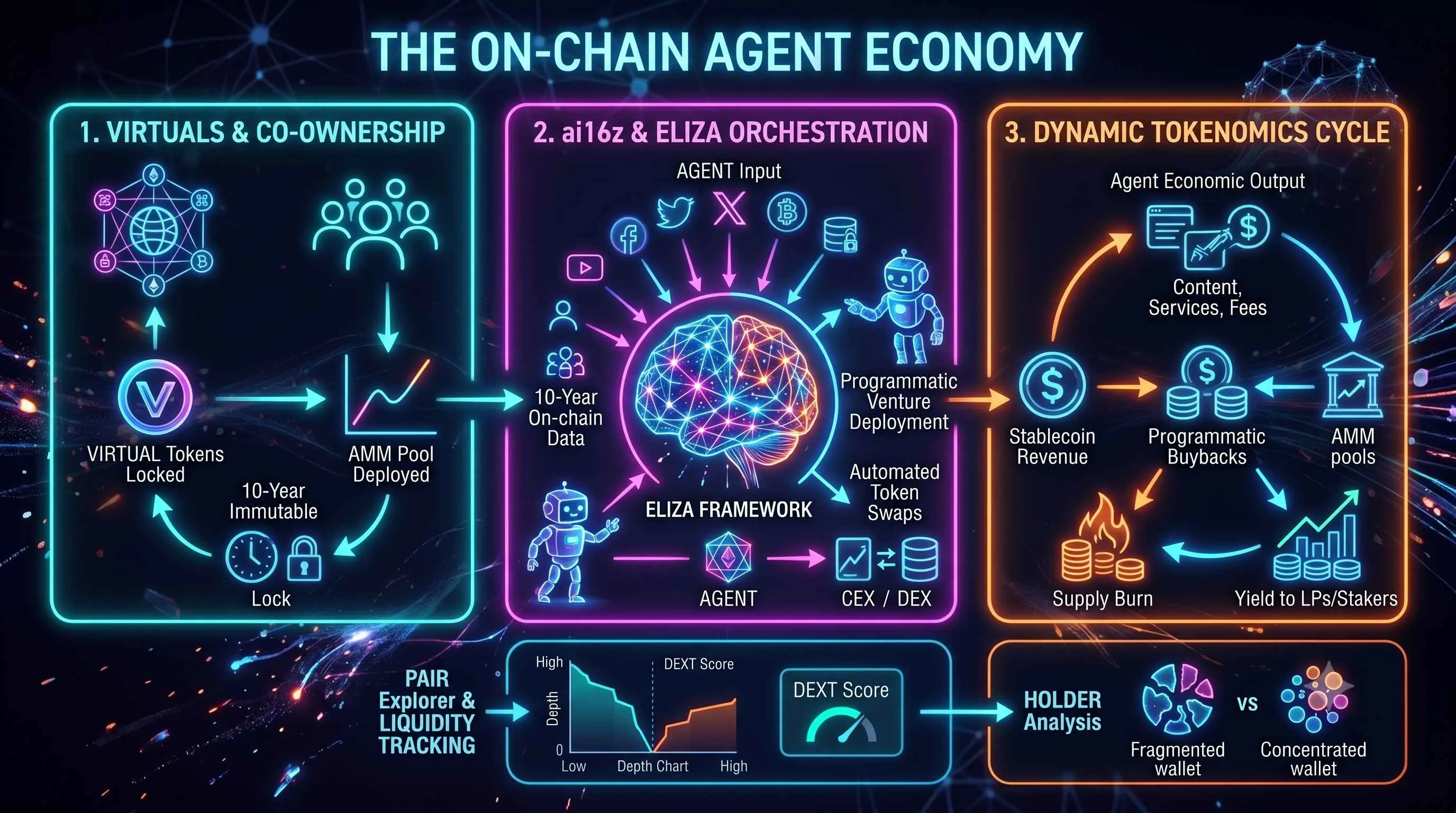
To launch a new agent, developers or community members allocate and lock native VIRTUAL tokens into a specialized smart contract configuration. This setup automatically deploys an internal liquidity pool paired directly with the newly issued agent token. To protect against malicious rugs or sudden protocol collapse, Virtuals implements an immutable ten-year liquidity lock on these foundational pairs. This long-term lock secures continuous token velocity and trade execution parameters across the ecosystem.
ai16z and the Eliza Orchestration Framework
While Virtuals focuses on consumer application layers, ai16z addresses programmatic venture capital deployment and open-source agent orchestration. Inspired by legacy venture structures, the platform operates as a decentralized autonomous organization (DAO) where capital allocation is directed by a fine-tuned agent mimicking prominent venture figures.
The core technology behind ai16z is Eliza, an open-source, modular multi-agent operating framework that quickly became a primary developer repository on GitHub. Eliza enables agents to:
Process multi-channel inputs across social media channels and on-chain decentralized networks.
Connect directly with cryptographic RPC nodes to execute token swaps on automated market makers (AMMs).
Adapt internal investment theses over time based on crowd-sourced community insights and on-chain metrics.
The Dynamic Microeconomics of Agent Token Architectures
Understanding the tokenomic structures of AI Agents on Crypto requires moving past traditional mining emissions models. Agents utilize interactive cycles where token value is linked to programmatic resource utilization and autonomous fee generation.
Under this tokenomic framework, an agent generates revenue by charging interaction fees, selling proprietary digital creations, or capturing trading spreads. This accrued capital, often collected in stablecoins or native gas tokens, is programmatically routed through decentralized exchange liquidity pools.
The smart contracts are engineered to execute automated market buybacks of the agent's own token. Once captured, these tokens are either burned to induce deflationary scarcity or distributed to staking nodes and liquidity providers. This architecture tightly links token performance to the actual utility and economic demand of the underlying AI model.
On-Chain Diagnostics: Evaluating Agents with DEXTools
Trading within the fast-moving AI agent narrative requires an advanced analytical routine. Because agent tokens can be launched rapidly via automated factory contracts, checking smart-contract security and liquidity configurations is mandatory to mitigate downside tail-risk. DEXTools delivers the precise tooling needed to parse these on-chain metrics in real time.
Assessing Pool Architecture via Pair Explorer
When reviewing newly initialized agent pairs on automated market makers like Raydium or Uniswap, the DEXTools Pair Explorer serves as the initial diagnostic layer.
Liquidity Pools Depth vs. Transaction Volume: Agent tokens frequently experience explosive volume spikes driven by algorithmic trading tools. If a pair exhibits high 24-hour volume but minimal liquidity depth, execution slippage increases significantly. Analysts look for steady, deep pools to absorb large market orders.
DEXT Score Verification: The system evaluates smart-contract attributes, code verification, and creator mint permissions to establish a reliability index. A low DEXT Score alerts market participants to unoptimized contract features, helping protect capital from malicious deployments.
Tracing Capital Flows and Wallet Concentration
Since many agent projects launch via fair-launch or bonding-curve structures, tracking supply concentration is essential. If early snipers or creator wallets control a disproportionate share of the circulating supply, the asset remains exposed to sudden liquidation risks.
Through the DEXTools Holder Analysis suite and integrated Bubblemaps, traders can audit address relationships. This feature maps interconnected wallets to determine if multiple ostensibly unique identities are controlled by a single insider entity. If the visual map displays large clusters moving funds in sync, it indicates high supply concentration. Conversely, a fragmented distribution pattern suggests steady, organic accumulation, reducing the risk of sudden, large-scale sell-offs.
Risk Management Regimes for Agent Markets
The high volatility of the AI agent narrative demands disciplined execution strategies to counteract emotional decision-making during major momentum expansions.
Identifying Relative Strength Divergences
On-chain price movements frequently signal weakness before it shows on standard candlesticks. By using DEXTools Charts, traders analyze the relationship between the Volume-Weighted Average Price (VWAP) and the Relative Strength Index (RSI).
If the spot price moves to a new local high while the underlying RSI creates a distinct lower high, an RSI divergence occurs. In many cases, this setup signals an exhaustion of immediate buying momentum, advising disciplined market participants to adjust stop-loss parameters or secure capital distributions rather than entering at local tops.
Setting Mechanical Execution Parameters via Price Alerts
The continuous nature of DeFi trading means that major support retests or rapid liquidation events frequently happen outside normal monitoring hours. Using the native Price Alerts feature within DEXTools allows for automated risk management.
Configuring tiered alerts around key structural zones-such as macro horizontal support levels or historic volume nodes-enables a programmatic profit-taking and capital preservation schedule. Securing gains at predetermined thresholds helps protect equity from sudden, ecosystem-wide market corrections.
Conclusion: The Strategic Analytical Horizon for Autonomous Crypto
Reviewing the expansion of AI Agents on Crypto reveals a structural transformation in on-chain interactions. Frameworks like Virtuals Protocol and engines like ai16z’s Eliza have established a foundation where autonomous software entities can act as independent economic actors.
However, fundamental alignment does not completely eliminate trading volatility. Successfully navigating these specialized token economies requires pairing long-term fundamental theses with strict on-chain validation. By utilizing DEXTools to continuously check pool depth, evaluate whale wallet graphs, identify structural technical indicators, and implement automated price execution thresholds, traders can efficiently separate short-term market noise from genuine, data-driven liquidity shifts.
- DEXTools Pair Explorer for Early Liquidity Signals
- Fee Revenue per Active Wallet vs Total Fees: Which Shows Real dApp Monetization?
- How to Read Liquidity Pool Data Before Buying a Token (2026)
- How to Check Liquidity Lock Before Buying a Token: Unlock Risk and Locker Verification (2026)
Disclaimer: This article is for informational purposes only and does not constitute investment advice, financial advice, trading advice, or any other kind of advice. DEXTools does not recommend buying, selling, or holding any cryptocurrency or token. Users should conduct their own research and consult with a qualified financial advisor before making any investment decisions. Cryptocurrency investments are volatile and high-risk. DEXTools is not responsible for any losses incurred.
Related Guides
- ai16z vs Virtuals vs ARC: Best AI Agent Platforms 2026
- What Is Virtuals Protocol? AI Agents on Base Guide 2026
- What Is ai16z (ElizaOS)? AI Agents Framework on Solana Guide 2026
- Solana AI Agents: How to Trade the New "Agentic Economy" (2026)
- What Is Spectral Network (SPEC)? The Onchain AI Agent Marketplace Explained in 2026