What Is Ethereum (ETH)? Beginner Guide 2026
— By Tony Rabbit in Tutorials
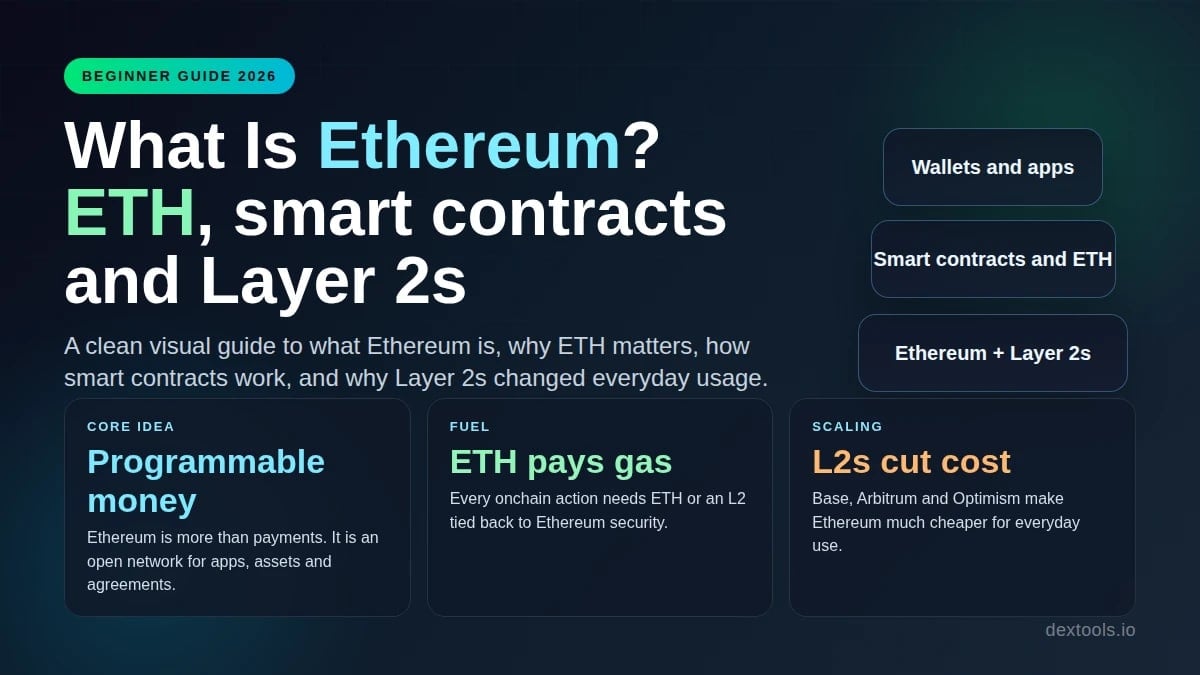
Ethereum explained for beginners: learn how ETH, smart contracts, gas, staking, Layer 2s, the Pectra upgrade, and ETH ETFs work in this 2026 guide.
What is Ethereum? Ethereum is a decentralized, open-source blockchain that runs smart contracts, hosts thousands of applications, and powers most of the stablecoin economy. It is the second-largest cryptocurrency by market capitalization after Bitcoin, but the comparison ends there. Where Bitcoin was designed as digital gold, Ethereum was designed as a global computer that anyone can program. In 2026, after the Pectra upgrade, the EigenLayer restaking boom, the launch of spot ETH ETFs, and the explosion of Layer 2 rollups, Ethereum is no longer just a chain. It is an entire economy.
This guide is written for absolute beginners, but it does not skip the parts that matter in 2026. We will explain what Ethereum is, what ETH the asset actually does, how smart contracts function, why gas fees exist, how the Merge changed the network forever, what Pectra added in 2025, why Layer 2s now process more transactions than mainnet, what ETH ETF flows mean for price, and whether ETH is legally a security. By the end, you will understand Ethereum better than most people who have been holding ETH for years.
Ethereum was proposed by Vitalik Buterin in late 2013 and launched publicly on July 30, 2015. Since then, it has processed billions of transactions, settled trillions of dollars in value, and become the settlement layer for everything from DeFi and NFTs to tokenized treasuries and on-chain identity. It is the most-used smart contract platform in the world, and it is the chain most institutions choose when they tokenize real-world assets.

What Is Ethereum in One Sentence?
Ethereum is a programmable blockchain that lets developers deploy applications and assets that run exactly as written, without any central operator able to censor, pause, or modify them. That single property, programmability without permission, is what separates Ethereum from Bitcoin and from every traditional financial database. Bitcoin runs one application: a peer-to-peer cash ledger. Ethereum runs millions of applications, all sharing the same global state.
The network does this by giving every developer access to the Ethereum Virtual Machine, or EVM. The EVM is a sandboxed computer that lives on every Ethereum node simultaneously. When you submit a transaction, every node runs that transaction through the EVM and updates its copy of the state. If even one node disagrees with the rest, the network rejects that node's view. This is how thousands of computers around the world stay synchronized without any central coordinator.
Ethereum is the world's most-used programmable blockchain. ETH is the asset that pays for using it, secures it through staking, and acts as collateral throughout DeFi. In 2026, most user activity happens on Ethereum Layer 2s like Base, Arbitrum, and Optimism, which settle back to Ethereum mainnet for security.
Ethereum vs Bitcoin: The Real Difference
Almost every beginner asks the same question first: what is the difference between Ethereum and Bitcoin? The short answer is that they were built for different purposes. Bitcoin was created in 2009 to be a censorship-resistant alternative to fiat money. Ethereum was created in 2015 to be a censorship-resistant alternative to centralized servers. They are both blockchains, but they solve different problems.
Bitcoin's design is intentionally minimal. It supports simple transactions, basic scripting, and not much more. This restraint is a feature, not a flaw. By keeping the protocol simple, Bitcoin maximizes security and predictability. Ethereum makes the opposite tradeoff. By supporting general-purpose computation, it unlocks an entire universe of applications, but at the cost of more complexity and more attack surface.
In 2026, both networks coexist comfortably. Bitcoin is the asset most institutions reach for when they want a digital store of value. Ethereum is the platform most institutions choose when they want to actually do something on-chain. Tokenize a treasury bill, run a stablecoin, build a perpetual exchange. That is Ethereum's job.
What Is ETH and What Does It Actually Do?
ETH, also called ether, is the native asset of the Ethereum network. It is not just a coin you buy and hold. It plays four distinct roles that make Ethereum function as a coordinated economic system. Understanding these roles is the difference between holding ETH as a speculative bet and understanding why institutions are accumulating it.
Every action on Ethereum and most Layer 2s ultimately requires ETH to pay gas. Even when you transact in USDC, ETH (or wrapped ETH) is what settles the fee.
ETH secures the network. Validators stake 32 ETH to propose blocks, earning rewards but risking slashing for misbehavior. Around 28% of all ETH is staked in 2026.
ETH and its liquid-staked derivatives (stETH, rETH, weETH) are the most-used collateral across DeFi lending, leveraged trading, and liquidity provision.
Through EigenLayer and similar protocols, staked ETH can be restaked to secure additional services (oracles, bridges, DA layers), creating new yield and new risk.
The ETH supply is dynamic, not fixed. Since the EIP-1559 upgrade in August 2021, a portion of every transaction fee is burned, permanently removing ETH from circulation. When network activity is high, more ETH is burned than is issued to validators, making ETH a net-deflationary asset. In quieter periods, issuance slightly exceeds burn. As of 2026, the average annualized supply change is hovering near zero, with periodic stretches of net deflation.
This burn mechanism is one of the strongest fundamental arguments for ETH. Unlike Bitcoin, which has fixed scarcity, Ethereum has activity-linked scarcity. The more the network is used, the more ETH disappears. This creates a feedback loop between ecosystem growth and ETH economics that has no equivalent in any other major cryptocurrency.
How Ethereum Works Under the Hood
To really understand Ethereum, you need to understand four layers: accounts, transactions, blocks, and state. Every action on Ethereum boils down to a transaction signed by an account, included in a block by a validator, that updates the global state. Sounds simple, but each of those layers has details that matter for security and cost.
Accounts
Ethereum has two kinds of accounts. Externally Owned Accounts (EOAs) are controlled by a private key and represent users. Contract accounts are controlled by code and represent smart contracts. Both have an address, a balance, and a nonce. Contract accounts also have storage and bytecode. Every interaction on Ethereum is initiated by an EOA but can cascade through dozens of contract accounts in a single transaction.
Transactions
A transaction is a signed message from an EOA that tells the network what to do. It includes the sender, recipient, value, data payload, gas limit, and gas price. The data payload is the part that triggers smart contract logic. When you "swap on Uniswap," your wallet builds a transaction whose data payload encodes a call to Uniswap's router contract. The network executes that call, updating balances along the way.
Blocks
Validators bundle transactions into blocks every 12 seconds. Since the Merge, blocks are not mined, they are proposed. A randomly selected validator gets the right to propose the next block, and a committee of other validators attests that the proposed block is valid. Blocks are finalized in epochs of 32 slots (roughly 6.4 minutes), after which the changes are economically irreversible.
State
The state is the snapshot of every account balance, every contract storage slot, and every nonce on Ethereum. The state is what makes Ethereum "stateful," unlike Bitcoin which is mostly stateless. Every block produces a new state root, which is a cryptographic hash committing to the entire state. This is what nodes compare to confirm they are in sync.
What Are Smart Contracts?
A smart contract is a piece of code deployed at an address on Ethereum that executes automatically when called. It cannot be edited after deployment (unless explicitly designed with an upgrade pattern), it cannot be censored, and it runs the same way for everyone. Smart contracts are why Ethereum can host applications. They are the building blocks that DeFi, NFTs, stablecoins, and DAOs are made of.
The most-used smart contracts in 2026 are token contracts. The ERC-20 standard defines how fungible tokens like USDC, USDT, LINK, and UNI behave. The ERC-721 standard defines NFTs. The ERC-1155 standard defines semi-fungible tokens used in gaming. These standards are why a single wallet like MetaMask can interact with thousands of different tokens without needing custom code for each.
Smart contracts are usually written in Solidity, a JavaScript-like language designed specifically for the EVM. Newer languages like Vyper (Python-flavored) and Huff (low-level) are also gaining traction. Once written, contracts are compiled into EVM bytecode and deployed by sending a transaction with no recipient. The network assigns the new contract an address, and from that moment, anyone in the world can call its functions.
Why Gas Fees Exist
Gas is the unit that measures computational effort on Ethereum. Every operation, every storage write, every signature check costs a fixed amount of gas. The gas price (in gwei, a billionth of an ETH) is set by the market based on demand. Your total fee is gas used multiplied by gas price. Gas exists for two reasons: to prevent infinite loops from clogging the network, and to compensate validators for their work.
Since EIP-1559, gas pricing has two components. The base fee is algorithmically set per block based on how full recent blocks were, and it is burned. The priority fee (or "tip") is paid to the validator and is set by the user to incentivize faster inclusion. When the network is busy, base fees rise quickly, which is what causes mainnet to feel expensive during bull markets, NFT mints, or token launches.
Gas fees on Ethereum mainnet are a feature, not a bug. They are the market price of using the most decentralized smart contract platform in the world. If you want cheap, you go to a Layer 2. If you want maximum security, you stay on mainnet. Both make sense for different use cases.
The Merge: How Ethereum Switched to Proof of Stake
On September 15, 2022, Ethereum completed the Merge. This was the moment when Ethereum's consensus mechanism switched from Proof of Work to Proof of Stake. It was one of the largest engineering events in crypto history, replacing the engine of a $200 billion network without any downtime. Energy consumption dropped by roughly 99.95%. Issuance dropped by roughly 90%. And ETH's economic profile changed from "digital commodity with high inflation" to "productive capital asset with sometimes-negative net issuance."
Under Proof of Stake, security comes from economic stake, not computational work. To run a validator, you deposit 32 ETH into the Beacon Chain deposit contract. You then run validator software that proposes and attests to blocks. If you behave honestly, you earn rewards (around 3-4% APR in 2026). If you misbehave, your stake gets slashed (partially or fully destroyed). This economic alignment is what keeps the network honest at scale.
Most users do not run their own validator. They use liquid staking protocols like Lido, Rocket Pool, or Coinbase, which pool ETH from many users into shared validators and issue a liquid token (stETH, rETH, cbETH) that represents the staked position. These tokens can be used as collateral elsewhere in DeFi, which is what created the liquid-staking-derivatives boom of 2023-2024.
Pectra: The 2025 Upgrade That Reshaped Ethereum
In May 2025, Ethereum activated the Pectra hard fork, the largest upgrade since the Merge. Pectra combines the Prague and Electra upgrades and ships some of the most user-visible changes Ethereum has ever made. If you are reading guides written before 2025, they are missing important parts of what Ethereum is today.
Regular EOAs can temporarily delegate to smart-contract code. This unlocks gas sponsorship, batched transactions, and session keys for any wallet, without migrating to a new account type.
Validator max effective balance raised from 32 ETH to 2048 ETH. Large stakers consolidate, smaller stakers compound rewards. Reduces validator count, shortens finality timeline.
Lays groundwork for data availability sampling, which scales blob throughput for Layer 2s by orders of magnitude. Bigger blob targets = cheaper L2 fees.
Target blobs per block raised from 3 to 6. Layer 2 data posting costs drop further, making rollup fees on Base, Arbitrum, and Optimism even cheaper.
The most visible impact for end users is EIP-7702. For the first time, your regular Ethereum wallet can act like a smart account temporarily. That means a dApp can sponsor gas for you, you can batch multiple actions into one signature, and you can authorize session keys that work like a "trusted device" for a specific app. Wallets like MetaMask, Rabby, and Trust have rolled out 7702 features through 2025 and 2026, and the user experience improvement is significant.
Layer 2 Rollups: Where Ethereum Activity Actually Lives Now
For years, the biggest complaint about Ethereum was the same: fees are too high. Mainnet was built for security first and throughput second. That tradeoff worked when there were 10,000 daily users. It broke when there were millions. The answer was not to abandon mainnet but to build execution layers on top of it. These are Layer 2 rollups.
A rollup processes transactions on a separate chain but posts compressed data and proofs back to Ethereum mainnet. Users get cheap, fast transactions. Mainnet gets compressed history it can verify. This is the model Ethereum chose in 2020 and committed to with the "rollup-centric roadmap." By 2026, the bet has paid off. More transactions happen on Ethereum L2s than on mainnet itself, and the gap is widening.
The two main rollup families are optimistic rollups and ZK rollups. Optimistic rollups assume transactions are valid by default and allow a challenge window (typically 7 days) for fraud proofs. ZK rollups use cryptographic validity proofs to prove every batch correct, allowing near-instant finality but at higher proving cost. In 2026, both flavors are competitive. ZK rollups are catching up on EVM compatibility, and optimistic rollups are getting faster withdrawals through liquidity-based bridge services.
For the average user, the difference between rollups feels smaller than the difference between mainnet and L2 in general. The single biggest practical question is: which chain has the app you want to use? Base dominates consumer apps and Coinbase-distributed activity. Arbitrum dominates DeFi liquidity. zkSync, Starknet, Linea, and Scroll are racing for general-purpose adoption.
EigenLayer and the Restaking Boom
One of the most important new primitives in the Ethereum ecosystem is restaking. EigenLayer introduced the concept in 2023 and went live on mainnet in 2024. The idea is simple: instead of having every new protocol bootstrap its own security from scratch, let stakers re-pledge their already-staked ETH (or liquid staking tokens) to secure additional services. These services are called Actively Validated Services, or AVSs.
Restaking unlocks an entirely new yield layer. A staker earns base staking rewards (~3-4%), plus restaking rewards from each AVS they secure (variable, often 1-5% combined). It also creates new risks: if you opt into an AVS with weak slashing conditions or buggy code, your restaked ETH can be partially slashed. By 2026, EigenLayer alone holds tens of billions of dollars in restaked ETH and competes with Symbiotic, Karak, and Ethereum-native restaking pathways enabled by EIP-7251.
For beginners, restaking is interesting in theory but not a starting point. Stick to plain staking first. Understand the risks before adding multiple slashing surfaces on top of one another.
ETH ETFs: The Institutional Era
On July 23, 2024, the US Securities and Exchange Commission approved spot Ethereum ETFs from BlackRock, Fidelity, Bitwise, 21Shares, Franklin, Invesco, Grayscale, and VanEck. This was the second great ETF moment for crypto, six months after spot Bitcoin ETFs launched in January 2024. The approval marked the formal entry of ETH into US-regulated wealth-management portfolios.
The flows since then have been uneven but ultimately positive. After modest early inflows, momentum picked up sharply in late 2025 as institutional allocators added ETH to balanced crypto sleeves. By 2026, the cumulative net inflow across all spot ETH ETFs is in the tens of billions of dollars, and BlackRock's ETHA and Fidelity's FETH have grown into multi-billion-dollar funds.
The ETH ETFs do not include staking yield (yet). That has been a recurring source of friction. As regulatory clarity around staking improves, expect to see staked-ETH ETFs or yield-bearing structures that pass validator rewards through to ETF holders. Several issuers, including 21Shares and Bitwise, have filed for this. When it launches, it will likely accelerate institutional accumulation further, because a yield-bearing version of ETH ETF starts to look like a productive bond-equivalent asset for treasuries.
Spot ETF flows are now one of the cleanest demand signals for ETH. Unlike exchange volume, which can be wash-traded, ETF flows represent real capital from regulated investors. Persistent net inflows mean institutional demand is absorbing supply. Persistent outflows mean institutions are reducing risk. Watching this flow on a weekly basis is one of the highest-signal data points in crypto in 2026.
Is ETH a Security? Let's Be Honest
This is the question most Ethereum guides avoid. Here is the honest answer: in the United States, ETH's status was ambiguous for years, but by 2026 it is effectively settled as a non-security commodity for purposes of spot trading. The CFTC has long treated ETH as a commodity. The SEC, after approving spot ETH ETFs (which would have been legally impossible if ETH were classified as an unregistered security), implicitly conceded the point in 2024.
That said, the picture is more nuanced for ETH-related products. Staking-as-a-service, where a company offers to stake your ETH for a fee and pay you yield, has been a focus of SEC enforcement. Kraken settled with the SEC over its US staking program in 2023. Coinbase has been in litigation over its staking product. By 2026, much of the staking-as-a-service uncertainty has been resolved in favor of clearer disclosure-based regimes, but pure liquid staking tokens still operate in a gray area in some jurisdictions.
For an individual user, holding and using ETH is not a regulated activity in any major jurisdiction. Selling ETH for fiat is a taxable event. Earning staking rewards is taxable income at the time of receipt. Yield-bearing DeFi products may have additional implications depending on your country. Always check local rules; the tax treatment of ETH staking varies significantly between the US, EU, UK, and other major regions.
What Is Ethereum Used For in 2026?
Ethereum in 2026 is not a single product. It is a substrate that powers many of the most important categories in crypto. Understanding the use cases is how you connect the abstract idea of "programmable blockchain" to real activity that real people are doing every day.
USDC, USDT, PYUSD, USDS and others issue primarily on Ethereum and its L2s. Stablecoin supply on Ethereum exceeds $150B in 2026.
Lending (Aave, Morpho), DEXs (Uniswap, Curve), perps (GMX, dYdX, Hyperliquid bridges), and yield aggregators all run on Ethereum or its L2s.
From profile-pic collections to in-game items, NFT activity continues. Base became the leading L2 for new consumer NFT launches in 2025.
BlackRock BUIDL, Ondo OUSG, Franklin BENJI, and Hashnote USYC put US Treasury bills on Ethereum, creating productive on-chain dollars.
ENS, Lens, Farcaster, and Sign Protocol turn Ethereum addresses into portable identities, profiles, and reputations.
Stablecoin transfers on Base, Arbitrum, and Optimism settle in seconds for cents. Real corporate flows are running here now.
Stablecoins deserve special attention because they are the use case that finally crossed from crypto-native into real-world money. By 2026, stablecoin transfer volume on Ethereum and its L2s rivals major card networks for monthly settlement value. Most of this volume is denominated in USDC and USDT, but PayPal's PYUSD and several bank-issued tokens have grown into the conversation as well. The stablecoin story is increasingly an Ethereum story.
How to Get Started With Ethereum: A Safe Path
If you are reading this because you want to actually use Ethereum, here is a path that minimizes the chance of an expensive beginner mistake. Most of the painful losses in crypto happen because someone rushed through these steps. Going slow is the highest expected-value move of your first month.
Risks and Limitations of Ethereum
No serious Ethereum guide should pretend the network is risk-free. Ethereum is the most-battle-tested smart contract platform in the world, but real losses happen every day, and most of them are preventable. Here are the categories you should be aware of.
Bugs in DeFi protocols have caused billion-dollar losses. Audits help but do not eliminate risk. Stick to long-lived, well-audited protocols when you start.
Fake apps, malicious approvals, and signature scams are the #1 cause of retail losses. Always verify URLs, use simulation tools, and revoke unused approvals.
Wrong network, wrong address, wrong slippage. Ethereum transactions are irreversible. Double-check everything before signing.
Third-party bridges between L2s have been hacked. Prefer native bridges and well-audited cross-chain messaging where possible.
ETH is volatile. Drawdowns of 50%+ have happened multiple times. Size your position assuming this can happen again.
ETH itself is settled, but staking products, DeFi protocols, and certain tokens still face shifting regulatory treatment in many jurisdictions.

The Future of Ethereum: 2026 and Beyond
The Ethereum roadmap is one of the longest-running technical roadmaps in crypto. After the Merge in 2022, Dencun in 2024 (which introduced blob storage for L2s via EIP-4844), and Pectra in 2025, the next major upgrade on the horizon is Fusaka. Fusaka is expected to ship PeerDAS in full form, raising blob throughput dramatically and pushing L2 fees down even further.
Beyond Fusaka, the longer-term ambitions include statelessness (so that running a node does not require storing the full Ethereum state), Verkle trees (which compress the state and make light clients more practical), single-slot finality (cutting finality from ~12 minutes to one slot), and continued progress on the Surge, Scourge, Verge, Purge, and Splurge phases that make up Vitalik's published roadmap.
The other major track is institutional adoption. Spot ETFs were the start. Tokenized treasuries are the present. Staked-ETH ETFs, tokenized money market funds, on-chain corporate treasuries, and stablecoin rails for cross-border B2B settlement are the near future. Ethereum is increasingly positioned as the neutral settlement layer that traditional finance is comfortable building on top of, exactly the role it set out to play a decade ago.
Pros and Cons of Ethereum
- Largest developer ecosystem in crypto
- Most-used smart contract platform
- Deepest DeFi and stablecoin liquidity
- Spot ETFs available in US since 2024
- ETH burns when network is active
- Native staking yield (3-4% APR)
- Strong Layer 2 ecosystem reduces costs
- Mainnet fees still spike during high demand
- L2 fragmentation adds UX complexity
- Smart contract risk in DeFi is real
- Beginners get drained by phishing
- High volatility (50%+ drawdowns)
- Staking products still face regulatory uncertainty
- Bridges remain a top hack target
Frequently Asked Questions
What is Ethereum in simple words?
Ethereum is a decentralized blockchain that runs programs called smart contracts. ETH is its native cryptocurrency, used to pay transaction fees, stake to secure the network, and act as collateral throughout DeFi. Unlike Bitcoin, which is mostly designed for payments and saving, Ethereum is a general-purpose platform that hosts thousands of applications.
What is the difference between Ethereum and ETH?
Ethereum is the network, the protocol, and the broader ecosystem of apps, validators, and users. ETH (or ether) is the native asset that lives on that network. You use ETH to pay gas fees, to stake, and to interact with DeFi. When someone says "I own Ethereum," they really mean they own ETH. The network itself is not something you can own.
Is Ethereum a good investment in 2026?
This is not investment advice, but the bull case in 2026 is strong: spot ETH ETFs are seeing sustained inflows, the Pectra upgrade improved UX, Layer 2s drove a wave of new users, and the burn mechanism keeps supply growth near zero. The bear case is also real: ETH has underperformed BTC over the last cycle, L2 fragmentation has been a UX drag, and competing L1s like Solana have captured significant mindshare. Size your position with both views in mind.
How much ETH do I need to stake?
To run your own validator, you need 32 ETH. After the Pectra upgrade in 2025, a single validator can hold up to 2048 ETH and compound rewards directly. If you have less than 32 ETH, you can use liquid staking protocols like Lido (any amount), Rocket Pool (mini-pools for less than 32 ETH), or a centralized provider like Coinbase or Kraken. These options have different trust assumptions, but all give you exposure to staking yield.
Why are Ethereum gas fees so high sometimes?
Mainnet block space is limited. When demand spikes (NFT mints, popular token launches, market volatility), the base fee algorithm raises prices to ration demand. This is a feature, not a bug, because it prevents the network from being overwhelmed. The solution in 2026 is to use a Layer 2 like Base, Arbitrum, or Optimism, where transactions cost a few cents instead of dollars, while still inheriting Ethereum's security through rollup proofs.
Is ETH a security?
For spot trading in the United States, ETH is effectively treated as a non-security commodity. The CFTC has consistently called it a commodity. The SEC approved spot ETH ETFs in July 2024, which implicitly required treating spot ETH as a non-security. Staking-as-a-service products and certain DeFi staking arrangements still face securities scrutiny in some cases, but holding, buying, and selling ETH is not a regulated securities activity in any major jurisdiction.
What are Ethereum Layer 2s and which should I use?
Layer 2s are separate blockchains that process transactions cheaply and post compressed data back to Ethereum for security. The major options in 2026 are Base (best for consumer apps and Coinbase users), Arbitrum (deepest DeFi liquidity), Optimism (Superchain ecosystem), zkSync, Starknet, Linea, and Scroll. For beginners, Base is often the easiest starting point because of Coinbase integration. For active DeFi users, Arbitrum is the default.
What was the Pectra upgrade and why does it matter?
Pectra was Ethereum's May 2025 hard fork, the largest upgrade since the Merge. Its headline features include EIP-7702 (which lets regular wallets temporarily act like smart accounts, unlocking gas sponsorship and batched transactions), EIP-7251 (raising the validator max effective balance to 2048 ETH), and increased blob capacity (cheaper L2 fees). Pectra dramatically improved user experience and L2 economics in one upgrade.
Can Ethereum be hacked?
The Ethereum base layer has never been hacked in over a decade of operation. The cryptography and consensus are extraordinarily secure. However, applications built on top of Ethereum have been hacked many times, usually due to bugs in smart contract code or compromised admin keys. Individual wallets are also frequently compromised through phishing, malicious approvals, and seed-phrase theft. "Ethereum is secure" and "every app on Ethereum is secure" are very different statements.
How is Ethereum different from Solana?
Solana is a single high-throughput L1 chain optimized for fast, cheap transactions at the cost of higher hardware requirements and a more centralized validator set. Ethereum is a modular ecosystem: a secure base layer plus many Layer 2 rollups handling execution. Ethereum prioritizes credibly neutral settlement and decentralization; Solana prioritizes raw performance. Both are major platforms, and many users hold both.
Disclaimer: This article is for educational purposes only and does not constitute investment, financial, legal, or tax advice. Network conditions, gas fees, validator economics, ETF flows, and regulatory treatment can change over time. Always verify the network, wallet, and destination before sending funds. Do your own research before allocating capital to any cryptocurrency.