What Is Pyth Network: Complete Pull Oracle Pricing Guide (2026)
— By Tony Rabbit in Tutorials

What is Pyth Network? Complete 2026 oracle guide: pull pricing model, Jane Street and Wintermute publishers, Wormhole cross-chain delivery, PYTH token, Pyth vs Chainlink.
Every decentralized application that touches real money needs to know one thing with absolute certainty: the price. A lending protocol cannot liquidate a position without knowing the market value of the collateral. A perpetuals exchange cannot settle a trade without a reliable mark price. A stablecoin cannot maintain its peg without a trusted feed. This is the silent foundation of decentralized finance (DeFi), and it is the problem that Pyth Network was built to solve.
Pyth Network is a first-party financial oracle that delivers high-frequency market data directly from the institutions that create that data. Instead of scraping prices from public APIs or relying on a small group of node operators to relay numbers, Pyth pulls live quotes from over 120 publishers, including Jane Street, Cumberland, Wintermute, CBOE, Binance, OKX, and Two Sigma. These are the desks and venues that move the actual markets. Their data flows directly into Pyth, gets aggregated into a single trusted price with a confidence interval, and is then made available across more than 90 blockchains.
What makes Pyth structurally different from older oracle designs is its pull oracle architecture. Rather than constantly broadcasting prices to every chain whether anyone needs them or not, Pyth stores updates off-chain and lets applications pull the freshest price on demand, paying gas only when a price is actually consumed. In this guide, you will learn exactly how Pyth works, who publishes to it, how confidence intervals improve risk management, how prices reach more than 90 chains through Wormhole, what the PYTH token does, and how Pyth compares to Chainlink in 2026.
What Is Pyth Network?
Pyth Network is a decentralized financial market data oracle that publishes more than 1,300 real-time price feeds for cryptocurrencies, equities, foreign exchange pairs, commodities, ETFs, and rates. It powers protocols handling over $1.5 trillion in cumulative trading volume and secures billions of dollars of total value across DeFi. The core promise is simple: get the same prices that professional trading firms see internally, delivered with millisecond latency, on any blockchain you build on.
The architecture has three moving parts. First, more than 120 first-party data publishers stream their prices directly into Pyth. These are not anonymous node operators reading APIs. They are the firms that quote and trade these assets for a living. Second, an aggregation algorithm running on a dedicated app-specific chain called Pythnet combines all the publisher inputs into a single robust price along with a confidence interval that quantifies how much the publishers agree. Third, those aggregated prices are made available off-chain and can be pulled onto any supported blockchain by users or applications when they need them.
This design solves a specific set of problems that have plagued on-chain price feeds for years. Traditional push oracles broadcast prices to every chain on a fixed schedule, which is expensive, slow, and wasteful when no one is reading the feed. They rely on third-party node operators that scrape data from public exchanges, which adds a layer of intermediation between the source and the consumer. And they typically deliver a single point estimate with no information about how confident the network is in that number. Pyth fixes all three.
A Short History: From Solana to a Multi-Chain Standard
Pyth launched in April 2021 on Solana. The choice of Solana was deliberate. Solana's sub-second block times and extremely low fees made it possible to publish prices many times per second without the gas cost becoming prohibitive. From the very beginning, Pyth was designed around the speed of professional markets rather than the constraints of Ethereum mainnet.
The project was incubated by Jump Trading, one of the largest proprietary trading firms in the world, alongside contributions from a coalition of trading firms, exchanges, and DeFi protocols. By the end of 2021, Pyth had attracted dozens of publishers and was supplying price data to early Solana DeFi projects like Mango Markets, Drift, and Solend. The Wormhole cross-chain bridge, built by the same broader ecosystem, became the rails that would eventually carry Pyth prices off Solana and onto Ethereum, Aptos, Sui, and dozens of other chains.
In 2023, Pyth transitioned its core aggregation logic to Pythnet, a dedicated app-specific chain forked from Solana's runtime. This separated price aggregation from the volatility of the main Solana network and gave Pyth a permissioned, high-performance environment optimized specifically for processing publisher quotes. In November 2023, the PYTH token launched, giving the community on-chain governance over the protocol. By 2026, Pyth has grown into the largest first-party oracle network in crypto, with feeds live on Ethereum, every major Layer 2, Aptos, Sui, TON, Sei, Berachain, Monad, and dozens more.
Pull Oracle vs Push Oracle: The Core Difference
Understanding the difference between a pull oracle and a push oracle is the single most important concept for understanding why Pyth exists. The mechanics determine cost, latency, freshness, and which kinds of applications can be built on top of the feed.
A push oracle works by having a network of node operators write the latest price to a smart contract on every supported chain at regular intervals. The price might update every minute, every hour, or every time it moves by a certain percentage. Chainlink's classic Data Feeds are the canonical example. The operators pay the gas to push these updates, which means the cost of the oracle is built into the long-term sustainability of the network. Applications read the most recent value from the on-chain contract whenever they need it.
A pull oracle inverts this flow. Prices are aggregated and signed off-chain, then stored on a fast network where anyone can fetch them. When an application actually needs a price, it pulls the latest signed update and submits it to the chain as part of its own transaction. The application pays the gas only at the moment of consumption, which means the oracle does not have to subsidize updates that nobody reads. Prices can also be updated as frequently as the off-chain network can produce them, which for Pyth is currently around 400 milliseconds per asset, with the Lazer product going even faster.
- Oracle pays gas to push updates
- Fixed update frequency (1m to 1h typical)
- Updates run even if nobody reads
- Limited number of supported feeds
- Higher long-term cost of operation
- App pays gas only when it consumes
- Sub-second updates available off-chain
- Pay-per-use efficiency
- 1,300+ feeds across asset classes
- Confidence interval included by default
The practical implication is significant. A perpetuals exchange that wants to mark positions every second can use Pyth to pull a freshly signed price the moment a trade is submitted. A push oracle would either need to publish that frequently to every chain (extremely expensive) or accept stale data. A lending protocol that only needs to check prices when liquidations occur can save enormous amounts of gas by pulling prices only at liquidation time. And a small chain with limited demand for an oracle does not have to subsidize a permanent push feed just to support a handful of applications.
The tradeoff is that the application has to do slightly more work. Instead of just calling latestAnswer() on a contract, the app has to fetch a signed update from Hermes (Pyth's off-chain price service) and submit it as part of the transaction. For most modern protocols, this is a non-issue because they are already constructing complex transactions, and the SDK abstracts the entire flow.
The Publisher Network: Who Provides the Data
The quality of any oracle is determined by the quality of its data sources. Pyth's competitive moat is that it has secured first-party publishing relationships with many of the largest market makers, proprietary trading firms, and exchanges in the world. As of 2026, more than 120 institutions publish prices directly to Pyth.
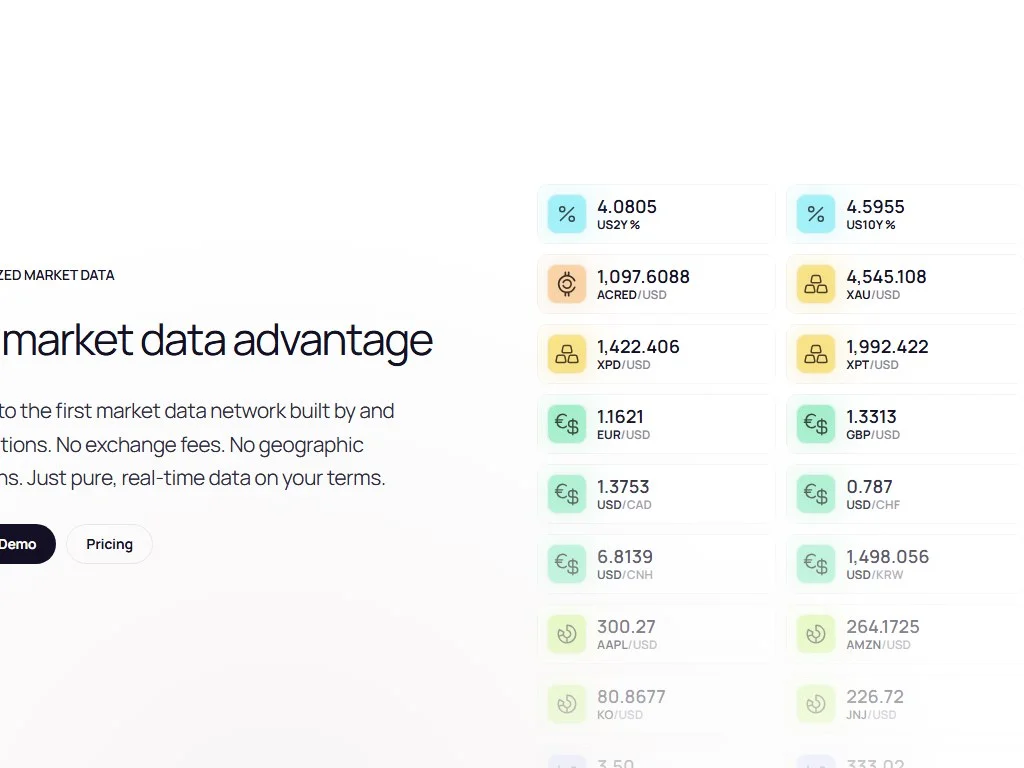
The publisher list reads like a who's who of professional crypto and traditional finance. Jane Street, one of the largest quantitative trading firms in the world, publishes equity and ETF prices. Cumberland, the crypto arm of DRW, publishes both crypto and FX feeds. Wintermute, one of the most active market makers in crypto, contributes spot and perpetual data. Jump Trading publishes across asset classes. CBOE, the parent of the Chicago Board Options Exchange, publishes equity and index data. Two Sigma, a major quantitative hedge fund, contributes pricing for various markets. Binance, OKX, Bybit, Kraken, Bitfinex, Gate.io, and other top exchanges publish their order book mid-prices directly.
This list matters because it directly answers a critical question: where does the price actually come from? With Pyth, the answer is the desks and venues that are actively quoting and trading the asset. They are not scraping a public API and forwarding the number. They are signing their own internal pricing and submitting it on-chain. This is the meaning of "first-party" in first-party oracle.
Jump Trading
Two Sigma
Susquehanna
Wintermute
GSR
Flow Traders
OKX
Bybit
Kraken
LMAX Group
Virtu Financial
Optiver
Each publisher is whitelisted by the Pyth governance process and is assigned a stake-weighted contribution to each feed. The more publishers contribute to a single feed, the more robust the aggregated price becomes. The most popular crypto feeds (BTC/USD, ETH/USD, SOL/USD) currently have between 30 and 60 publishers each, which means any single firm having a bad print, a stuck quote, or a malicious entry has effectively zero impact on the final aggregated value.
Price Aggregation and Confidence Intervals
The most underrated technical feature of Pyth is the confidence interval. Every price Pyth publishes comes paired with a number that says how much the publishers agree about the value. This single addition transforms how downstream protocols can manage risk, and almost no other oracle provides it.
Here is how the aggregation works. Each publisher submits two numbers for every feed they contribute to: a price and their own confidence in that price (typically the bid-ask spread or a measure of internal model uncertainty). The aggregation algorithm running on Pythnet takes all of these inputs, applies a stake-weighted robust aggregation, throws out extreme outliers, and produces two outputs: an aggregate price and an aggregate confidence interval. The confidence interval represents roughly one standard deviation of where the true market price is likely to be.
Confidence intervals matter because real markets are not infinitely liquid. During normal trading on BTC/USD, the confidence interval might be 5 dollars on a 70,000 dollar price, which is essentially zero. During a flash crash, an exchange outage, or a moment of extreme volatility, the same feed might show a confidence interval of 500 dollars or more because publishers genuinely disagree about where the market is. A naive oracle would publish a single point estimate and the downstream protocol would have no idea anything was wrong. Pyth tells you exactly how uncertain the price currently is.
Sophisticated protocols use the confidence interval as a circuit breaker. Drift, the largest Solana perpetuals exchange, refuses to mark positions when the confidence interval exceeds a threshold relative to the price. Lending protocols use it to adjust haircuts on collateral during volatile periods. Stablecoin issuers use it to pause minting and redemption when the input prices are uncertain. This is the kind of risk management that traditional finance treats as table stakes but that most DeFi protocols have historically ignored because the oracle data did not include it.
Wormhole and Cross-Chain Price Delivery
Pyth aggregates prices on Pythnet, but the applications that consume Pyth prices live on more than 90 different chains. The bridge between aggregation and consumption is Wormhole, the cross-chain messaging protocol that originated alongside Pyth in the broader Solana ecosystem.
Here is the flow in detail. Once Pythnet produces a new aggregated price, the update is signed by a network of nineteen Wormhole guardian nodes. These guardians run distributed infrastructure and collectively attest that a particular message originated from Pythnet. Their signed attestation, called a Verifiable Action Approval (VAA), is then made available through a public web service called Hermes. Any application on any supported chain can fetch the latest VAA, submit it to the on-chain Pyth contract on its target chain, and the contract verifies the guardian signatures before updating its stored price.
This is much more efficient than running independent oracles on every chain. A single VAA can be consumed on any of the 90+ destination chains. New chains can be added by simply deploying the Pyth contract and pointing it at the same set of guardian signatures. As Wormhole adds new destinations, Pyth gets that distribution essentially for free. To dive deeper into how the underlying transport works, see our guide on the Wormhole bridge.
The security model assumes that a supermajority of guardians is honest. As of 2026, the nineteen guardians include Jump Crypto, Certus One, Everstake, Chorus One, Staked, Figment, P2P Validator, and other major validators in the broader staking ecosystem. A malicious update would require thirteen of those guardians to collude, which is a difficult coordination problem against entities with significant business reputations to lose.
Pyth Lazer: Sub-Second Data for High-Frequency Applications
Pyth's standard feeds update roughly every 400 milliseconds, which is fast enough for the vast majority of DeFi applications. But there is a category of users that needs more: market makers running on-chain, perpetuals exchanges with millisecond latency requirements, and high-frequency strategies that need to react to information faster than the standard feed cadence. For these users, Pyth introduced Lazer in 2024.
Lazer is a separate product that delivers ultra-low-latency price updates with millisecond-level cadence. It is optimized for trading applications that cannot tolerate the slight lag introduced by standard publish intervals. Lazer uses the same publisher network and the same aggregation principles, but the entire pipeline is tuned for raw speed. Updates can be pulled and submitted to chains that have fast enough block times to make use of them, including Solana, Aptos, Sui, Monad, and other high-throughput environments.
The use cases for Lazer are specific but high-value. On-chain market makers can use Lazer to update their quotes faster than the broader market, capturing spread before slower bots can react. Perpetuals exchanges with funding rate calculations that depend on instantaneous prices can use Lazer to reduce the gap between off-chain and on-chain marks. Liquidation engines protecting against fast-moving cascades can use Lazer to trigger before the position falls underwater. These are professional use cases, and they are part of why the largest trading firms in crypto have built their on-chain operations around Pyth.
Supported Chains in 2026
Pyth's distribution footprint is the largest of any oracle network in crypto. As of 2026, prices are available on more than 90 blockchains. The list includes every major Layer 1 and Layer 2 you would expect, plus many newer or more specialized environments.
For builders, this means that choosing Pyth is essentially future-proofing your oracle decision. If your protocol expands to a new chain, the odds are extremely high that Pyth already supports it, and even if a particular chain is new, the integration path is well documented. For users, it means the same prices that power Drift on Solana are powering Aevo on the Ethereum Layer 2 ecosystem, which makes cross-protocol arbitrage less prone to oracle-induced dislocations.
The PYTH Token: Governance and Staking
The PYTH token launched in November 2023 and serves as the governance and economic security layer of the protocol. It is not a payment token in the sense that users do not pay PYTH to consume prices. The fees for pulling prices are paid in the native gas token of whatever chain the user is on. Instead, PYTH is used to vote on protocol parameters, govern publisher whitelisting, and stake to provide economic security around oracle data.
The total supply of PYTH is 10 billion tokens, with circulation expanding over a multi-year vesting schedule that runs through 2027. Allocations went to publishers (rewarding them for contributing data), protocol development, ecosystem growth, community grants, and the foundation. The vesting structure has been a source of price pressure on the token as cliffs unlock, but it also ensures that publishers and contributors remain economically aligned with the long-term success of the network.
Oracle Integrity Staking, launched in 2024, lets PYTH holders stake their tokens behind specific publishers. If a publisher submits prices that deviate significantly from the truth (as determined by on-chain oracle data and slashing rules), the staked tokens can be slashed. In exchange for accepting this risk, stakers earn a share of the protocol revenue and PYTH emissions. This is the mechanism that turns the publisher network from a permissioned set of trusted firms into a genuinely economically secured oracle.
Governance proposals through PYTH cover meaningful decisions: which new feeds to launch, which publishers to admit, what slashing parameters should be, how protocol revenue is distributed, and what new product directions to fund. The Pyth DAO has already approved hundreds of new feeds, multiple protocol upgrades, and the Lazer product roadmap through this process.
Pyth vs Chainlink: Head to Head in 2026
The single most common question people ask about Pyth is how it compares to Chainlink. Both are legitimate, well-engineered oracle networks, and they have meaningfully different design philosophies. The honest answer is that they are good at different things, and many serious protocols use both.
Chainlink's strength is its track record. It has been live since 2017, has secured the largest DeFi protocols on Ethereum mainnet for years, and has a mature ecosystem of node operators, data providers, and integrations. Its push-based model is well-suited for protocols where prices change slowly and applications need a single number to read at low cost. Aave, Compound, MakerDAO, and most of the established Ethereum lending stack run on Chainlink.
Pyth's strength is its source data and update speed. It can deliver prices that change tens of times per second when the market is moving, and it sources them from the institutions that are actually setting those prices. Its cross-chain footprint via Chainlink CCIP versus Wormhole is also several times larger. Drift, Synthetix V3, Aevo, dYdX v4, and most of the modern perpetuals and derivatives stack run primarily on Pyth.
The honest conclusion is that there is room for both. Different protocols have different risk profiles and different cost sensitivities. A long-tail lending protocol on a low-cost Layer 2 might happily pay Pyth's pull-time gas in exchange for sub-second prices. A blue-chip lending protocol on Ethereum mainnet might prefer Chainlink's heartbeat updates because the gas cost of pulling Pyth on every interaction would be prohibitive. Both networks coexist in the broader ecosystem, and many protocols actually integrate both as a redundancy measure.
dApps Using Pyth Network
The protocols that have chosen Pyth tell you a lot about where the network's strengths are most valued. The list is heavily weighted toward derivatives, perpetuals, and high-throughput applications where data freshness directly translates into either user experience or protocol safety.
Drift Protocol is the largest perpetuals exchange on Solana and was one of the earliest Pyth integrators. Drift uses Pyth for mark prices, funding rate calculations, and liquidation triggers. The 400-millisecond update cadence is what makes high-leverage perpetuals viable on a chain with sub-second blocks. Drift's confidence interval guards are a textbook example of using Pyth's full feature set to manage risk.
Synthetix V3 migrated to Pyth as its primary oracle for the perpetuals product line on Optimism, Base, and Arbitrum. The decision was driven by the need for faster updates than the previous oracle could provide. Synthetix perps depend on tight mark prices to keep funding rates accurate and to prevent toxic flow from exploiting stale data.
Aevo, the options and perpetuals platform that grew out of Ribbon Finance, uses Pyth for its underlying price feeds. Aevo's options pricing depends on accurate, frequent spot price data, and the alternative of running internal oracles introduced unacceptable centralization risk.
dYdX v4, the Cosmos app-chain version of dYdX, integrated Pyth alongside its own internal price aggregation as the primary data source for its perpetuals markets. Hyperliquid, despite running significant internal infrastructure, references Pyth for cross-checks. Kamino, the leading lending protocol on Solana, uses Pyth for collateral pricing. Solend, MarginFi, Jupiter Perpetuals, Zeta, and almost the entire Solana derivatives stack runs on Pyth.
On the EVM side, Vertex Protocol, Morpho for certain markets, Pendle for principal token pricing, and Ribbon-derived structured products all use Pyth in production. The pattern is clear: when speed, breadth of asset coverage, or cross-chain consistency matters, Pyth wins the integration.
How to Integrate Pyth as a Developer
Integrating Pyth into a smart contract is straightforward, but the workflow is different from a push oracle so it is worth walking through. The high-level steps are: install the Pyth SDK for your target chain, fetch a signed price update from Hermes off-chain, submit that update along with your transaction, and read the freshly updated price inside your contract.
On EVM chains, the Pyth contract exposes two key functions. The first, updatePriceFeeds(bytes[] calldata updateData), accepts the signed VAA from Wormhole and updates the on-chain price for the relevant feeds. The second, getPriceUnsafe(bytes32 id) or the safer getPriceNoOlderThan(bytes32 id, uint maxAge), reads the current price along with its confidence interval and timestamp.
The recommended pattern is to compose both calls in a single transaction. Your application's frontend or backend fetches the latest signed update from Hermes (typically over an RPC-style HTTPS API), passes that data into the user transaction along with whatever the user is actually trying to do (deposit, borrow, trade), and the contract first calls updatePriceFeeds then reads the fresh price for its business logic. The user pays gas once for the entire bundle.
Critical security considerations during integration include checking the timestamp on the returned price (reject anything older than your tolerance, typically 10 to 60 seconds depending on use case), checking the confidence interval as a percentage of price (reject if too wide), and verifying that the price feed ID you are reading actually corresponds to the asset you think it does. The SDK provides utilities for all of this. Skipping these checks is one of the most common sources of oracle-related bugs in production.
Risks and Limitations
No oracle is perfect, and being honest about Pyth's risks matters more than cheerleading. The main risks fall into three categories: publisher quality, Wormhole bridge security, and the gas cost of pulling prices.
The publisher quality risk is structural. While Pyth has done an excellent job recruiting top-tier firms, the network ultimately trusts that those firms publish honest prices. If a publisher's internal systems are compromised, if a malicious quote is pushed by mistake, or if a coordinated subset of publishers collude, the aggregated price could be manipulated. The stake-weighted aggregation and outlier rejection mitigate this, but they do not eliminate it. The bigger the divergence a single publisher attempts, the more likely it gets thrown out as an outlier, but small biases applied by multiple publishers simultaneously are harder to detect. Oracle Integrity Staking provides slashing-based deterrence, but the slashing rules are still maturing.
The Wormhole bridge risk is more concentrated. Cross-chain price delivery depends on the nineteen guardian nodes signing VAAs. A compromise of thirteen guardians (the supermajority threshold) would allow a malicious party to inject false prices to any destination chain. Wormhole has had one major exploit historically (February 2022, on the Solana to Ethereum bridge, exploiting a smart contract bug rather than the guardian set), and has invested heavily in security since. But the dependency exists, and protocols building on Pyth are inherently building on Wormhole.
The gas cost risk is more mundane but more frequent. Pulling a price means paying the gas to verify guardian signatures and update the on-chain price feed, which on Ethereum mainnet can cost meaningful amounts of gas. For high-volume applications, this is fine because the cost is amortized across many user actions. For low-volume applications, it can make Pyth more expensive in practice than a subsidized push oracle. The recommendation is to model the per-transaction cost honestly before committing to a particular oracle.
Additional risks include the standard MEV concerns around oracle updates (a sophisticated searcher could in theory front-run a price update transaction with their own price update at a slightly different value), the regulatory uncertainty around financial market data redistribution, and the dependency on Hermes infrastructure being available when applications need to fetch updates.
Frequently Asked Questions
Q What is Pyth Network in simple terms?
Q How is a pull oracle different from a push oracle?
Q Who publishes data to Pyth?
Q What is a confidence interval in a Pyth price feed?
Q How does Pyth deliver prices to so many chains?
Q What is the PYTH token used for?
Q Is Pyth better than Chainlink?
Q What is Pyth Lazer?
Q Does Pyth work on Ethereum mainnet?
Q How many price feeds does Pyth offer?
Q How fast does Pyth update prices?
Conclusion: The Oracle Layer for Real-Time DeFi
Pyth Network represents a fundamentally different approach to bringing market data on-chain. Instead of relying on third-party scrapers and scheduled broadcasts, it sources prices directly from the institutions that move markets and makes those prices available the instant they update. The combination of first-party publishers, the pull architecture, confidence intervals, Wormhole-based cross-chain delivery, and the Lazer high-frequency product gives builders a toolkit that simply did not exist a few years ago.
For the protocols building modern DeFi, especially perpetuals, options, structured products, and any application where data freshness directly impacts user outcomes, Pyth has become the default choice. For users, the benefit is invisible but real: the mark prices powering your favorite perpetuals exchange, the liquidation triggers protecting your lending position, the spot quotes settling your trades. These are increasingly sourced from the same desks that make professional markets, with full transparency about how confident the network is in every number.
The oracle problem is one of the oldest unsolved problems in crypto, and no single network has fully solved it. But Pyth has moved the frontier significantly. It will continue to compete with Chainlink and newer entrants on different dimensions, and the healthiest outcome for DeFi is exactly that competition. For now, if you are building anything that needs fast, broad, institutionally-sourced price data across many chains, Pyth is the network you should evaluate first.
Related Guides
- Chainlink vs Pyth: Crypto Oracle Networks Compared (2026)
- What Is Chainlink: Oracles, Data Feeds and Offchain Services (2026)
- How Bonding Curves Price Tokens on Pump.fun and Friend.tech (2026)
- What Is a Price Oracle in Crypto? Guide (2026)
- What Is a Rug Pull in Crypto: Complete Anatomy and Prevention Guide (2026)