What is the Lightning Network? Bitcoin L2 Scalability Guide
— By AliceOnChain in Tutorials

Bitcoin is the most secure decentralized network, but it faces severe throughput bottlenecks. This advanced tutorial unpacks the architecture of the Lightning Network, evaluates its operational hurdles, and details how layer-2 ecosystems impact broader market dynamics.
For the complete, up-to-date guide, read our full guide here.
What is the Lightning Network? Bitcoin L2 Scalability Guide
Bitcoin established the foundation for decentralized digital scarcity, yet its architectural design prioritizes security and decentralization over raw transaction speed. With a base layer capable of processing roughly seven transactions per second and block confirmation times averaging ten minutes, the network frequently experiences severe congestion during periods of high market activity. This structural bottleneck results in spiking transaction fees, making microtransactions or high-frequency transfers impractical on the base chain.
To solve this dilemma without compromising the core security properties of the main ledger, developers looked outside the base layer. But what is the Lightning Network exactly? Positioned as a prominent Bitcoin L2 solution, it functions as a decentralized system built on top of the primary blockchain to enable instant, high-volume, and low-cost transactions. This technical guide will unpack how this payment protocol operates, analyze its underlying mechanics, evaluate its structural challenges, and explain how to monitor layer-2 market dynamics using DEXTools.
2. The Architecture of Off-Chain Settlement
To truly grasp how layer-2 scaling works, we must look beyond basic consumer payment apps and evaluate the cryptographic foundations that make off-chain settlement possible without introducing trusted intermediaries. When users ask what is the Lightning Network trying to achieve, the answer centers on moving transactional computational weight off the main ledger while maintaining absolute settlement finality.
Bidirectional Payment Channels
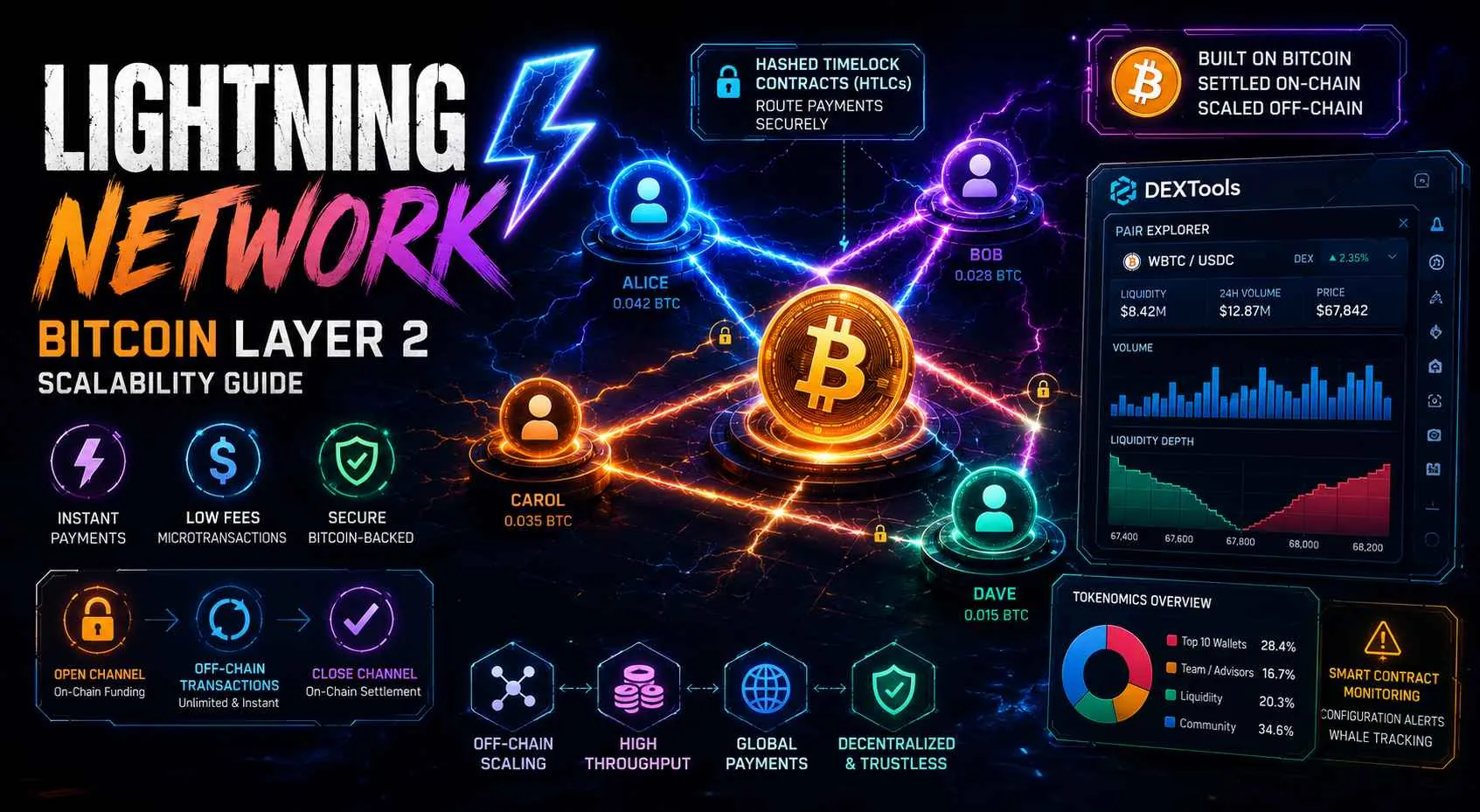
At the core of this network are bidirectional payment channels. Imagine two parties who frequently trade or transact. Instead of writing every individual transfer to the base blockchain, they open a dedicated channel by deploying a 2-of-2 multi-signature funding transaction on the main ledger. This action acts as an on-chain escrow account.
Once the funding transaction is confirmed, both parties can execute an unlimited number of transfers off-chain. Each transfer modifies the balance distribution of the channel’s total capacity. These balance updates are signed cryptographically by both participants, rendering them technically binding, yet they remain entirely off-chain until the parties decide to close the channel.
Hashed Timelock Contracts (HTLCs)
A common question when discovering this scaling framework is: do users need to open a direct channel with every single person they wish to pay? The answer is no, thanks to Hashed Timelock Contracts (HTLCs). Understanding what is the Lightning Network routing mechanism relies completely on how these specialized contracts function.
HTLCs enable routed payments across a vast interconnected web of individual channels. If Participant A wants to send a payment to Participant C, but only shares a channel with Participant B, the funds can be routed securely through Participant B. HTLCs use cryptographic hashes and time-bound locks to ensure that intermediary routing nodes cannot steal the funds. The intermediary only receives their tiny routing fee if they successfully pass the payment along to the final destination within the allotted time frame. If a routing node goes offline or attempts fraud, the funds are safely returned to the sender via automated time-lock conditions.
3. The Lifecycle of an Off-Chain Transaction
Understanding the technical journey of these funds helps market participants identify where network friction and potential liquidity constraints can occur across the layer-2 payment ecosystem.
Channel Initialization and Funding
Every payment pathway begins with a standard on-chain transaction. The capital committed during this step establishes the absolute maximum capacity of that specific channel. Because this initialization requires a base-layer transaction, users must pay prevailing network mining fees to establish their connection. During market manias, high base-layer fees can increase the upfront cost of opening new channels.
Off-Chain State Updates
Once initialized, the balance shifts dynamically with each transaction. These updates are called state changes. Instead of broadcasting these changes to miners, participants simply exchange revoked commitment transactions. Anyone analyzing what is the Lightning Network protocol safety matrix will discover that if one party attempts to cheat by broadcasting an older, more favorable state to the main blockchain, the protocol's built-in penalty mechanism allows the honest party to claim the entire balance of the channel.
Settlement and Channel Closure
When the transacting parties finish their relationship, they execute a cooperative closure. The final state of the channel is compiled into a single transaction and broadcasted back to the base blockchain. The miners validate the signatures, close the multi-sig account, and distribute the remaining coins to each user's main wallet address. This process reduces hundreds or thousands of off-chain microtransactions into just two on-chain actions: one to open and one to close.
4. Liquidity Bottlenecks and Operational Trade-offs
While the protocol provides near-instantaneous transfers for minimal fees, it introduces distinct technical trade-offs and capital efficiency challenges that differ significantly from alternative layer-1 asset classes.
The Inbound Liquidity Problem
A major operational hurdle within this ecosystem is the management of channel capacity. A payment channel functions like an abacus; you can only slide beads back and forth. If you open a channel with 0.1 BTC of your own capital, your initial outbound capacity is 0.1 BTC, but your inbound capacity is zero. You cannot receive a payment until you first spend some of your balance or find a peer willing to lock up their own capital on the other side of your channel. Managing this balance dynamically requires sophisticated node operations and specialized liquidity management strategies.
Routing Fees and Node Centralization
To move payments across the network, routing nodes charge micro-fees. While these fees are small compared to base-layer costs, they create an economic incentive structure. Nodes with substantial capital can establish massive well-connected hubs, offering highly reliable payment routing. This economic reality creates a natural pull toward capitalization clusters, where a small percentage of heavily funded routing hubs handle a significant portion of total network traffic.
5. Analyzing Layer-2 Ecosystem Dynamics on DEXTools
As scaling technologies mature, the broader digital asset ecosystem has witnessed an explosion of wrapped assets, tokenized layer-2 derivatives, and infrastructure tokens that support cross-chain payment rails. Advanced on-chain analysts track these assets to gauge broader market sentiments and liquidity flows.
Step 1: Monitoring Derivative Liquidity and Volume
When evaluating tokens tied to scaling infrastructure or wrapped assets bridged from layer-2 ecosystems, the DEXTools Pair Explorer serves as a vital diagnostic tool.
Slippage and Depth Metrics: Trading layer-2 utility tokens or wrapped Bitcoin variants requires deep liquidity. Thin pools can lead to significant slippage during periods of high market volatility, distorting the tracking efficiency of the asset relative to its true market value.
Volume Anomaly Tracking: Sudden spikes in trading volume on wrapped or bridged pairs often precede periods of high network congestion on the base chain, as capital seeks more efficient transaction pathways.
Step 2: Investigating Tokenomics and Smart Contract Risks
Many scaling projects deploy intermediate token models to incentivize liquidity provision or node operations.
Holder Analysis: Use DEXTools tokenomics analysis features to review how protocol incentive tokens are distributed. A high concentration of tokens held by a few unverified wallets introduces structural market risk, as large-scale liquidations can rapidly destabilize secondary market pairings.
Configurability Alerts: Set up custom DEXTools Price Alerts and monitor contract transactions for unexpected administrative changes. Infrastructure tokens with highly centralized multi-sig structures require continuous oversight to protect against smart contract vulnerabilities.
Conclusion
Understanding what is the Lightning Network and how it scales the digital asset economy provides vital context for interpreting modern market architecture. By shifting transactional volume away from the primary blockchain into highly efficient, cryptographically secured state channels, the ecosystem achieves the throughput necessary for global adoption without sacrificing decentralized settlement guarantees.
Analyzing these systems reveals that while they introduce specific liquidity constraints and capital management complexities, their development plays a critical role in mitigating network congestion. By tracking the flow of capital, assessing liquidity pool depths, and analyzing token distributions via DEXTools, market participants can successfully navigate the risks and opportunities within the expanding layer-2 landscape.
What Is the Lightning Network? How Bitcoin Layer 2 WorksAster Chain: Privacy-First Layer-1 Blockchain for Decentralized Derivatives Trading
How to Use Base Chain in 2026: Wallet Setup, Bridge and First Transaction Guide
How to Analyze Solana Meme Coins Before Trading: On-Chain Risk Checklist (2026)
Disclaimer: This article is for informational purposes only and does not constitute investment advice, financial advice, trading advice, or any other kind of advice. DEXTools does not recommend buying, selling, or holding any cryptocurrency or token. Users should conduct their own research and consult with a qualified financial advisor before making any investment decisions. Cryptocurrency investments are volatile and high-risk. DEXTools is not responsible for any losses incurred.
The Lightning Network's Economic Implications for Bitcoin
Beyond its technical prowess in scaling transactions, the Lightning Network introduces profound economic shifts for the Bitcoin ecosystem. By enabling near-instant, low-cost microtransactions, it unlocks use cases previously impractical on the base layer. This facilitates a broader adoption of Bitcoin as a medium of exchange, moving beyond its primary role as a store of value or a settlement layer for large transfers. The economic implications extend to empowering global remittances, enabling pay-as-you-go services, and fostering a new wave of Bitcoin-native businesses.
The network also subtly alters the demand dynamics for on-chain block space. While Lightning transactions occur off-chain, their initial channel openings and subsequent closures still require base layer transactions. A flourishing Lightning Network could lead to a decrease in the urgency of individual on-chain transactions for smaller amounts, but potentially an increase in demand for opening and closing larger channels, or for settling disputes. This creates a fascinating interplay between the two layers, where the success of one influences the economic pressure on the other.
Driving Bitcoin's Utility Premium
- Enhances Bitcoin's fungibility by making smaller units of BTC practically spendable.
- Reduces the economic friction for everyday purchases, increasing Bitcoin's utility premium.
- Fosters the development of a 'circular economy' where individuals can earn and spend Bitcoin seamlessly.
- Potentially impacts on-chain transaction fee markets by offloading high-frequency, low-value transfers.
- Opens new revenue streams for node operators through routing fees, incentivizing network participation.
Ultimately, the Lightning Network is not just a technological upgrade; it is an economic accelerator, positioning Bitcoin to capture a larger share of the global digital payments market. Its success will be measured not just in throughput, but in the tangible economic activities it enables and the new value it creates for users worldwide.
Related Guides
- What Is the Lightning Network? How Bitcoin Layer 2 Works
- Lightning Network Setup: How to Open Your First Channel
- How Blockchain Sharding Works: Parallelization, Throughput and Design Tradeoffs (2026)
- Blockchain Trilemma Explained: Scaling 2026
- Based Rollups Explained: Ethereum Scaling Guide
Frequently Asked Questions
What is the Lightning Network?
The Lightning Network is a layer 2 protocol built on top of Bitcoin that enables faster and cheaper payments. It moves most transactions off the main chain into payment channels and settles back to the base layer when channels are closed.
How does the Lightning Network work?
Two parties open a payment channel by committing funds in an on-chain transaction, then exchange many off-chain payments by updating their shared balance. When they close the channel, the final balance is recorded on the Bitcoin blockchain.
Why is the Lightning Network needed for Bitcoin?
The Bitcoin base layer has limited transaction throughput and can become slow or costly during high demand. The Lightning Network helps scale small and frequent payments by handling them off-chain while still relying on Bitcoin for final settlement.
What are the risks of using the Lightning Network?
Risks can include channel liquidity limits, the need to stay online or rely on watchtowers to detect fraud, and the general complexity of channel management. Funds in channels are also exposed to smart-contract and operational risks distinct from simple on-chain holding.