Blockchain Trilemma Explained: Scaling 2026
— By Tony Rabbit in Tutorials
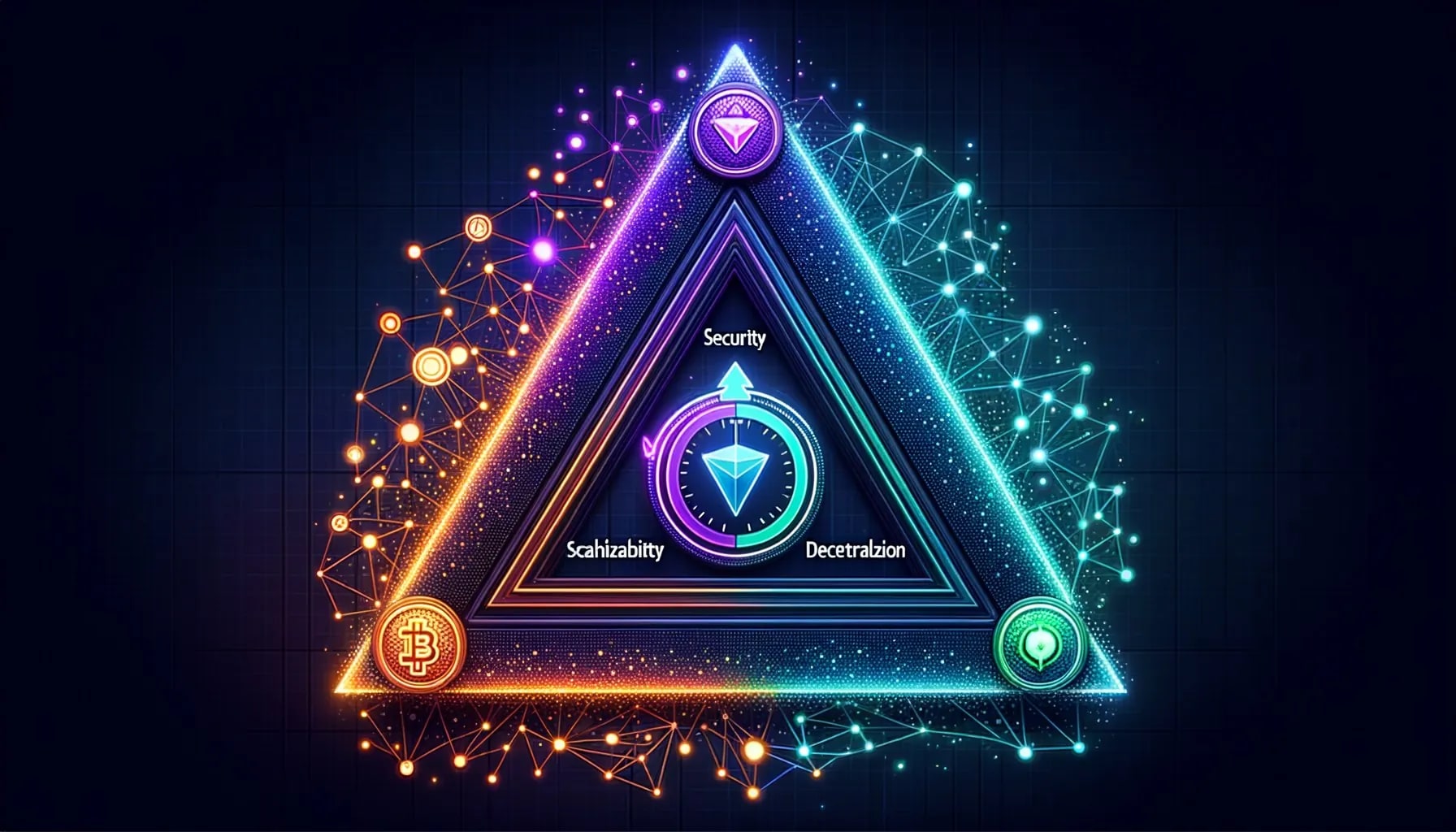
Blockchain trilemma explained: learn the scalability tradeoffs of security and decentralization, and why chains keep sacrificing part of the triangle.
Intent check: This page explains the tradeoff framework itself. If you want one specific scalability architecture, read How Blockchain Sharding Works: Parallelization, Throughput and Design Tradeoffs (2026)
Every Layer 1 marketing deck published since 2020 has made the same audacious claim: this is the chain that finally solves the blockchain trilemma. They promise security as good as Bitcoin, decentralization as broad as Ethereum, and scalability that puts Visa to shame. The pitch is intoxicating, the diagrams are slick, and the venture money has flowed accordingly. Yet eight years after Vitalik Buterin first formalized the concept, the trilemma remains the single most important constraint shaping how every public blockchain behaves in 2026.
The trilemma is the observation that any decentralized network must trade off three core properties: security, scalability, and decentralization. You can optimize for two of them at the same time, but improving the third without compromising the others has historically been mathematically impossible. This is not a marketing gimmick. It is a deep structural reality of distributed consensus, and it explains why Bitcoin still confirms only seven transactions per second, why Ethereum gas fees still spike during bull markets, and why high-throughput chains keep getting accused of being too centralized.
In this guide, you will learn exactly what the blockchain trilemma is, who coined it and why it matters, how each of the three properties is measured, why the math forces a trade-off, and how the major chains of 2026 (Bitcoin, Ethereum, Solana, BNB Chain, Avalanche, Sui, TON, Aptos) score against each axis. You will also see how rollups, modular blockchains, and sharding attempt to escape the constraint, whether any chain has actually solved the trilemma, and what all of this means in practice for the fees you pay, the finality you wait for, and the safety of the assets you hold.
What Is the Blockchain Trilemma?
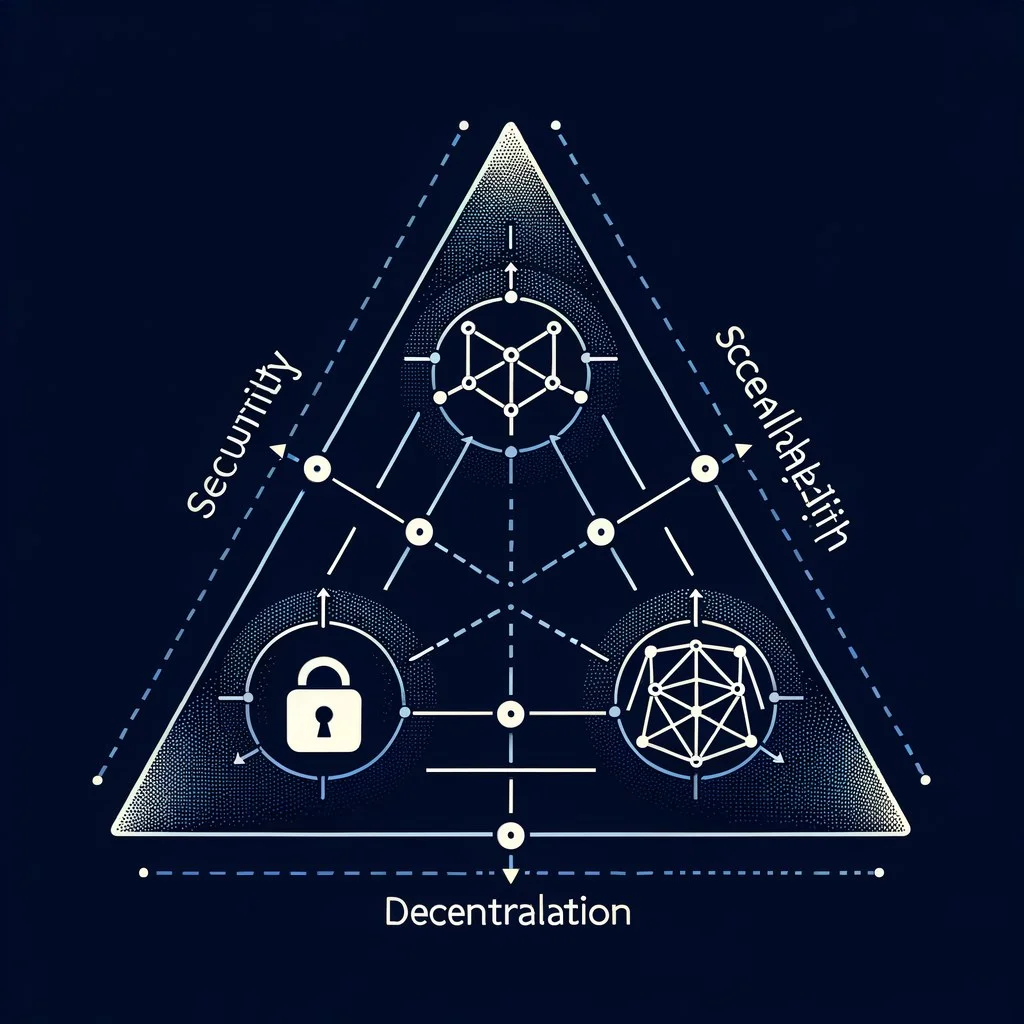
The blockchain trilemma is the idea that decentralized networks face an unavoidable trade-off between three desirable properties: security, scalability, and decentralization. The term was popularized by Vitalik Buterin, the co-founder of Ethereum, in blog posts and conference talks dating back to 2017. Buterin did not invent the trade-off itself, which had been discussed informally by Bitcoin researchers for years, but he gave it a clear name, formalized the constraints, and made it the framing device for an entire generation of blockchain research.
The intuition is simple. To make a blockchain secure, you need many independent participants verifying every transaction. To make it decentralized, you need those participants to be cheap to run, so anyone with a normal computer can join the network. To make it scalable, you need to process a lot of transactions quickly. The problem is that processing more transactions makes the network harder to verify, which either reduces decentralization (because only powerful machines can keep up) or reduces security (because participants stop verifying and just trust others).
Buterin's original framing was that a blockchain can have at most two of these three properties at any given time. Bitcoin is secure and decentralized but not scalable. A traditional database is secure and scalable but not decentralized. A high-throughput chain with only a handful of validators might be scalable and (debatably) secure but is not decentralized. The trilemma is the conceptual map that explains why this is so, and the search for ways around it has driven essentially every major engineering effort in crypto for the last decade.
The Three Properties Explained
Before we can score chains against the trilemma, we need to be precise about what each property actually means. Loose definitions are how marketing teams claim to have solved a problem they have only redefined. Here is what each vertex of the triangle really refers to.
Security
Security in a blockchain context means the network's resistance to being rewritten, censored, or attacked. The most common threat model is the 51% attack, where a malicious actor controls enough of the network's hash power or stake to override honest participants. A secure chain is one where this attack is prohibitively expensive, either because the underlying resource (electricity in proof of work, staked capital in proof of stake) costs billions of dollars to acquire, or because the attacker would destroy the value of what they are trying to steal.
Security is also about validator economics. A network is only as secure as the economic incentive for validators to follow the rules. If staking rewards are too low, fewer participants secure the chain. If finality is probabilistic rather than absolute, attackers might find narrow windows to reorganize recent blocks. Bitcoin's roughly $25 billion annual security budget (the dollar value of new BTC issuance plus fees) makes its security famously robust. Smaller chains with millions in security spend are far easier to attack, even if they advertise the same consensus algorithm.
Scalability
Scalability is the network's capacity to process transactions cheaply and quickly. It is usually measured in TPS (transactions per second), but raw TPS is a misleading number on its own. A chain that processes 10,000 simple token transfers per second is not directly comparable to one that processes 1,000 complex smart contract calls per second. The honest metric combines TPS with gas costs per transaction and time to finality, the moment when a transaction becomes economically irreversible.
Scalability also includes cost predictability. A chain that processes 1,000 TPS most of the time but spikes to $100 transaction fees during congestion is less useful than one that maintains a steady $0.01 fee. For end users, scalability is felt as the experience of clicking confirm and waiting either 400 milliseconds or 12 minutes for the network to acknowledge your action. For protocols building on top, it dictates which use cases (gaming, social, micropayments) are economically viable at all.
Decentralization
Decentralization is the trickiest property to define because it has multiple dimensions. The cleanest definition is the number, geographic distribution, and independence of the entities producing and verifying blocks. A chain with 10,000 validators run by 10,000 different operators across 100 countries is more decentralized than one with 200 validators run by 20 known entities in a single jurisdiction.
Just as important is the hardware floor. If running a full validator requires a $20,000 server with a fiber connection, then only well-funded operators can participate. If it requires a Raspberry Pi, then anyone can. Decentralization also extends to client diversity (how many software implementations of the protocol exist), the ability for users to run a light client to verify the chain without trusting third parties, and the resistance of the protocol's governance to capture by a single faction.
Why You Can Only Have Two
The math behind the trilemma is elegant. To process more transactions per second, you need to do more work per second. That work has to happen somewhere. The two main options are (1) make every node do more work or (2) split the work across multiple nodes. Option one trades decentralization, because heavier nodes mean fewer people can run them. Option two trades security, because if no single node verifies the whole chain, you have to trust that the shards or sub-committees doing the work are honest.
The cleanest way to see this is through the lens of light client economics. A light client is software that verifies a chain without storing the full state. For light clients to work, the protocol must include succinct proofs that anyone can check on a phone. If a chain produces too much data per second, those proofs become too expensive to verify, and light clients fall back to trusting full nodes. That collapses one of the foundational guarantees of permissionless decentralization, which is that anyone can independently verify the truth.
Vitalik framed the constraint formally as the requirement that for a chain to be truly decentralized, regular users should be able to run a node on consumer hardware. Once you accept that constraint, the data throughput of the chain is bounded by what an average laptop can verify. Push throughput higher than that, and either users stop verifying (decentralization fails) or only data centers can run nodes (decentralization fails differently). Either way, you have given something up to gain scalability.
Bitcoin and the Trilemma
Bitcoin is the original and still the most extreme example of the security-decentralization corner of the triangle. It deliberately sacrifices scalability to maximize the other two. Block size is capped at roughly 1 to 4 megabytes (after SegWit weighting), block time is fixed at 10 minutes, and base-layer throughput sits at around 7 TPS. There is no plausible roadmap that increases that number on the base layer, because the Bitcoin community has explicitly chosen to keep the chain verifiable by anyone with a cheap computer.
What Bitcoin gains in exchange is staggering. The total cost to mount a sustained 51% attack on Bitcoin is in the tens of billions of dollars, since an attacker would need to either acquire roughly half the global ASIC supply or build a comparable amount from scratch. Bitcoin runs on tens of thousands of independent nodes, distributed across every continent. The protocol is so conservative that genuine consensus changes are rare and require near-unanimous agreement. Bitcoin is the gold standard for security and decentralization, full stop.
Scalability on Bitcoin is happening, but on Layer 2. The Lightning Network adds high-throughput payment channels on top of the base chain, and projects like Stacks, Rootstock, and various rollup proposals (BitVM, Citrea) bring smart contracts and higher throughput while inheriting Bitcoin's security. The base layer's refusal to scale is not a bug but a design choice that pushes the trade-off up the stack. Bitcoin chose its two vertices in 2009 and has held them with stubborn discipline ever since.
Ethereum and the Trilemma
Ethereum's relationship to the trilemma is more complex and more interesting. The base chain runs at roughly 15 to 30 TPS for typical transactions, far below modern competitors, but Ethereum's strategy is the rollup-centric roadmap. The idea is to keep the Layer 1 deliberately slow, secure, and maximally decentralized while moving the bulk of transaction execution to Layer 2 rollups that post compressed proofs back to Ethereum.
Since the Merge in 2022, Ethereum has run on proof of stake with over a million validators, making it among the most decentralized chains in existence by raw validator count. EIP-4844 (the Dencun upgrade in early 2024) introduced blob storage, a cheap form of data availability specifically designed for rollups. Full danksharding, the long-term scaling vision, will multiply blob capacity further, allowing Ethereum's effective TPS (including rollups) to push into the tens or hundreds of thousands without compromising the base layer's decentralization.
Critics argue that this strategy moves the trade-off rather than solving it, because the rollups themselves often have centralized sequencers, and bridging between rollups introduces new trust assumptions. Defenders respond that as long as users can always exit a rollup back to L1 trustlessly using fraud proofs or validity proofs, the rollup inherits L1 security where it matters. This is the central bet of Ethereum in 2026, and the experiment is still running.
Solana and the Trilemma
Solana takes the opposite approach to Ethereum. Instead of pushing execution to Layer 2, Solana scales the base layer aggressively through high-performance engineering: a single global state machine, parallel transaction execution via the Sealevel runtime, the Proof of History clock, and a network designed around fast hardware and high-bandwidth connections. The result is real-world throughput in the thousands of TPS, sub-second finality, and transaction fees often below $0.001.
The decentralization question is where Solana invites the most debate. The chain has around 1,500 to 2,000 active validators, which is far fewer than Ethereum but still more than most competitors. The validators are geographically distributed and economically independent, but the hardware requirements (multiple CPU cores, hundreds of gigabytes of RAM, NVMe storage, gigabit network) put running a node out of reach for most hobbyists. Solana defenders argue that validator count and hardware floor are not the only metrics that matter, and that the Nakamoto coefficient (the minimum number of validators needed to halt the chain) is healthy.
Security has been more contested. Solana has experienced multiple network halts over the years, mostly due to engineering bugs rather than economic attacks, and each halt reignites the debate about whether high-throughput chains can match Bitcoin or Ethereum's resilience. As of 2026 the Firedancer client (a second independent validator implementation by Jump Crypto) has dramatically improved client diversity and network stability, addressing one of the longest-standing critiques. Solana's bet is that the trilemma's "decentralization" axis can be relaxed slightly in exchange for transformative scalability, and that the user experience advantages will compound over time.
Other Chains Scored: BSC, AVAX, TON, SUI, APT
The major non-Ethereum, non-Solana chains each occupy distinct positions in the trilemma triangle. Here is how they score in 2026 based on real-world performance and structural design.
BNB Chain runs a 21-validator BFT consensus called Parlia, with validators primarily approved by Binance-aligned governance. This gives BSC excellent throughput (about 60 to 100 TPS in practice with sub-3-second blocks) and cheap fees, but it scores poorly on decentralization. Security is decent because validators have meaningful stake, but a coordinated subset could halt or censor the chain. BSC is the textbook example of trading decentralization for scalability.
Avalanche uses a novel consensus called Snowman that achieves sub-2-second finality with around 1,200 validators. The Primary Network is reasonably decentralized, and subnets (now called L1s in Avalanche terminology) let projects spin up application-specific chains with their own validator sets. Avalanche is a more balanced position on the triangle than BSC, with stronger decentralization but a higher hardware requirement than Ethereum.
TON (The Open Network), originally designed by the Telegram team, uses dynamic sharding to achieve very high throughput. Its tight integration with Telegram (which has roughly a billion users) has driven enormous user growth. The trade-off is that the validator set is smaller and more permissioned in practice, and the sharded architecture makes light client verification harder than on a monolithic chain.
Sui and Aptos both emerged from the Diem (formerly Libra) project at Meta and use the Move programming language. Sui's object-centric model and Aptos's Block-STM parallel execution engine both push base-layer scalability into the thousands of TPS with sub-second finality. Both chains have moderately sized validator sets (over 100 active validators each) and rely on Byzantine fault tolerance for security. They score well on scalability and security, with decentralization in the middle band of the major chains.
Solutions: How Chains Try to Escape the Trilemma
The trilemma is not a static constraint. Decades of cryptographic research and engineering have produced a toolkit of techniques that genuinely loosen the trade-offs. None of them eliminate the triangle, but the best ones bend it in a way that gives users meaningfully better trade-offs than the naive baseline.
Execute transactions off-chain, post compressed proofs to L1. Inherit L1 security while scaling 10 to 100x.
Split the chain into parallel shards, each processing a subset of transactions. Total throughput multiplies with shard count.
Separate execution, settlement, consensus, and data availability into specialized layers that interoperate.
Independent chains pegged to a parent. Faster and cheaper, but with their own validator security and bridge risk.
Two or more parties transact off-chain and settle only the final state on-chain. Used by Lightning Network on Bitcoin.
ZK-proof systems that keep data off-chain entirely. Maximum throughput, weaker data availability guarantees.
Optimistic Rollups
Optimistic rollups assume transactions are valid by default and only run a dispute mechanism if someone challenges the result. Arbitrum, Optimism, Base, and Blast are the leading optimistic rollups in 2026. They achieve roughly 10 to 100x the throughput of Ethereum L1 at a fraction of the cost, while inheriting L1 security through fraud proofs that allow honest parties to challenge invalid state transitions within a 7-day window.
The cost of optimistic rollups is the withdrawal delay. To exit funds back to Ethereum L1 trustlessly, users must wait the full challenge period, typically a week. Most users bridge through third-party liquidity providers who advance funds immediately for a small fee, but trustless exits remain slow. Optimistic rollups also rely on at least one honest verifier to actively monitor and challenge bad state roots, which is a 1-of-N trust assumption rather than the 1-of-many of full L1 consensus.
ZK Rollups
ZK rollups use validity proofs (succinct cryptographic proofs that a batch of transactions is valid) rather than fraud proofs. zkSync, StarkNet, Linea, Scroll, and Polygon zkEVM are the leading ZK rollups. They post a proof to L1 with every batch, and L1 verifies the proof in constant time regardless of how many transactions the batch contains.
The advantage is that withdrawals can be near-instant, because there is no dispute window to wait through. The proof is sufficient evidence that the new state is correct. The disadvantage has historically been that generating ZK proofs is computationally expensive and slow, but proof generation costs have fallen by orders of magnitude since 2022. By 2026, ZK rollups are competitive with optimistic rollups on cost and superior on withdrawal speed, which is why most expect them to dominate the next wave of L2 adoption.
The Modular Thesis
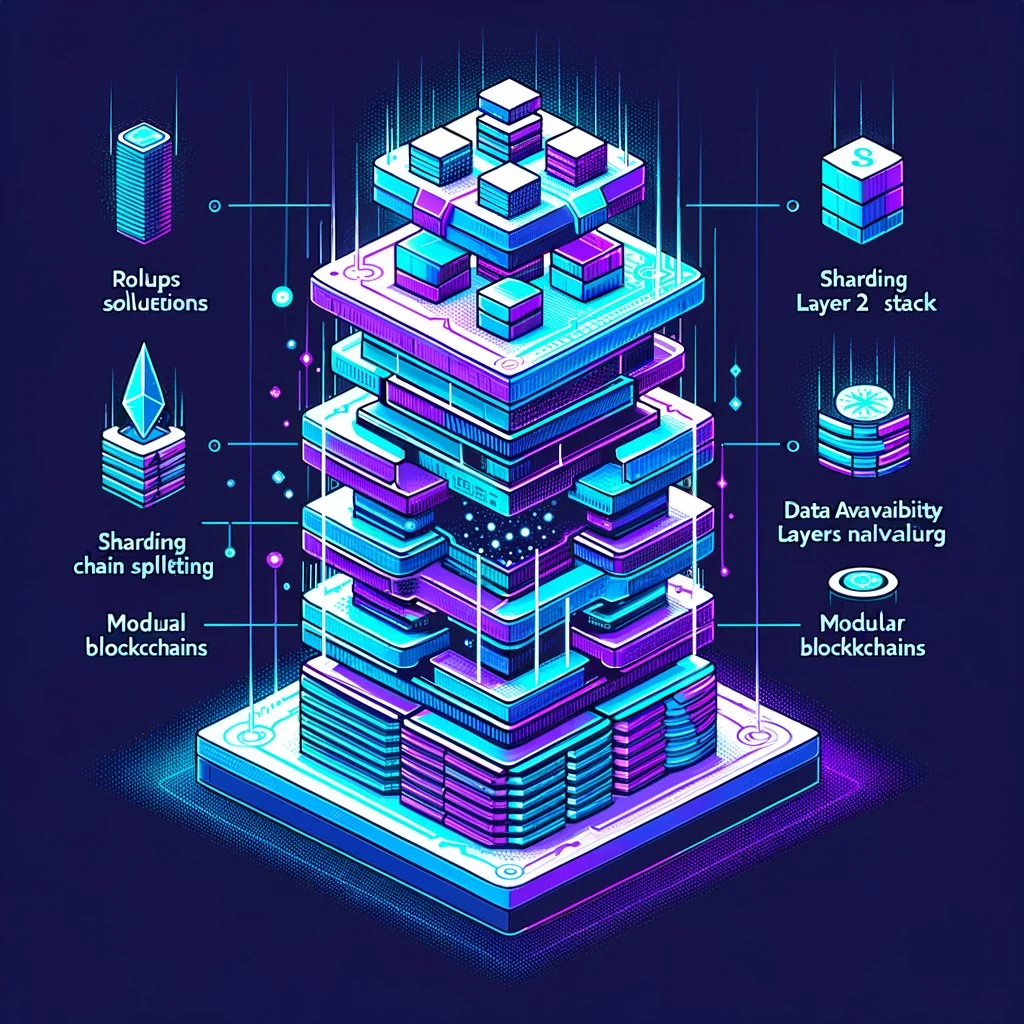
The most ambitious answer to the trilemma is the modular blockchain thesis, championed by projects like Celestia, EigenDA, and Avail. The idea is to separate the four core functions of a blockchain (execution, settlement, consensus, and data availability) into specialized layers that can each scale independently. Instead of one monolithic chain trying to do everything, a modular stack assigns each job to the layer best suited to it.
Celestia is a pure data availability layer. It does not execute transactions or run smart contracts. It only orders transactions and makes their data available for verification. Rollups can post their transaction data to Celestia (which is far cheaper than posting to Ethereum) and use their own logic for execution and a separate chain for settlement. The result is throughput that scales with the data availability layer rather than with execution throughput.
EigenDA and Avail are similar but with different trust models. EigenDA leverages Ethereum's restaking ecosystem to bootstrap economic security, while Avail (originally a Polygon project, now independent) uses its own validator set with a focus on light-client-friendly data availability sampling. The modular thesis is a genuine attempt to soften the trilemma by letting each layer optimize for its own corner of the triangle, and by 2026 it has produced live networks processing billions of dollars in value.
Has Anyone Actually Solved the Trilemma?
The honest answer is no, but the trade-offs have meaningfully softened. Every chain or stack that claims to have solved the trilemma has done so by relaxing one of the definitions. Some chains relax the "verifiable by anyone" requirement and allow only well-resourced validators. Some chains relax the "single global state" requirement and shard transactions across sub-chains, which works for parallelizable workloads but breaks for use cases like global DeFi where atomicity matters. Some chains relax the "instant finality" expectation and use probabilistic finality that gets stronger over time.
- Rollups inherit L1 security while scaling 100x
- ZK proofs let light clients verify huge state changes
- Modular DA layers decouple throughput from execution
- Solana and Aptos hit 5000+ real TPS with thousands of nodes
- Hardware is getting cheaper faster than state grows
- L2 sequencers remain centralized in most rollups
- High-TPS chains require data-center-grade hardware
- Modular adds new trust assumptions between layers
- Bridges between rollups and chains remain hacked frequently
- Liveness halts on monolithic high-throughput chains persist
What has changed is the curve along which the trilemma operates. In 2017, the Pareto frontier of decentralization, scalability, and security was painfully steep. Adding any meaningful throughput came at significant cost to one of the other vertices. By 2026, advances in cryptography (ZK proofs, data availability sampling), engineering (parallel execution, optimized state management), and architecture (modular stacks) have pushed the frontier outward. Chains that would have been considered impossible a decade ago, like Ethereum with 100,000 TPS effective throughput via rollups while maintaining a million validators, are now reality.
The frontier has moved, but it still exists. Every chain still picks a point on a triangle, even if the triangle itself has gotten larger. The question for the next decade is whether further cryptographic and engineering breakthroughs will continue to expand the frontier, or whether we are approaching a hard physical limit set by network bandwidth, hardware speeds, and the laws of distributed consensus.
What This Means for Users
For the average crypto user, the trilemma translates directly into three practical experiences: the fees you pay, how long you wait, and how confident you can be that your assets are safe. Understanding the trilemma helps you choose which chains to use for which purposes.
If you are moving life savings, holding for years, or transacting in amounts where settlement assurance matters more than speed, you want maximum security and decentralization. Bitcoin and Ethereum mainnet are the obvious choices. Yes, you will pay higher fees and wait longer. That is the cost of certainty. For storing wealth, paying $20 for a transaction once a year is not a meaningful expense relative to the assurance you get in return.
If you are trading, gaming, or making many small transactions, you want scalability. Solana, BSC, modern L2s like Arbitrum or Base, or chains like Sui and Aptos are all reasonable choices. The trade-offs are real (slightly weaker decentralization, occasional outages on monolithic chains, sequencer centralization on rollups) but for high-frequency low-value transactions, those trade-offs are usually worth taking. The cost of a $50 gas fee on Ethereum mainnet to swap $100 worth of memecoins is obviously absurd.
If you are bridging or using rollups, take five minutes to understand the security model of the specific rollup. Does it have fraud proofs deployed? Who can post state roots? How decentralized is the sequencer? Is the bridge between L1 and L2 native to the rollup or a third-party multisig? These details matter, because the security of your assets depends on the weakest link in the stack you are using.
What This Means for Developers
For developers building on top of blockchains, the trilemma forces a choice about which trade-off profile fits your application. There is no universally best chain. There are only chains that fit specific use cases.
For applications that handle high value and need maximum settlement assurance (institutional DeFi, large stablecoin transfers, blue-chip NFTs), build on Ethereum mainnet or its most security-focused L2s. Accept that fees will be higher and design your UX around that constraint. Your users are not optimizing for cents per transaction. They are optimizing for confidence that the network will be there in 20 years and that no government, foundation, or company can rug them.
For applications that need massive throughput and tight UX (gaming, social, prediction markets, consumer payments), build on Solana, Sui, Aptos, or modern Ethereum L2s with strong infrastructure. Your users want apps that feel like Web2, and a 12-second confirmation window kills your retention curve. Take the slightly weaker decentralization profile in exchange for the latency improvements.
For applications that need specific properties (privacy, app-specific governance, customized fee markets), consider rollups, app-chains, or Cosmos zones. The proliferation of frameworks like the OP Stack, Arbitrum Orbit, Polygon CDK, and Cosmos SDK means that launching an application-specific chain is no longer a moonshot. The trilemma still applies, but you get to choose your specific point on the triangle.
The Future: Quantum, Restaking, and the Sovereignty Axis
Three trends are reshaping the trilemma in 2026 and beyond. First, the looming threat of cryptographically relevant quantum computers is forcing every chain to plan for post-quantum signature schemes. ECDSA, the signature scheme used by Bitcoin and Ethereum, is theoretically vulnerable to Shor's algorithm running on a sufficiently powerful quantum machine. The timeline is debated, but every serious chain is now researching lattice-based or hash-based replacements. This is primarily a security axis change, but the new schemes typically have larger signatures, which affects scalability.
Second, restaking (popularized by EigenLayer on Ethereum) is letting protocols share security across multiple use cases. Validators stake ETH to secure Ethereum consensus, then opt in to secure additional services (oracles, bridges, data availability layers, app-chains) that pay them additional yield in exchange for taking on additional slashing risk. Restaking effectively extends Ethereum's security budget to new use cases, which is a clever way to amortize the cost of decentralized security across more services. It also introduces new systemic risks, because correlated slashing events could cascade.
Third, an emerging school of thought argues for adding a fourth axis to the trilemma: sovereignty. As app-chains and rollups proliferate, projects increasingly value control over their own chain logic, governance, and economics. A chain that lets a project freely fork its rules and migrate is more sovereign than one bound by a parent chain's governance. Sovereignty is partly orthogonal to the original three properties and partly in tension with them, since a fully sovereign chain has to bootstrap its own security rather than borrowing it from a parent. The trilemma may become a tetralemma over the next decade as the design space matures further.
Frequently Asked Questions
Who coined the blockchain trilemma?
The term blockchain trilemma was popularized by Vitalik Buterin, the co-founder of Ethereum, in research notes and talks dating back to 2017. The underlying trade-off had been discussed informally in the Bitcoin community for years, but Buterin gave it a clear name and framing that has shaped the entire field of blockchain research since.
Is the blockchain trilemma solved?
No, but the trade-offs have meaningfully softened thanks to rollups, ZK proofs, and modular blockchain architectures. Every chain still picks a point on a triangle of trade-offs, but the triangle is larger in 2026 than it was a decade ago. Anyone claiming to have fully solved the trilemma has usually relaxed one of its definitions.
Can a blockchain have all 3 trilemma properties at once?
Not in equal maximum measure on a single monolithic chain. Modular stacks like Ethereum plus rollups plus a data availability layer come closest, by letting each layer specialize in one or two properties while composing into a system that approximates all three. Pure monolithic chains always sit at a clear point on the triangle.
Which crypto is most scalable in 2026?
By raw real-world TPS, Solana, Sui, and Aptos lead among major monolithic L1s, each handling several thousand TPS with sub-second finality. By total ecosystem throughput including Layer 2s, Ethereum leads, with rollups like Arbitrum, Base, Optimism, and zkSync collectively processing tens of thousands of TPS while inheriting Ethereum L1 security.
What is the data availability layer?
The data availability layer is the component of a blockchain stack that guarantees transaction data is published and retrievable by anyone. In modular blockchains like Celestia, EigenDA, and Avail, data availability is separated from execution and settlement so that rollups can post their data cheaply to a specialized DA layer instead of paying expensive Ethereum gas fees.
Are rollups the answer to the trilemma?
Rollups are the most successful answer so far for chains that prioritize decentralization and security on the base layer. They scale execution off-chain while inheriting L1 security through fraud proofs or validity proofs. They are not perfect, since sequencers are often centralized and cross-rollup interoperability is still maturing, but they have proven that you can scale a chain meaningfully without sacrificing base-layer decentralization.
Why is decentralization so hard to measure?
Decentralization has multiple dimensions including validator count, geographic spread, client diversity, hardware floor, governance distribution, and resistance to capture. A chain might score well on one metric (many validators) but poorly on another (validators all run the same client software). Common composite metrics like the Nakamoto coefficient help summarize the picture but no single number captures every dimension.
What is the difference between sharding and rollups?
Sharding splits a blockchain into parallel sub-chains that each process a subset of transactions, with the protocol providing security across all shards. Rollups execute transactions off-chain in a separate environment and post compressed proofs back to the main chain. Sharding is a horizontal scaling technique inside a single chain, while rollups are an external execution layer that inherits security from a base chain.
Conclusion
The blockchain trilemma is the most important concept in cryptocurrency for understanding why chains behave the way they do. It is not a marketing slogan to be solved with a clever rebrand. It is a structural reality of distributed consensus, formalized by Vitalik Buterin and stress-tested by every major chain since. Bitcoin chose security and decentralization. Ethereum is using rollups to bend the curve. Solana scales the base layer at the cost of harder validation. BSC trades decentralization for cheap throughput. Each chain occupies a different point on the triangle, and that point determines the entire shape of the network's economics, governance, and user experience.
The good news is that the frontier of what is achievable has moved dramatically since 2017. Cryptographic breakthroughs in zero-knowledge proofs, engineering advances in parallel execution, and architectural innovations like modular blockchains have all expanded the design space. By 2026 it is possible to build systems that would have seemed impossible a decade ago, with effective throughput in the tens of thousands of TPS while maintaining truly permissionless validation. The trilemma still exists, but the trade-offs are softer and the choices richer.
The next time you see a new chain claim to have solved the trilemma, do not take the slogan at face value. Ask which property they relaxed to make the math work. Ask about validator count, hardware requirements, finality guarantees, and the trust model for any bridges or sequencers. Read the comparison matrix in this guide and place the chain on the triangle yourself. The blockchain that fits your needs depends on what you are doing, and the trilemma is the framework that turns that abstract question into a concrete choice. Understanding it is the difference between buying into a marketing pitch and making an informed decision about where to put your transactions, your applications, and your capital.