Lightning Network Setup: How to Open Your First Channel

Running payments directly on Bitcoin's base layer can be slow and expensive. We break down channel reserves, inbound liquidity splits, and automated LSP architectures.
The Liquidity Layer: Moving Past On-Chain Scalability Constraints
- Bitcoin's base layer provides unmatched, high-assurance global settlement security. However, because block space is strictly limited and transaction confirmation times average 10 minutes, running high-frequency web micro-payments directly on Layer 1 is technically and economically unfeasible.
- The Lightning Network elegantly circumvents this scaling limit. Operating as an off-chain Layer 2 transaction grid, Lightning maps a borderless web of bidirectional payment channels pre-funded by smart contracts. Opening your first channel means transitioning from slow base-layer settlements into instantly clearing, micro-fee payments. This structural guide details the underlying liquidity rules, protocol fee matrices, and various onboarding paths, from zero-config mobile software to professional cloud routing nodes.
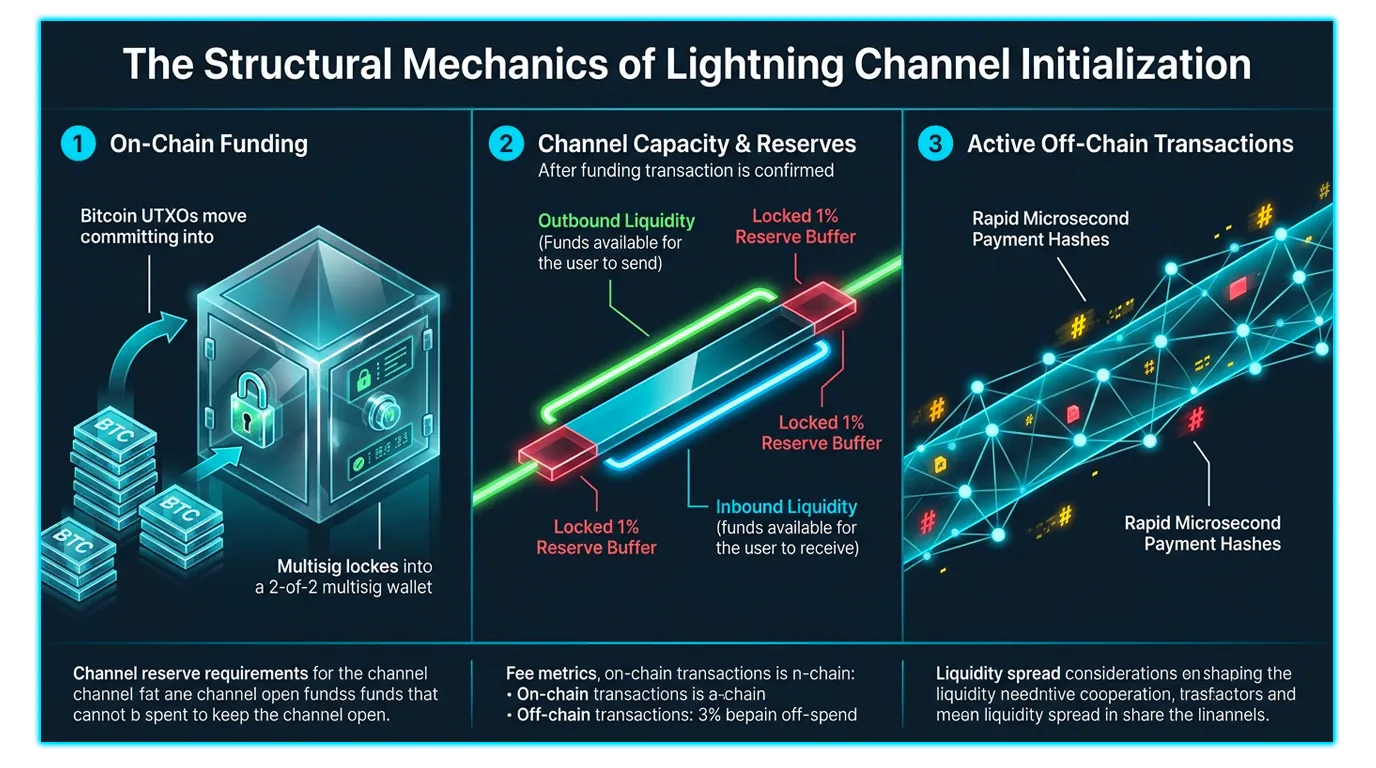
1. Structural Mechanics: Liquidity Splits and Channel Reserves
Before initiating a channel transaction, a user must understand the fundamental physical constraints of Lightning liquidity. A payment channel behaves exactly like an abacus: to push coins to one side, those coins must already physically exist within the channel loop.
Channel Creation and LSP Charges
Opening a channel is fundamentally an on-chain action that locks a Bitcoin UTXO into a 2-of-2 multisig smart contract. You must pay the baseline Bitcoin miner network mining fees to confirm this setup transaction on Layer 1. When using consumer mobile wallets, automated entities called Liquidity Service Providers (LSPs) manage this setup for you "on-the-fly," charging either a flat satoshi processing fee or a nominal percentage tax to open and manage the liquidity lines instantly.
Off-Chain Routing Parameters
Once a channel confirms, subsequent payments routed across the network bypass miners entirely. Instead, intermediate routing nodes forward your payment hashes, charging micro-fees built around two explicit parameters:
Base Fee: A flat, fixed cost applied to every transaction regardless of size, denominated in millisatoshis (msats) (where 1,000 msat = 1 satoshi).
Fee Rate: A proportional charge calculated based on the total transaction value being moved, expressed in parts per million (ppm). For example, a fee rate of 200 ppm translates to a tiny 0.02% tax (200 satoshis per million sats routed).
3. Onboarding Pathways: Selecting Your Node Architecture
How you choose to open your first channel depends on your target budget, technical expertise, and desire for capital sovereignty.
Phoenix: Automated Splicing Mobile Node
- Developed by ACINQ, Phoenix operates as a native, self-custodial mobile wallet that runs a full Lightning node directly on your phone. Phoenix simplifies liquidity management through an advanced implementation called splicing. Instead of cluttering your dashboard with dozens of isolated channels,
- Phoenix merges your liquidity into a single dynamic channel. When you add on-chain funds or receive a payment that exceeds current capacities, Phoenix automatically executes a "splice-in" transaction directly on Layer 1, charging raw network mining fees to resize your channel capacity on-the-fly without locking you into percentage fees.
Breez: The SDK-Driven Mobility Client
Breez functions as another premier self-custodial mobile wallet that abstracts channel management via its native LSP engine. When an incoming payment demands a fresh channel open, Breez automatically creates a channel on-the-fly, charging a flat setup fee (typically 0.4% to 0.75% of the amount received, with a minimum 2,000 satoshi floor to cover baseline on-chain miner demand). Breez has increasingly modularized its core architecture into an open-source SDK, allowing developers to embed automated Lightning infrastructure directly into third-party consumer fintech apps.
Umbrel: Sovereignty via Self-Hosted Hardware
For users seeking maximum economic autonomy, Umbrel provides a plug-and-play home server operating system that transforms a mini PC or Raspberry Pi into a dedicated Bitcoin and Lightning node. Running an Umbrel node gives you absolute, unfiltered control over channel parameters. Using node management toolkits like ThunderHub or Ride The Lightning (RTL), you scan network topologies, select high-reputation peer nodes manually, fund large public channels (recommended at 1,000,000+ sats minimum), and set your own custom base and ppm fee rates to farm passive routing income.
Voltage: Enterprise Cloud-Hosted Infrastructure
If you want to run a dedicated, high-performance routing node but want to sidestep the physical risks of home setups (such as local internet blackouts, hardware drive failures, or power grid failures) Voltage offers a robust enterprise alternative. Voltage provisions production-grade LND and Core Lightning instances natively within secure cloud environments. Operators manage their cryptographic nodes remotely through advanced APIs and graphical interfaces, enjoying perfect 24/7 uptime to execute rapid batch channel openings and manage high-volume commercial flows smoothly.
Lightning Network Infrastructure Deployment Matrix
| Platform | Node Type | Channel Management | Primary Fee Model |
| Phoenix | Mobile Edge | Automated Splicing | Mining fee per splice |
| Breez | Mobile Edge | Automated LSP | On-the-fly LSP % fee |
| Umbrel | Bare-Metal Home | 100% Manual User | Miner fee to open |
| Voltage | Cloud Hosted | Enterprise Developer | Cloud subscription + Miner fee |
4. Monitoring Layer-2 Ecosystem Metrics via DEXTools Telemetry
- As decentralized scalability infrastructure scales across both Bitcoin and specialized Layer-2 ecosystems, tracking capital velocities, liquidity depth configurations, and the secondary market health of network utility protocols becomes an indispensable risk mitigation strategy. Sourcing analytics through advanced decentralized charting architectures like DEXTools gives market participants an essential universal platform to monitor live token behaviors, evaluate pool depths, and inspect contract parameters across all public execution networks.
- By leveraging core features like the Pair Explorer, Live New Pairs dashboard, and the integrated Trade Story or Top Traders diagnostic tools, technical traders can seamlessly audit localized volume trends, track large whale wallet capital reallocations via the Big Swap Explorer, and check automated contract safety scores before initiating any on-chain interactions, ensuring your hardened hardware setup interacts safely with verified market venues.
You can access DEXTools here and start trading today!
Disclaimer: This article is for informational purposes only and does not constitute investment advice, financial advice, trading advice, or any other kind of advice. DEXTools does not recommend buying, selling, or holding any cryptocurrency or token. Users should conduct their own research and consult with a qualified financial advisor before making any investment decisions. Cryptocurrency investments are volatile and high-risk. DEXTools is not responsible for any losses incurred.
Related Guides
- What is the Lightning Network? Bitcoin L2 Scalability Guide
- What Is the Lightning Network? How Bitcoin Layer 2 Works
- How to Use Kraken Exchange: Account Setup, Verification and First Trade (2026)
- How to Use Base Chain in 2026: Wallet Setup, Bridge and First Transaction Guide
- DEXTools Beginner Tutorial: Setup, Navigation and First Trade Checks (2026)