Based Rollups Explained: Ethereum Scaling Guide
— By Whatsertrade in Tutorials

Based rollups explained: learn how they change sequencing on Ethereum and why they matter for decentralization, fragmentation, and Layer 2 design.
This page explains what based rollups are and why they matter for Ethereum sequencing. It is a Layer 2 architecture guide, not a general ETH scaling listicle.
Key Takeaways
- What Are Based Rollups
- Why Sequencing Matters
- How Based Rollups Could Improve Ethereum Scaling
- The Role Of Preconfirmations
- Why Traders Should Care
- Based Rollups And L2 Fragmentation
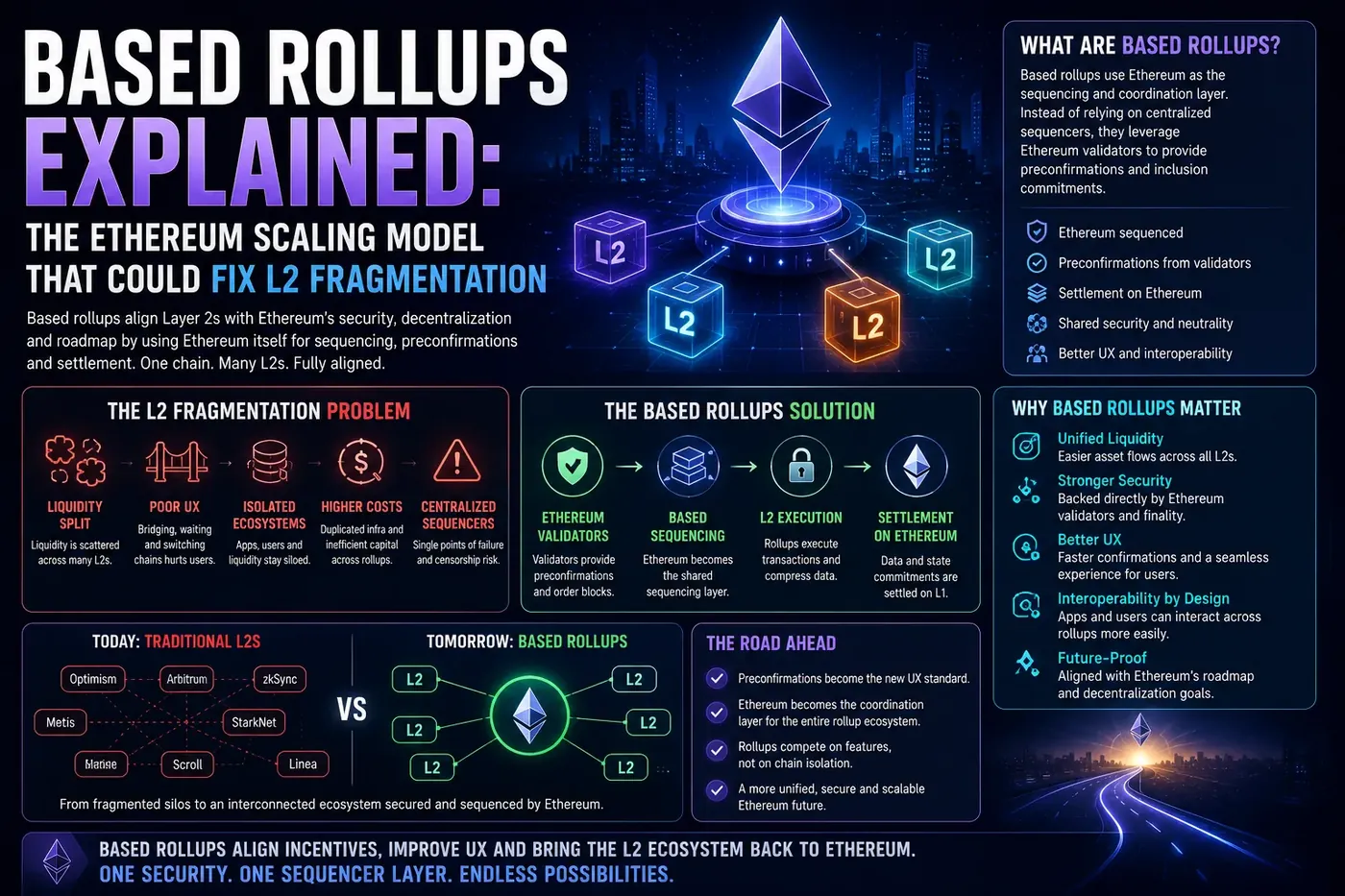
Ethereum scaling has made major progress, but it has also created a new challenge. The ecosystem now has many Layer 2 networks, each with its own sequencer, liquidity, bridges, applications and user experience. Transactions are cheaper, but the system can feel fragmented.
Based rollups are one proposed answer to this problem.
They aim to bring rollup sequencing closer to Ethereum itself, reducing dependence on centralized sequencers and creating a more native scaling model for the Ethereum ecosystem.
What Are Based Rollups
A based rollup is a rollup that uses Ethereum validators or Ethereum aligned infrastructure to sequence transactions. In a typical rollup today, a centralized or semi centralized sequencer orders transactions before they are posted to Ethereum. This can be fast and efficient, but it introduces trust assumptions and potential points of control.
Based rollups take a different approach. Instead of relying on an independent sequencer, they use Ethereum as the sequencing layer. This can make the rollup more aligned with Ethereum security and neutrality.
The idea is simple but powerful. If Ethereum already provides decentralized validation, why not use that foundation for ordering rollup transactions too?
Why Sequencing Matters
Sequencing is the process of ordering transactions. In DeFi, order matters a lot. The order of swaps, liquidations, arbitrage trades and token launches can determine who profits and who loses.
When a single sequencer controls ordering, users must trust that sequencer to behave fairly. A centralized sequencer can also create downtime risk. If it fails, the rollup experience can degrade.
Sequencing also connects to MEV, which stands for maximal extractable value. Whoever influences transaction order may influence value extraction. This makes sequencing one of the most important parts of rollup design.
Based rollups attempt to move this power closer to Ethereum rather than leaving it in the hands of separate operators.
How Based Rollups Could Improve Ethereum Scaling
The first benefit is stronger alignment with Ethereum. A based rollup can inherit more of Ethereum's neutrality by using Ethereum validators for sequencing.
The second benefit is reduced centralization risk. If transaction ordering depends on Ethereum rather than one rollup operator, users may face fewer trust assumptions.
The third benefit is better composability in the long term. If multiple rollups use Ethereum aligned sequencing, cross rollup coordination could become cleaner.
The fourth benefit is credibility. Ethereum users care about decentralization. A scaling system that feels more native to Ethereum may attract developers and liquidity that want stronger security guarantees.
The Role Of Preconfirmations
One challenge for based rollups is speed. If a rollup waits directly for Ethereum block times, the user experience may feel slower than current L2 sequencers. Traders expect fast confirmations, especially on decentralized exchanges.
This is where preconfirmations matter.
A preconfirmation is an early promise that a transaction will be included. It gives users faster feedback before final settlement. For traders, this can create a smoother experience while still keeping the rollup connected to Ethereum sequencing.
In a successful based rollup design, preconfirmations could provide the speed users expect while preserving stronger Ethereum alignment.
Why Traders Should Care
Traders may not care about rollup architecture until it affects execution. Based rollups could influence fees, confirmation speed, MEV exposure, liquidity routing and cross chain trading.
If based rollups reduce sequencer risk, traders may gain more confidence during volatile periods. If they improve neutrality, trading environments may become fairer. If they support better cross rollup coordination, liquidity may become easier to access.
On the other hand, if preconfirmation systems are poorly designed, traders could face uncertainty around execution. The details matter.
Based rollups are not just infrastructure theory. They could shape how swaps, liquidations and arbitrage work across Ethereum L2 networks.
Based Rollups And L2 Fragmentation
L2 fragmentation is one of the biggest user experience problems in Ethereum today. Assets sit on different networks. Applications launch on different rollups. Bridges add friction. Users must constantly choose where to trade.
Based rollups do not solve all fragmentation by themselves, but they may help create a more unified foundation. If more rollups share Ethereum based sequencing, coordination between them can become more natural.
This could support a future where users interact with applications without constantly thinking about networks, bridges and sequencers.
The long term goal is not just cheaper transactions. It is a more coherent Ethereum experience.
Risks And Tradeoffs
Based rollups also have tradeoffs. They may be technically harder to build. They may need strong preconfirmation markets to compete with fast centralized sequencers. They may create new forms of competition among validators, builders and rollup teams.
There is also a business model question. Many rollups earn value from sequencing. If sequencing moves closer to Ethereum, revenue models may change. This could affect incentives for L2 teams.
Another challenge is adoption. Developers and users often choose speed and liquidity first. A based rollup must provide a strong user experience, not just better decentralization.
Why Based Rollups Fit Ethereum's Long Term Vision
Ethereum's roadmap is built around scaling through rollups while preserving the base layer as a secure settlement and coordination layer. Based rollups fit this vision because they keep rollups tightly connected to Ethereum.
They also reflect a broader trend. The ecosystem is moving from isolated L2 networks toward more shared infrastructure. Shared sequencing, intents, preconfirmations and chain abstraction are all part of this shift.
Based rollups may become one of the key models for making Ethereum scaling feel more unified and less fragmented.
Final Thoughts
Based rollups are an important idea because they address a central question in Ethereum scaling. How can rollups stay fast and affordable without sacrificing neutrality, decentralization and alignment with Ethereum?
The answer may involve Ethereum based sequencing, preconfirmations and new coordination systems between rollups.
For traders, this matters because infrastructure shapes execution. The next generation of L2 networks will not only compete on fees. They will compete on trust, speed, liquidity and fairness.
Based rollups could become a major step toward a more unified Ethereum ecosystem.
How to Bridge Crypto Between Chains: Complete Cross-Chain Tutorial 2026 How to Use 1inch: Complete DEX Aggregator Swap Tutorial (2026) How to Use OKX Web3 Wallet: Multi-Chain DeFi Hub Guide (2026) How to Bridge Crypto Between Chains: Complete Cross-Chain Tutorial 2026 How to Use 1inch: Complete DEX Aggregator Swap Tutorial (2026) How to Use OKX Web3 Wallet: Multi-Chain DeFi Hub Guide (2026)Related Guides
- What Is Movement Labs? Move-Based Ethereum L2 Guide 2026
- Top 5 Layer 2 Networks in 2026: Best Ethereum Scaling Solutions Compared
- Ethereum's Layer 2 vs. Layer 3: Specialized Scaling
- What is the Lightning Network? Bitcoin L2 Scalability Guide
- What Is Sui? Beginner Guide to the Move-Based L1 and SUI Token (2026)
- Danksharding Explained
Frequently Asked Questions
What is a based rollup?
A based rollup is a Layer 2 rollup that uses Ethereum's own Layer 1 validators to decide transaction ordering, instead of relying on its own separate sequencer. This means the underlying base layer drives sequencing for the rollup.
How is a based rollup different from a normal rollup?
A typical rollup usually runs a dedicated sequencer, often a single centralized one, to order and batch transactions. A based rollup delegates that sequencing role to Layer 1 validators, which is intended to inherit more of the base layer's decentralization and censorship resistance.
Why do based rollups matter for Ethereum scaling?
They aim to scale Ethereum while reducing the centralization and trust assumptions tied to standalone sequencers. They are also discussed as a way to reduce fragmentation and improve interoperability across Layer 2 ecosystems.
What are the trade-offs of based rollups?
Relying on Layer 1 for sequencing can simplify some trust assumptions but may affect transaction speed, fee capture, and how much control the rollup team has over ordering. The design space is still evolving, so different implementations make different trade-offs.