How Blockchain Sharding Works: Parallelization, Throughput and Design Tradeoffs (2026)
— By Tony Rabbit in Tutorials

Learn how blockchain sharding works, why parallelization matters for throughput, and what design tradeoffs appear when chains split work across shards.
Intent check: This page is about sharding as one scalability architecture. If you want the broader framework of security, decentralization, and scalability tradeoffs, read Blockchain Scalability Tradeoffs.
If a single highway has only one lane, no amount of clever traffic lights can turn it into a freeway. That is essentially the problem most early blockchains run into the moment adoption picks up. Every full node has to process every transaction, store every piece of state, and verify every block. The result is congestion, soaring fees, and the painful realization that decentralization and scalability are pulling in opposite directions. Sharding is the architectural answer the industry keeps coming back to, and in 2026 it is more relevant than ever.
This guide is the crypto-specific take on sharding. If you searched for "what is sharding" expecting database talk, you are in the right place but with a twist. We will cover sharding as it lives inside blockchain networks: how nodes are split into committees, how transactions get routed across parallel chains, how state is partitioned, and how the entire mess stays secure under adversarial conditions. Database sharding inspired the name, but blockchain sharding has to solve problems no SQL cluster ever faced, like Sybil resistance, fork choice, and cross-shard atomicity.
By the end of this article you will understand the three core flavors of sharding, why Ethereum quietly pivoted from execution sharding to data sharding, how networks like NEAR, TON, Polkadot, Zilliqa, and MultiversX implement it in production, how rollups and sharding interact in the modular stack, and which open problems remain unsolved heading into the next cycle. This is a long read written for developers and advanced users who want substance, not slogans.
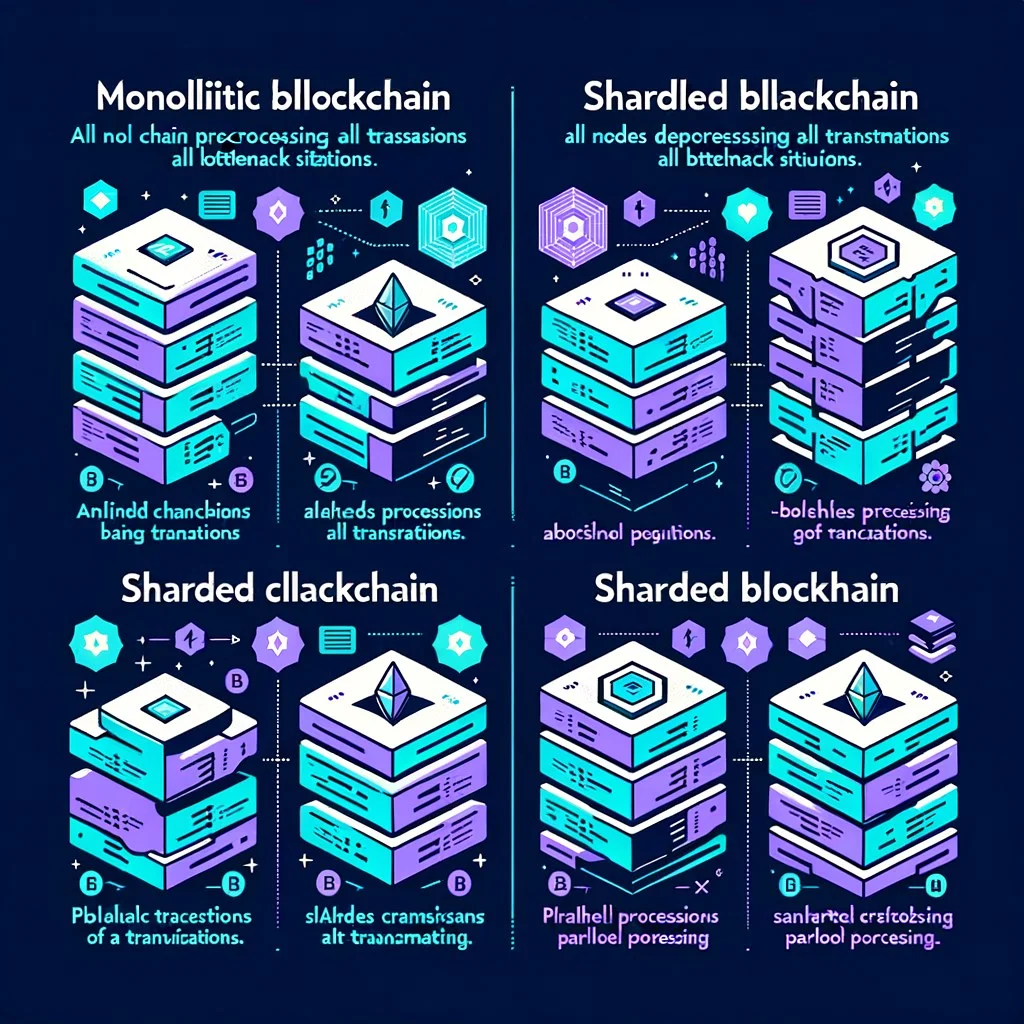
What Is Sharding in Blockchain
Sharding is a horizontal partitioning technique borrowed from distributed databases and adapted to blockchain consensus. Instead of asking every node to validate every transaction across one global chain, the network is split into smaller groups called shards. Each shard processes its own subset of transactions, maintains its own portion of the state, and produces its own blocks in parallel with the others. A coordination layer, often called the beacon chain or relay chain, stitches everything together and keeps the shards in agreement on global ordering and finality.
The crypto-specific twist matters. In a database, you trust the operator and the only enemy is hardware failure. In a public blockchain, the operator does not exist and the enemy is a financially motivated attacker. So a blockchain shard cannot simply be "any node that happens to hold this partition." It has to be a randomly assigned, periodically rotated validator subset with enough collective stake to make corruption economically irrational. Random committee assignment is the secret sauce that turns database sharding into something safe to deploy on a permissionless network.
You can think of a sharded blockchain as a federation of mini-chains that share a security budget. Every shard inherits the security of the whole validator set through random sampling and cryptographic attestation, while only processing a fraction of the workload. That is the trick that lets total network throughput grow roughly linearly with the number of shards, at least in theory. In practice there are caveats around cross-shard messaging, data availability, and validator load that the rest of this guide will unpack.
Why Blockchains Need Scaling
Before getting into sharding mechanics, it is worth grounding why the industry obsesses over scalability. Bitcoin processes around 7 transactions per second. Ethereum mainnet sits at roughly 15 to 30 TPS depending on transaction complexity. Visa, for comparison, handles tens of thousands per second on a normal day and peaks far higher during shopping holidays. If crypto wants to host social networks, gaming economies, and high-frequency trading, those numbers are non-starters.
The bottleneck is not bandwidth, it is the requirement that every full node must independently verify every transaction. That requirement is what gives a blockchain its trust-minimized properties. You do not have to trust miners, validators, or other users because you can run a node yourself and check the entire history. But this same property caps throughput at the speed of the slowest reasonable consumer hardware. Push too hard on block size or block time and you push validators off the network, centralizing the chain into a small set of well-funded operators.
This is the famous blockchain trilemma articulated by Vitalik Buterin: decentralization, security, and scalability, pick two. Sharding is the most direct architectural attempt to break the trilemma by reducing the per-node workload without reducing the number of nodes. Other approaches like Layer 2 rollups attack the same problem from a different angle by moving execution off-chain. The two strategies are complementary, not mutually exclusive, and 2026 has shown they work best together.
Congestion is not an abstract concern. During the 2021 NFT boom and the 2024 inscription craze, Ethereum gas fees regularly exceeded 200 gwei, making a single swap cost over 100 dollars. Solana has suffered repeated outages when transaction floods overwhelmed its leader nodes. Bitcoin mempool backlogs during ordinal frenzies pushed fees past 50 dollars per transaction. Every wave of adoption stress-tests the underlying architecture, and the chains that handled it best either had sharding-like designs or aggressive Layer 2 ecosystems.
How Sharding Works: The Core Idea
At its most fundamental level, sharding does three things in parallel. It splits the validator set into committees, splits the transaction load across those committees, and splits the global state so each committee only needs to hold a portion of it. Each of these splits can be implemented independently, which is why you will hear about network sharding, transaction sharding, and state sharding as separate concepts even though a complete sharded chain combines all three.
The coordination problem is what makes blockchain sharding hard. In a non-sharded chain, the global state transitions in lockstep: every block updates every account that was touched, and every node sees the same view. In a sharded chain, shard A might be transferring tokens between two accounts at the same moment shard B is updating a smart contract that depends on those accounts. Without careful design, you get inconsistent state, double spends, or stalled cross-shard transactions. Most modern designs solve this with a beacon chain that produces a canonical ordering of shard block headers, plus a messaging protocol that lets shards reference each other's finalized state.
1/N of TX
1/N of TX
1/N of TX
1/N of TX
The diagram above shows the core difference visually. On the left, every node carries the full burden, so adding nodes only adds redundancy, not capacity. On the right, work is partitioned, so adding shards effectively adds capacity, with the beacon chain providing the global consistency that keeps it all coherent. The exact mechanism for splitting work and coordinating state is where every sharded protocol differs.
The Three Types of Sharding
Sharding is not one technique, it is a family of three related techniques that are often combined. Understanding the distinction matters because some chains call themselves "sharded" while only implementing one of the three, and the security and scalability implications differ significantly.
Splits the validator set into committees. Each committee handles a different shard. Earliest and simplest form of sharding.
Routes transactions to specific shards based on sender, contract, or hash. Each shard processes its assigned TX subset in parallel.
Partitions the global state so each shard stores only its slice. Most powerful and most complex form. Cuts node storage requirements drastically.
Network Sharding
Network sharding is the most basic flavor. The validator set is divided into committees through a random shuffling process, often driven by a verifiable random function or VRF on the beacon chain. Each committee is responsible for one shard's consensus and block production for a defined epoch, after which the assignment is reshuffled. This rotation is critical for security because it makes it economically infeasible for an attacker to bribe or compromise the validators of a specific shard, since they do not know in advance which shard they will land on.
Network sharding by itself does not increase throughput much because every node may still need to verify the outputs of every shard. Its real value is in setting up the security primitive that the other two sharding types depend on. Without random committee assignment, transaction and state sharding would be wide open to targeted attacks against specific partitions.
Transaction Sharding
Transaction sharding routes individual transactions to specific shards. The routing key can be the sender's address, the destination contract, or a hash of the transaction itself. Zilliqa, one of the earliest production deployments of transaction sharding, splits transactions by sender address. Each shard processes its subset in parallel, then submits its results to a final consensus step where the global block is assembled.
The catch with transaction sharding alone is that all nodes still need to store the full state. So while you get parallel execution, you do not get the storage reduction that comes with state sharding. This is sometimes called "execution sharding" in Ethereum's earlier roadmap documents.
State Sharding
State sharding is the heaviest lift and the biggest payoff. The global state is partitioned so that each shard only stores a portion. A node assigned to shard 3 only needs to keep the accounts, balances, and smart contract storage that live on shard 3. The result is a dramatic reduction in storage and bandwidth requirements per node, which means cheaper hardware, easier participation, and more decentralization.
The cost is complexity. When a transaction needs to read or write state on a different shard than the one it was submitted to, the shards have to communicate. This is the cross-shard problem, and it dominates the engineering challenges of building a state-sharded chain. We will dig into it in the next section.
Cross-Shard Communication
Cross-shard transactions are where theory meets reality. Imagine Alice on shard 1 wants to send tokens to Bob on shard 2. The transfer cannot complete atomically within a single shard because the state changes touch two partitions that are produced by different committees in different blocks. If shard 1 deducts Alice's balance but shard 2 fails to credit Bob, you have lost funds. If the reverse happens, you have created funds out of thin air. Neither is acceptable.

Most production designs solve this with a two-phase commit protocol mediated by the beacon chain. Shard 1 first locks Alice's funds and emits a cross-shard receipt that gets recorded in its block header. The beacon chain finalizes that header. Shard 2 then includes the receipt in its next block, credits Bob, and emits a confirmation that gets included on the beacon chain. Only after both legs are finalized is the transfer considered complete. The whole dance typically takes one to a few seconds depending on the chain's slot time and finality gadget.
NEAR Protocol popularized a particularly elegant approach called asynchronous cross-shard transactions. NEAR treats every cross-shard call like an asynchronous message, similar to how microservices communicate over a network. The sender shard schedules the call, the receiver shard processes it in a later block, and any reply comes back asynchronously. Developers write contracts with explicit promise-based APIs, which makes the asynchrony visible at the application layer. The tradeoff is that smart contract code becomes more verbose, but the protocol gets to scale cleanly without exotic atomicity guarantees.
Polkadot uses a different model called Cross-Consensus Messaging or XCM. Parachains, which are essentially Polkadot's shards, communicate by sending XCM messages through the relay chain. Each parachain operates as a sovereign execution environment, and XCM provides a standardized format for asset transfers, contract calls, and governance actions across them. TON workchains use a hierarchy of shardchains and a masterchain that routes messages, with the masterchain producing global state proofs that every shard references.
Sharding Trade-Offs
Sharding is not free. The same partitioning that creates parallelism also creates new attack surfaces, and the engineering of a sharded chain is a constant balancing act. The most discussed risk is the single-shard takeover, sometimes called the 1% attack. In a chain with 100 shards and 10,000 total validators, each shard might only have 100 validators. An attacker who controls 1% of the total stake could in principle target a single shard and reach a majority there, even though they hold a tiny share of the network overall.
Random committee assignment is the primary defense. By rotating validator subset assignments unpredictably and frequently, the protocol denies the attacker the chance to concentrate stake on a target shard. A well-designed VRF combined with stake-weighted sampling makes the probability of an attacker controlling more than one third of any committee vanishingly small, assuming they do not control a supermajority of the total network. Many designs also require attestations from a quorum of validators outside the producing committee, adding another layer of defense.
The other big trade-off is data availability. If a shard's block producers publish a block but withhold the underlying transaction data, the rest of the network cannot verify the block or detect fraud. This is the data availability problem, and it has motivated a wave of innovation including modular blockchain designs and dedicated data availability layers like Celestia. We will revisit this in the data availability sampling section.
State growth, validator load balancing, and the complexity of running a node that may need to switch shards mid-epoch are additional pain points. None of these are insurmountable, but they explain why production sharded chains took years to mature and why some teams ultimately pivoted to rollup-centric scaling instead.
- Horizontal scalability: throughput grows with shard count
- Parallel execution: shards process blocks independently
- Lower hardware requirements: nodes store partial state
- Wider validator participation: cheaper to run a node
- Native L1 scaling: no bridge or rollup dependency
- Composable within shard: instant atomic ops in-shard
- Cross-shard complexity: async messaging breaks atomicity
- Single-shard security: 1% attack risk on small committees
- Data availability problem: nodes do not see all data
- Validator coordination: rotation overhead and sync costs
- Developer friction: contracts must handle async calls
- MEV fragmentation: ordering games multiply per shard
Sharding vs Rollups vs Sidechains
Crypto's scaling stack is a soup of overlapping concepts, and sharding gets confused with rollups and sidechains regularly. They are fundamentally different approaches even when they look similar from a user perspective. Sharding is a Layer 1 scaling technique that changes the base chain's architecture. Rollups are Layer 2 constructions that execute transactions off-chain and post compressed results back to the base layer. Sidechains are independent chains connected by bridges.
The clearest way to distinguish them is by where execution happens and where security comes from. Sharding executes on the base chain across multiple parallel chains, all secured by the same validator set. Rollups execute off-chain on their own sequencers but post data and proofs to the base layer, inheriting its security through cryptographic or economic guarantees. Sidechains execute on their own infrastructure with their own validators and only loosely connect to the main chain through bridges, meaning their security is independent.
Within rollups there is a further split between optimistic vs ZK rollups based on how they prove correctness back to the base layer. Optimistic rollups assume validity unless challenged within a window, while ZK rollups submit cryptographic proofs of correctness with each batch. Both approaches benefit enormously from sharded data availability on Layer 1, which is exactly where Ethereum's modern roadmap ended up.
In a fully modular stack, sharding and rollups complement each other. A sharded Layer 1 provides cheap, plentiful data availability and settlement. Rollups built on top of it execute the bulk of user transactions and post their compressed batches to the sharded base layer. This is the direction Ethereum has been heading since the 2022 merge, and it is where the industry consensus seems to be settling for the next cycle.
Sharding in Practice: Real Implementations
Theory is one thing, shipping it is another. A handful of networks have deployed sharding in production and have years of operational experience to draw from. Each made different design choices, and comparing them is instructive.
Dynamic resharding with chunks aggregated into a single logical block. Stateless validation via state witnesses keeps nodes lightweight.
First production sharded chain. PBFT-based committees process TX in parallel, then DS committee assembles the global block.
Heterogeneous shards (parachains) with their own runtimes, secured by a shared relay chain validator set. XCM for messaging.
Combines network, TX, and state sharding with adaptive shard count. Metachain coordinates and shuffles validators each epoch.
Infinite sharding paradigm with dynamic split and merge. Masterchain coordinates workchains, each of which can have its own shardchains.
Pivoted from execution sharding to data sharding via blobs (EIP-4844). Rollups use blob space for cheap data availability.
NEAR Nightshade
NEAR's Nightshade design treats the entire network as producing one logical block per slot, but that block is composed of "chunks," with each chunk produced by a different shard. Validators are split into committees that each take a chunk, and a beacon-like coordination produces the unified block header. NEAR has been live with this design since 2020 and has gradually expanded to more shards as the network grew. The asynchronous cross-contract call model is a defining feature of NEAR development, and it taught the industry valuable lessons about how to expose async semantics to developers.
Zilliqa
Zilliqa went live in 2019 and was the first major public chain to ship sharding. It uses network sharding plus transaction sharding without state sharding, meaning nodes still hold the full state. Throughput scales with the number of shards up to a ceiling, and the Directory Service (DS) committee assembles results from each shard committee into a global block. Zilliqa is a useful reference point because it proves the concept works in production, even if its design choices have been refined by later projects.
Polkadot Parachains
Polkadot's parachain model is sharding with sovereignty. Each parachain is essentially a heterogeneous shard with its own runtime logic, governance, and tokenomics, but secured by Polkadot's relay chain validator set through a process called shared security. Parachain validators are randomly assigned and rotated, and the relay chain provides finality. Parachain slots are auctioned, which gates how many parachains can exist at once but ensures each one has economic skin in the game.
MultiversX
MultiversX (formerly Elrond) implements adaptive state sharding, which automatically adjusts the number of shards based on network load. The metachain coordinates the worker shards, handles validator shuffling, and processes cross-shard finalizations. MultiversX combines all three sharding types in one design, and on testnets has demonstrated throughputs in the hundreds of thousands of TPS, though real-world usage has been lower.
TON Workchains
TON deserves a dedicated mention because its sharding model is unusually ambitious. The masterchain coordinates workchains, and each workchain can dynamically split into shardchains when load grows and merge back when it shrinks. This "infinite sharding paradigm" is designed to handle massive scale without requiring manual shard provisioning. If you want a deeper look, our dedicated TON sharding guide breaks down the masterchain, workchains, and shardchains hierarchy in detail.
Ethereum and Sharding
Ethereum's relationship with sharding is one of the most interesting case studies in protocol design. The original Ethereum 2.0 roadmap from 2017 envisioned 64 execution shards, each with its own state and transaction processing, all coordinated by the beacon chain. The Beacon Chain itself launched in December 2020, and for a while the community assumed full execution sharding was just a few years away.
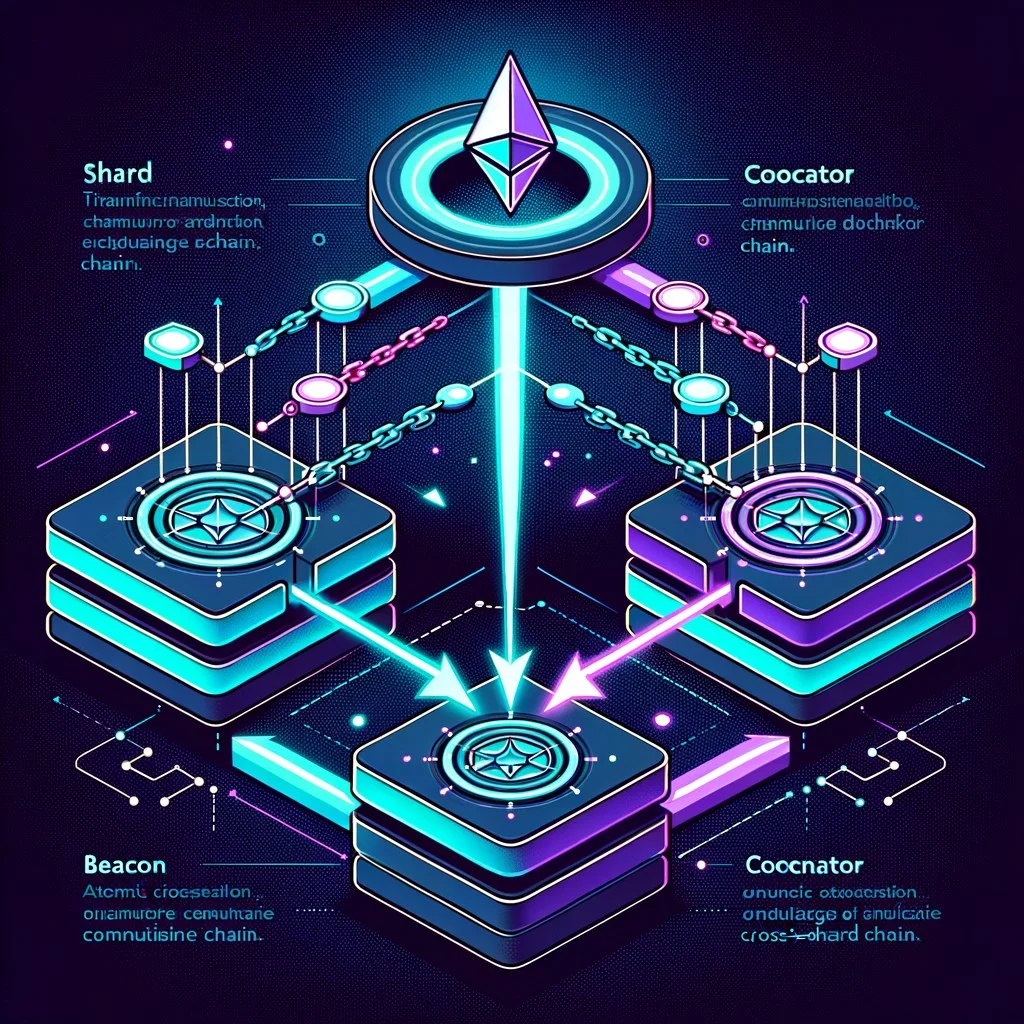
Then came the rollup-centric pivot. In late 2020 Vitalik Buterin proposed that instead of sharding execution at Layer 1, Ethereum should make rollups the primary scaling vehicle and shard data availability instead. The reasoning was that rollups, especially ZK rollups, could deliver execution scalability faster than rebuilding the EVM across multiple shards, and that the base layer could focus on what it does best: settlement and data availability. The community agreed, and execution sharding was effectively shelved.
What replaced it is danksharding. Proposed by Ethereum researcher Dankrad Feist, danksharding turns Ethereum into a data availability layer for rollups. Instead of multiple execution shards, the chain offers "blobs," which are large chunks of data attached to blocks but not processed by the EVM. Rollups post their compressed transaction data as blobs, get cheap storage, and inherit Ethereum's security. EIP-4844, also called proto-danksharding, shipped in 2024 and introduced blob-carrying transactions as a precursor to full danksharding.
In 2026, Ethereum is in the middle of rolling out full danksharding, which dramatically increases blob throughput and introduces data availability sampling so that no single node needs to download every blob. The end state is a chain where rollups handle execution, blobs provide cheap data availability, and ordinary full nodes verify everything through sampling and cryptographic commitments. It is sharding, just not the kind the 2017 roadmap promised.
Data Availability Sampling
Data availability sampling, often shortened to DAS, is one of the most important innovations in blockchain scalability research and it deserves its own section. The problem it solves is straightforward: in any sharded or rollup-based system, the network needs to be sure that the data behind a block has actually been published, even if no single node has downloaded all of it. Without that guarantee, a malicious block producer could publish a header but withhold the data, making fraud detection impossible.
The naive solution is to require every node to download all data, but that defeats the point of sharding. DAS solves this with erasure coding plus random sampling. The block data is erasure-coded so that any 50% of the encoded bytes is enough to reconstruct the full data. Each node then randomly samples small slices of the encoded data from the network. If a producer is withholding data, the missing slices will quickly show up across many independent samplers, and the block can be rejected before it gets finalized.
The math is beautiful. With only a few dozen random samples per node, the probability of failing to detect a missing data block becomes vanishingly small. This means that even very lightweight clients, including mobile and browser-based ones, can participate in data availability verification without downloading the full chain. data availability sampling is at the heart of Ethereum's full danksharding plan and is also the core technology behind Celestia, the first chain designed from scratch as a dedicated data availability layer.
Celestia and similar projects belong to the modular blockchain movement, which separates execution, settlement, consensus, and data availability into specialized layers. A rollup might execute transactions, settle disputes on Ethereum, achieve consensus through its own sequencer, and post data to Celestia for availability. Sharded data layers and modular architectures are converging on the same vision: keep each function narrow, scale each layer independently, and let the market choose the best combination.
Limitations and Open Problems
For all its promise, sharding still has unsolved problems that researchers and engineers grapple with daily. Cross-shard atomicity remains the hardest. The two-phase commit protocols used today work, but they introduce latency that can stretch cross-shard transactions to multiple slots. For applications that depend on synchronous composability, like complex DeFi protocols that need to execute multiple steps atomically, this latency is a real constraint. Some teams are exploring optimistic cross-shard execution with rollback, which would feel synchronous to the user but require periodic reconciliation under the hood.
MEV across shards is another open problem. On a monolithic chain, the validator producing the block has a single window in which to extract maximal extractable value. On a sharded chain, MEV opportunities can span multiple shards, requiring coordination between block producers on different committees. This creates new attack vectors like bribery between shard leaders or selective censorship of cross-shard messages. The 2024 to 2026 wave of MEV research has produced several proposed mitigations including proposer-builder separation extended to sharded settings, but none have been fully deployed at scale.
Validator load balancing is a quieter but important issue. If one shard becomes more popular than the others, perhaps because a hot dApp lives on it, its validators face higher computational and storage demands. Adaptive sharding designs like MultiversX try to rebalance dynamically by splitting hot shards, but the process is non-trivial and introduces new failure modes. NEAR's chunks-only producer model partially addresses this by letting chunk producers specialize in specific shards while validators stay flexible.
Long-range state proofs, stateless validation, and witness sizes are also active research areas. The dream is a sharded chain where every node, including phone clients, can verify any block on any shard with minimal data, using cryptographic proofs to compress what would otherwise be terabytes of state. Verkle trees, Merkle Mountain Ranges, and recursive ZK proofs all play into this future. We are not there yet, but the trajectory is clear.
The Future of Sharding
The future of sharding does not look like the 2017 vision of monolithic chains with 64 execution partitions. It looks like a modular stack where sharded data availability layers sit underneath ecosystems of rollups, and where Layer 1 sharding and Layer 2 rollups complement each other instead of competing. Ethereum's danksharding plus the rollup-centric roadmap is the clearest expression of this, but Cosmos zones with shared security, Polkadot's elastic scaling parachains, and TON's infinite sharding are all walking related paths.
Expect data availability to become a commodity in the next few years. Multiple chains will compete to offer the cheapest, most reliable DA layer for rollups and app-chains. Sharding will be the underlying technique that makes this competition possible, because without it no single chain could handle the data volume from thousands of rollups and app-chains. We may even see specialized shards for specific workloads, such as one shard optimized for low-latency trading data and another for archival storage.
Cross-chain composability will improve dramatically as cross-shard messaging matures. The same protocols that let parachains talk to each other or workchains coordinate across TON can be generalized to let rollups talk natively without relying on third-party bridges. This is one of the reasons the modular movement and the sharded chain ecosystem are converging: they share infrastructure needs.
From a developer perspective, sharding is becoming a backend concern rather than a frontend one. The early sharded chains forced developers to think hard about which shard their contract lived on, how to handle async calls, and how to manage state across partitions. The newer designs hide more of this behind tooling and runtime abstractions, letting developers write code that looks single-chain even though it executes across many shards. As this trend continues, sharding will fade into the infrastructure and most users will never notice it is there, much like CDN caching or database sharding in traditional web apps.
FAQs
Does Ethereum still use sharding?
Yes, but not in the way originally planned. Ethereum pivoted from execution sharding to data sharding, branded as danksharding. The Beacon Chain still coordinates a sharded data availability layer, and EIP-4844 introduced blob-carrying transactions in 2024 as the first step. Full danksharding is rolling out through 2026 and will dramatically expand the chain's data availability capacity, primarily benefiting rollups. So the chain is sharded, just for data rather than execution.
What is the difference between sharding and rollups?
Sharding is a Layer 1 scaling technique that splits the base chain into multiple parallel chains processed by different validator committees. Rollups are Layer 2 constructions that execute transactions off-chain and post results back to the base layer, inheriting the base layer's security through either fraud proofs or zero-knowledge proofs. Sharding scales the base layer, rollups scale on top of it. They are complementary, and the modern stack uses both.
Is sharding secure?
Sharding can be secure if designed correctly. The main risk is the single-shard takeover, where an attacker concentrates stake on a specific shard. Random committee assignment, frequent rotation, stake-weighted sampling, and quorum attestation are the standard defenses. Combined with data availability sampling and economic incentives like slashing, modern sharded chains achieve security levels comparable to monolithic chains, though the security model is more complex to reason about. A 51% attack on a single shard with weak randomness would be much cheaper than attacking the whole chain, which is why randomness quality matters so much.
What is data availability sampling?
Data availability sampling is a technique that lets light nodes verify that block data has been published without downloading the entire block. The data is erasure-coded so that any fraction of it can reconstruct the whole, and nodes randomly sample small slices from the network. If data is being withheld, the missing slices show up quickly across many samplers. DAS is central to Ethereum's danksharding plan and to dedicated data availability chains like Celestia.
Which blockchains use sharding in 2026?
Production sharded chains in 2026 include NEAR Protocol (Nightshade), Zilliqa, Polkadot (parachains), MultiversX (adaptive state sharding), and TON (workchains and shardchains). Ethereum implements data sharding via danksharding. Celestia and similar modular chains use sharding-adjacent techniques for data availability. Each design makes different trade-offs between execution sharding, state sharding, and data sharding, but all share the core idea of partitioning workload across parallel committees.
Can a sharded chain support smart contracts that span multiple shards?
Yes, but the developer experience differs from a monolithic chain. Most sharded chains require cross-shard contract calls to be asynchronous, meaning the caller schedules a call and the result comes back in a later block. NEAR's promise-based API is a representative example. Some designs aim to provide synchronous cross-shard composability through optimistic execution with rollback, but production deployments today lean heavily on async patterns, which influences how DeFi protocols and games are architected on sharded chains.
Conclusion
Sharding is one of the deepest architectural ideas in blockchain engineering. It takes the trilemma head-on by partitioning work across validator committees, splitting state across shards, and coordinating through a beacon chain. Done well, it delivers throughput that scales with shard count while preserving decentralization and security. Done poorly, it opens new attack surfaces and complicates the developer experience. The chains that have shipped sharding successfully spent years iterating on the design, and the lessons from NEAR, Zilliqa, Polkadot, MultiversX, and TON have informed the entire industry.
The 2026 picture is more nuanced than the 2017 vision. Pure execution sharding has largely given way to data sharding plus rollups, with modular architectures combining specialized layers for execution, settlement, consensus, and data availability. Ethereum's pivot from 64 execution shards to danksharding plus rollups is the most visible example, but it is part of a broader industry consensus. Whether you are building a DeFi protocol, choosing a chain to deploy on, or just trying to understand where crypto infrastructure is heading, sharding is a concept worth knowing in depth.
The next time you see a chain advertising "100,000 TPS" or "infinite scalability," look at how it implements sharding. Ask whether it shards network, transactions, state, or data. Check how it randomizes committees, how cross-shard messages work, and whether data availability sampling is part of the stack. The answers will tell you far more about the chain's real engineering than any marketing slide. Combine that knowledge with an understanding of PoW vs PoS consensus mechanisms, and you have the foundation to evaluate any new blockchain on its technical merits rather than its hype.
Related Guides
- Blockchain Scalability Tradeoffs: Security, Decentralization and the Trilemma (2026)
- Sui Network Architecture: Object-Centric Design, Parallel Execution and DeFi Apps (2026)
- Blockchain Technology Explained 2026: Beginner's Complete Guide
- Solana Blockchain: How it works and real-world impact.
- What Is NEAR Protocol? Beginner Guide to Nightshade, Sharding and NEAR Token (2026)
Frequently Asked Questions
What is sharding in blockchain?
Sharding splits a blockchain into smaller partitions called shards that process transactions in parallel. This lets the network handle more activity at once instead of every node processing every transaction.
How does sharding improve scalability?
By spreading work across multiple shards, the network can process many transactions simultaneously rather than one chain handling everything sequentially. This increases overall throughput as more shards are added.
What are the tradeoffs of sharding?
Sharding adds complexity, including the challenge of communicating securely between shards and keeping each shard well secured. Poorly designed sharding can weaken security if a single shard is easier to attack than the whole network.
What is cross-shard communication?
Cross-shard communication is the process that lets transactions and data move between different shards. It is one of the harder design problems in sharded systems because it must stay secure and consistent across partitions.