What Is MegaETH? Real-Time Ethereum L2 Guide 2026
— By Tony Rabbit in Tutorials
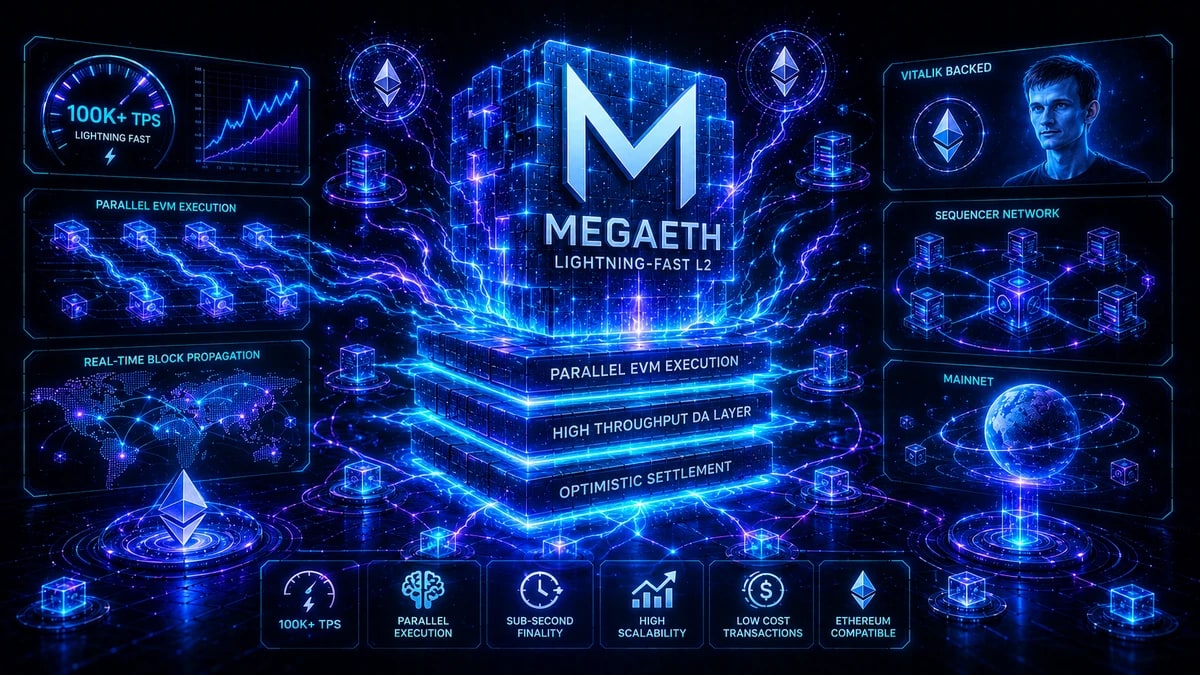
MegaETH is a real-time Ethereum L2 targeting 100,000 TPS via a specialised sequencer. Architecture, $MEGA token, testnet steps and airdrop guide.
MegaETH is one of the most ambitious projects to ever come out of the Ethereum ecosystem. It promises something that has felt impossible since the day Ethereum launched in 2015: a real-time blockchain that settles transactions in roughly one millisecond, hits 100,000 transactions per second, and still inherits the security of Ethereum mainnet. If those numbers hold, it would put MegaETH on par with centralised exchanges for speed while remaining fully decentralised at the settlement layer.
The hype around MegaETH is not just marketing. The project is backed by Vitalik Buterin, Sreeram Kannan of EigenLayer, and Joseph Lubin of Consensys. Its co-founders include Yilong Li (a Stanford PhD whose dissertation work on microsecond-scale distributed systems underpins the design), Lei Yang from MIT, and Shuyao Kong, formerly head of global business at Consensys.
In this guide you will learn what MegaETH actually is, how its specialised sequencer architecture works, how it compares to other L2 networks like Arbitrum, Optimism and Base, how it stacks up against Solana and Monad, what the $MEGA token plans look like, and how to add MegaETH to MetaMask, claim faucet ETH, and use the testnet dApps that are likely to drive any future airdrop.
What Is MegaETH in Plain English
MegaETH is a real-time Ethereum Layer 2 designed for sub-millisecond block times via specialised sequencer hardware, targeting 100,000 transactions per second. It uses a single high-performance sequencer for ordering, separate prover nodes for state verification, and EigenDA for data availability. The result is a fully EVM compatible network where Solidity contracts deploy unchanged but execute roughly 5,000 times faster than Ethereum mainnet.
Let us unpack each piece. "Real-time" means the chain produces a new block every millisecond or so, not every twelve seconds like Ethereum. "Layer 2" means MegaETH does not have its own validator set securing user funds. Instead it batches transactions, publishes data to Ethereum (via EigenDA) and inherits Ethereum's settlement guarantees. "Specialised sequencer" means one beefy node, with custom optimisations and lots of RAM, doing the ordering work that thousands of validators do on a normal blockchain.
The trade-off is obvious: a single sequencer is faster but more centralised than a permissionless validator set. MegaETH's bet is that for many use cases (DEX trading, gaming, social apps, MMOs) users care more about latency than about the political question of who orders transactions, so long as Ethereum still guarantees that nothing gets stolen and nothing gets censored permanently.
A Short History of MegaETH
MegaETH Labs was founded in 2023 by Yilong Li, Lei Yang and Shuyao Kong. Yilong Li's academic background is the heart of the technical thesis. His Stanford dissertation focused on building distributed systems with microsecond-scale response times, which is essentially what the MegaETH sequencer is: a single-node datacentre machine doing in software what a normal blockchain does across thousands of consumer nodes. Lei Yang's MIT research on networking complements that, and Shuyao Kong's Consensys background provided the bridge into Ethereum's institutional and venture investor world.
The project raised a $20 million seed round in mid-2024 led by Dragonfly Capital with participation from a long list of strategics and angels. Crucially, Vitalik Buterin participated personally, as did Sreeram Kannan, the founder of EigenLayer, and Joseph Lubin, co-founder of Ethereum and CEO of Consensys. Sreeram's involvement is particularly notable because MegaETH uses EigenDA, EigenLayer's data availability service, as part of its core stack.
The public testnet opened in late 2024 with a curated set of dApps and an aggressive points and quest programme. The testnet has been one of the most active in crypto since launch, frequently producing tens of millions of transactions per day at near-zero cost. Mainnet is targeted for 2025-2026, with the $MEGA token launch expected to coincide with mainnet or shortly after.
Alongside the technical work, MegaETH built a unique community structure. The Fluffle is a 10,000 piece NFT collection that doubled as an OG pass, with holders getting priority access to testnet features, airdrop weighting and governance signals. MegaMafia is a curated builder cohort of teams that committed to launching on MegaETH at mainnet. Both initiatives gave the network a real social layer before any token even existed, which is a deliberate inversion of the standard "launch token, then attract builders" playbook.
How the MegaETH Architecture Actually Works
To understand why MegaETH is so fast, you have to understand what slows down a normal blockchain. On Ethereum mainnet, every full node runs the EVM, executes every transaction, and stores the full state. Block production takes 12 seconds because the network has to give thousands of geographically distributed validators time to converge on the same view of state. That redundancy is what makes Ethereum secure, but it also caps throughput at around 15 TPS and gives users a multi-second wait for finality.
MegaETH breaks that monolithic node design into three specialised roles: sequencer, prover, and full node. Only one of those roles needs to be fast in real time. The other two can take their time without holding up the user experience.
The Sequencer: Where Speed Comes From
The sequencer is a single high-performance machine, expected to run on something like a 100 core server with hundreds of gigabytes of RAM and high-bandwidth networking. Its job is to receive transactions from users, order them into blocks, and execute them against in-memory state. Because there is only one sequencer, there is no consensus overhead. The sequencer simply decides on the order and pushes the result. With everything in RAM and no networking round trips for consensus, block times of around one millisecond become achievable.
This is the most controversial design decision in MegaETH, and the team is upfront about it. A single sequencer is, in the short term, a single point of failure for liveness. If the sequencer goes down, the chain pauses. The argument is that this is acceptable because the sequencer cannot steal funds or invalidate state. Those guarantees come from the prover layer and from Ethereum settlement, both of which are independent of the sequencer.
Provers: Verification Without Speed Pressure
Prover nodes re-execute the blocks produced by the sequencer and generate cryptographic proofs (or fraud proofs, depending on which phase of the roadmap you are looking at) that the state transitions were valid. These nodes do not need to be fast in real time, because users have already received their soft confirmation from the sequencer. Provers just need to eventually agree with each other and publish their conclusions on Ethereum.
This split between fast ordering and slow verification is the same idea that powers optimistic rollups, but MegaETH pushes the asymmetry much further. On Arbitrum or Optimism, the sequencer still runs full execution and publishes state roots quickly. On MegaETH, the sequencer is allowed to scream ahead while provers catch up over seconds or minutes. For applications, what matters is that the soft confirmation is essentially instant, and that the final settlement on Ethereum will eventually agree.
EigenDA for Data Availability
At 100,000 TPS, MegaETH cannot post all of its transaction data directly to Ethereum mainnet. There simply is not enough blob space, and even with EIP-4844 blobs, the cost would be enormous. Instead, MegaETH posts data to EigenDA, the data availability service built on EigenLayer. EigenDA is secured by restaked ETH, which means the same validators that secure Ethereum are also securing MegaETH's data layer, just in a different role.
The result is a stack where ordering happens in one centralised but accountable place, verification happens across many independent provers, and data availability rides on Ethereum's restaked security. Users get speed; the system gets security. If you want to dig deeper into how restaking ties all of this together, the EigenLayer ecosystem is worth understanding.
Real-Time Apps: Why 1ms Block Times Actually Matter
Most people see "100,000 TPS" and assume it is just a bigger number than Ethereum. The deeper point is what those numbers unlock at the application layer. A 1 ms block time is not just "12,000 times faster than Ethereum." It is a qualitative shift that lets entire app categories exist on chain that previously had to live on centralised servers.
The clearest example is central limit order book (CLOB) DEXs. Every serious centralised exchange uses a CLOB, where limit orders sit on a book and a matching engine pairs them off. On Ethereum L1, building a CLOB on chain is unworkable: every order placement, cancel and match would cost gas, and confirmation lag means market makers cannot pull orders fast enough to avoid being picked off. As a result, the on-chain world settled for AMMs and constant product formulas, which are great for tail tokens but inefficient for blue chip pairs. On MegaETH, with sub-millisecond block times and effectively zero fees, a real CLOB becomes plausible. That is why testnet DEXs like GTE are getting so much attention.
Gaming is another category that needs this. A fast paced action game makes thousands of state changes per second per player. To do that on a 12 second block time would be impossible without rollup-of-rollup architectures and ugly batching. With MegaETH, every shot fired, every item picked up, every position update can be a transaction. The chain becomes a real-time game server, not just a settlement layer. The same logic extends to MMOs, social apps with per-tap interactions, and high frequency prediction markets.
MegaETH vs Other Layer 2 Networks
To position MegaETH properly, it helps to compare it against the current L2 leaders: Arbitrum, Optimism and Base, plus zkEVMs like zkSync and Linea. All of them are EVM equivalent or compatible. The differences are in throughput, finality and target use case.
The way to read that table is not "MegaETH wins everything." Each design picks a point on a triangle between speed, decentralisation and cost. Optimism and Arbitrum stay closer to Ethereum's decentralisation profile but cap out at thousands of TPS. zkEVMs add cryptographic finality but pay for it in proving costs. Solana picks raw speed but uses its own validator set. MegaETH's claim is that by leaning on EigenDA and Ethereum settlement, it can match Solana on user experience without giving up Ethereum's security.
MegaETH vs Solana and Monad: The "Solana on Ethereum" Thesis
One framing you will hear constantly is that MegaETH is "Solana on Ethereum." This is half marketing, half real architectural insight. The shared idea is that you can have a high-performance chain by accepting more validator concentration in exchange for raw speed. Solana uses a small set of high-performance validators. MegaETH goes further and uses a single sequencer plus separate provers. Both prioritise user experience over node operator decentralisation.
Where the comparison breaks is on the settlement layer. Solana is its own L1, so its security is its own validator set. If that set has issues, there is nothing above it to fall back on. MegaETH is an L2, so its worst case is a sequencer outage. User funds remain provably correct on Ethereum, and a force-exit mechanism allows users to withdraw even if the sequencer never comes back. For institutional users and DeFi protocols that want Ethereum-grade trust assumptions, that distinction matters.
Monad is the other comparison point. Monad is a Layer 1 EVM that targets 10,000 TPS by parallelising execution and rewriting the EVM client from scratch in C++. It is also EVM compatible, also raised a huge round, and is also chasing the same builder cohort. The main difference is the architecture choice: Monad bets on parallel execution at the L1 layer, MegaETH bets on a specialised sequencer at the L2 layer. Both can coexist, and many builders are deploying to both testnets to hedge. Our deep dive on sharded blockchains covers some of the same throughput design space from a different angle.
The MegaETH Ecosystem and Top Testnet dApps
An L2 is only as useful as the apps built on it. The MegaETH testnet has spent the last year onboarding hundreds of teams, but a handful of flagship dApps have emerged as the must-use entry points for anyone trying to position for the airdrop or just kick the tyres on real-time DeFi.
GTE: The Real-Time Order Book DEX
GTE is the most architecturally ambitious dApp on MegaETH. It is a hybrid DEX that combines a fully on-chain central limit order book for blue chips with an AMM for long-tail tokens. The 1 ms block time lets professional market makers post tight quotes and pull them quickly enough to avoid adverse selection, which is impossible on slower chains. For users, the result is centralised exchange-grade pricing on a fully on-chain venue. If MegaETH delivers, GTE could be the first real challenge to centralised order book exchanges on chain. Compare its design philosophy with Uniswap v4 hooks to see how different the AMM and CLOB approaches really are.
Cap: Yield-Bearing Stablecoin Engine
Cap takes advantage of MegaETH's speed to run a yield engine on stablecoin deposits, routing capital across DeFi strategies in real time. The same logic on Ethereum mainnet would be too gas-heavy to be competitive. On MegaETH, fees are so low that strategies can rebalance constantly, capturing yield that would otherwise leak to MEV bots on slower chains. It is one of the clearest demonstrations of why latency matters in DeFi.
Avon: On-Chain Money Markets at Scale
Avon is a lending and borrowing market in the spirit of Aave or Compound but designed from the ground up for a real-time chain. The protocol uses high-frequency interest rate updates, instant liquidation auctions, and risk parameters that can be tuned per block. This shifts liquidations from a winner-takes-all gas auction (the pain of mainnet) to a smoother, more efficient market. The user experience is closer to a centralised broker than to a traditional money market.
Other Notable Testnet Apps
Beyond the big three, the MegaETH testnet hosts dozens of perpetual exchanges, prediction markets, NFT mints, on-chain games, and social apps. The MegaMafia cohort is the easiest way to track quality launches. Bridges from Ethereum, Arbitrum and other L2s have been deployed to make moving testnet ETH onto MegaETH straightforward. Wallets like MetaMask, Rabby and OKX Wallet all support the testnet by default once you add the network details.
$MEGA Token, The Fluffle, and Airdrop Expectations
The single biggest question for most readers is how the $MEGA token will work and whether testnet activity will translate into a meaningful airdrop. The team has been deliberately cagey on details, but the pattern is consistent with other recent L2 launches.
$MEGA is expected to be the gas, staking and governance token of MegaETH. Like other rollups, MegaETH could theoretically launch using ETH as gas, but the network has signalled that a native token will play a role in sequencer-related economics, EigenDA payments and ecosystem incentives. The token has not launched as of this writing in 2026, but mainnet plus token generation event (TGE) is the assumed milestone.
The Fluffle, MegaETH's 10,000 piece NFT collection, is the closest thing to a confirmed allocation. Fluffle holders have been promised priority access and a meaningful share of any airdrop. Beyond that, the public allocation is expected to be driven by a points programme that rewards testnet activity, builder contributions, and community engagement. Bridging testnet ETH, swapping on GTE, providing liquidity, lending on Avon, minting NFTs, and using social apps all generate points or equivalent metrics that the team is widely believed to track.
The standard airdrop hunting playbook applies here, with a few caveats specific to MegaETH. First, sybil resistance is going to be strict. The team has been vocal about wanting to reward genuine users and builders, not farms. Second, the Fluffle is a strong signal: holders are likely to be weighted higher, and there is a real cost to acquiring one. Third, because the testnet is so active, casual usage will not be enough. The teams behind successful past airdrops on Arbitrum, Optimism, zkSync, and Linea have all sharpened their sybil detection, and MegaETH is hiring from the same talent pool.
One important warning: never sign sketchy transactions or interact with unofficial "MegaETH" sites. Many phishing operations target airdrop hunters. Read up on Permit2 token permissions and on transaction simulation before approving anything that interacts with your mainnet wallet, even on testnet.
How to Use the MegaETH Testnet Step by Step
Here is the practical walkthrough. The whole flow takes about ten minutes if you already have MetaMask installed. Use a fresh testnet wallet, never your main wallet. For best practices, check our guide on the burner wallet workflow before you start farming any new network.
Step 1: Add the MegaETH Testnet to MetaMask
Open MetaMask, click the network selector at the top, and choose "Add network" then "Add a network manually." You will need the official MegaETH testnet parameters: a network name (use "MegaETH Testnet"), an RPC URL (from the official MegaETH docs), the chain ID, the currency symbol, and a block explorer URL. Always copy these from the official MegaETH documentation at megaeth.com, never from a random Discord link or Google result. Phishing networks with similar names are a real risk.
Once you save, MetaMask will switch to the new network. Your balance will show zero ETH, which is expected. The address you use here can be the same as your normal address since it is just an account identifier, but if you want to be careful, use a fresh wallet generated specifically for this testnet.
Step 2: Claim Faucet ETH
Visit the official MegaETH faucet linked from megaeth.com. Most faucets require you to connect a wallet, complete a captcha and sometimes prove ownership of a small amount of mainnet ETH or a Discord role. Once you pass the checks, the faucet drips a small amount of testnet ETH to your address. This is enough to pay gas for hundreds or thousands of testnet transactions because fees are negligible. If the faucet is dry, try the secondary faucets listed in the MegaMafia community pages, or bridge testnet ETH from Sepolia using one of the supported bridges.
Step 3: Bridge Testnet ETH (Optional)
If you need more than the faucet provides, bridges between Sepolia (Ethereum testnet) and MegaETH testnet are usually available. Visit the official bridge UI, connect your wallet, select Sepolia as the source, MegaETH testnet as the destination, enter an amount and confirm. Bridging on the testnet is usually instant or near-instant because of the sub-millisecond block time on the destination side. Always verify the bridge URL through the official docs.
Step 4: Swap on a Testnet DEX
Open GTE or another major MegaETH testnet DEX. Connect your wallet, approve a token if needed, and execute a swap. You will see the transaction confirm in roughly the time it takes you to read this sentence. Take a moment to appreciate it: this is what every chain feels like it should feel like. Repeat with a few different pairs to register usage. Compare the experience to a normal swap with our 1inch DEX aggregator guide for a sense of where MegaETH fits in the broader DEX landscape.
Step 5: Try DeFi, Games and Social Apps
Lend on Avon. Deposit on Cap. Mint a testnet NFT. Play one of the on-chain games. Try a social app. Each interaction is a data point, both for your own learning and for any future airdrop metrics. Variety matters more than volume for sybil-resistant programmes.
Step 6: Track Your Progress
Use the official MegaETH dashboard (when available) and any community trackers to watch points or equivalent metrics. Cross-reference with social channels for new programmes or seasonal boosts. Treat any tracker you do not control as informational only; the real allocation will be determined by MegaETH Labs at TGE.
Risks and Open Questions
No honest tutorial would skip the risks. MegaETH is bold, technically interesting, and unproven. Here are the main reasons to stay clear-eyed.
Centralised sequencer. The single sequencer is the most discussed concern. It is a single point of failure for liveness, and during outages users will not be able to transact. The mitigation is the force-exit path back to Ethereum, but in practice users would have to wait for a much slower fallback to retrieve funds. Until a decentralised sequencer roadmap is delivered, this remains an open issue.
Hardware dependency. The 1 ms block time assumes a very specific sequencer hardware profile. Real-world performance will depend on how that hardware behaves under sustained load, with adversarial transaction patterns, and across network conditions. Mainnet will be the real test.
EigenDA dependency. If EigenDA suffers an outage or a serious incident, MegaETH's data availability layer suffers with it. EigenDA is itself relatively young, and although the restaking model is technically elegant, it is still being battle-tested. Our coverage of pull-based oracles like Pyth looks at related questions around shared infrastructure dependencies.
Tokenless until launch. There is no $MEGA token yet, which means there is no easy way to express a view on MegaETH financially. Speculation runs through Fluffle NFTs, points proxies and ecosystem token plays, all of which are higher risk than a direct token bet.
Competition. Monad, Solana, Aptos, Sui, and other high-throughput chains are all chasing the same builders. If any of them ships first or ships better, MegaETH could find itself with technology that arrives a year too late.
Regulatory and airdrop risk. Airdrops have come under sharper regulatory scrutiny in some jurisdictions. The MegaETH launch will have to navigate that landscape carefully. From a user perspective, never use a VPN to claim from a jurisdiction you do not legally reside in, and always check eligibility rules at TGE.
Use Cases That Become Possible on MegaETH
Beyond the obvious DeFi and gaming categories, MegaETH unlocks several application archetypes that are interesting to think through.
Real central limit order books, tight quotes, fast cancels. Centralised exchange UX on chain.
Fast paced action titles, persistent worlds, MMOs with thousands of state changes per second per player.
Yield strategies that rebalance every block, instant liquidations, sub-second oracle updates for derivatives.
Per-tap interactions, micro-payments, tip jars, live engagement metrics, prediction markets that update in real time.
Real-time prediction markets are a particularly interesting category. On Polymarket today, you can bet on outcomes, but the on-chain settlement is too slow for fast moving events. On MegaETH, you could have prediction markets that move with the underlying news, with order books that refresh in milliseconds.
Another category is tokenised real-world assets. Real-time settlement allows for tokenised treasuries, money market funds and equities that behave more like their off-chain counterparts. Our guide on Ondo Finance and RWA treasuries covers the broader RWA opportunity that an L2 like MegaETH could supercharge.
MegaETH for Traders and Investors
For traders, MegaETH is interesting in several dimensions. Until $MEGA launches, the most direct exposure is through Fluffle NFTs. Floor prices have been volatile but reflect a strong narrative bid whenever testnet milestones land. Ecosystem token plays are riskier but offer leveraged exposure: tokens of MegaMafia teams, bridge providers and infrastructure tools all carry some correlation with MegaETH's progress.
For more risk averse readers, the cleanest exposure is to ETH itself. Any L2 that succeeds at scale generates demand for ETH as gas and as the underlying asset secured by Ethereum settlement. Our market analysis on whether to buy ETH covers the broader thesis.
For active traders, the real prize is what mainnet enables on day one. Real-time DEXs with tight spreads will create a new class of arbitrage opportunities between MegaETH and other venues. Liquidations on Avon and similar protocols will be more efficient, which means lower bad debt for protocols. Tools for spotting trends like detecting fake volume become essential when a brand new ecosystem is bootstrapping.
Best Practices for MegaETH Users
If you plan to use MegaETH seriously, here are the principles that will keep you out of trouble.
Use a separate testnet wallet. Generate a fresh address, fund it from a faucet, and never reuse it for mainnet. The same applies at TGE: claim airdrops to a dedicated wallet before bridging anything to a long-term storage address. Read our guide on wallet security best practices for a deeper dive.
Verify every URL. Phishing sites that mimic MegaETH faucets, bridges and dApps are common. Bookmark the official megaeth.com link and access everything from there. Always inspect contract addresses in your wallet popup. Familiarity with address poisoning scams is also helpful, since real-time chains create new attack surfaces.
Treat points as informational. Anything that is not a confirmed token allocation is, by definition, speculative. Do not let dashboards convince you to deploy mainnet capital into testnet activity that has no guaranteed return.
Watch the official channels. The MegaETH team has been disciplined about its communications, but the airdrop window will be short and information-dense. Twitter, Discord and the official blog are the canonical sources. Anything else is rumour.
Diversify your time. If you are airdrop hunting, MegaETH is one of several major launches in the same window. Spreading effort across MegaETH, Monad and a couple of other ecosystems hedges against any single launch underdelivering.
Pros and Cons Summary
- Sub-millisecond block times unlock real-time apps
- 100,000+ TPS goal beats every major L2 today
- Full EVM equivalence, Solidity contracts deploy as is
- Backed by Vitalik, Sreeram, Lubin and top funds
- EigenDA and Ethereum settlement preserve security
- Strong builder cohort via MegaMafia and Fluffle
- Single sequencer is a centralisation trade-off
- Hardware dependency for sustained throughput
- Tokenless until TGE, hard to invest directly
- EigenDA still relatively young in production
- Heavy competition from Monad, Solana, Aptos, Sui
- Airdrop expectations may be overheated
Frequently Asked Questions
Q What is MegaETH in simple terms?
MegaETH is a real-time Ethereum Layer 2 designed for sub-millisecond block times via specialised sequencer hardware, targeting 100,000 transactions per second. It uses a single high-performance sequencer for ordering, separate prover nodes for verification, and EigenDA for data availability, while inheriting Ethereum's settlement security.
Q Who founded MegaETH and who is backing it?
MegaETH was founded by Yilong Li (Stanford PhD in microsecond-scale distributed systems), Lei Yang (MIT), and Shuyao Kong (formerly head of global business at Consensys). The seed round was led by Dragonfly Capital, with personal participation from Vitalik Buterin, EigenLayer founder Sreeram Kannan, and Consensys CEO Joseph Lubin.
Q How does MegaETH achieve 100,000 TPS?
MegaETH splits node roles into a specialised sequencer that orders and executes transactions in memory on high-performance hardware, separate prover nodes that re-execute blocks and post proofs, and EigenDA for data availability. By concentrating real-time work in one optimised machine and offloading verification, MegaETH targets roughly one millisecond block times and 100,000+ TPS.
Q How is MegaETH different from Arbitrum or Optimism?
Arbitrum and Optimism are general purpose optimistic rollups with block times around one or two seconds and throughput of a few thousand TPS. MegaETH pushes the optimistic rollup design further by running a specialised high-performance sequencer and separate provers, aiming for sub-millisecond block times and 100,000+ TPS. The trade-off is more concentrated sequencer infrastructure in exchange for real-time user experience.
Q Is MegaETH a ZK rollup or an optimistic rollup?
MegaETH is structurally an optimistic rollup with separate prover nodes that verify state transitions. Future roadmap items may incorporate ZK proofs for faster finality, but the core architecture today relies on optimistic verification combined with EigenDA for data availability, rather than zero-knowledge proofs of execution.
Q When does MegaETH mainnet launch?
The MegaETH public testnet opened in late 2024. Mainnet is targeted for 2025 to 2026, with the exact date dependent on completing testnet milestones and audits. The $MEGA token generation event is widely expected to coincide with mainnet launch or follow shortly after.
Q Is there a MegaETH token yet?
No, $MEGA has not launched as of the publication date of this guide. The native token is expected to power gas, staking and governance on the MegaETH network, and is widely expected to launch alongside or shortly after mainnet. Any token claiming to be $MEGA before that point is a scam.
Q What is The Fluffle NFT collection?
The Fluffle is MegaETH's official 10,000 piece NFT collection. It serves as an OG pass for the ecosystem, granting holders priority access to testnet features, early invitations to new dApps, and a strong signal for any future airdrop allocation. Fluffle holders are widely expected to receive weighted treatment when $MEGA launches.
Q How do I add MegaETH testnet to MetaMask?
Open MetaMask, click the network selector, choose "Add network" then "Add a network manually," and paste the official MegaETH testnet parameters from megaeth.com (network name, RPC URL, chain ID, currency symbol, block explorer URL). Save the network, switch to it, claim faucet ETH, and you are ready to interact with testnet dApps. Never copy these parameters from unofficial sources.
Q Is MegaETH safer than Solana for DeFi?
MegaETH and Solana make different trade-offs. Solana is its own Layer 1 with its own validator set. MegaETH is a Layer 2 that uses EigenDA for data availability and Ethereum for final settlement, which means user funds remain provably correct on Ethereum even if the MegaETH sequencer goes down. For protocols that want Ethereum-grade settlement security with high throughput, MegaETH has an architectural advantage. Both will need to prove themselves in production.
Q Can existing Ethereum contracts deploy on MegaETH?
Yes. MegaETH is fully EVM equivalent, which means Solidity smart contracts deploy as is, with the same tooling (Hardhat, Foundry, Remix), the same wallets (MetaMask, Rabby, OKX Wallet) and the same standards (ERC-20, ERC-721, ERC-1155). Teams can port existing dApps with minimal changes, taking advantage of the much higher throughput and lower latency.
Q What are the main risks of using MegaETH?
The main risks are centralised sequencer outages affecting liveness, hardware dependency for sustained 100,000 TPS performance, EigenDA dependency for data availability, no native token yet (so financial exposure is indirect), heavy competition from Monad, Solana and other high-throughput chains, and the usual airdrop hunting risks including phishing, sybil detection and regulatory uncertainty. Use a fresh wallet and verify every URL.
Final Thoughts: Where MegaETH Fits in 2026
MegaETH is the most aggressive bet that the future of Ethereum scaling is not just "another L2" but a redesign of what L2s can be. By specialising the sequencer into a single high-performance node and offloading data availability to EigenDA, the project sidesteps the traditional throughput ceiling that has limited every rollup before it. If it works at mainnet scale, MegaETH could compress the gap between decentralised and centralised infrastructure to nearly nothing on the user-facing side.
The trade-offs are real. A single sequencer is centralised in the short term. Hardware-driven performance is hard to validate without years of production. EigenDA is young. The token is not yet live. The competition is fierce, with Monad attacking from the L1 side and Solana already deployed at scale. Any one of these could go wrong, and MegaETH could end up as a brilliant idea that arrived a year too late, or that was outshipped by a less ambitious but more conservative competitor.
For users in 2026, the right posture is curiosity plus caution. Add the testnet to MetaMask. Claim faucet ETH. Try GTE, Cap, Avon and a few smaller apps. Hold a Fluffle if you can afford to, or follow the ecosystem from the sidelines. Do not stake mainnet capital on speculative point dashboards. Watch for mainnet announcements, audit results, and the eventual $MEGA TGE. If MegaETH delivers, it will change what builders can do on Ethereum. If it does not, you will still have learned what real-time blockchain UX feels like, which is itself a useful benchmark for evaluating every other chain that calls itself fast. Either way, MegaETH is one of the most important experiments running in crypto right now, and worth understanding deeply.