What Is Ondo Finance: Complete RWA Treasuries Guide (2026)
— By Tony Rabbit in Tutorials

What is Ondo Finance? Complete 2026 RWA guide: OUSG and USDY tokenized treasuries, BlackRock BUIDL integration, ONDO governance token, Ondo Chain L1 and institutional yield onchain.
If you have heard the phrase "tokenized treasuries" thrown around in DeFi circles over the past two years, there is one company whose name keeps coming up: Ondo Finance. Ondo has quietly become the largest non-stablecoin issuer of yield-bearing tokenized US Treasuries on public blockchains, with billions in assets under management and a product lineup that bridges Wall Street to onchain crypto in a way few others have managed.
Ondo Finance is a real-world asset (RWA) platform that issues tokenized versions of short-duration US Treasury bills, money market funds, and cash equivalents. Its flagship products, OUSG and USDY, let qualified investors and global retail users earn US Treasury yield directly from a self-custody wallet, redeemable 24/7 across Ethereum, Solana, Sui, Aptos, and Mantle. In 2025, Ondo also launched Ondo Chain, a purpose-built Layer 1 designed specifically to host institutional RWAs with permissioned validators and native settlement assets.
This guide breaks down what Ondo Finance actually is, how its different products compare, how OUSG is backed by BlackRock's BUIDL, what the ONDO token does, who can actually buy these assets, and how Ondo compares to alternatives like Maple and Centrifuge. By the end you will understand both the retail and institutional sides of the Ondo ecosystem and where it fits in the broader RWA landscape.
What Is Ondo Finance?
Ondo Finance is a New York-based financial technology company that creates tokenized versions of traditional financial products, primarily US Treasuries and money market funds, and issues them as ERC-20 tokens (and equivalents on other chains) that can be held in any compatible self-custody wallet. The core idea is simple: take a regulated, yield-bearing asset from traditional finance, wrap it in a smart contract, and let it move at the speed of crypto.
Where stablecoins like USDC and USDT keep all the yield from their reserves and pay you zero, Ondo's tokens pass through the actual interest earned on the underlying Treasury bills. If short-term US Treasuries yield 4.8%, holders of OUSG or USDY capture that yield directly, minus a small management fee. This is the fundamental value proposition that has made Ondo the second-largest non-stablecoin tokenized treasury issuer behind only BlackRock's BUIDL.
The company has built a vertically integrated stack: tokens (OUSG, USDY, USDtb), a DeFi protocol (Flux Finance), a Layer 1 blockchain (Ondo Chain), and a governance token (ONDO). This stack lets Ondo serve everyone from sophisticated institutions buying nine-figure positions in OUSG to retail users in emerging markets parking savings in USDY through a mobile app.
A Brief History: From Goldman Sachs to Onchain Treasuries
Ondo was founded in 2021 by Nathan Allman and Pinku Surana, both alumni of Goldman Sachs' Digital Assets group. The two had spent years inside one of the most powerful trading desks on Wall Street watching the slow encroachment of blockchain technology into capital markets and decided to build the infrastructure to bring traditional yield products onchain in a compliant, institutional-grade way.
The company raised a Series A in April 2022 led by Founders Fund and Pantera Capital, joined by Coinbase Ventures, Tiger Global, and others. The initial product was a structured finance protocol that offered tranched yield products built on top of DeFi, but the team quickly pivoted as it became clear that the real opportunity was not in repackaging existing DeFi yield. It was in bringing actual Treasury yield onchain.
OUSG launched in January 2023 as the first tokenized US Treasury product targeted at qualified institutional buyers. USDY followed later that year as an open access version aimed at non-US retail users. In March 2024, BlackRock launched BUIDL, and Ondo immediately announced it would migrate the backing of OUSG into BUIDL, creating one of the most consequential partnerships in the RWA space. In 2025, Ondo announced Ondo Chain, a permissioned-validator Layer 1 designed specifically for institutional RWAs.
The Ondo Product Lineup at a Glance
Ondo's product suite is built around a clear segmentation: who can access it (US accredited vs global retail vs institutional), what yield profile it offers, and what role it plays in DeFi composability.
Backing: BlackRock BUIDL + cash
Yield: Treasury bill rate, daily
Min size: $100,000
Redemption: 24/7 in USDC or USD
Backing: Short-dated Treasuries + bank deposits
Yield: Accrues into token price
Min size: $500
Transfer: 40-day lockup, then free
Backing: ~90% BUIDL + cash
Yield: None (keeps spread)
Use case: Payments, settlement
Peg: 1:1 with USD
This three-product approach lets Ondo capture different segments without one product cannibalizing another. OUSG is for big money, USDY is for everyone else outside the US, and USDtb is a payments-focused stablecoin that competes with USDC.
OUSG vs USDY: The Key Distinctions
These two are the products most people confuse. They both pay Treasury yield. They both sit on Ethereum, Solana, and other chains. But they are designed for completely different audiences and have completely different regulatory frameworks. Understanding the difference matters because it determines whether you can even legally hold the token.
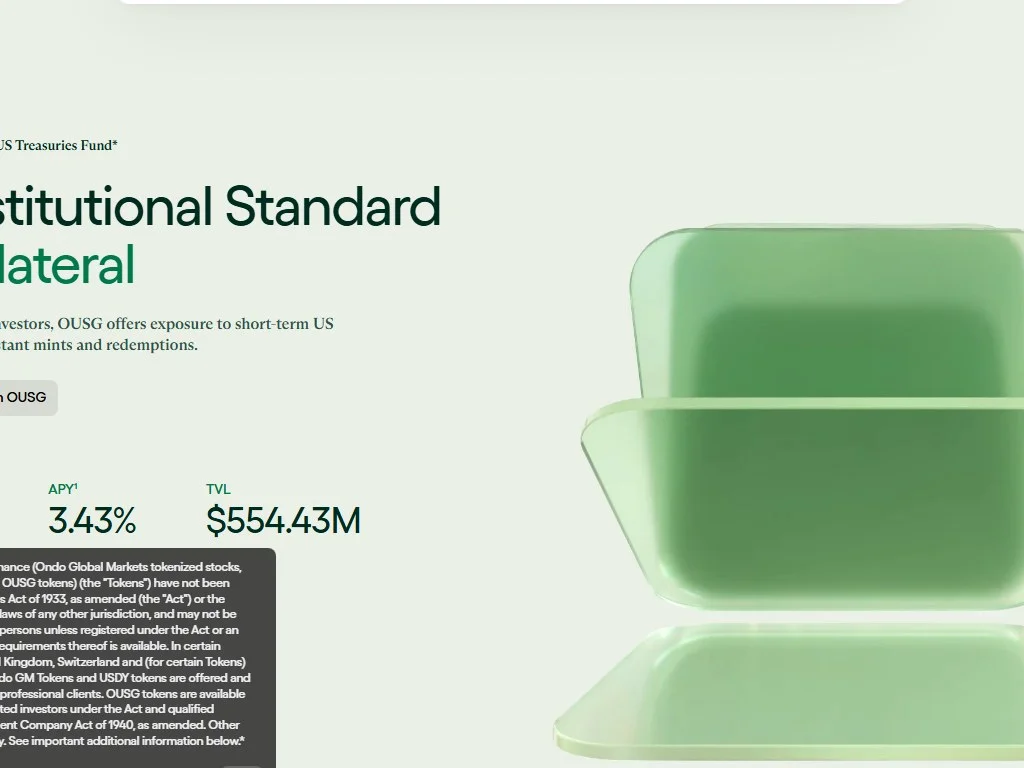
OUSG is structured under Rule 144A and Regulation D, which means it is only available to accredited investor and qualified purchaser categories in the United States, plus non-US institutional buyers. The token itself enforces this at the smart contract level through a whitelist. You cannot just buy OUSG on a DEX or transfer it to someone who has not completed Ondo's KYC and accreditation process. The minimum subscription is $100,000, and the product yields the Treasury bill rate minus a 0.15% management fee.
OUSG is a rebasing token: yield accrues by the token balance growing over time. You buy 100,000 OUSG today, and a year later your wallet shows 104,800 OUSG without any action on your part. This makes accounting clean for institutional users.
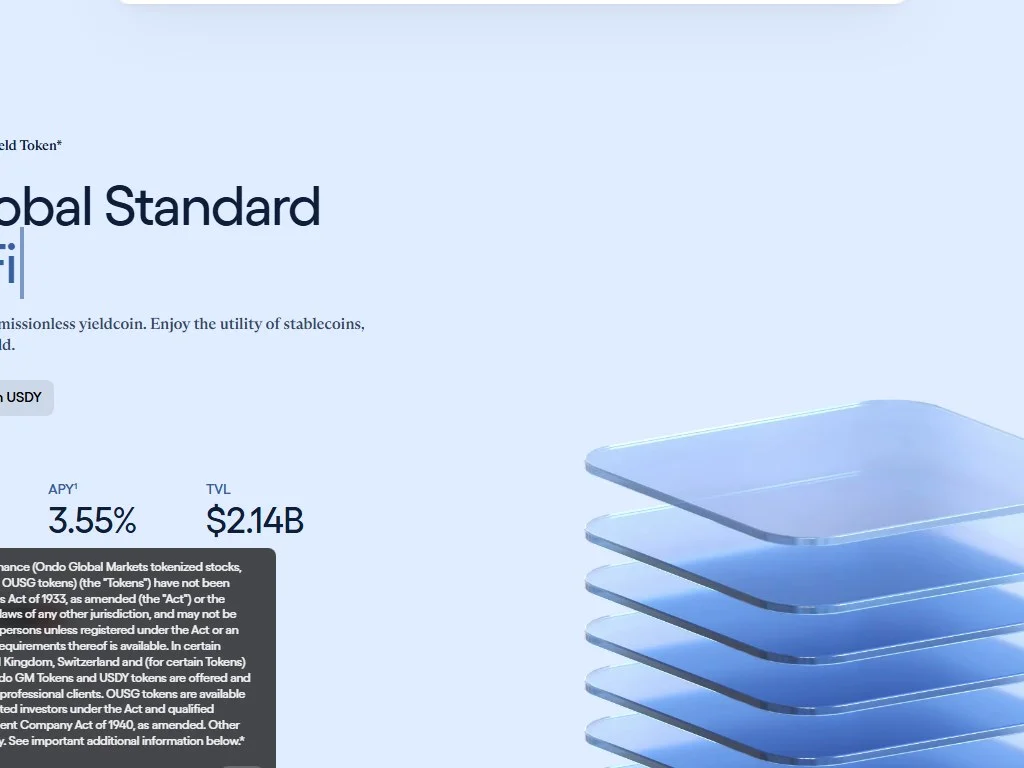
USDY is structured under Reg S, which is the regulation that governs offerings to non-US persons. This means USDY is explicitly not available to US persons (US citizens, residents, or entities) but is available to almost everyone else, including retail users in Europe, Latin America, Asia, and Africa. The minimum is just $500, and there is a 40-day lockup period after purchase before tokens can be freely transferred (a standard Reg S requirement).
USDY is an accruing token, not rebasing. Your balance stays the same in token count, but the redemption value of each token grows. One USDY might be worth $1.05 today and $1.10 a year from now. This structure makes USDY work better as collateral in DeFi protocols because lenders do not have to handle balance changes.
One way to think about it: OUSG is the institutional product, designed to comply with the strictest US securities rules, while USDY is the export product, designed to reach the global crypto user base that does not have easy access to dollar yields locally.
USDtb: Ondo's Stablecoin Play
USDtb is Ondo's entry into the stablecoin market, launched in late 2024 in partnership with Ethena Labs. Unlike OUSG and USDY, USDtb is not yield-bearing for the holder. It is a 1:1 USD-pegged stablecoin that competes head-on with USDC and USDT in payments, settlement, and DeFi use cases.
What makes USDtb interesting is its backing. Roughly 90% of its reserves are held in BlackRock BUIDL, with the remainder in cash and short-term Treasuries for redemption liquidity. This means USDtb is one of the most transparently backed stablecoins ever launched: every dollar of USDtb is verifiably backed by an onchain BlackRock-managed Treasury fund that anyone can audit through public blockchain explorers.
The economics work for Ondo because it captures the spread. When you hold USDtb, you do not earn the Treasury yield, Ondo does. This is the same business model that makes Circle (USDC) and Tether (USDT) some of the most profitable companies in crypto. USDtb gives Ondo a piece of that pie while leveraging its existing BUIDL infrastructure.
USDtb launched first on Ethereum and has expanded to Solana, Sui, and other chains. By 2026 it had crossed several billion in circulating supply, driven largely by integrations with Ethena's USDe ecosystem where USDtb serves as one of the primary reserve assets.
How BUIDL Backs OUSG (and USDtb)
The relationship between Ondo and BlackRock's BUIDL is one of the most important structural facts in the RWA market, and it is often misunderstood. Let us walk through exactly how it works.
BlackRock's BUIDL (BlackRock USD Institutional Digital Liquidity Fund) is a tokenized money market fund issued on Ethereum and other chains. BlackRock owns the fund, Securitize handles the tokenization and transfer agency, and qualified institutional buyers can subscribe directly. The fund holds short-term US Treasury bills, repo agreements, and cash, and pays out yield daily.
When Ondo migrated OUSG to be backed by BUIDL in 2024, the structure became layered. Here is the flow when someone subscribes to OUSG:
The brilliance of this structure is that Ondo no longer has to operate the fund management infrastructure for OUSG. BlackRock does it. Ondo focuses on the tokenization, distribution, and onchain rails. BlackRock provides the institutional credibility, the regulatory wrapper, and the actual Treasury management. BUIDL handles the heavy lifting on the traditional finance side.
This also creates a powerful network effect for BlackRock: every dollar of OUSG (and roughly 90% of USDtb) flows into BUIDL, growing BUIDL's AUM and reinforcing BlackRock's position as the dominant institutional onchain asset manager.
Ondo Chain: A Layer 1 for Institutional RWAs
In early 2025, Ondo announced Ondo Chain, a new Layer 1 blockchain designed specifically to host institutional real-world assets. The key design choice is permissioned validators: instead of anyone being able to run a validator, Ondo Chain restricts validation to vetted institutional participants like Franklin Templeton, Wellington Management, Wisdom Tree, ABN AMRO, and others.
This sounds anti-crypto, but it solves a specific problem that has held back institutional RWA adoption. Institutions cannot operate in environments where MEV bots can sandwich their trades, where validators might collude to censor transactions, or where regulatory uncertainty about who is processing transactions creates compliance risk. By making validation permissioned, Ondo Chain offers an environment where institutions can transact with the legal certainty they need while still benefiting from public, auditable blockchain rails.
Ondo Chain is fully EVM-compatible, so any Ethereum smart contract can be deployed there with minimal changes. It uses a delegated proof-of-stake consensus where validators stake ONDO tokens (and accept delegations from ONDO holders) to participate. The native gas asset is a multi-collateral basket that can include OUSG, USDY, and other approved RWAs, meaning users can pay gas fees with yield-bearing tokens.
Only vetted institutions like Franklin Templeton, Wellington, and Wisdom Tree can run nodes, eliminating MEV concerns for institutional flow.
Any Ethereum smart contract redeploys with minimal changes. Existing tooling like Hardhat, Foundry, and MetaMask all work.
Gas fees can be paid with OUSG, USDY, or other approved tokenized treasuries, earning yield while transacting.
Built-in bridges to Ethereum, Solana, and Sui let RWAs flow in and out without third-party bridge risk.
Ondo Chain is a direct response to the criticism that public blockchains are not ready for institutional money. Whether the market agrees is still being decided, but several major asset managers have signed up as validators, which is a strong signal.
The ONDO Token: Staking and Governance
The ONDO token launched in January 2024 with an airdrop to early users of Ondo's products and Flux Finance participants. Total supply is fixed at 10 billion tokens with a typical vesting schedule for team, investors, and ecosystem reserves.
ONDO serves two primary purposes: governance and staking on Ondo Chain.
Governance: ONDO holders vote on parameters for Ondo's products and the Ondo Foundation's operations. This includes things like which new chains to deploy on, which assets to add to the product lineup, fee structures, and grant allocations. The governance system uses a snapshot-based voting mechanism similar to other major DAOs, which prevents flash loan governance attacks.
Staking on Ondo Chain: With the launch of Ondo Chain, ONDO became a productive asset. Token holders can delegate to validators (or run a validator themselves if they qualify) and earn a share of transaction fees and block rewards. This gives ONDO an explicit cash flow component beyond pure governance utility.
One important nuance: ONDO does not entitle holders to revenue from OUSG or USDY management fees directly. The Ondo Foundation, which governs the protocol, can decide via ONDO votes how to use treasury funds, but there is no automatic dividend flow from product revenues to token holders. This is a deliberate regulatory design choice. Distributing revenue directly to token holders would likely classify ONDO as a security under US law.
Flux Finance: Ondo's DeFi Protocol
Flux Finance is a Compound V2 fork built by Ondo Finance Inc. and now governed by the Ondo DAO. It is a lending market that accepts both permissioned tokens like OUSG and permissionless tokens like USDC and DAI as collateral. The result is a unique hybrid: institutional RWA collateral being used to borrow stablecoins that flow into the broader DeFi ecosystem.
The simplest use case: an institution holds $10 million of OUSG earning Treasury yield. They want to free up some liquidity without selling the OUSG. They deposit OUSG into Flux as collateral and borrow USDC against it. The OUSG keeps earning Treasury yield, the institution gets stablecoin liquidity, and Flux suppliers (anyone with USDC) earn a borrow rate.
This is the kind of capital efficiency that DeFi originally promised but RWAs have struggled to deliver. With Flux, Ondo built the missing piece: a money market designed from day one to handle compliant, whitelisted assets alongside fully permissionless ones.
Flux is also one of the few DeFi protocols where the supply and borrow rates respond directly to traditional finance interest rates. When the Fed raises rates, OUSG yield goes up, demand for OUSG-collateralized loans rises, and Flux USDC supply rates rise to match. This creates a clean transmission mechanism from TradFi rates to DeFi rates.
Retail vs Accredited: Who Can Actually Buy?
This is the question most readers care about, and the answer depends on where you live and how much money you have.
Product: USDY
How to buy: Complete KYC at ondo.finance, send USDC or USD, receive USDY in your wallet.
Minimum: $500
Lockup: 40 days before free transfer
Product: OUSG
How to buy: Complete accredited investor verification, KYC/AML, sign subscription docs.
Minimum: $100,000
Requirements: $1M+ net worth or $200K+ income
Direct access: None to OUSG or USDY.
Indirect option: USDtb stablecoin (no yield).
Alternative: Money market funds, Treasury ETFs in brokerage account.
Status: Securities law prohibits public offering
The frustrating reality for US retail is that the very people who built crypto cannot directly hold the Treasury-backed tokens designed to bring TradFi yield onchain. This is not Ondo being exclusionary, it is the SEC's framework around securities offerings. To distribute OUSG to US retail, Ondo would need a full S-1 registration like a public mutual fund, which is a massive undertaking. USDY's Reg S structure means it cannot be offered to US persons by design.
If you are a US retail user who wants Treasury yield with crypto-style settlement, your alternatives are tokenized money market ETFs offered through platforms like Robinhood Crypto or Coinbase, holding USDC and accepting that you do not get the yield, or using stablecoin yield products that themselves invest in RWAs.
How to Buy OUSG or USDY: Step by Step
If you qualify (non-US for USDY, accredited US/qualified institutional for OUSG), here is the practical buying process. Both flows start at ondo.finance.
Step 1: Account creation and KYC. Sign up with email, complete identity verification with documents (passport or government ID, proof of address). USDY KYC is straightforward retail-style verification. OUSG additionally requires accredited investor verification through documents like tax returns, brokerage statements, or a letter from a CPA or lawyer attesting to net worth or income thresholds.
Step 2: Connect your wallet. Ondo supports MetaMask, WalletConnect, Phantom (for Solana), and other major wallets. The wallet you connect is the one that will receive the tokens. Make sure it is a wallet you fully control and back up your seed phrase before depositing meaningful funds.
Step 3: Fund the purchase. For USDY, you can send USDC directly from your wallet or wire USD to Ondo's banking partner. For OUSG, USDC is the standard subscription asset. Minimums are $500 for USDY and $100,000 for OUSG.
Step 4: Receive tokens. After the purchase clears (instant for USDC subscriptions, 1-2 business days for wire), the tokens appear in your wallet. USDY tokens will be locked from transfers for 40 days but you can hold them and accrue yield during that period. OUSG can be redeemed back to USDC 24/7 with no holding period.
Step 5: Use, hold, or redeem. Both tokens accrue yield automatically. You can also use them in compatible DeFi protocols (USDY widely, OUSG only in whitelisted protocols like Flux), use them as collateral, or redeem them back to USDC at any time through the Ondo app.
DeFi Composability: What Can You Actually Do With USDY?
One of the strongest arguments for tokenized Treasuries over traditional money market funds is composability. Once USDY is in your wallet (post-40-day lockup), it can plug into the broader DeFi ecosystem. Here are the most useful integrations as of 2026.
Lending markets: USDY is accepted as collateral on Morpho, Spark Protocol, and select markets on Aave through governance-approved markets. You can deposit USDY, earn Treasury yield, and borrow stablecoins against it to free up liquidity without losing yield exposure.
DEX liquidity: USDY/USDC pools exist on Curve, Uniswap V3, and several Solana DEXs. These pools tend to have low slippage because USDY's value moves slowly and predictably (it accrues Treasury yield over time but does not deviate from its accrual rate).
Yield aggregators: Protocols like Pendle let users separate USDY's yield stream from the principal token, creating fixed-rate yield products and yield-trading markets that did not exist before tokenized Treasuries.
Cross-chain movement: USDY exists natively on Ethereum, Solana, Sui, Mantle, and Aptos through official bridges. This lets users hold Treasury yield in whatever chain has the best DeFi ecosystem for their needs.
OUSG has more limited composability because of its permissioned nature, but inside whitelisted DeFi (primarily Flux Finance and select institutional rails), it functions similarly. The composability gap is the cost of OUSG's stricter regulatory model.
Ondo vs Maple vs Centrifuge: How They Differ
The RWA space has multiple players, and they are often lumped together. They are actually very different in what they tokenize and who they serve.
The simplest mental model: Ondo brings the safest yield onchain (US Treasuries), while Maple, Centrifuge, and Goldfinch bring riskier credit yield onchain (private loans, invoices, emerging market debt). The yields on those alternatives are higher (sometimes 8-12% versus Ondo's 4-5%) but so is the risk of default.
From a market size perspective, Ondo dominates the tokenized Treasury segment that has driven most of the RWA narrative. Tokenized treasuries are by far the largest RWA category onchain, and within that category Ondo is the largest non-BlackRock issuer.
Regulatory Framework: How Ondo Stays Compliant
Ondo's entire architecture is shaped by US securities law. Every product decision, every transfer restriction, every whitelist requirement traces back to a specific regulatory framework. Understanding this is critical because it explains both Ondo's strengths and its limitations.
OUSG (Rule 144A + Reg D): Sold as a private placement to accredited investors and qualified institutional buyers. Smart contract whitelist enforces transfer restrictions to keep tokens only in eligible wallets. Annual reporting to the SEC. Audited by major Big Four firms.
USDY (Reg S): Offered exclusively outside the United States. 40-day distribution compliance period (the lockup). After the lockup, tokens can transfer freely among non-US persons. Ondo enforces non-US status at the subscription level through KYC.
USDtb: Operates under various money transmission and stablecoin regulations depending on the jurisdiction. The Ondo entity issuing USDtb is licensed for the activities it conducts, similar to how Circle operates USDC.
Ondo Chain: Designed to comply with potential future regulations around blockchain-based financial market infrastructure. The permissioned validator model anticipates regulatory pressure on public chains that handle securities transactions.
The regulatory clarity Ondo has built into its products is part of why traditional financial institutions are willing to integrate with it. Wisdom Tree, Franklin Templeton, ABN AMRO, and others would not validate Ondo Chain or use OUSG as a reserve asset if the regulatory situation were ambiguous. This is the trade-off: less permissionless freedom, more institutional adoption.
Risks to Consider
Ondo's products are about as safe as crypto-native investments get, but they are not risk-free. Here are the main risks worth knowing.
Smart contract risk: Like any onchain product, OUSG, USDY, and USDtb rely on smart contracts that could have bugs. Ondo has been audited multiple times by reputable firms, but the possibility of an undiscovered vulnerability is never zero.
Counterparty risk: OUSG holders are exposed to BlackRock through BUIDL, to Securitize as transfer agent, and to Ondo itself as the issuer. USDY holders are exposed to Ondo's banking partners holding the underlying cash and Treasuries. A failure at any of these counterparties could affect redemptions.
Regulatory risk: US regulators could change their stance on tokenized securities, requiring product modifications or even shutdowns. The SEC has taken inconsistent positions on tokenized assets, and a hostile administration could create headwinds.
Custody risk: You hold OUSG and USDY in your own wallet. If you lose your seed phrase or get phished, those tokens are gone with no recovery mechanism. Always practice strong wallet security.
Liquidity risk: While Ondo offers 24/7 redemptions, large redemption events could in theory strain liquidity, particularly for USDtb where 90% of reserves sit in BUIDL which has its own redemption window during US market hours.
Yield compression risk: Ondo's yields are tied to short-term Treasury rates. If the Fed cuts rates aggressively, yields could drop to near zero (as they did from 2008 to 2022). The value proposition weakens significantly in a low-rate environment.
Why Ondo Matters for the Broader RWA Narrative
Beyond the specific products, Ondo represents something bigger: a working proof that tokenized traditional assets can scale and that the regulatory frameworks for doing so exist (with effort). Ondo has shown that the path from idea to multi-billion-dollar tokenized product runs through partnerships with major asset managers (BlackRock), tier-one legal work (the Reg D/Reg S architecture), and patient institutional sales.
This matters because the next wave of RWA will likely follow a similar playbook. Tokenized equities, tokenized corporate bonds, tokenized real estate, and tokenized commodities all face similar challenges: regulated issuer, qualified custodian, transfer agent, whitelist enforcement, retail-vs-accredited segmentation. Ondo built that stack for Treasuries, and the same stack can be applied to other asset classes.
The competition is intensifying. BlackRock's BUIDL, Franklin Templeton's BENJI, Mountain Protocol's USDM, and several other tokenized Treasury products are growing. But Ondo's combination of product breadth (OUSG, USDY, USDtb, plus Flux and Ondo Chain), partnerships, and developer adoption gives it a strong position to remain a core piece of RWA infrastructure for years.
The longer-term question is whether tokenized RWAs end up as a meaningful share of global financial assets or remain a niche crypto product. If even 1% of the $40+ trillion in US Treasuries moves onchain over the next decade, the implications for Ondo (and the protocols it integrates with, including MakerDAO RWA vaults and Aave's RWA markets) are enormous.
Video: Ondo Finance Explained
Visual overview of Ondo Finance, tokenized treasuries, and how OUSG and USDY work.
Frequently Asked Questions
Q What is Ondo Finance in one sentence?
Q What is the difference between OUSG and USDY?
Q Is the ONDO token a security?
Q Can US retail investors buy OUSG or USDY?
Q How is OUSG backed?
Q What is Ondo Chain?
Q What yield does USDY pay?
Q Can I use USDY as collateral in DeFi?
Q How is Ondo different from BlackRock BUIDL?
Q What chains does Ondo support?
Q Is Flux Finance the same as Ondo Finance?
Conclusion
Ondo Finance has become the most important non-stablecoin RWA platform onchain by doing the hard work of building products that satisfy both sides of the divide. OUSG gives institutions the regulatory clarity they need, USDY gives global retail users access to Treasury yield they cannot easily get from local banks, and USDtb plays in the high-volume stablecoin market that funds everything else. Underneath those products sits Ondo Chain, an institutional Layer 1, and Flux Finance, a DeFi lending layer that brings RWA collateral into productive use.
The story matters because it shows that the bridge between traditional finance and DeFi is real and growing. Trillions of dollars in Treasuries, money market funds, and other yield-bearing instruments will eventually move onchain, and Ondo is positioned to capture a meaningful piece of that flow. For now, the playbook is still being written. Regulatory frameworks will evolve, competitors will emerge, and product structures will refine themselves around real user behavior.
If you are a non-US retail user looking for safe dollar yield in a self-custody wallet, USDY is one of the cleanest options available. If you are a US accredited investor or institution, OUSG offers a regulatory-compliant path to BlackRock-managed Treasury yield with crypto-native settlement. If you cannot access either, watching the ONDO token, the Ondo Chain ecosystem, and the broader tokenized treasuries category may be the best way to participate in this build-out. The age of pure speculation in crypto is fading. The age of onchain real-world assets, with Ondo near the front of the pack, is just getting started.
Related Guides
- What is Ondo Finance (ONDO)? Tokenized Treasuries Explained
- What Is Backed Finance (bIB01)? Tokenized Stocks and Bonds RWA Guide 2026
- Top 5 Real World Asset (RWA) Tokens in 2026: Tokenized Finance Goes Mainstream
- Tokenized Treasuries: Complete 2026 Guide to Onchain US T-Bills
- What Is Tokenization? How Real World Assets Become Onchain Claims (2026)
- What Is OpenEden? Tokenized US Treasuries (TBILL) Explained