What Is Sei? Parallelized EVM and Trading Focus (2026)
— By AliceOnChain in Tutorials

What is Sei? Learn how its Parallelized EVM works and why the architecture is built for high-frequency decentralized exchanges and fast DeFi trading.
What is Sei? Parallelized EVM and Trading Focus
The decentralized exchange landscape has evolved rapidly, with decentralized finance (DeFi) accounting for a significant portion of all blockchain activity. As decentralized trading gains more mainstream traction, the underlying infrastructure must keep pace. General-purpose blockchains, while versatile, have often prioritized broad application compatibility over optimized high-performance trading environments. This has frequently resulted in congestion, high transaction fees, and poor user experiences, particularly during periods of high market volatility. Developers have spent years wrestling with the trilemma: how to achieve decentralization, security, and scalability without sacrificing any single component. The problem of building a scalable exchange layer has proven to be incredibly persistent. If you are asking what is Sei, it is a Layer 1 blockchain specifically designed to solve these issues. It is the first chain whose architecture is completely optimized, from top to bottom, with decentralized trading as its core focus, offering the industry's fastest time-to-finality and a unique mechanism for parallelizing transaction execution that includes full compatibility with the Ethereum Virtual Machine (EVM).
For traders and analytical users leveraging DEXTools, Sei represents a potentially monumental shift in the user experience of decentralized applications (dApps), creating an environment where decentralized trading feels as fast and efficient as its centralized counterparts.
The Core Problem: Why General-Purpose Blockchains Struggled with Trading
Traditional blockchains, most notably Ethereum, process transactions sequentially (one after another). When the network experiences high traffic, a bidding war for block space ensues, causing transaction fees to skyrocket. This execution model is incredibly inefficient for exchange dApps, which often involve massive volumes of frequent, nearly simultaneous interactions. Central limit order books (CLOBs), which are standard in centralized finance for offering deep liquidity, are notorious "gas guzzlers" when implemented on traditional blockchains. The technical limitation means that most decentralized exchanges (DEXs) had to adopt Automated Market Maker (AMM) models, which, while revolutionary, introduced their own challenges such as impermanent loss for liquidity providers and high price slippage for traders.
In essence, general-purpose chains were trying to solve the trilemma of security, decentralization, and scalability while simultaneously accommodating everything from complex social media protocols to simple asset transfers. When what is Sei is asked, it's vital to recognize that the chain does not prioritize general-purpose applications; it prioritizes speed and trading.
The Sei V2 Solution: Specialized Trading Infrastructure and the Parallelized EVM
Sei is not trying to compete as a direct Ethereum replacement in every use case. Instead, it aims to create the single most efficient Layer 1 for decentralized trading. With its V2 upgrade, it pioneered two critical technological advancements that differentiate it from other infrastructures: Parallelized EVM and a built-in Central Limit Order Book (CLOB).
Understanding the Parallelized EVM (EVM++)
One of the major breakthroughs of Sei V2 is its development of the first parallelized Ethereum Virtual Machine. The EVM is the dominant execution environment in Web3, providing compatibility with Ethereum tools, wallets (like MetaMask), and developer resources. Most chains, however, use a single-threaded EVM, making transaction execution inherently sequential.
Sei V2 solves this by introducing a "parallel processing" engine for its EVM compatibility layer. Imagine a busy supermarket that typically operates with a single checkout lane. General-purpose chains might try to increase the speed of that one lane, but congestion is inevitable. Parallelization is the equivalent of opening ten checkout lanes simultaneously. When multiple traders are interacting with different trading pairs, the Parallelized EVM can execute those transactions concurrently rather than sequentially.
This optimization is incredibly effective for decentralized trading:
Massive Scalability: By utilizing the multiple cores of validator nodes, the network can process thousands of EVM-compatible transactions in parallel, significantly increasing throughput.
Reduced Gas Fees: As congestion is minimized, gas fees remain consistently low, allowing for a far more efficient trading experience.
Developer Friendly: This architecture ensures that dApps built with Solidity (Ethereum's programming language) can be seamlessly deployed on this infrastructure without needing to rewrite their code. Developers get the scaling benefits of parallelization without sacrificing their existing codebase.
The Power of the Native CLOB
A Central Limit Order Book is the gold standard of trading liquidity. It matches buyers and sellers at specific prices, providing greater capital efficiency and less slippage than the AMM model. To support this on-chain without prohibitive gas costs, the L1 includes a native CLOB integrated directly into its core protocol at the consensus level. This means it's not a dApp on the chain; it is the chain.
This built-in feature offers unique advantages:
Deeper Liquidity: DeFi dApps (DEXs, money markets, options protocols) built on this Layer 1 can plug into a shared native order book, creating a "liquidity backplane" that deepens markets and improves pricing for users across the ecosystem.
Asset Agnostic: The CLOB supports trading for any asset type, not just native tokens. This versatility is crucial for fostering a robust ecosystem of assets.
MEV Prevention: The chain's parallelized architecture also incorporates specific features designed to prevent Front-running and Miner Extractable Value (MEV). This means users are protected from sophisticated arbitrage attacks that often plague traders on general-purpose blockchains.
On DEXTools, when you track a trading pair on a protocol utilizing this infrastructure, you are likely benefiting from the native CLOB, providing faster order matching and deeper liquidity than what traditional AMMs can offer.
Sei (SEI) in 2026: More than Speed
The SEI token is the lifeblood of this decentralized infrastructure. Its utility has only grown throughout 2025 and 2026, as the ecosystem has expanded and diversified:
Transaction Fees and Gas: As with any Layer 1, the native token is required to pay for all network interactions, acting as the primary medium for gas on the Parallelized EVM.
Staking and Validation: SEI holders stake their tokens to secure the protocol through a specialized Proof of Stake (PoS) consensus mechanism. Validators must bond a minimum amount of SEI to operate a node and are rewarded with transaction fees. This mechanism ensures economic finality is achieved quickly.
Governance: Governance is decentralized, with SEI holders voting on critical parameters such as network upgrades, inflation rates, and ecosystem grant allocations. Stakers often receive additional rewards through modular airdrops from new protocols built on the ecosystem.
For traders using DEXTools, tracking SEI and tokens within this L1 is increasingly important. A high rate of activity often correlates with a healthy and growing network utility, indicating that the built-in CLOB and parallelization are being actively utilized by dApps and their users.
How Sei Accelerates Decentralized Trading and DEXTools Utility
Traders and dApps on general-purpose chains often rely on external indexers and APIs to get accurate, real-time data, but this introduces latency. The infrastructure addresses this directly by optimizing every layer for trading dApps, providing the industry's fastest time-to-finality (measured in sub-seconds). This rapid settlement ensures that market data is truly real-time.
For DEXTools, this fast finality and the integrated native CLOB are incredible advantages. When integrated, the platform can display real-time data, including active order books and rapid price movements, providing the precise analytics needed by traders. The unique MEV protection ensures the data being displayed on the project is accurate and not skewed by predatory market manipulation.
When a user asks what is Sei, it's crucial to convey that it isn't just about faster transaction confirmation; it's about optimizing the entire infrastructure stack specifically for the decentralized exchange layer.
The Future of Decentralized Finance is Specialized
General-purpose chains have their place and will continue to dominate applications that do not require specialized throughput. However, as decentralized trading volumes grow, the need for an optimized infrastructure that can handle that load is undeniable. Sei's strategy of specializing in trading while offering the Parallelized EVM solves the trilemma of security, decentralization, and scalability specifically for the most dominant use case in crypto. By providing a native, shared liquidity pool, deep parallelization, and sub-second finality, this L1 creates an environment where decentralized trading is no longer a slow, inefficient alternative, but a robust, scalable reality.
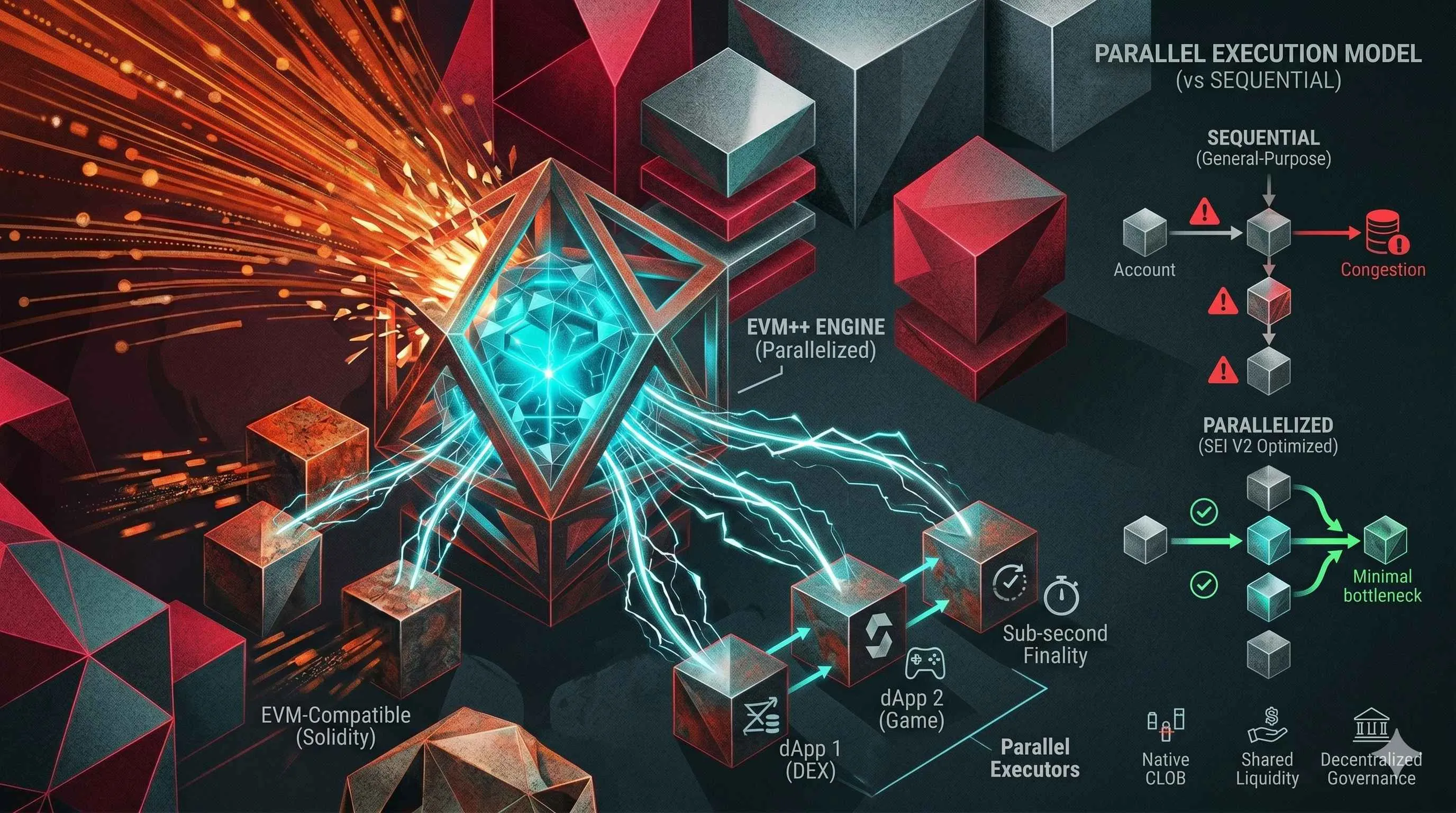
Understanding what is Sei requires seeing the blockchain landscape not as a winner-takes-all race, but as a specialized and diverse ecosystem. This L1 did not try to be the one-size-fits-all solution; it prioritized decentralized trading to create a better infrastructure for the exchange of digital assets. By Decoupling specialized tasks like liquidity provisioning through its built-in CLOB and maximizing throughput with its Parallelized EVM, the project provides a truly optimized foundation for thousands of high-performance dApps. As decentralized finance matures through 2026, this infrastructure will remain the bedrock for a scalable and efficient interchain future, making decentralized trading more accessible and powerful for everyone.
- How to Bridge Crypto Between Chains: Complete Cross-Chain Tutorial 2026
- How to Use 1inch: Complete DEX Aggregator Swap Tutorial (2026)
- How to Use OKX Web3 Wallet: Multi-Chain DeFi Hub Guide (2026)
Disclaimer: This article is for informational purposes only and does not constitute investment advice, financial advice, trading advice, or any other kind of advice. DEXTools does not recommend buying, selling, or holding any cryptocurrency or token. Users should conduct their own research and consult with a qualified financial advisor before making any investment decisions. Cryptocurrency investments are volatile and high-risk. DEXTools is not responsible for any losses incurred.
Related Guides
- What Is Monad: Complete Parallelized EVM Layer 1 Guide (2026)
- What Is MegaETH? Real-Time Ethereum L2 Guide 2026
- How to Use Unibot: EVM Telegram Trading Workflow (2026)
- Sui Network Architecture: Object-Centric Design, Parallel Execution and DeFi Apps (2026)
- zkEVM Types Compared: Polygon vs zkSync vs Scroll 2026
Frequently Asked Questions
What is Sei in crypto?
Sei is a layer 1 blockchain designed with a focus on trading and high performance applications. It aims to offer fast finality and low latency so decentralized exchanges and DeFi apps can run more like traditional markets.
How does a parallelized EVM work?
A parallelized EVM lets the network process multiple transactions at the same time instead of strictly one after another, as long as those transactions do not touch the same state. This can increase throughput compared to a fully sequential execution model.
Why is Sei built for high frequency trading?
Sei prioritizes fast block times, quick finality, and efficient order handling, which are useful for traders who need rapid execution. These properties are meant to reduce delays between placing and confirming a trade.
Is Sei compatible with Ethereum tools?
Because Sei supports an EVM environment, developers can often reuse Ethereum style smart contracts and familiar tooling. Always confirm specific compatibility details in the official documentation before deploying.