Margin Trading in Crypto: Beginner Guide (2026)
— By Tony Rabbit in Tutorials

Margin trading in crypto explained: a beginner guide to leverage, liquidation, isolated vs cross margin, top venues, and the risks retail traders face.
Margin trading sounds simple on the surface. Borrow money from your exchange, use it to buy more crypto than your wallet balance allows, and pocket the bigger gains when the trade works. That is the pitch, and it is technically accurate. What the pitch leaves out is that the same mechanism that multiplies your wins multiplies your losses, and the math is brutally one-sided when prices move against you. Most retail accounts that touch margin do not survive twelve months.
If you have spent any time in crypto Twitter, Telegram, or YouTube, you have seen the screenshots. A trader turns $500 into $40,000 with 50x leverage on a single Bitcoin move. What you rarely see is the other ninety nine accounts that tried the same trade with the same leverage and got liquidated on a routine wick before the move even started. Survivorship bias is the engine that keeps the margin trading pipeline full of new retail money.
This guide is written to make you respect margin trading before you ever click the borrow button. You will learn exactly how margin works in crypto, what leverage, initial margin, and maintenance margin actually mean, how a liquidation price is calculated, the difference between isolated margin and cross margin, why liquidations cascade, and what a margin call actually is in a crypto context. By the end you will have a clear, honest framework for deciding whether margin makes sense for the kind of trader you actually are, not the trader you wish you were.
What Is Margin Trading?
Margin trading is the practice of borrowing capital from a broker or exchange to open a position larger than your account balance. In crypto, the broker is the exchange, the borrowed capital is usually a stablecoin or the asset you want to trade, and the collateral is whatever you have deposited into your margin account. You pay interest on the borrowed amount for as long as the position stays open, and the exchange has the right to forcibly close your position the moment your collateral can no longer cover potential losses.
The core idea is amplification. If you have $1,000 and you buy Bitcoin spot, a 10% move in BTC turns into a 10% move in your account. If you take that same $1,000, post it as collateral, and borrow $4,000 to open a $5,000 position, a 10% move in BTC turns into a 50% move in your account. The exposure is five times larger, so every basis point in BTC translates into five basis points in your equity. That is what leverage means in practical terms.
The reason this matters for crypto specifically is that crypto markets move faster and further than almost any other asset class. A 5% daily move in Bitcoin is normal. A 20% daily move in a mid cap altcoin is a Tuesday. When you stack 10x or 50x leverage on top of that natural volatility, ordinary price action becomes account ending. Margin trading does not change the market. It changes how much of the market sits inside your account.
How Margin Trading Works in Crypto
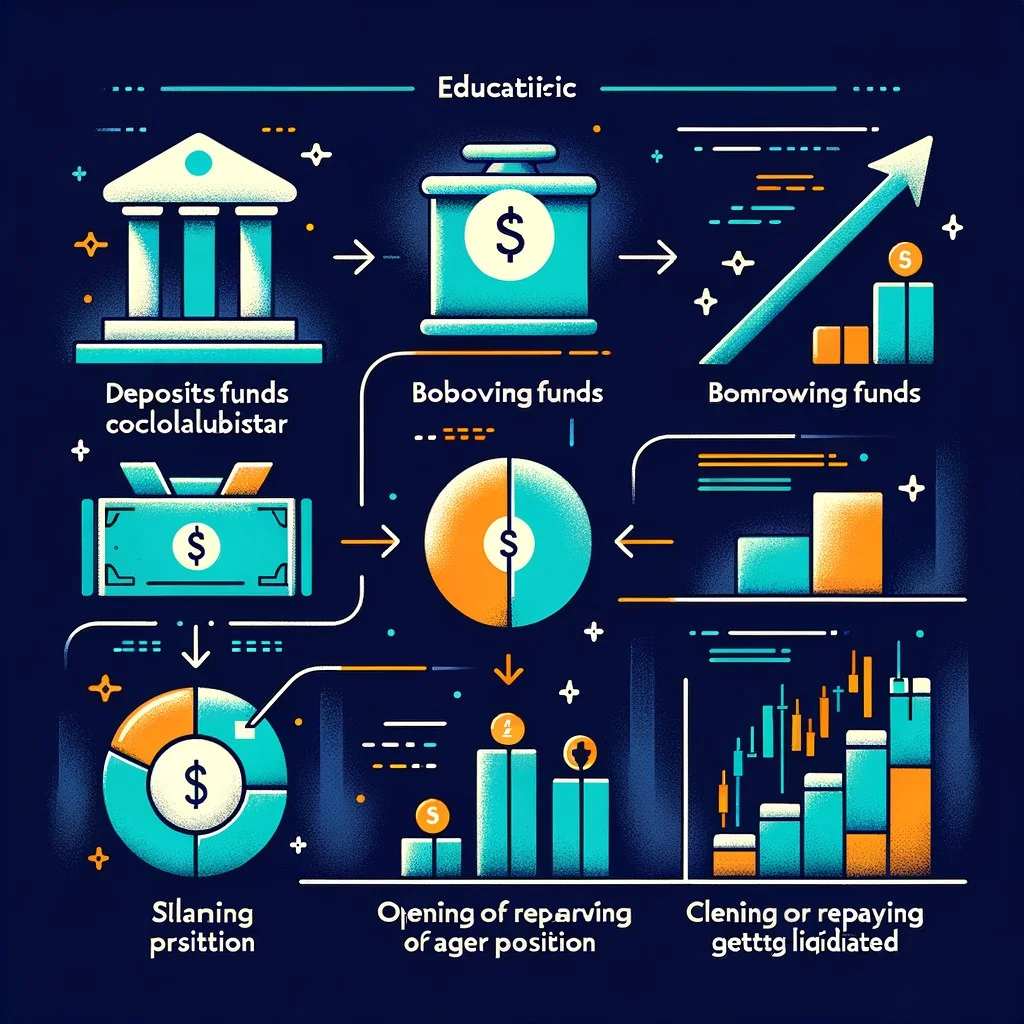
The mechanics are simpler than most beginners expect. You move funds into a margin wallet, choose how much leverage you want, open a long or short position, and the exchange handles the borrowing in the background. You never actually receive the borrowed funds in a separate wallet. They are deployed directly into the position you opened. When you close, the exchange repays itself first, deducts any fees and interest, and returns whatever is left to your margin wallet.
The lifecycle of a single margin trade fits into four clean steps, and understanding them is non negotiable before you ever risk real money.
To make this concrete, walk through a real worked example. You deposit $1,000 in USDT as collateral. You choose 5x leverage and go long Bitcoin. The exchange effectively lends you $4,000 worth of BTC exposure, and your position is now $5,000 notional. Two scenarios matter here, and they are mirror images of each other.
- Position value: $5,000 -> $5,250
- Gain: $250
- Collateral: $1,000 -> $1,250
- Return on collateral: +25%
- Position value: $5,000 -> $4,750
- Loss: $250
- Collateral: $1,000 -> $750
- Return on collateral: -25%, near liquidation
Notice the asymmetry that is hiding in plain sight. A 5% favorable move gives you a 25% gain on collateral, which feels great. A 5% adverse move pushes you a quarter of the way to zero. To get back to break even from there, you do not need a 25% recovery on collateral. You need the position to recover the full 5% it dropped, and your collateral has now shrunk, so the recovery comes from a smaller base. Drawdowns on margin are mathematically harder to climb out of than equivalent spot drawdowns, and that is at modest 5x leverage. At 25x or 50x, a 2% adverse wick can end the position entirely.
Key Concepts: Initial Margin, Maintenance Margin, Liquidation Price
Three terms run the entire margin trading system. If you internalize these three, you will understand 80% of why people get liquidated and how to avoid being one of them.
Initial margin is the collateral you have to put up to open a position at a given leverage. The formula is straightforward. Initial margin equals position size divided by leverage. A $10,000 position at 10x leverage requires $1,000 of initial margin. A $10,000 position at 50x leverage requires only $200. Exchanges publish initial margin tables for every contract, and the tier increases for very large positions to discourage whales from concentrating risk.
Maintenance margin is the minimum collateral the exchange demands while the position is open. It is always lower than initial margin, typically 0.4% to 1% of position size on major contracts. As your unrealized losses grow, your usable collateral shrinks. The instant it falls below maintenance margin, the exchange starts the liquidation engine. There is no warning email, no grace period, no second chance. The system is fully automated and runs on every price tick.
Liquidation price is the price at which your collateral exactly equals maintenance margin. Cross that price and your position is gone. The simplified formula for a long position is liquidation price equals entry price multiplied by (1 minus 1 divided by leverage plus maintenance margin rate). For a 10x long on BTC entered at $100,000 with a 0.5% maintenance margin, the liquidation price sits roughly at $90,500. That is a 9.5% adverse move from entry. At 25x leverage, the same position liquidates at about $96,500, a 3.5% adverse move. At 100x, the buffer collapses to under 1%.
Every exchange shows the liquidation price on the order ticket before you confirm. Look at it. Compare it to the range the asset has moved in the last 24 hours. If your liquidation price is inside the normal daily range, you are not trading. You are gambling on a coin flip with negative expected value because of fees and funding.
Leverage Explained: 2x, 5x, 10x, 50x, 125x
Exchanges advertise leverage like horsepower on a car. The number is meant to feel exciting. In reality, leverage is the inverse of how much breathing room you have before you blow up, and the relationship is not linear. The jump from 2x to 5x is moderate. The jump from 25x to 100x is the difference between trading and clicking a button labeled detonate.
Used by professional traders for capital efficiency, not for thrills. Liquidation requires a 40-50% adverse move on the underlying. Survivable.
The realistic zone for swing traders using stop losses. Liquidation in the 9-20% adverse move range. Works if you actually respect risk.
Reserved for scalpers with tight stops on highly liquid pairs. Liquidation in 2-4%. One wick away from zero. Most retail uses this and dies.
Marketing toy. Liquidation under 1%. Fees and slippage eat your expected value even when you are right on direction. Do not.
The honest truth nobody at an exchange will say out loud is that high leverage exists because it generates fees and liquidations, both of which are revenue for the platform. When Binance, Bybit, or OKX put 125x in the leverage slider, they are not offering you a trading tool. They are offering you an extremely fast way to convert your deposit into their insurance fund. The deeper you go into the slider, the closer the experience gets to a slot machine. Read more on this dynamic in our dedicated leverage trading guide.
Isolated Margin vs Cross Margin
Every margin position you ever open will run in one of two modes, and the choice changes how a losing trade interacts with the rest of your account. This is the single most important risk setting on the order ticket, and most beginners ignore it entirely.
Isolated margin assigns a specific amount of collateral to a single position. If the trade goes against you, only that allocated collateral can be lost. The rest of your margin wallet is untouched. The downside is that the position liquidates faster because it cannot pull additional collateral from elsewhere. The upside is that one bad trade cannot blow up your entire account.
Cross margin uses your entire margin wallet balance as the collateral pool for every open position. Losing trades draw down the shared balance, which means a losing position has a much wider buffer before it liquidates. The downside is severe. A single position that goes badly wrong can drain every other position with it, and a cascade across correlated trades can zero an entire account in one move. Cross margin is appropriate for hedged portfolios where positions offset each other. It is not appropriate for directional retail trading.
For 95% of beginners and even most intermediate traders, isolated margin is the right default. It enforces position level risk and forces you to think about how much you are willing to lose on each individual idea. Cross margin should be reserved for traders who have built actual hedges and understand correlation, not as a way to delay liquidation by a few extra percent.
Where to Margin Trade Crypto in 2026
The margin trading venue you choose affects fees, available leverage, asset coverage, and the quality of the liquidation engine. Here are the major options retail traders actually use in 2026, with the honest tradeoffs of each.
Binance Margin is the largest by volume. It offers spot margin (up to 10x on major pairs) and perpetual futures with leverage up to 125x on BTC and ETH. Liquidity is unmatched, fees are low, and the matching engine handles enormous volume without slippage. The downside is regulatory complexity in some jurisdictions, including the US where Binance.US is a separate, more limited entity.
Bybit built its reputation on derivatives and remains a primary venue for perp futures traders. Leverage goes up to 100x on BTC and ETH. The interface is cleaner than Binance for new derivatives traders, and copy trading features are well integrated. Fees are competitive and the platform pays funding rebates in some conditions.
Kraken Pro offers spot margin up to 5x on a curated list of assets. Leverage is conservative compared to offshore venues, but Kraken has the strongest US regulatory posture of any major derivatives platform. If you are based in the US and want margin without legal ambiguity, Kraken Pro is usually the right call. See our broader exchanges comparison for tradeoffs.
OKX is a serious institutional grade venue with deep order books, advanced order types, and a wide selection of perpetual contracts. Leverage tops out at 125x on majors. The platform is particularly strong for altcoin futures and offers unified accounts that combine spot, margin, and derivatives collateral.
dYdX is the leading decentralized perpetual futures exchange. There is no custodian holding your funds. You trade directly from your wallet through the dYdX chain. Leverage on majors is up to 50x. Fees are lower than centralized peers once you account for volume tiers, and the platform is non KYC for most jurisdictions, although that varies. Liquidation engines on dYdX are deterministic and transparent on chain, which some traders prefer over the black box mechanics at centralized exchanges.
Margin Trading vs Spot vs Futures vs Perpetual
These four terms get used interchangeably by beginners, and that confusion costs people money. They are not the same product. Each has different mechanics for borrowing, settlement, and risk.
The cleanest mental model: spot is ownership without leverage, margin (spot) is borrowed real assets with interest, dated futures are synthetic contracts that settle on a specific calendar date, and perpetual futures are synthetic contracts that never settle and instead use a periodic funding payment to keep their price tethered to spot. The risk profile escalates roughly in that order, and so does the complexity of managing the position. For a deeper dive on the most popular of these, see our perp futures guide, and for the directional basics see long vs short.
Funding Rates and Costs
Margin trading is not free. There are three cost layers that compound against you for as long as the position is open, and underestimating them is one of the most common reasons profitable looking trades become losing trades by exit.
The first cost is the trading fee, which you pay on entry and exit. On most exchanges this is 0.02% to 0.075% per side on derivatives, and slightly higher on spot margin. The second cost is borrow interest on spot margin, which is charged hourly on the borrowed portion of the position. Rates fluctuate with demand and can spike to several percent per year on popular tokens during high volatility periods.
The third cost, and the one most beginners discover painfully, is the funding rate on perpetual futures. Every eight hours (sometimes hourly on high volatility pairs), longs pay shorts or shorts pay longs based on the difference between the perp price and the spot index. When markets are bullish, longs typically pay. When markets are bearish, shorts typically pay. The rate is small per cycle (often 0.01% to 0.1%) but it compounds across hundreds of cycles for a position held over weeks. A 0.05% funding rate every eight hours equals 0.15% per day, or roughly 4.5% per month, which is enough to flip a flat trade into a clear loser.
Before opening a perp position, check the current funding rate and the rolling average for the pair. If you are about to pay 0.1% every eight hours, your entry needs to outperform 0.3% per day just to break even. That is a non trivial hurdle, and many traders ignore it entirely until the funding bill comes due.
Liquidations: How They Work and Why They Cascade
A liquidation is the forced closure of your position by the exchange when your collateral can no longer cover potential losses. It is not negotiable, not reversible, and not delayed. The instant the mark price touches your liquidation price, an automated engine submits a market order to close your position. Whatever fills, fills. Whatever does not fill at acceptable prices gets handed to the exchange insurance fund or socialized across profitable traders, depending on the venue.
The reason liquidations cluster and cascade is straightforward and important. Imagine ten thousand long positions on BTC with liquidation prices spread between $98,000 and $99,000. Price drifts down to $99,100. A few positions get liquidated. Each liquidation sends a market sell order into the orderbook, pushing price down by a few dollars. That extra movement triggers the next batch of liquidations. Each new sell order pushes price lower again. Within seconds, the orderbook can absorb thousands of forced sales, and the mark price drops a thousand dollars on what started as a routine pullback.
This is called a liquidation cascade, and it is the mechanism behind most of the violent wicks you see on BTC and ETH charts. Sophisticated traders watch open interest and funding rates to estimate where these clusters sit, and they actively trade against the cascade. Some go further and intentionally push price toward known liquidation pools, a practice called liquidation hunting. This is not a conspiracy theory. It is documented behavior on every major venue and is openly discussed on trading desks.
Liquidation cascades are not edge cases. They happen on a near weekly basis on BTC and ETH, and on a near daily basis on smaller altcoins. If your liquidation price sits inside a cluster that the market can reach with normal volatility, your position is not a question of if but when. The exchange engine does not care about your thesis, your stop loss intention, or whether you were about to log in. It cares only about the mark price crossing a number.
Overleverage compounds the problem. At 50x, ordinary slippage on the liquidation order can wipe out more than your collateral, leaving the insurance fund to cover the gap. On a bad day for the insurance fund, this gets socialized via auto deleveraging, where profitable traders on the opposite side have their positions force closed at the bankruptcy price. The risk you signed up for is not just losing your collateral. It is being part of the chain that loses other people's profits too.
Risks of Margin Trading
The risks of margin trading are not abstract. They are mechanical, mathematical, and quantifiable, and every one of them has emptied retail accounts at scale.
Overleverage is the headline risk. The slider on every exchange is designed to feel like a video game setting. It is not. Every step up the leverage curve narrows your liquidation buffer by a corresponding ratio. A 10x position survives roughly a 9% adverse move. A 50x position survives roughly 1.8%. A 100x position survives less than 1%. The natural intraday range of major crypto assets is more than enough to liquidate the upper end of that ladder on routine days.
Slippage on liquidation compounds the loss beyond what the leverage math suggests. When the engine submits a market order to close your position, it eats through the orderbook at whatever fills are available. In thin markets or during fast moves, the average fill price can be materially worse than the displayed liquidation price. Read our slippage guide for the deeper mechanics. The practical takeaway is that the published liquidation price is best case, not the typical outcome.
Exchange counterparty risk sits on top of all the trading risks. When you margin trade on a centralized exchange, your collateral is held in custody by that exchange. If the exchange goes insolvent, gets hacked, freezes withdrawals, or restricts access for your jurisdiction overnight, your collateral becomes an unsecured claim in a bankruptcy proceeding that may take years to resolve. FTX, Mt. Gox, QuadrigaCX, Celsius, and a long list of smaller venues have all done this to their customers.
Market gap risk is the killer that retail rarely considers. In a fast crash or pump, price can skip past your stop loss and your liquidation price without filling at either. The orderbook simply does not have liquidity at the levels in between, so the next available print is several percent away. You end up worse than your worst case scenario. This happens regularly on altcoin perps during liquidity crunches and during low liquidity hours like weekend mornings.

Best Practices: Position Sizing, Stop-Loss, Don't Average Down on Margin
If you are going to margin trade despite everything above, here is the minimum discipline framework that distinguishes traders who survive from those who do not. None of this is exciting. All of it is necessary.
Size every position by risk, not by leverage. Before you open the trade, decide the maximum dollar amount you are willing to lose if the stop hits. Then work backward to figure out the position size. If you have a $10,000 account and you accept 1% risk per trade ($100), and your stop is 3% away from entry, your position size should be roughly $3,300, not whatever the maximum leverage allows. The leverage is just the tool to make the position fit your collateral. It is not the goal.
Use a hard stop on every entry. Place the stop the moment the position fills, not as an intention you will execute manually when price gets close. Manual stops fail because traders rationalize and hesitate. Hardware level stops at the exchange execute regardless of your emotional state. Our stop-loss and take profit vs stop loss tutorials walk through the exact mechanics on each major exchange.
Never average down on a margin position. Adding to a losing position on spot is a defensible long term strategy when you have conviction and time. Adding to a losing position on margin is mathematically suicidal because it lowers your average price but also lowers your liquidation buffer relative to current price. You are tightening the trap while moving the floor up to meet you. The exchanges love this behavior. It generates a second round of fees and a more aggressive liquidation.
Cap your account level exposure. Even with isolated margin per position, the sum of your open margin positions creates an aggregate account risk. A practical ceiling is no more than 20-30% of total account equity tied up in active margin notional at any time. The remainder stays in stables or spot as dry powder for the inevitable opportunities created by other people's liquidations.
Common Beginner Mistakes
The mistakes that wipe out new margin traders are remarkably consistent across years, exchanges, and assets. If you avoid these five, you outperform the median retail margin trader by a wide margin.
The first mistake is choosing maximum leverage on a small account. A new trader with $500 reaches for 50x or 100x because the math looks tempting. Five hundred at 50x is a $25,000 position. A 1% favorable move pays $250, which feels enormous on a $500 base. The same 1% adverse move wipes out half the account, and a 2% wick takes the rest. The smaller the account, the more conservative the leverage should be, because there is no recovery from zero.
The second mistake is ignoring funding rates on perpetuals. A trader takes a long position on a popular meme coin when funding is at 0.3% per eight hours. After three days the position is paying 2.7% in funding alone, which is more than the entire move they were targeting. Funding rates above 0.1% per eight hours signal extreme one sided positioning and are typically a contrarian indicator, not a justification for piling in.
The third mistake is holding through high implied volatility events like major macro releases, exchange listings, or unlock cliffs without reducing leverage. Volatility expansion does not announce itself politely. It manifests as a 5-10% wick that takes out clusters of liquidations on both sides. If you cannot reduce leverage or close ahead of known volatility events, you are accepting binary risk on a non binary trade.
The fourth mistake is mistaking unrealized profit for working capital. New traders see their PnL on the screen and treat it as available collateral for new positions. It is not, until you close. A reversal that takes out your unrealized gain also tightens every other position you opened using it as imagined margin. Lock profits in real terms before redeploying.
The fifth mistake is the revenge trade after a liquidation. The emotional state after a liquidation is the worst possible state in which to make sizing decisions. Traders re enter at double the previous size, double the leverage, or both. The second blow up is faster and bigger than the first. Walk away from the keyboard for at least 24 hours after any liquidation. The market will still be there.
Margin Trading and Taxes
Tax treatment of margin trading varies significantly by jurisdiction, and the details matter because the same trade can be taxed very differently depending on where you file. This section is general and not legal advice. Always consult a qualified accountant for your specific country.
In the United States, margin trading on crypto generally creates a taxable event on every close, whether the position was profitable or not. Short term capital gains apply to positions held under one year, taxed at ordinary income rates. The interest you pay on borrowed funds may be deductible as investment interest, subject to limits. The IRS has been increasingly specific about crypto reporting, and exchanges issue 1099 forms in many cases. Treating margin trades as off the books is not a viable strategy in 2026.
In the European Union, treatment depends on the member state. Germany has notably favorable rules for spot crypto held over one year, but those rules typically do not extend to derivatives and margin positions, which are taxed as capital gains or speculative income. France, Spain, and Italy each have their own frameworks, often distinguishing between professional and retail trader status. In the UK, margin trading gains fall under capital gains tax with an annual allowance, and contracts for difference style instruments may be treated as gambling in some narrow cases (do not rely on this).
In most jurisdictions, the practical rule is to keep clean, exchange exported records of every fill, every funding payment, every fee, and every liquidation. Tax software that integrates with major exchanges has become reasonably mature, but it is only as accurate as the data you feed it. Manual reconstruction after a year of active trading is brutal. Set up the export automation on day one.
Frequently Asked Questions
Is margin trading the same as futures?
No. Margin trading in the traditional sense involves borrowing actual assets (usually stablecoins or the token you want to trade) and paying interest on the loan. Futures are synthetic contracts that derive their value from an underlying asset. You never own or borrow the underlying. Both use leverage, both can be liquidated, but the borrowing mechanics, fees, and tax treatment are different. Most retail traders today use perpetual futures even when they call it margin trading, because perps offer higher leverage and are easier to operate than classic spot margin.
What is a margin call in crypto?
A margin call is a notification from the exchange that your collateral has dropped close to the maintenance margin level and that you need to either deposit more funds or accept liquidation. In traditional finance, margin calls give traders hours or days to respond. In crypto, the warning window is measured in seconds at best, and most exchanges do not issue a meaningful call at all before the liquidation engine fires. The practical reality of a crypto margin call is that you see your collateral approaching maintenance margin in real time on the screen, and unless you act immediately, the system closes the position for you.
How much leverage is safe in crypto?
There is no universally safe leverage, only leverage that is appropriate for a specific strategy and account size. For swing trading on majors with proper stops, 3x to 5x is typically the upper bound of sustainable leverage. For intraday scalping on highly liquid pairs with tight stops, experienced traders may use 10x. Anything above 25x is essentially a directional gamble where the edge has to be very high to overcome fees, funding, and slippage on liquidation. For beginners, 2x to 3x is the realistic ceiling until you have at least six months of profitable execution at that level.
Can I lose more than my deposit margin trading?
On most modern crypto exchanges, no. Major venues like Binance, Bybit, OKX, and Kraken operate insurance funds that absorb the residual loss when a liquidation closes below the bankruptcy price. In exchange for that protection, you can lose 100% of your isolated margin or your entire margin wallet under cross margin. In rare cases of extreme market dislocation where the insurance fund is exhausted, exchanges use auto deleveraging to socialize the loss across profitable traders on the opposite side. Some smaller or unregulated venues may still expose you to negative balances, so check the specific terms of your exchange before depositing.
Why do liquidations cascade?
Liquidations cascade because each forced market order moves price, which triggers the next batch of positions whose liquidation prices were just slightly further away. On highly leveraged pairs, clusters of liquidation prices sit within a narrow band, and once price enters that band, the engine fires through them sequentially in seconds. The selling (in a long cascade) or buying (in a short cascade) feeds on itself until the cluster is exhausted or until counter liquidity arrives. This is why you see vertical candles of 5-10% on BTC and ETH during fast moves. The market is not pricing new information. It is processing forced flow from the liquidation engine.
Should beginners use margin trading at all?
For most beginners, the answer is no until you have demonstrated consistent profitability on spot for at least six months. Margin trading is a force multiplier, and force multipliers amplify whatever they are pointed at. If your spot trading is profitable, margin can scale the returns at controlled risk. If your spot trading is not profitable, margin scales the losses faster than you can react. The smart sequence is spot first, paper trade derivatives second, small live derivatives with strict risk controls third. Skipping straight to high leverage is the most common reason new traders never make it past their first deposit.
Conclusion
Margin trading is a tool, not a strategy. The tool itself is neutral. It multiplies exposure, and it does that with mechanical honesty. The reason it destroys most retail accounts is not the tool. It is the gap between how the leverage slider is presented and how the math actually works on the way down. Exchanges are not in the business of teaching that math. This guide is.
If you take only three things from everything above, take these. First, your liquidation price is a hard line, not a soft warning, and it must sit outside the normal volatility range of the asset you are trading. Second, leverage should be the byproduct of your position sizing math, not the input. Choose risk first, then choose the leverage that fits. Third, the exchange's incentives are not aligned with your survival. The platform makes money on fees, funding, and liquidations, all three of which scale with the leverage you use. Respect that the venue is not your partner.
Margin trading can be a legitimate and even powerful part of an experienced trader's toolkit. Pair traders, market makers, arbitrageurs, and disciplined swing traders all use leverage productively. The shared feature among traders who use margin well is brutal honesty about position sizing, mechanical stop discipline, and a long history of profitable spot trading before they ever turned on the borrow function. If you do not have that profile yet, the smartest margin trade is the one you do not take. Build the foundation on spot first. The leverage will still be there when you are ready, and your account will still be there to use it.
Related Guides
- What Is Futures Trading in Crypto? How Leverage, Margin and Liquidation Work (2026)
- Kraken Pro Tutorial: Spot, Margin and Futures Explained
- How to Use Dolomite: Lending and Margin Tutorial (2026)
- What Is Wash Trading in Crypto? Complete Beginner Guide (2026)
- Wash Trading Red Flags on Exchanges and DEXs (2026)