Take Profit vs Stop Loss in Crypto: Key Differences (2026)
— By Tony Rabbit in Tutorials
Learn the real difference between take profit and stop loss in crypto, how trigger price differs from fill price, and why liquidity changes exit behavior.
Take profit and stop loss solve two different problems in a trade. A take-profit tells you where you want to get paid if the idea works. A stop-loss tells you where the idea is wrong and where you need to exit before a manageable loss turns into damage. Beginners often talk about both in one breath, but they are not interchangeable. One structures upside, the other defines downside.
Intent check: This page owns the comparison angle, including trigger logic and fill behavior. If you want the hands-on tutorial for where to place both orders on a real trade, read How to Set Stop-Loss and Take-Profit in Crypto.
That distinction matters even more in crypto because volatility can make a planned level and an actual fill price diverge quickly. On liquid markets the gap may be small. On fast or thin markets it can be painful. So a good exit plan is not just "TP here, SL there." It is also understanding trigger price, execution type, spot vs futures mechanics, and how position size connects to the whole trade.
Quick answer
- A take-profit locks in gains if price reaches your target area. A stop-loss limits damage if the setup fails.
- The trigger price is not always the final fill price, especially when the exit becomes a market order in a fast market.
- On spot, TP/SL logic often revolves around trigger price, order price, and available assets. On futures, it also interacts with position mode and how the platform closes exposure.
- Use DEXTools to plan levels and liquidity context first, then choose execution rules that actually fit the market you are trading.
The Core Difference Between Take Profit and Stop Loss
A take-profit level is where you plan to exit because the trade succeeded enough to justify realizing gains. A stop-loss is where you plan to exit because the trade failed enough to prove the thesis wrong. Good traders define both before the trade is live, not after emotions arrive.
The mistake beginners make is treating stop loss like a pain threshold and take profit like a wish. In reality, both should come from structure. The stop should live where the setup is invalidated. The take-profit should live where the market is likely to react, where reward-to-risk becomes attractive, or where your plan says partial profits make sense.
Take profit vs stop loss at a glance
Trigger Price vs Fill Price
This is one of the most important details in the whole subject. A trigger price decides when an exit order wakes up. The fill price is where the order actually executes. Those are often close, but they are not guaranteed to be identical.
Bybit's spot documentation makes this explicit. A TP/SL order can trigger when the last traded price reaches your preset level, but the resulting order may then execute as a market order or sit as a limit order depending on what you chose. That means a stop-limit or take-profit-limit order can trigger correctly and still fill later, partially, or not at all if liquidity disappears. A market-style exit is more likely to fill, but not always at the exact number you imagined.
Take Profit and Stop Loss on Spot vs Futures
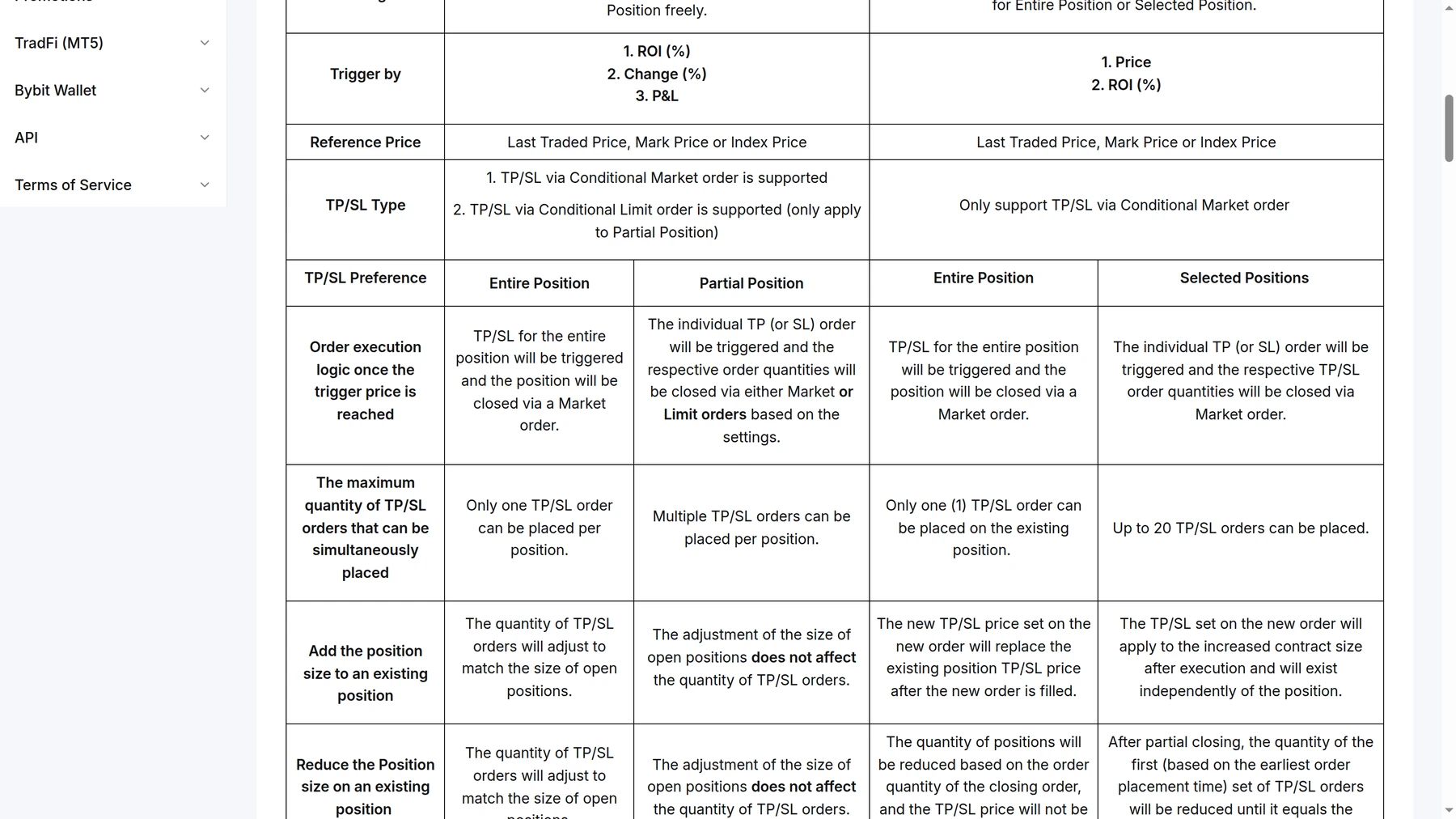
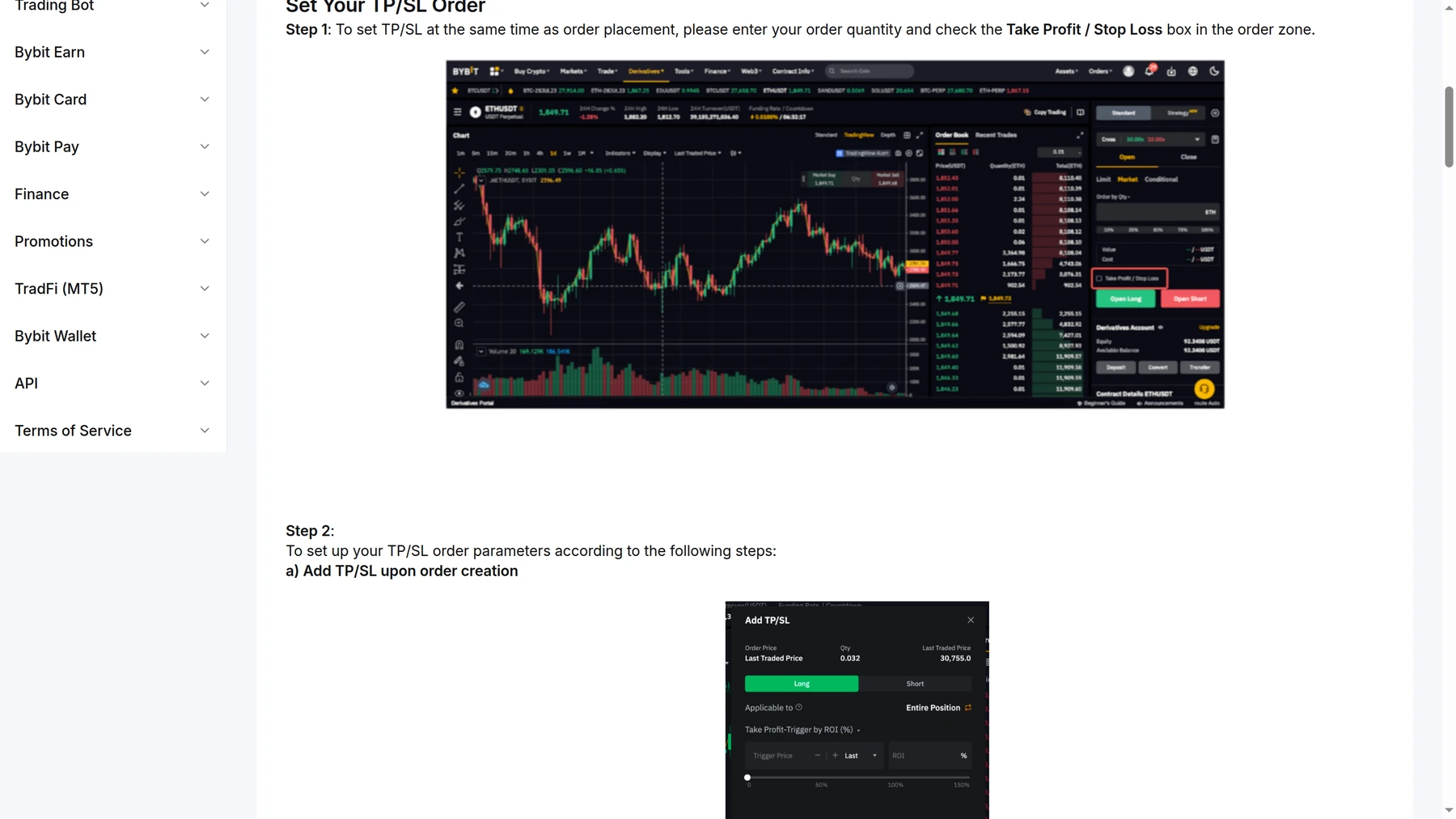
Spot and futures use similar words, but the mechanics are not identical. On spot, the order usually works with assets you already own or intend to buy, and the platform may ask for trigger price, order price, and quantity. On futures, the order is managing an open position and may offer entire-position or partial-position logic, reference prices such as last, mark, or index, and different execution rules once the trigger fires.
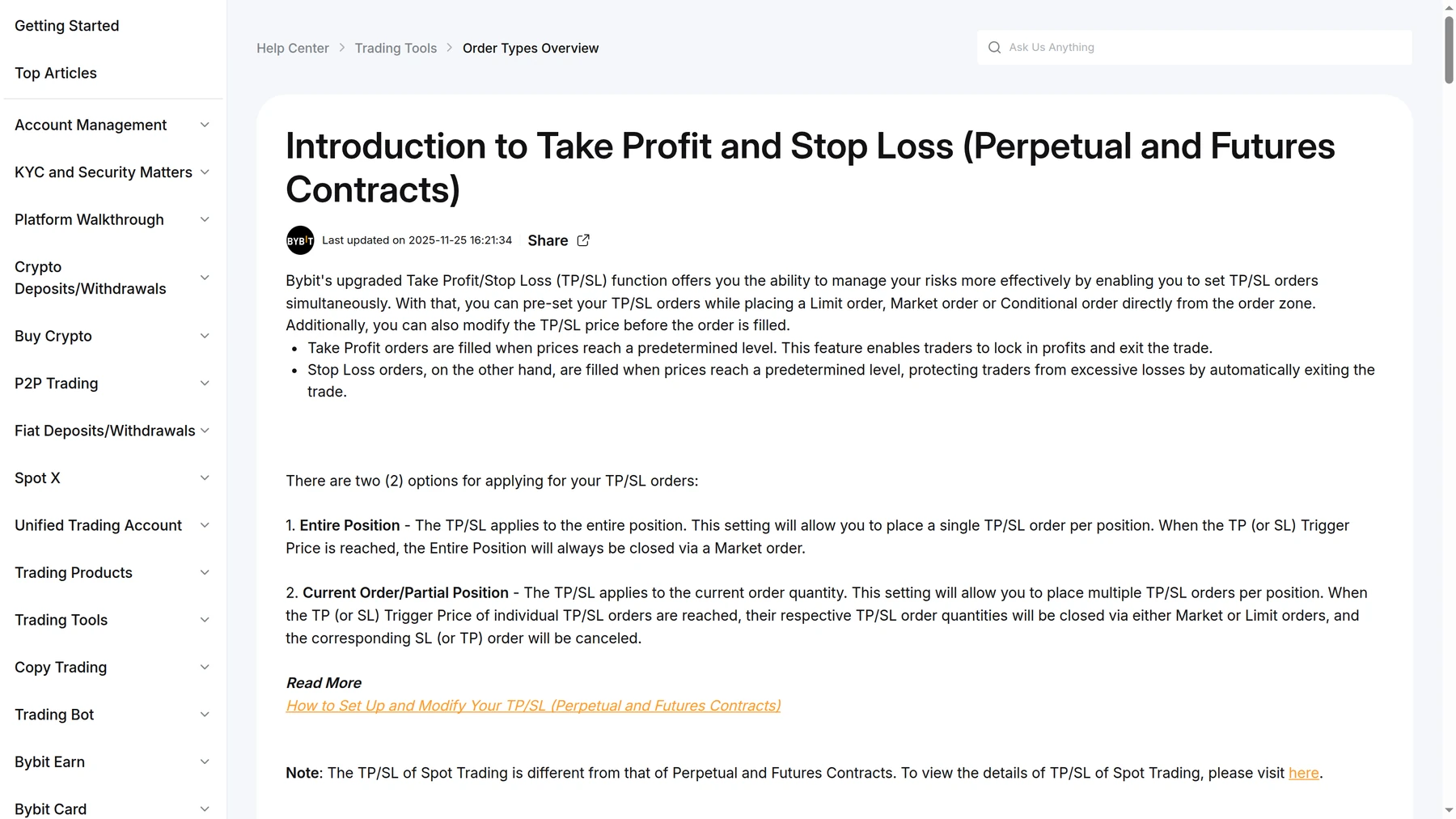
Bybit's futures help pages are useful here because they show the two big distinctions clearly. First, futures TP/SL can be tied to the whole position or to partial position logic. Second, the platform can trigger based on different reference prices such as last, mark, or index price. That matters because a trader can be directionally right and still get surprised if they never understood which reference price actually controls the trigger.
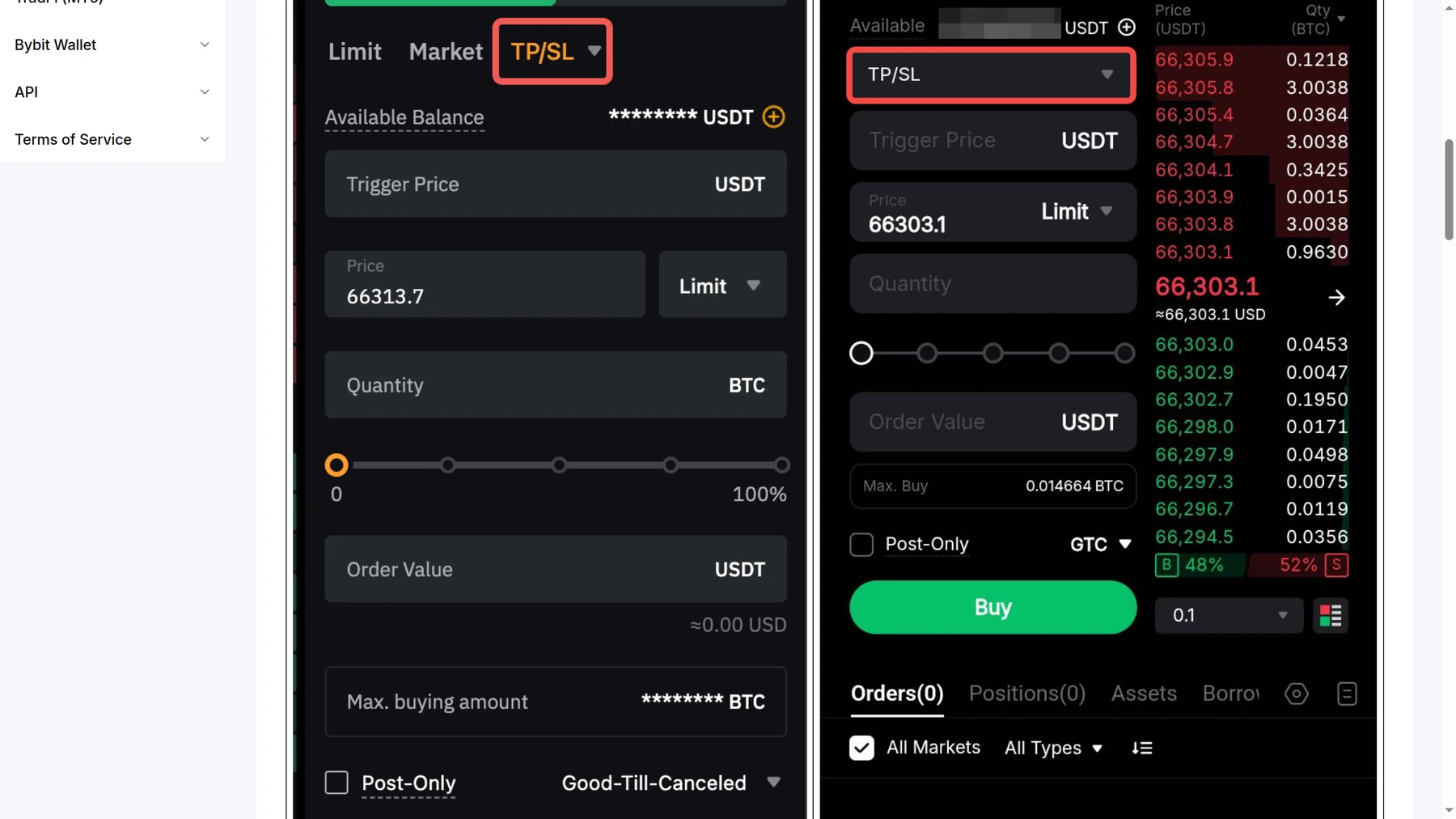
What changes between spot and futures
If you want the order-type background, our stop-limit vs stop-market guide and crypto order types guide go deeper into the execution side.
Risk-Reward and Position Sizing Connect the Whole Plan
Take profit and stop loss only become a real system when position size fits the distance between them. If your stop needs to be wide because the setup structure is wide, the size has to shrink. If the nearest realistic target offers poor reward relative to the risk, the trade may not be attractive at all.
Simple risk-reward thinking
That is why our position sizing guide pairs naturally with this article. A stop-loss without size discipline is only half a plan.
How DEXTools Helps Plan Exits Before the Order Exists
DEXTools does not natively place broker-style stop losses for every DEX workflow, but it is still valuable at the planning stage. You can use the chart to map support and resistance, inspect volume around prior reactions, compare liquidity with your intended size, and decide whether the pair is even clean enough for a meaningful stop and target.
That is especially important on DEX pairs where execution may be manual, alert-based, or dependent on swap conditions rather than exchange-native TP/SL fields. In those cases, DEXTools helps you define the levels and market quality first. Then you choose whether the trade is good enough to justify any execution risk at all.
A practical DEXTools exit-planning workflow
- Mark the invalidation level first. If price reaches it, the idea is wrong.
- Map one or two realistic take-profit areas using prior highs, resistance, and volume context.
- Check liquidity before trusting the plan. A pretty target is useless if the exit will be ugly.
- Size the trade from the stop distance, not from excitement.
- If the pair is too thin to respect your plan, skip it.
Common Take-Profit and Stop-Loss Mistakes in Volatile Crypto Markets
Mistakes that keep hurting traders
If you want the tactical side after this conceptual comparison, the follow-up is How to Set Stop-Loss and Take-Profit in Crypto Trading. That article focuses more on placement logic, while this one focuses on the difference between the two tools and how execution mechanics change the outcome.
Frequently Asked Questions
What is the difference between take profit and stop loss?
Take profit locks in gains when price reaches your target area. Stop loss limits downside when the setup fails and price reaches your invalidation level.
Is trigger price the same as fill price?
Not always. The trigger activates the exit logic, while the final fill depends on order type, liquidity, and how fast the market is moving.
What is better, stop-market or stop-limit?
Stop-market usually prioritizes execution, while stop-limit prioritizes price control. The better choice depends on liquidity and how much non-fill risk you can tolerate.
Do take profit and stop loss work the same on spot and futures?
No. Spot often focuses on trigger price, order price, and available assets, while futures also adds position mode and reference-price logic such as last, mark, or index price.
Can I use DEXTools to plan take profit and stop loss levels?
Yes. DEXTools is useful for mapping structure, volume, and liquidity context before you choose whether the trade deserves a target and an invalidation level at all.
Related DEXTools tutorials
Disclaimer: This article is for educational purposes only and does not constitute investment or trading advice. Crypto execution depends on platform rules, liquidity, and market conditions, so always verify how your exchange or trading venue actually handles trigger price, order type, and position mode.
Related Guides
- How to Set Stop-Loss and Take-Profit in Crypto: Entry, Risk and R:R Setup (2026)
- Is Ripple the Same as XRP? Key Differences Explained (2026)
- EMA vs SMA in Crypto: Key Differences, Signals and Best Uses (2026)
- CBDCs vs Stablecoins: Key Differences for Crypto Users
- Meme Coin Position Size Calculator: Profit, Risk and Market Cap Scenarios (2026)