How to Set Stop-Loss and Take-Profit in Crypto: Entry, Risk and R:R Setup (2026)
— By Tony Rabbit in Tutorials

Learn how to set stop-loss and take-profit levels in crypto using chart structure, risk-per-trade sizing, reward-to-risk planning, and practical execution rules.
Stop-loss and take-profit are not advanced extras for professional traders. They are the basic structure that keeps a crypto trade from turning into a random bet. In practice, a trade idea is only complete once you know where you are wrong, where you want to get paid, and how much size fits that risk.
Intent check: This page is the practical setup tutorial, focused on placement, sizing, and execution. If you want the concept-level difference between the two order types first, read Take Profit vs Stop Loss in Crypto.
This matters even more in crypto because volatility, thin liquidity, and fast sentiment shifts can move a pair much harder than beginners expect. On liquid majors the move can still be violent. On smaller DEX pairs, slippage and pool depth can make a bad exit even worse. That is why good traders do not ask only, "Where can this go?" They ask, "What am I risking if I am wrong, and is the reward worth it?"
Quick answer
- Set a stop-loss where the trade idea is clearly invalidated, not at a random percentage.
- Set a take-profit where price is likely to react, such as prior highs, resistance, or a reward-to-risk target.
- Size the trade from your account risk and stop distance. Wider stop means smaller size.
- On volatile or illiquid crypto pairs, remember that a planned exit is not always the same as a perfect execution price.
What Is a Stop-Loss in Crypto Trading?
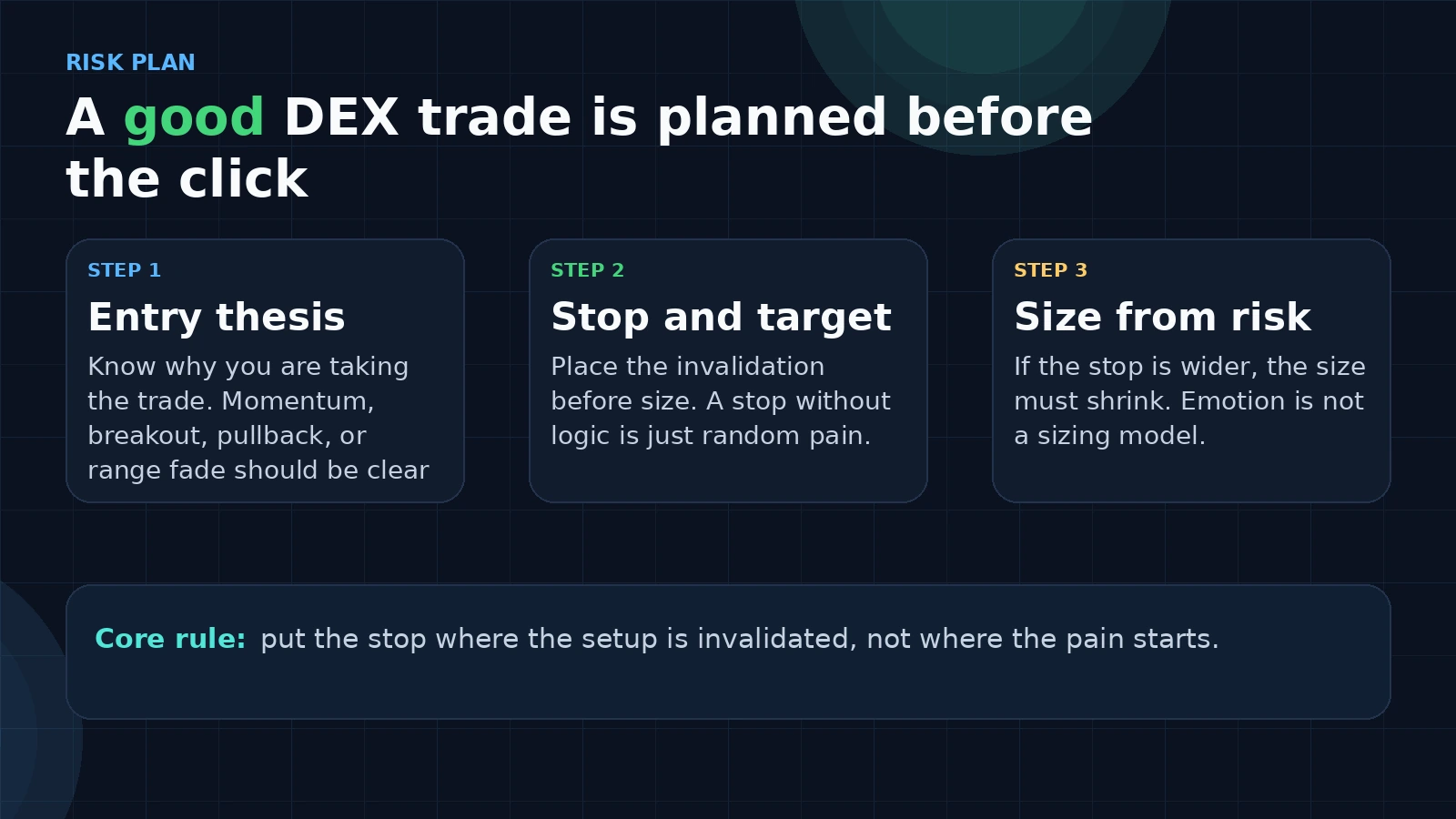
A stop-loss is the price level or exit condition that tells you the trade idea is no longer valid. If price reaches that area, the point is not to negotiate with the market. The point is to exit because the reason for entering is no longer intact.
Beginners often treat the stop-loss like a pain threshold. They place it at a number that feels uncomfortable to lose, or at a round percentage that has nothing to do with chart structure. That is backwards. The stop belongs where the setup is broken. If you bought a support bounce, the stop usually belongs below the support area that should have held. If you bought a breakout, the stop often belongs below the breakout level or below the structure that would prove the move failed.
A stop-loss is not the same thing as
What Is a Take-Profit in Crypto Trading?
A take-profit is the price area where you plan to realize gains instead of waiting for the market to decide everything for you. In simple terms, it answers the other half of the trade: if you are right, where does this move have a strong chance of slowing down, rejecting, or becoming less attractive?
Good take-profit levels usually come from structure, not greed. Traders often use prior highs, resistance zones, measured move targets, round-number levels, or a predefined reward-to-risk ratio. Some scale out in pieces. For example, a trader may take partial profit at the first target, move the stop to reduce risk, and leave a smaller remainder for a larger continuation.
How traders commonly choose take-profit levels
Why You Need Both, Not Just One
A stop-loss without a take-profit still leaves the upside vague. A take-profit without a stop-loss leaves the downside undefined. Both are needed because trading is a math problem before it becomes a feelings problem.
Imagine you risk 5% to try making 4%. Even if you win often, that structure gives you very little room for mistakes. Now compare that with a setup where you risk 1 unit to make 2 or 3 units and only take it when the chart structure supports the idea. You do not need perfection. You need reasonable asymmetry plus discipline.
How to Place a Stop-Loss Without Randomness
The simplest way to place a stop-loss is to start from the setup type. Ask what would prove the idea wrong on the chart or in the flow. That answer matters more than any fixed percentage rule.
Common setup logic
On DEX pairs, add one more layer of caution. If liquidity is thin and wicks are violent, a technically correct stop can still sit inside the noise. In those cases the answer is not to remove the stop. The answer is usually to reduce size, require cleaner structure, or skip the trade if the pair does not offer professional enough conditions.
How to Place a Take-Profit That Makes Sense
Take-profit placement should answer two questions. First, where is price likely to react? Second, is the potential reward large enough compared with the risk you are taking?
A common mistake is choosing a take-profit that is too ambitious for the actual chart. If nearby resistance sits 8% above your entry but your plan needs a 25% move to justify the trade, then either the trade is not attractive or the entry is late. Another common mistake is refusing to take profit because the market "could go higher." Of course it could. That does not make every open gain a hold forever situation.
Many traders improve quickly when they start using a layered approach:
Position Size Is What Connects the Whole Plan
This is the part most beginners skip. They decide size first, then place a stop somewhere after the fact. That is one of the fastest ways to oversize a trade. The cleaner process works in the opposite order.
- Choose the entry only if the setup is valid.
- Place the stop where the idea is actually wrong.
- Measure the distance between entry and stop.
- Choose how much of your account you are willing to risk on this one trade.
- Calculate size from that risk, instead of from emotion.
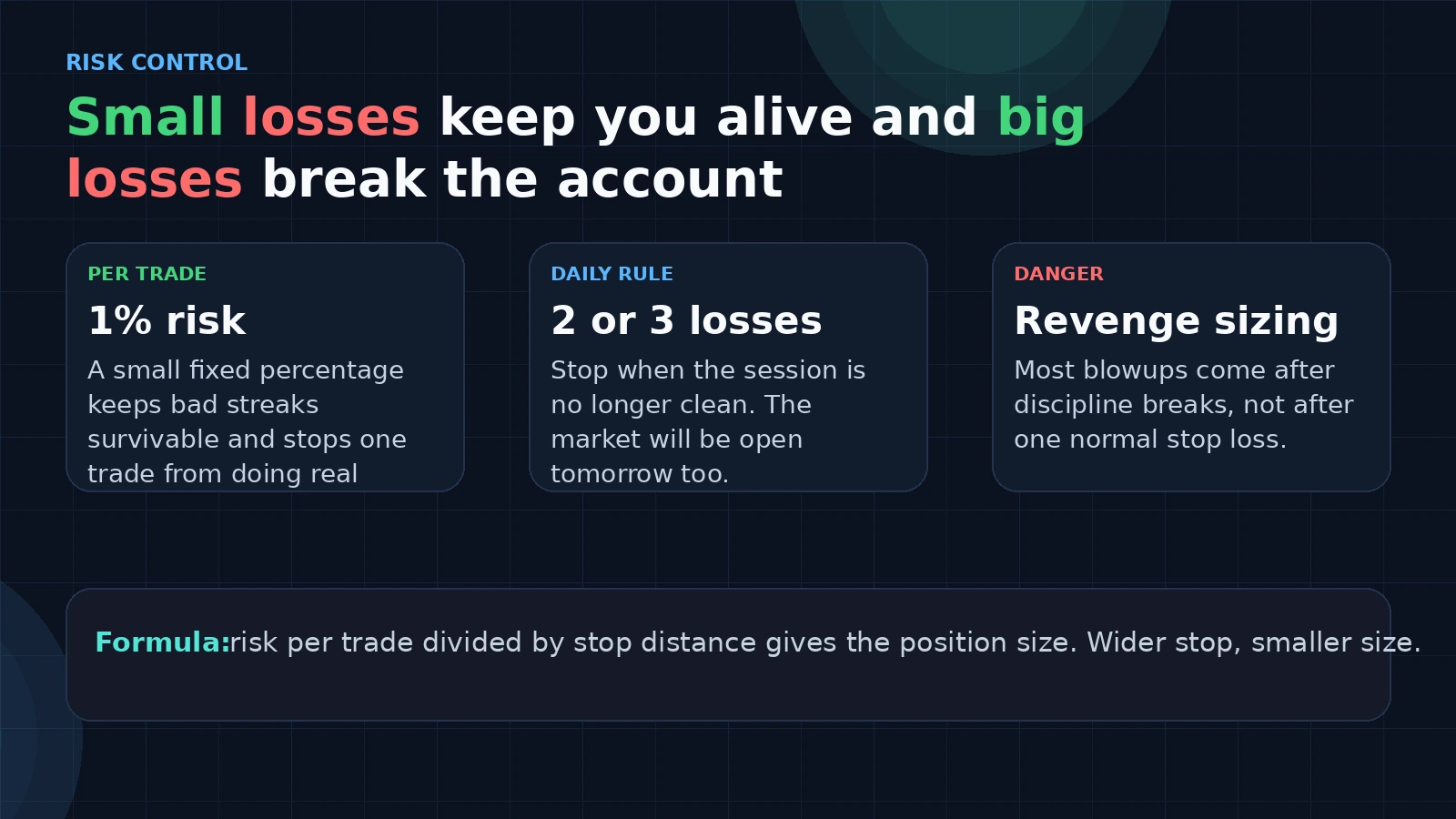
For example, if your maximum risk per trade is $100 and the distance between entry and stop represents 5%, your position size should be built so that a full stop costs about $100, not whatever amount feels exciting in the moment. That is how consistent traders survive streaks of normal losses without blowing up the account.
Crypto-Specific Problems Beginners Miss
Crypto adds a few complications that make stop-loss and take-profit planning more important, not less.
Common Stop-Loss and Take-Profit Mistakes
A Simple Beginner Checklist Before You Enter
- What exactly is the setup, and what would prove it wrong?
- Where is the stop if the idea fails?
- Where is the first realistic target?
- Is the reward worth the risk?
- How much liquidity is behind the pair, and how ugly could the exit get?
- What size keeps the loss acceptable if the stop is hit?
Frequently Asked Questions
What is the difference between stop-loss and take-profit?
A stop-loss defines where you exit if the trade idea fails. A take-profit defines where you realize gains if the trade works. One controls downside, the other structures upside.
Where should I place a stop-loss in crypto?
Place it where the trade setup is invalidated, such as below support, below a breakout level, or below the swing structure that should have held if the idea was correct.
What is a good take-profit target in crypto trading?
A good take-profit usually sits near prior resistance, a measured move target, or a reward-to-risk level that makes the trade worth taking, often around 2:1 or better when structure allows it.
Should I always use a fixed percentage stop-loss?
Not usually. Fixed percentages can ignore the real chart structure. The setup should decide the stop first, and the position size should adapt to that distance.
Why do stop-losses fail on some low-liquidity crypto pairs?
The decision level can still be correct, but the final exit can suffer from slippage or weak pool depth. That is why thin liquidity requires smaller size, stricter selectivity, or no trade at all.
Related reading
Disclaimer: This article is for educational purposes only and does not constitute investment, tax, or legal advice. Crypto markets are volatile, and real execution can differ from planned levels due to slippage, liquidity, and platform-specific behavior.
Related Guides
- Take Profit vs Stop Loss in Crypto: Key Differences, Trigger Logic and Fill Risk (2026)
- How to Use Crypto Grid Trading Bots: Setup, Parameters and Risk Controls (2026)
- How to Set Up Trezor Hardware Wallet: Safe 3 and Safe 5 Tutorial (2026)
- Meme Coin Position Size Calculator: Profit, Risk and Market Cap Scenarios (2026)
- Impermanent Loss Explained: Examples and How to Reduce It