What Is Slippage in Crypto? Complete Beginner Guide (2026)
— By Tony Rabbit in Tutorials
Learn what slippage means in crypto, why it happens on DEXs and CEXs, how slippage tolerance works, and how to reduce bad fills before you place a trade in 2026.
Slippage in crypto is the difference between the price you expected and the price your trade actually executes at. It sounds minor until you realize it directly affects what you pay when buying, what you receive when selling, and whether a trade idea still makes sense after execution.
This matters on both centralized exchanges and decentralized exchanges, but the mechanics are not identical. On a CEX, slippage often comes from walking through the order book. On a DEX, it usually comes from pool depth, price movement during execution, and the slippage tolerance you allow. Either way, the result is the same: the final fill is not the price you thought you were getting.
Quick answer
- Slippage is the gap between your expected trade price and your actual execution price.
- It usually gets worse with low liquidity, large order size, fast price movement, and loose DEX slippage settings.
- Negative slippage means a worse fill than expected. Positive slippage means a better one.
- Traders reduce slippage by using liquid pairs, smaller orders, calmer market conditions, and tighter execution settings.
What slippage means in crypto
When you click buy or sell, the price you see on screen is not always the exact price you will receive. If the market moves, if available liquidity is thin, or if your trade size is large relative to the available depth, your final average execution can shift. That shift is slippage.
For a buyer, slippage usually means paying more than expected. For a seller, it usually means receiving less than expected. But slippage is not always negative. Sometimes the market moves in your favor during execution and you get a better fill. That is called positive slippage.
Important nuance
A simple slippage example
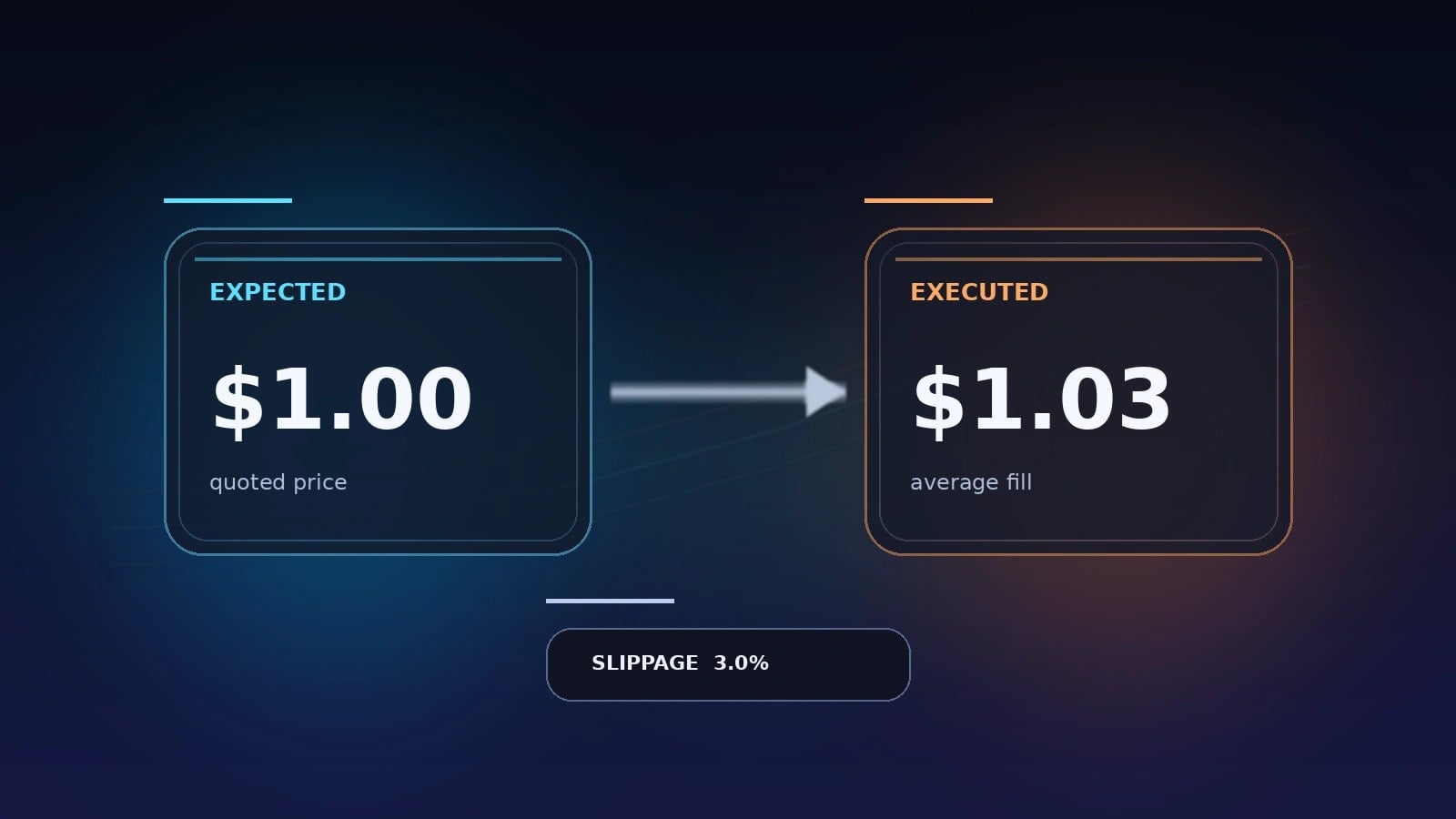
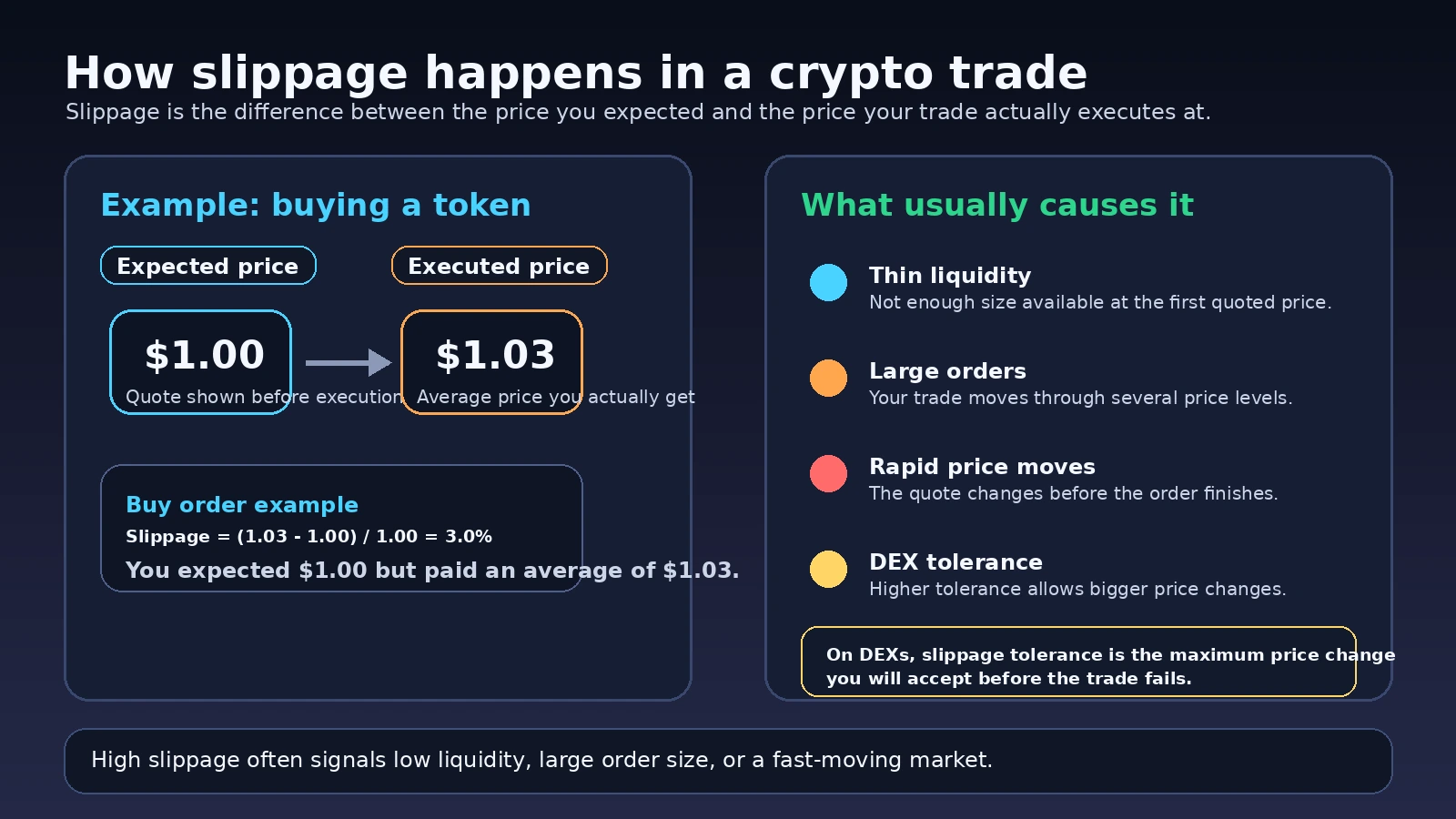
Imagine you submit a market buy when the quoted price is $1.00, but by the time the order finishes filling your average execution price is $1.03. Your slippage is 3%.
That does not necessarily mean the token suddenly became 3% more valuable in some fundamental sense. It means your execution had to move through worse prices than the first quote shown to you. In thin or fast markets, that can happen quickly.
Why slippage happens
Slippage is really an execution problem. It appears when the market cannot give you your full size at the first quoted price.
There is also an adversarial angle on some DEX trades. If your settings are too loose and the mempool environment is hostile, bots may take advantage of that execution window. This is one reason traders care about MEV and not just price movement alone.
Slippage vs price impact
People often mix up slippage and price impact, but they are not exactly the same thing.
For practical trading, the distinction matters because the fix is not always the same. If your order size is the problem, splitting the trade or using more liquid venues can help. If timing is the problem, avoiding volatile conditions may matter more.
CEX slippage vs DEX slippage
Slippage feels different on centralized and decentralized venues because the underlying market structure is different.
This is also why experienced traders do not only look at the token chart. They think about the actual venue and execution path. A good-looking chart can still be a bad trading environment if depth is poor.
What slippage tolerance means
On DEXs, slippage tolerance is the maximum execution difference from the quoted price that you are willing to accept before the swap fails or reverts. If your tolerance is too tight, the trade may fail often. If it is too loose, the trade may go through at a much worse price.
There is no single perfect tolerance for every market. Deep and stable pairs can usually handle tighter settings. Thin or highly volatile pairs may need more room, but that extra room is exactly what raises the risk of worse execution.
How to reduce slippage
You cannot eliminate slippage completely, but you can usually reduce it.
- Trade the most liquid pair or venue available.
- Break large orders into smaller pieces when appropriate.
- Avoid thin books, shallow pools, and chaotic news spikes.
- Use limit orders on CEXs when price precision matters more than instant execution.
- Keep DEX slippage tolerance as low as practical.
- Be extra careful with memecoins, microcaps, and fast-moving launches.
If the market is thin and the trade is large, sometimes the right answer is not to force the trade. Slippage is one of the cleanest signals that the market structure may not support the size or urgency you want.
Beginner takeaway
Frequently Asked Questions
What is slippage in crypto?
Slippage is the difference between the price you expected and the price your trade actually executes at.
Why does slippage happen in crypto?
Slippage usually happens because liquidity is thin, the trade is large, the market is moving quickly, or the DEX execution path allows more price deviation.
Is slippage always bad?
No. Slippage can be negative or positive. Negative slippage gives you a worse fill than expected, while positive slippage gives you a better one.
What is slippage tolerance in crypto?
On DEXs, slippage tolerance is the maximum execution difference from the quoted price you are willing to accept before the swap fails or reverts.
How do you reduce slippage in crypto?
Use more liquid pairs, smaller trade sizes, calmer market conditions, tighter DEX settings, and limit orders on CEXs when execution precision matters.
Related reading
Disclaimer: This article is for educational purposes only and does not constitute investment, tax, legal, or financial advice. Trade execution quality depends on liquidity, volatility, order type, route quality, and market conditions at the time you place the trade.
Related Guides
- Best Slippage Settings for Memecoins in 2026
- What Is Crypto Bridge Slippage? Why Cross-Chain Transfers Drift (2026)
- The Hidden Cost of a Round Trip Trade: Slippage, Gas, Failed Transactions and Fees
- How to Set Slippage Tolerance on Any DEX (2026)
- Liquidity Pool Economics: Fees, Slippage and Impermanent Loss