Kraken Pro Tutorial: Spot, Margin and Futures Explained

Moving to an advanced trading terminal maximizes capital efficiency. We break down the technical realities of Kraken Pro spot books, multi-asset margin pools, and futures liquidations.
What is Kraken?
- Kraken (operated by Payward Inc.) is one of the longest-running, most heavily regulated, and cryptographically secure centralized digital asset exchanges in the world. Founded in 2011 and maturing by 2026 into a massive multi-asset corporate powerhouse valued at over $20 billion, the ecosystem is widely recognized for its institutional-grade security framework and regular real-time Proof of Reserves (PoR) independent audits.
- Rather than operating strictly as a crypto-to-fiat marketplace, Kraken acts as a highly diversified global financial router. It unifies high-liquidity digital asset spot trading with regulated synthetic perpetual futures derivatives (operating under European MiFID II frameworks), non-custodial Web3 wallet gateways, institutional custody desks, money market products, prediction markets, and tokenized traditional equity portals (via its integrated xStocks platform).
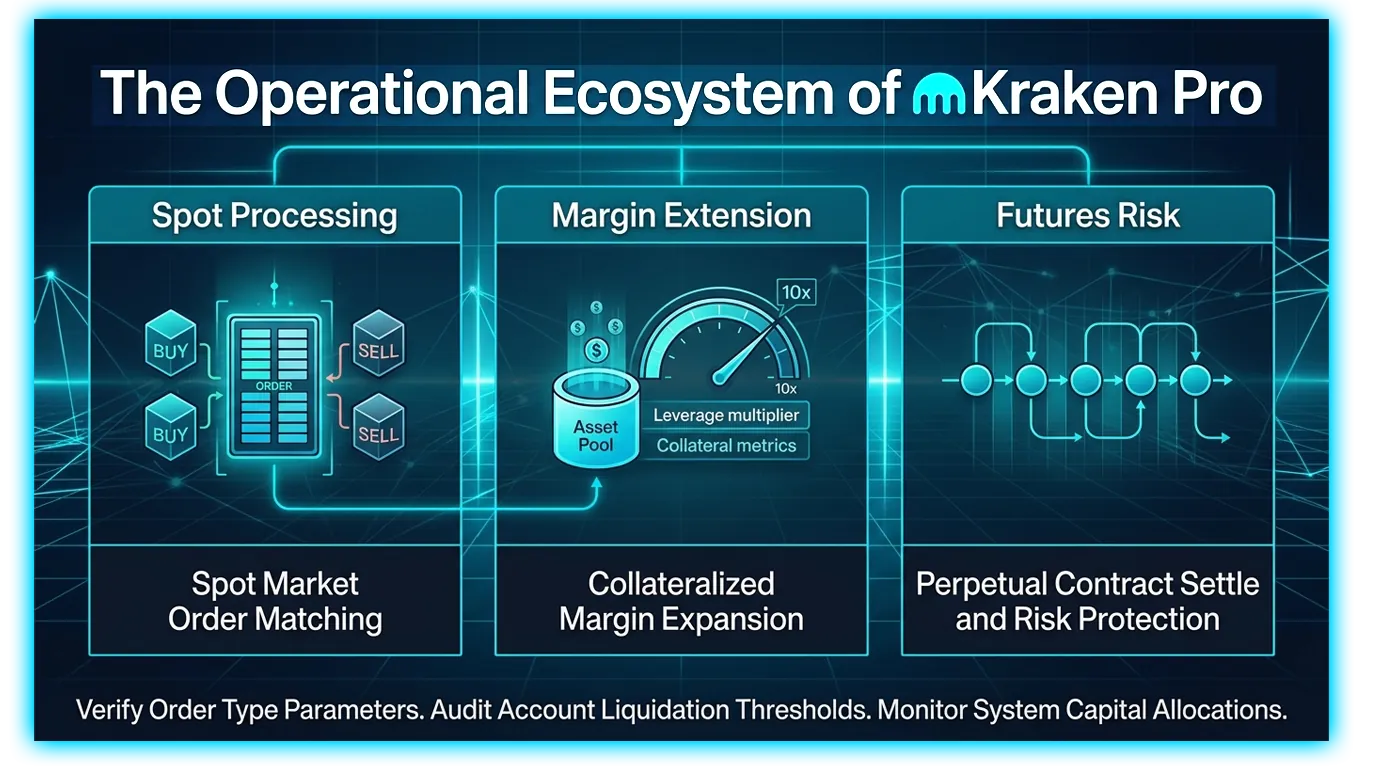
1-Market Orders: Instantly matches your trade against the existing limit orders resting at the absolute top of the public book, prioritizing immediate execution over a precise price guarantee.
2-Limit Orders: Restricts execution to a precise target price. The order enters the book ledger passively and only fills if the wider market trends to touch your exact parameter.
3-Conditional Stop Loss & Take Profit: Automates defensive execution rules. Users can program a hidden trigger price that instantly transforms into an active market or limit order the moment a target asset declines or gains to a specific boundary, shielding working capital from overnight volatility events.
2. Margin Trading: Collateral Flexibility and Extended Leverage
For experienced market participants seeking to amplify their nominal market exposure without depositing extra baseline capital, Kraken Pro offers deeply integrated Spot Margin functionalities.
The Multi-Asset Collateral Hub
- A major structural advantage of Kraken Pro’s margin system is its diverse collateral flexibility. Rather than restricting collateral backing exclusively to stablecoins like USDC or cash balances, the engine permits traders to utilize dozens of distinct digital assets as active collateral.
- This means a user can hold an existing long-term position in assets like Ethereum or Solana, keep those tokens inside their account, and instantly leverage their underlying value to open separate positions without forcing a sell event.
The Leverage Mechanics and Fee Cycles
Eligible retail and institutional traders can access up to 10x leverage on selected prime trading pairs, deploying positions across two primary directional strategies:
- Going Long: Borrowing fiat or stablecoins from Kraken's internal credit pools to purchase an asset, expecting to sell it back at a higher price to pocket the difference.
- Going Short: Borrowing the actual digital asset from the lending pool and selling it instantly onto the open spot market, intending to buy it back cheaper later to return to the pool.
- Maintaining these leveraged positions incurs specific holding costs separate from standard transaction maker-taker fees. The platform applies an explicit Opening Fee the moment a position is initialized, followed by a recurring Rollover Fee charged automatically every four hours. This rollover rate is dynamically calculated based on prevailing utilization metrics within the lending pool but locks in firmly at the moment of order execution to ensure absolute cost transparency.
3. Futures Trading: Perpetual Derivatives and Risk Underwriting
Beyond spot margin mechanics, Kraken Pro provides a dedicated derivatives environment optimized for advanced hedging architectures: Kraken Futures.
Perpetual Contracts vs. Spot Margin
While spot margin involves borrowing real underlying assets to buy or sell on the actual spot market, futures contracts are synthetic cash-settled derivatives. Trading a perpetual futures contract means you are buying or selling a financial agreement that tracks an underlying asset index price, completely bypassing physical token ownership and eliminating spot spot-borrowing restrictions.
The Margin Maintenance Lifecycle
Derivatives trading requires continuous account surveillance to monitor the relationship between overall account equity and required margin limits. The platform provides interactive real-time trackers:
Used Margin: The specific portion of account equity actively locked and withheld to maintain your active futures contracts.
Free Margin: The remaining unencumbered collateral capacity available to deploy into new positions.
Margin Level Percentage: The ultimate indicator of portfolio health, evaluating the exact ratio of total account equity against your locked used margin boundaries.
If adverse market price actions drive your overall account equity below the exchange's strict Initial and Maintenance Margin Thresholds, the position faces automated Liquidation. The risk clearinghouse engine steps in to automatically close out open contracts in real-time, enforcing standardized execution fees to insulate the global exchange platform from incurring unbacked system debt.
Technical Execution Matrix: Kraken Pro Capabilities
| Trading Module | Primary Underlying Mechanism | Maximum Leverage Limit | Core Cost Profiles | Settlement Framework |
| Spot Market | Physical Direct Asset Exchange | No Leverage (1x Base) | Trailing 30-day Maker / Taker schedule | Immediate Physical Ownership |
| Spot Margin | Asset Borrowing via Credit Pools | Up to 10x Leverage | Opening fee + 4-hour dynamic rollover fees | Physical Asset Borrow Settlement |
| Futures Market | Synthetic Index Cash Derivatives | Highly Variable Limits | Baseline contract trade fees + funding rates | Cash-Settled Synthetic Contracts |
Universal On-Chain Forensics and Trading Telemetry via DEXTools
- Utilizing advanced decentralized charting architectures like DEXTools gives market participants an essential universal platform to monitor live token behaviors, evaluate pool depths, and inspect contract parameters across all public execution networks.
- By leveraging core features like the Pair Explorer, Live New Pairs dashboard, Trade Story or Top Traders, technical traders can audit localized volume trends, track large whale wallet capital reallocations via the Big Swap Explorer, and check automated contract safety scores before initiating any on-chain interactions, ensuring your hardened hardware setup interacts safely with verified market venues.
Disclaimer: This article is for informational purposes only and does not constitute investment advice, financial advice, trading advice, or any other kind of advice. DEXTools does not recommend buying, selling, or holding any cryptocurrency or token. Users should conduct their own research and consult with a qualified financial advisor before making any investment decisions. Cryptocurrency investments are volatile and high-risk. DEXTools is not responsible for any losses incurred.
How to Bridge Crypto Between Chains: Complete Cross-Chain Tutorial 2026 How to Use 1inch for Swaps: Classic, Fusion and Limit Orders (2026) How to Use OKX Web3 Wallet: Multi-Chain DeFi Hub Guide (2026)Related Guides
- How to Use Kraken Pro: Step by Step Guide (2026)
- Spot vs Futures in Crypto: Complete Beginner Guide (2026)
- Margin Trading in Crypto: Beginner Guide (2026)
- How to Use Dolomite: Lending and Margin Tutorial (2026)
- What Is Futures Trading in Crypto? Guide 2026
Frequently Asked Questions
What is the difference between spot, margin, and futures trading?
Spot trading means buying or selling the actual asset for immediate settlement, while margin lets you trade with borrowed funds, and futures are contracts to trade an asset at a set price later. Margin and futures add leverage and therefore more risk.
How does margin trading work?
In margin trading you borrow funds to open a larger position than your own capital would allow, using your balance as collateral. If the trade moves against you and your collateral falls too low, the position can be liquidated.
What is a liquidation in futures trading?
Liquidation is the forced closing of a leveraged position when losses reduce your margin below the required level. It is the exchange's way of preventing your account from going negative on a losing trade.
Is leveraged trading riskier than spot trading?
Yes. Leverage amplifies both gains and losses, so a small adverse price move can wipe out a leveraged position while a spot holding would only lose part of its value. Beginners often start with spot trading to limit risk.