Exploring Rollup Sequencers in Layer 2
— By Whatsertrade in Tutorials
Uncover what rollup sequencers do, why they matter in Layer 2 models, and their effect on transaction ordering and network efficiency.
A rollup sequencer is a core component of many Layer 2 scaling solutions. It is responsible for collecting, ordering, and batching transactions before they are submitted to the main blockchain.
Key Takeaways
- Why Transaction Ordering Matters
- How a Rollup Sequencer Works
- Why Rollups Need Sequencers
- Centralization Concerns
- Sequencers and Fairness
- Rollup Sequencers and MEV
In many rollup systems, the sequencer acts as the first point of contact for user transactions. When a user interacts with a Layer 2 network, their transaction is usually sent to the sequencer.
The sequencer decides the order in which transactions are processed.
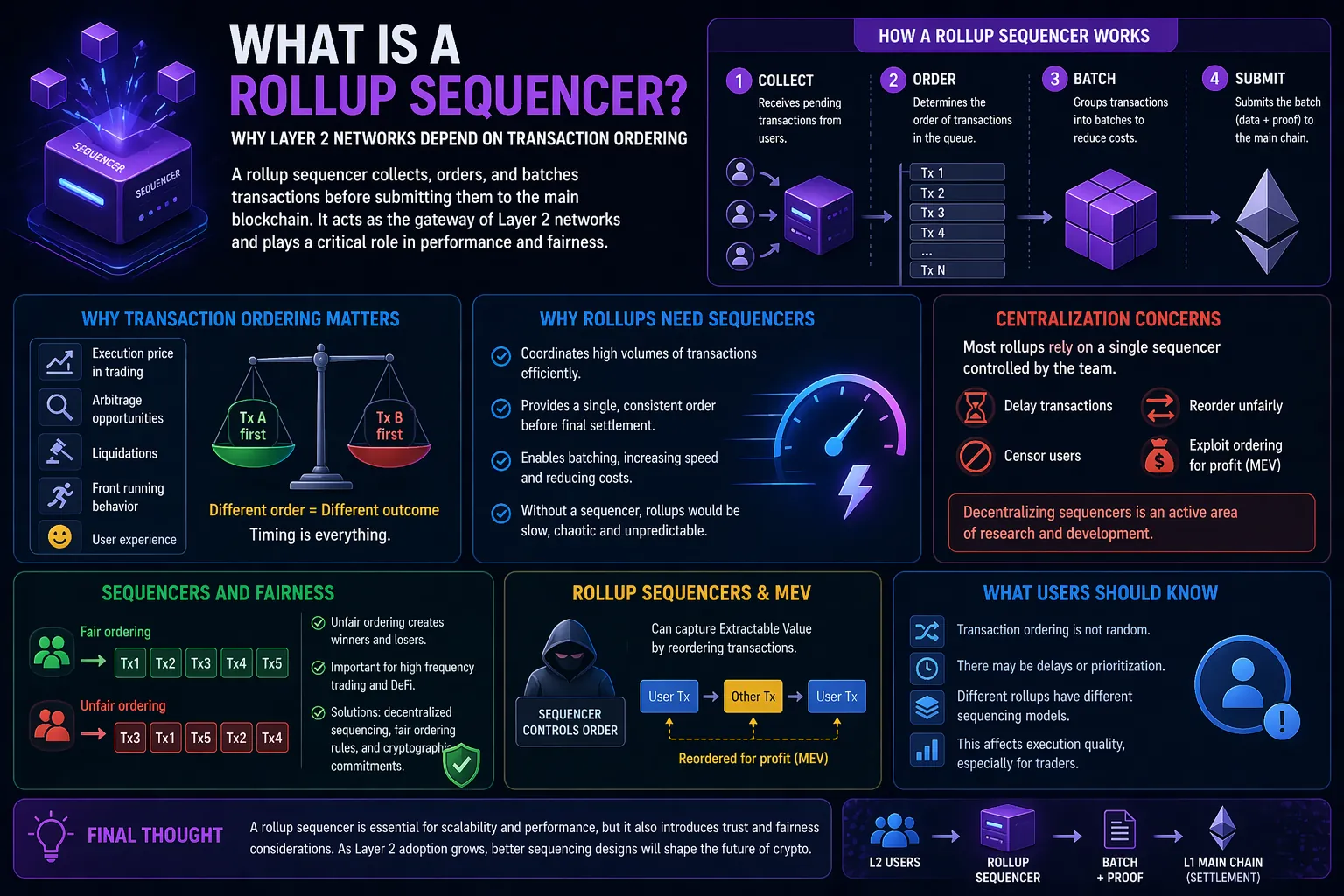
Why Transaction Ordering Matters
At first glance, ordering transactions may seem like a simple technical task. In reality, it has important consequences.
The order of transactions can affect:
Execution price in trading
Arbitrage opportunities
Liquidations
Front running behavior
User experience
In markets, timing is everything. A small difference in ordering can lead to different outcomes for users.
This is why the role of the rollup sequencer is not neutral. It has real economic implications.
How a Rollup Sequencer Works
When a user submits a transaction to a Layer 2 network, it is received by the sequencer.
The sequencer then:
Collects incoming transactions
Determines their order
Groups them into batches
Submits the batch to the main chain
This batching process reduces costs because many transactions are compressed into a single operation on the base layer.
It also increases speed, since users do not need to wait for every transaction to be processed individually on the main chain.
Why Rollups Need Sequencers
Layer 2 solutions exist to improve scalability. Without a sequencer, it would be difficult to coordinate large numbers of transactions efficiently.
The sequencer acts as a coordinator. It ensures that transactions are processed in a consistent order and that the network can operate smoothly.
Without it, the system would become slower and less predictable.
Centralization Concerns
Many current rollups rely on a single sequencer controlled by the project team. This creates a point of centralization.
A centralized sequencer could:
Delay transactions
Reorder transactions unfairly
Censor users
Exploit ordering for profit
Even if these risks do not materialize, they are important to consider.
This is why decentralizing sequencers is an active area of research and development.
Sequencers and Fairness
Fairness in transaction ordering is a major topic in crypto.
If a sequencer prioritizes certain transactions, it can create an uneven playing field. Some users may consistently get better execution, while others are disadvantaged.
This is especially relevant in high frequency trading environments, where milliseconds matter.
Solutions such as decentralized sequencing, fair ordering mechanisms, and cryptographic commitments are being explored to address this issue.
Rollup Sequencers and MEV
Sequencers are closely related to the concept of extractable value. Because they control transaction ordering, they may be able to capture value by reordering transactions.
This creates incentives that can conflict with user fairness.
Understanding the role of the sequencer helps users better understand how value flows in Layer 2 systems.
What Users Should Be Aware Of
Most users interact with rollups without thinking about the sequencer. However, it is important to understand that:
Transaction ordering is not random
There may be delays or prioritization
Different rollups may have different sequencing models
For traders, this can affect execution quality.
Final Thoughts
A rollup sequencer is a critical component of Layer 2 infrastructure. It enables fast and efficient transaction processing, but it also introduces new questions around fairness, centralization, and incentives.
As Layer 2 adoption grows, the design of sequencers will play a key role in shaping user experience and trust in these systems.
How to Bridge Crypto Between Chains: Complete Cross-Chain Tutorial 2026 How to Use 1inch: Complete DEX Aggregator Swap Tutorial (2026) How to Use OKX Web3 Wallet: Multi-Chain DeFi Hub Guide (2026)Frequently Asked Questions
What is a rollup sequencer?
A rollup sequencer is a component in a layer 2 scaling solution that orders and batches transactions before submitting them to the layer 1 blockchain.
What is the role of a sequencer in a rollup?
Sequencers aggregate transactions, compress them, and then post the compressed data to the mainnet, reducing the data footprint and transaction costs on the layer 1 chain.
Are rollup sequencers centralized or decentralized?
Sequencers can be centralized, operated by a single entity, or decentralized, involving multiple participants to enhance censorship resistance and reliability.
What is the difference between an optimistic rollup and a ZK rollup sequencer?
While both types of rollups use sequencers, optimistic rollups rely on fraud proofs for security, whereas ZK rollups use validity proofs to ensure the correctness of transactions.
Why are sequencers important for rollup efficiency?
Sequencers improve efficiency by batching numerous transactions into a single layer 1 transaction, significantly reducing gas fees and increasing transaction throughput for the network.