What Is Internet Computer (ICP)? Reverse Gas Explained
— By AliceOnChain in Tutorials
Learn what Internet Computer (ICP) is and how its Reverse Gas Model removes gas fees for users and reshapes the Web3 experience in this 2026 guide.
What is Internet Computer (ICP)? Reverse Gas Model Explained
The dream of a truly decentralized internet, where applications run without the need for Big Tech cloud providers like AWS or Google Cloud, is the core mission of Internet Computer (ICP). While most blockchains are limited to being "global ledgers" for financial transactions, ICP is designed as a "World Computer" capable of hosting everything from social media to enterprise software entirely on-chain.
For the DEXTools community, understanding what is Internet Computer (ICP) is vital to grasp how it scales beyond DeFi into the broader world of decentralized web services.
The Core Vision: What is Internet Computer (ICP)?
Unlike traditional networks that rely on external servers to host their front-ends, the protocol allows developers to build "Canisters"-smart contracts that can store gigabytes of data and serve web pages directly to your browser.
When you ask what is Internet Computer (ICP) in the context of 2026, you are looking at a network that operates at web speed with near-infinite scalability. This is made possible by its unique "Chain Key Technology," which allows the network to finalize transactions in 1-2 seconds and split itself into multiple subnets to handle increasing demand.
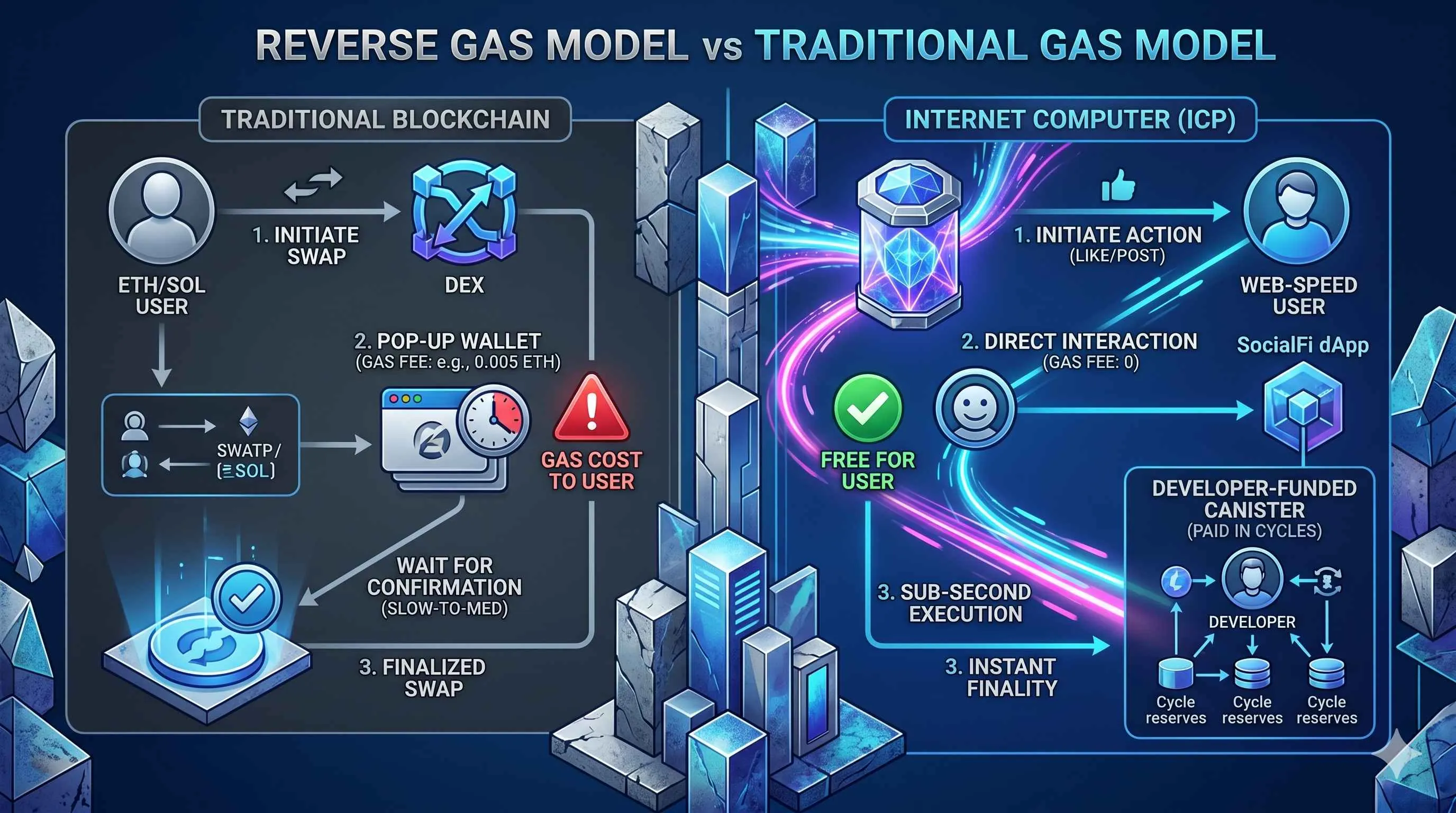
One of the biggest hurdles to mass blockchain adoption is "gas fees." On Ethereum or Solana, users must own the native token to pay for every interaction. ICP flips this script with its Reverse Gas Model.
How it Works
In this ecosystem, users do not pay for gas. Instead, the developers fund their own applications with "Cycles" (stable-value units converted from ICP tokens).
Seamless Experience: A user can interact with a decentralized app (dApp) just like they do with a traditional website-no wallet pop-ups for every click and no need to buy tokens first.
Mass Adoption: This makes the network the perfect home for "SocialFi" and gaming, where requiring a fee for every "like" or "move" would kill the user experience.
Canisters: Smart Contracts on Steroids
To fully answer what is Internet Computer (ICP), we must talk about Canisters. These are more than just smart contracts; they are computational units that bundle code and state together.
Autonomous Evolution: Canisters can be set to update themselves or be governed by a Decentralized Autonomous Organization (DAO).
Direct Integration: In 2026, Canisters on the protocol have native integration with Bitcoin (through the threshold ECDSA protocol). This means an ICP smart contract can hold and send real BTC without using a risky bridge.
The ICP Token: Cycles and Governance
The ICP token serves three critical functions within the infrastructure:
Fueling Computation: It is burned and converted into "Cycles" to power the canisters via the Reverse Gas Model.
Staking for Governance: Holders can lock their tokens in "Neurons" to participate in the Network Nervous System (NNS), the world's most advanced on-chain DAO.
Rewarding Nodes: It is used to compensate the independent data centers that provide the hardware power for the network.
On DEXTools, you can track the ICP/USDT pair to monitor the economic health of the network, which is increasingly tied to the amount of ICP being burned for computational cycles.
ICP and DEXTools: Tracking a New Web
As more DeFi protocols launch on the platform, such as ICPSwap and Sonic, liquidity is growing rapidly. Using the DEXTools Pair Explorer, you can monitor these native assets.
The beauty of this ecosystem is that when you trade on a DEX built on ICP, the experience feels like a centralized exchange due to the Reverse Gas Model and sub-second execution, but with the security and transparency of a decentralized ledger.
Conclusion
Understanding what is Internet Computer (ICP) requires shifting your perspective from "blockchain as a bank" to "blockchain as a server." By removing the friction of gas fees for users and offering a high-performance environment for developers, this network is building the foundation for an open, decentralized internet. As we progress through 2026, the Reverse Gas Model remains its strongest weapon in the fight for the next billion Web3 users.
- How to Bridge Crypto Between Chains: Complete Cross-Chain Tutorial 2026
- How to Use 1inch: Complete DEX Aggregator Swap Tutorial (2026)
- How to Use OKX Web3 Wallet: Multi-Chain DeFi Hub Guide (2026)
Disclaimer: This article is for informational purposes only and does not constitute investment advice, financial advice, trading advice, or any other kind of advice. DEXTools does not recommend buying, selling, or holding any cryptocurrency or token. Users should conduct their own research and consult with a qualified financial advisor before making any investment decisions. Cryptocurrency investments are volatile and high-risk. DEXTools is not responsible for any losses incurred.
Related Guides
- Stock-to-Flow Bitcoin Model: Scarcity Valuation Guide (2026)
- Crypto DCA Calculator: Model Recurring Buys and Current Value (2026)
- What Is Web3: The Complete Guide to the Decentralized Internet (2026)
- What Is Mog Coin (MOG)? The Internet Culture Memecoin Explained in 2026
- Cosmos (ATOM) Explained: IBC, Interchain Security and the Internet of Blockchains (2026)
Frequently Asked Questions
What is the Internet Computer (ICP) and its main purpose?
The Internet Computer (ICP) aims to create a decentralized internet where applications can operate independently of major cloud providers like AWS or Google Cloud.
How does the Reverse Gas Model work in Internet Computer (ICP)?
The Reverse Gas Model allows developers to fund their applications with 'Cycles,' eliminating the need for users to pay gas fees for interactions.
What are Canisters in the context of Internet Computer (ICP)?
Canisters are advanced smart contracts that bundle code and state, allowing for significant data storage and functionality. They can autonomously update and are integrated with Bitcoin, enabling ICP smart contracts to handle real BTC transactions.
What roles does the ICP token play in the Internet Computer ecosystem?
The ICP token serves multiple functions, including fueling computation by being converted into 'Cycles,' enabling governance participation through staking, and rewarding nodes that provide the network's hardware power.
How does Internet Computer (ICP) enhance user experience compared to traditional blockchains?
ICP enhances user experience by removing gas fees and allowing for rapid transaction finalization, making interactions with decentralized applications feel as smooth as using centralized platforms.