What Is Token Vesting in Crypto? Guide (2026)
— By Tony Rabbit in Tutorials

Learn what token vesting is in crypto, how cliff and linear schedules work, why it matters for dilution risk, and how to read vesting data before buying.
Token vesting is one of the most important tokenomics concepts in crypto because it tells you when locked allocations become available over time. If you ignore vesting, you may be looking at a token's current chart without understanding how much future supply is still waiting behind it.
That is a dangerous blind spot. A project can look strong on price, narrative, and even current market cap while still carrying a heavy release schedule for team wallets, investors, advisors, or ecosystem allocations. This is why stronger traders do not only ask what the token is doing now. They ask how the supply is supposed to reach the market next.
Quick answer
- Token vesting means locked tokens are released over time instead of all at once.
- It is mainly used for teams, investors, advisors, and strategic allocations.
- The two most common models are cliff vesting and linear vesting.
- For traders, vesting matters because it changes the future supply path and potential dilution pressure.
What token vesting actually means
In crypto, vesting is the schedule that defines when previously locked token allocations become available. Instead of releasing a large block of tokens on day one, the project spreads those releases across months or years. That is why vesting is really a supply-timing system.
From a trader perspective, the question is simple: who is getting tokens, when are they getting them, and how large are those releases compared with current circulating supply and liquidity? If you cannot answer those three questions, you are not reading the token properly.
Why token vesting exists
Token vesting exists because releasing everything at once would often create immediate chaos. If team members, venture investors, and insiders all received full access at launch, many projects would face brutal sell pressure before the market had time to absorb the supply.
That does not mean every long vesting schedule is automatically good. It means vesting is part of the quality signal. A project with clear lockups and rational release pacing is easier to trust than one with fuzzy distribution language and a thin tokenomics page.
Cliff vesting vs linear vesting
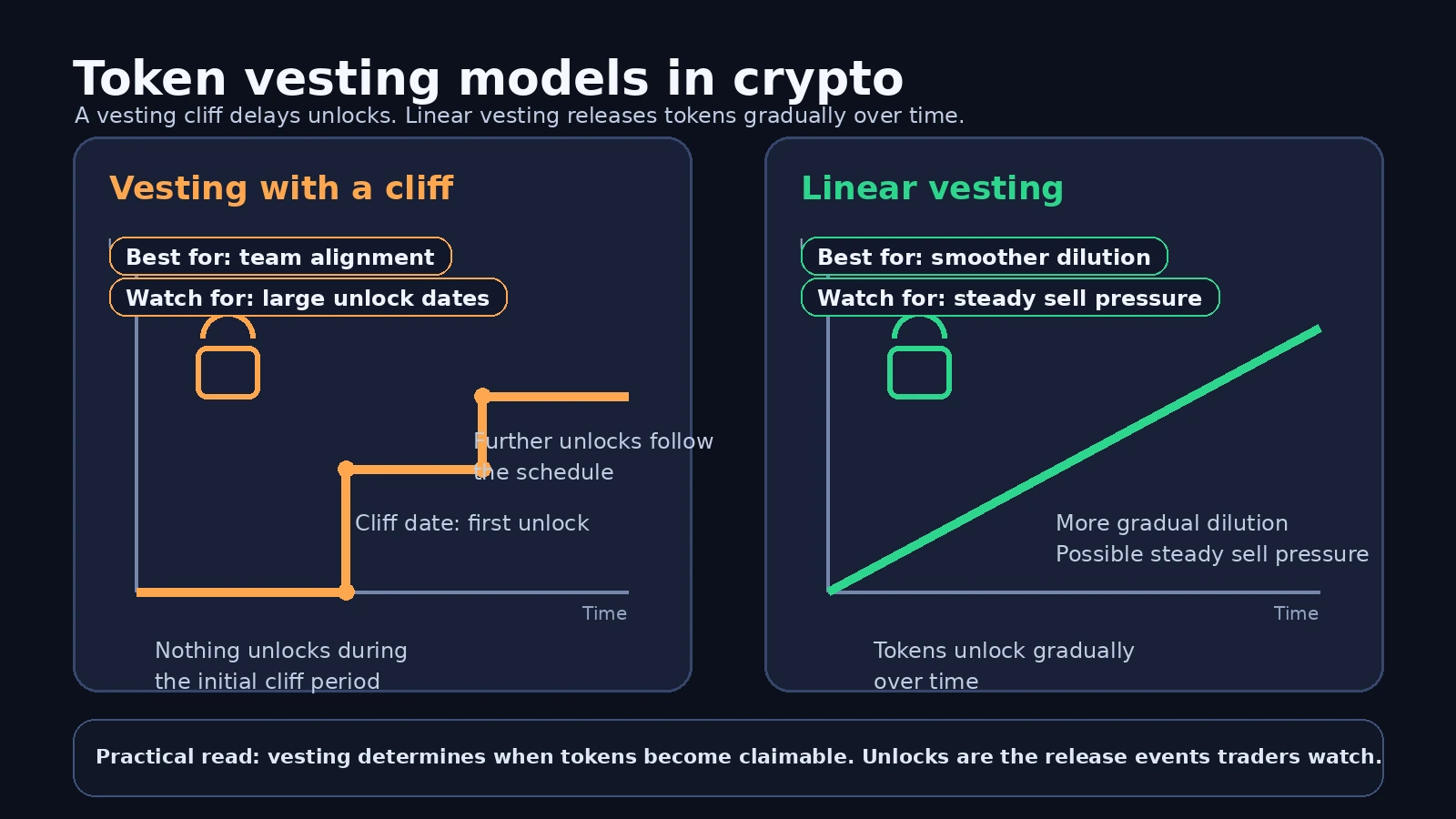
The two most common structures are cliff vesting and linear vesting.
Practical read
Token vesting vs token unlocks
These terms are related but not identical. Vesting is the full release schedule. Unlocks are the actual release events that traders watch on the calendar.
If you want the trader-side workflow for those events, our token unlock guide is the natural companion piece.
Who usually receives vested tokens
Vested tokens usually belong to the groups that got early allocations before public markets fully formed.
- Core team and founders: usually the most closely watched category.
- Seed and venture investors: often large allocations with long schedules.
- Advisors and consultants: smaller allocations but still relevant.
- Ecosystem or treasury buckets: sometimes scheduled through grants, incentives, or emissions.
From a market perspective, the label matters because the likely behavior can differ. Team, VC, advisor, and ecosystem allocations do not always create the same kind of pressure once tokens become available.
How to read a vesting schedule before buying
The best way to use vesting is not as trivia. It is as a pre-trade research step.
- Check current circulating supply versus total or max supply.
- Identify the next meaningful unlock date and size.
- See which wallet category receives the tokens.
- Ask whether the release follows a cliff or a steady linear schedule.
- Compare the future supply path with current liquidity, volume, and valuation.
This is where vesting links naturally to other metrics. A token can look manageable on current market cap and still be much riskier once you compare its future supply path with market cap, FDV, and real liquidity.
Common vesting red flags
Where to find vesting data
The best source is always the project's own documentation, but you should not stop there.
That full-context approach is what separates surface-level tokenomics reading from research that can actually improve entries and position sizing.
Frequently Asked Questions
What is token vesting in crypto?
Token vesting is a release schedule that makes locked token allocations become available over time instead of all at once.
What is the difference between vesting and token unlocks?
Vesting is the full release plan. Unlocks are the specific dates or tranches that become available within that plan.
What is cliff vesting in crypto?
Cliff vesting means nothing unlocks during an initial waiting period, then a larger first release happens at the cliff date before later vesting may continue.
Why does token vesting matter for investors?
Because vesting changes future supply, dilution pressure, and the risk that large holders receive tokens that may later be sold into the market.
Where can I check token vesting schedules?
Start with the project whitepaper and tokenomics page, then confirm the release path with unlock trackers and current market data.
Related reading
Disclaimer: This article is for educational purposes only and does not constitute investment, tax, legal, or financial advice. Token vesting schedules can change, and market impact depends on liquidity, sentiment, and how specific allocations behave after release.