Lido on Ethereum: stETH, wstETH and Dual Governance Explained (2026)

A deeper protocol-level look at Lido's staking mechanics, stETH and wstETH behavior, governance structure, and validator concentration risks on Ethereum.
Intent check: This page is the deeper staking-mechanics explainer for Lido. If you want the cleaner top-level overview of liquid staking, stETH, and LDO, read What Is Lido Finance?. If you want the hands-on staking walkthrough, read How to Use Lido Finance.
The Staking Dilemma: Unlocking Capital from the Consensus Layer
- Proof-of-Stake consensus mechanisms require market participants to lock up native assets to secure the underlying blockchain network. On Ethereum, native solo staking demands a structural commitment: validators must lock exactly 32 ETH, maintain continuous server uptime, manage cryptographic validator keys, and accept absolute illiquidity during high-demand market phases.
- This creates an friction point where capital efficiency is sacrificed for network security. Lido Finance dismantles this trade-off by operating as a decentralized liquid staking protocol that converts locked consensus assets into liquid, composable tokens.
- Operating across multiple blockchain layers with billions in total value locked, the protocol provides an open marketplace for non-custodial liquid staking. This guide provides a detailed analysis of Lido's token mechanics, the validator concentration dilemmas that shape its governance model, the innovations of the Community Staking Module (CSM), and the platform's position within the web3 ecosystem.
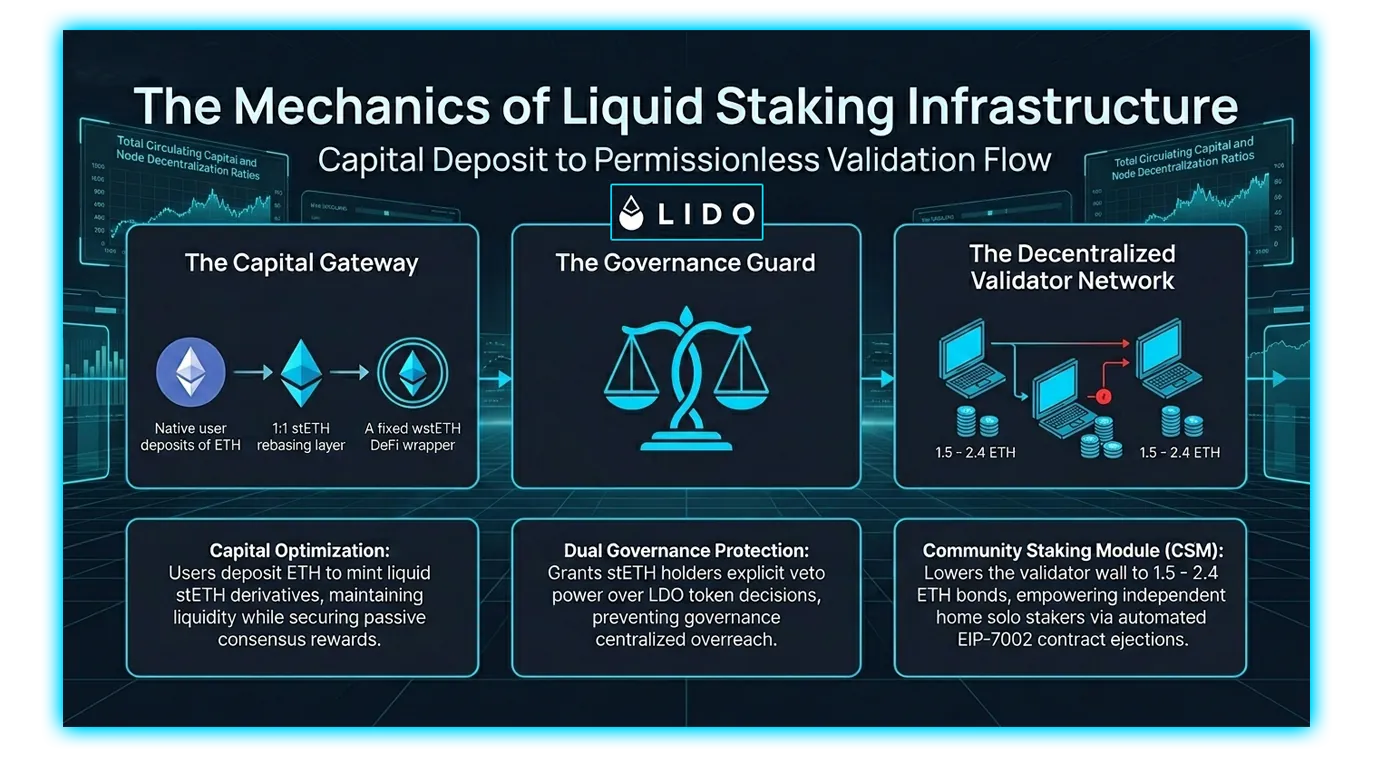
1. Core Mechanics: How stETH and wstETH Work
The Rebasing Yield Model (stETH)
In exchange for your deposit, the protocol instantly mints and issues Staked ETH (stETH) at a 1:1 ratio. stETH functions as a liquid staking token (LST) that mirrors the value of your underlying ETH while accumulating network staking rewards.
The Rebase Mechanism: stETH balances update programmatically every day through a balance rebase. When validators successfully generate consensus rewards or capture maximum extractable value (MEV), the total amount of stETH in your private wallet increases automatically.
The Token Take-Rate: The protocol charges a baseline fee (typically around 5% to 6.11% as of recent DAO updates), split directly between the node operators and the Lido DAO treasury to fund protocol safety modules.
The DeFi Composability Wrapper (wstETH)
While rebasing tokens function smoothly inside standard Web3 wallets, many automated decentralized protocols (like lending markets or liquidity pools) are mathematically incapable of handling daily elastic balance changes. To bridge this gap, Lido utilizes Wrapped Staked ETH (wstETH).
Instead of expanding your token balance daily, wstETH uses a fixed token supply model where the value of the token increases relative to ETH over time.
When staking rewards accrue, your quantity of wstETH remains stable, but each individual token becomes redeemable for a larger fraction of stETH, making it the preferred collateral layer for integrated DeFi applications.
2. The Validator Concentration and Decentralization Dilemma
Lido's rapid scaling has made it the single largest holder of staked capital on Ethereum, commanding approximately 23% to 30% of all consensus validator nodes. While this deep pool provides exceptional security and liquidity depth, it creates significant decentralization concerns within the core Ethereum developer community.
Systemic Concentration Risks
If a single staking protocol controls near or above a critical threshold (such as 33% of all active network validators), it introduces a tail-risk event for network neutrality:
Governance Dominance: The protocol could theoretically gain outsized influence over transaction ordering, block finalization, or protocol-level upgrades.
The Censorship Vector: Regulatory pressure applied to a centralized cluster of node operators could force block censorship at the validation level, undermining Ethereum's core permissionless ethos.
Structural Governance Backstops
To defuse these concentration tail risks and protect network integrity, Lido implemented Dual Governance. This framework bridges the gap between governance token holders and everyday users:
The Veto Guard: Historically, LDO tokenholders held absolute power over protocol updates. Dual Governance grants stETH users a programmatic veto power over any proposed DAO changes.
The Safety Escape: If LDO holders attempt to push a malicious or non-compliant upgrade that compromises network neutrality, stETH holders can freeze protocol operations or trigger an orderly settlement exit, isolating user funds from governance overreach.
3. Decentralizing the Base Layer: The Community Staking Module (CSM)
To transition away from a curated, monolithic node operator structure and address concentration concerns directly, Lido developed the Community Staking Module (CSM). Launched as a permissionless validation layer, the CSM enables home solo stakers and independent operators to run native Ethereum nodes under the Lido protocol flag.
Lowering the Capital Wall: Instead of the standard 32 ETH native requirement, the CSM allows operators to spin up a validator key by depositing an ETH-based bond as low as 1.5 to 2.4 ETH (especially when utilizing the Identified Community Staker framework). This bond serves as a security layer to cover potential performance penalties or slashing events.
EIP-7002 Integration: The architecture integrates native Execution Layer Triggerable Withdrawals. This software framework permits the protocol to programmatically eject underperforming or malicious validators directly via the smart contract layer, reducing trust assumptions and safeguarding user APR.
Expanding the Footprint: Over the course of recent protocol iterations, the permissionless staking allocation limit has scaled up from 3% to 5%, with target roadmaps moving toward 10% of total protocol stake, structurally diversifying the global validator set.
4. Technical Trade-offs and Market Realities
Staking Operational Comparison
| Staking Methodology | Minimum Capital Buffer | Liquidity Configuration | Operational Maintenance | Centralization Profile |
| Vanilla Solo Staking | 32 ETH | Absolute Lockup (Queue Dependent) | High Server / Infrastructure Management | Maximum Decentralization |
| Curated LST (Legacy) | No Minimum | Instant Secondary Markets | Fully Outsourced to Node Operators | Concentrated Validator Risk |
| Lido CSM / Modular V3 | 1.5 - 2.4 ETH Bond | Highly Composable (stETH/wstETH) | Managed by Solo Operators via CSM Ramps | Distributed Permissionless Nodes |
Strengths and Capabilities
Ecosystem Network Effects: As the deepest liquidity wrapper on Ethereum, stETH serves as the default collateral rail across the vast majority of lending markets and stablecoin issuers.
Instant Capital Liquidation: Unlike native validators forced to wait in long consensus exit queues, stETH holders can liquidate positions instantly on secondary markets.
Critical Limitations
Smart Contract Complexity: Accumulating billions in value within an interconnected framework of rebase logic and multi-chain vaults introduces cross-contract code risks.
Regulatory Horizon Pressures: The classification status of liquid staking derivatives remains an ongoing discussion for global financial watchdogs, introducing unexpected compliance headwinds for centralized access nodes.
Remember that with DEXTools, you can trade tokens quickly, securely, and seamlessly using some of the best DeFi tools available. Click here to get started today.
Disclaimer: This article is for informational purposes only and does not constitute investment advice, financial advice, trading advice, or any other kind of advice. DEXTools does not recommend buying, selling, or holding any cryptocurrency or token. Users should conduct their own research and consult with a qualified financial advisor before making any investment decisions. Cryptocurrency investments are volatile and high-risk. DEXTools is not responsible for any losses incurred.
Related Guides
- What Is Lido Finance? Liquid Staking, stETH and LDO Explained (2026)
- How to Use Lido Finance: Stake ETH, Receive stETH and Manage Risks (2026)
- Lido vs Rocket Pool: Ethereum Liquid Staking Compared (2026)
- Liquid Staking Explained: stETH, rETH, jitoSOL and More
- Ethereum Yield Evolution: Liquid Staking vs. Restaking
Frequently Asked Questions
What is the difference between stETH and wstETH?
stETH is a rebasing token whose balance grows over time to reflect staking rewards, while wstETH wraps stETH at a fixed balance whose value increases instead. Many DeFi protocols prefer wstETH because non-rebasing tokens are easier to integrate.
How does liquid staking work with Lido?
You deposit a stakeable asset and receive a liquid staking token that represents your staked position plus accruing rewards. This lets you keep earning staking yield while still being able to use the token elsewhere in DeFi.
What does the LDO token do?
LDO is the governance token used to vote on protocol parameters and decisions through the Lido DAO. Holding LDO does not by itself give a share of staking rewards.
What are the risks of liquid staking?
Key risks include smart contract vulnerabilities, validator slashing, and the liquid staking token trading below the value of the underlying asset during market stress. Concentration of staking through a single provider can also raise network centralization concerns.