ERC-7683: Transforming Cross-Chain DeFi Liquidity
— By Whatsertrade in Analysis
ERC 7683 introduces a new standard for cross-chain intents, simplifying DeFi trading across Ethereum L2 networks. Learn why it's a game-changer.
DeFi has a liquidity problem. Not due to a lack of liquidity, but because it is fragmented across numerous chains, rollups, bridges, and applications. A trader may discover the best price on one network, hold funds on another, and need to bridge through a third service before completing a transaction. This creates friction, delay, and increased risk.
ERC 7683 aims to make this experience simpler by standardizing how cross chain intents are expressed and fulfilled, introducing a shared framework for efficient DeFi trading across Ethereum L2 networks.
This is not just another technical proposal. It could become part of the infrastructure that makes chain abstraction feel real for everyday traders.
Understanding ERC 7683
Exploring the ERC 7683 Standard
ERC 7683 serves as a standard for cross chain intents, focusing on simplifying user goals. Instead of manually managing every technical step, the user specifies the desired outcome. This allows DeFi liquidity to flow more freely.
For instance, a trader aiming to swap USDC on one chain for ETH on another currently faces a complex process involving bridging, waiting, switching networks, finding liquidity, and then swapping. An intent-based system changes this by allowing the user to express the final desired result with specialized actors competing to execute it.
ERC 7683 helps define a common structure for these orders, enabling wallets, applications, and solvers to interact seamlessly.
The Need for a Cross-Chain Trading Standard
The existing cross chain experience is untidy. Each bridge has its own interface, every protocol uses its own message format, and liquidity routes change incessantly. Users must comprehend chains, gas tokens, bridge risks, and settlement times.
This results in a subpar trading experience, hampering adoption and making DeFi appear more complex than necessary.
A universal standard could diminish fragmentation. If numerous applications speak the same intent language, users can access better routes without needing to understand the technical path. Wallets can become more intuitive, solvers more efficient, and protocols can integrate into a broader execution network.
ERC 7683 aims to establish shared rails for this intricate process.
How ERC 7683 Revolutionizes Cross-Chain Trading
High-Level Functionality
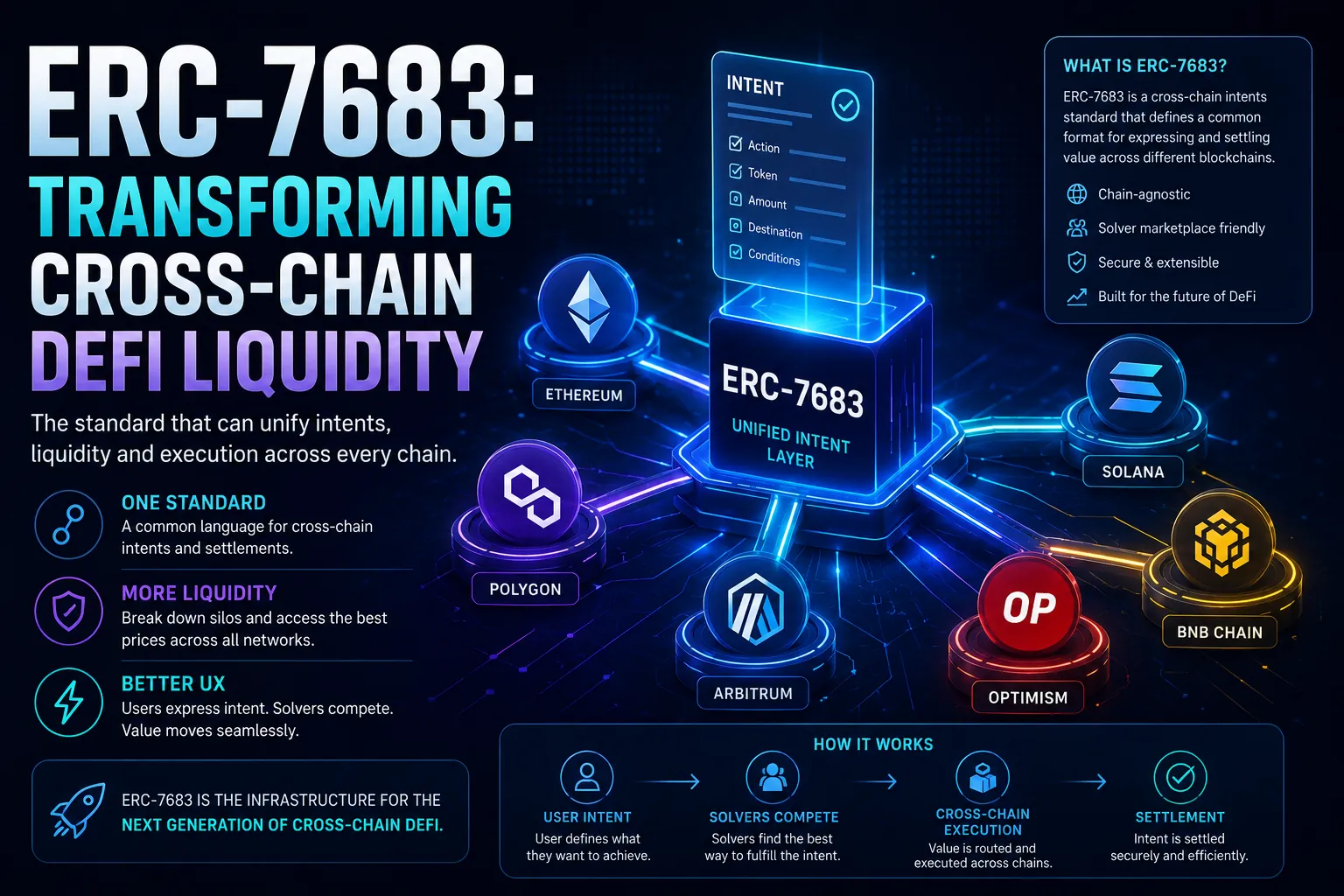
In an ERC 7683 style flow, the user creates an order that describes what they want. The order includes the input asset, output asset, origin chain, destination chain, and conditions for completion.
Solvers then compete to fulfill that order, utilizing their liquidity, routing logic, bridge connections, or market-making strategy. Once the outcome is delivered, settlement confirms the user's receipt of the requested item.
The trader is alleviated from manually managing every intermediate step, focusing only on the result.
This approach is potent as it transitions the user experience from transaction management to outcome management, simplifying cross chain intents substantially.
Role of Solvers in DeFi Trading
Solvers are entities that execute user intents. They find the best way to complete an order and capture a fee or spread for doing so.
In the traditional DeFi scene, users direct transactions to protocols. An intent-based system instead has users outsource execution logic to a competitive market. This market includes professional market makers, bridge operators, automated routing systems, and specialized trading infrastructure.
While solvers enhance execution, they also raise questions: Who controls solver access? Are fills transparent? Could a few large solvers monopolize the market? How are users shielded from poor execution?
These concerns are vital as the future of cross-chain trading may hinge on solver competition.
ERC 7683's Impact on L2 Ecosystems
Ethereum scaling has created numerous Layer 2 networks. Each L2 offers cheaper transactions and unique applications, but liquidity gets scattered. A token may trade actively on Base, Arbitrum, Optimism, Scroll, or Linea, but transitioning between them is cumbersome.
ERC 7683 could help reduce this fragmentation. If traders can express a desired cross chain result from one wallet interface, the specific L2 becomes less burdensome.
This advancement doesn’t render chains irrelevant; security, liquidity, fees, and application quality remain significant. However, the user experience can become more fluid and integrated.
For L2 networks, this is both an opportunity and a challenge. Simplified cross-chain execution can attract more flow, although it might also make liquidity more fiercely competitive, removing geographical liquidity barriers.
Benefits for DeFi Traders
The most evident benefit for DeFi traders is convenience, as they can access liquidity across networks without manually bridging each time.
Another benefit is improved execution. Competing solvers could provide users with better pricing, quicker settlements, or lower total costs.
A third benefit lies in reduced complexity. Traders might not need to hold gas tokens on every chain or understand every bridge route.
Lastly, there's the benefit of a cleaner wallet experience. Users could approve a single intent representing the final trade, rather than switching networks and confirming multiple transactions.
Potential Risks and Questions
While ERC 7683 doesn't eliminate risk, it does change where risks manifest.
Solver centralization poses a concern. If a few solvers dominate flow, the system may lose competitiveness, resulting in poorer pricing or hidden execution fees for users.
Settlement risk is another area of concern. Cross-chain systems rely on dependable messaging, liquidity, and verification. Though standards improve coordination, they don’t erase bridge or execution risk.
User education is equally important. If wallets make intents overly abstract, traders might approve actions without realizing implications like trade conditions, fees, or timing.
Ultimately, a robust EPC 7683 implementation would require strong wallet designs, transparent solver markets, and clear user protection measures.
ERC 7683 and the Future of Chain Abstraction
Chain abstraction suggests that users shouldn’t worry about which chain they’re operating on. They should be able to trade, pay, borrow, or invest through a seamless interface while the infrastructure manages the underlying complexities.
ERC 7683 fits directly into this vision by providing a mechanism for users to express cross chain outcomes, with execution networks competing to deliver them.
This becomes increasingly crucial as DeFi proliferates across more L2s, appchains, and modular networks. Without improved standards, fragmentation will continue to grow. Standards like ERC 7683 could unify and enhance the user experience significantly.
ERC 7683 is more than a technical standard; it's part of a larger shift in DeFi from manual transactions to intent-based execution.
For traders, the promise is simple: enhanced cross-chain access, reduced friction, and more efficient liquidity operations. For protocols, the challenge is building open markets that avoid recreating centralized intermediaries under a new guise.
If cross-chain intents gain adoption in DeFi, ERC 7683 might become one of the keystones making it possible.
How to Bridge Crypto Between Chains: Complete Cross-Chain Tutorial 2026 How to Use 1inch: Complete DEX Aggregator Swap Tutorial (2026) How to Use OKX Web3 Wallet: Multi-Chain DeFi Hub Guide (2026)