What Is Finality in Crypto? Explained Simply (2026)
— By Whatsertrade in Tutorials

Finality in crypto is when a blockchain transaction becomes irreversible and permanently settled. Learn about probabilistic vs. deterministic finality.
Finality in crypto refers to the critical point at which a blockchain transaction is considered irreversible and permanently settled on the ledger. It signifies the highest level of certainty that a transaction will not be altered, rolled back, or replaced, ensuring its integrity and immutability within the decentralized network. This concept is fundamental to the security and trustworthiness of all blockchain applications, from simple payments to complex DeFi operations, as it dictates when users can truly rely on their transactions being complete.
What is Finality in Crypto? The Core Concept
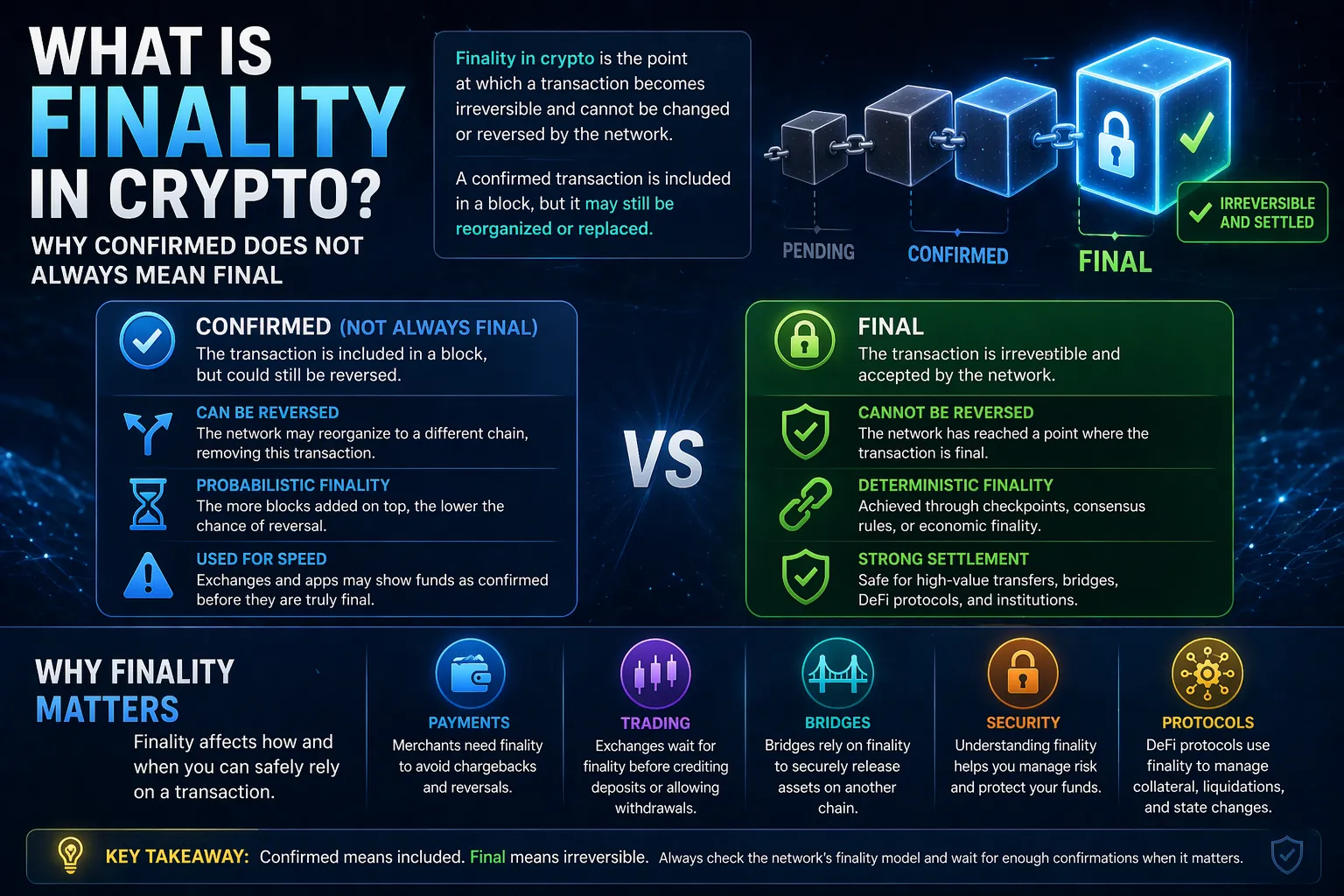
Finality in crypto is one of the most misunderstood concepts in the blockchain world. Many users assume that once a transaction is confirmed, it is also finalized. However, in reality, confirmed transactions do not always mean they are irreversible. Depending on the blockchain, a transaction may be visible, included in a block, and yet not fully settled in the strongest sense possible.
This distinction holds far greater significance than most users realize. Finality directly impacts payments, exchange deposits, bridge transfers, trading execution, and even the safety of cross-chain applications. Without understanding finality in crypto, you might mistakenly consider a transaction complete when the network still regards it as susceptible to reversal or reorganization.
Defining Finality in Blockchain Technology
In essence, finality refers to the point at which a blockchain transaction becomes effectively irreversible. Once a transaction reaches finality, the network accepts it as settled, ensuring it should not be rolled back or replaced. This concept matters because various blockchains achieve finality uniquely.
Some networks offer stronger and faster settlement guarantees, while others rely on probability, where the risk of reversal diminishes over time as more blocks are added. So, when people inquire about finality in crypto, the short answer is: it represents the level of certainty that a transaction will remain permanently recorded on the blockchain.
Dissecting Confirmations: When It Feels Final But Isn't
A confirmed transaction indicates it has been included in a block, an important step, but not the end of the story on every blockchain. On certain networks, a newly confirmed transaction can still face reversal if the chain undergoes reorganization. Reorganization occurs when the network substitutes one recent block history with a competing alternative.
In such instances, a transaction that appeared confirmed may vanish from the accepted chain. This is why many exchanges and services wait for multiple confirmations before crediting deposits. They do not solely wait for visibility but seek stronger confidence that the transaction will persist in the canonical chain. Put another way, confirmation often marks the beginning of settlement confidence, not the final stage.
Probabilistic vs. Deterministic Finality: The Two Main Approaches
In the crypto landscape, two broad finality approaches exist. Understanding these is key to grasping how different blockchains operate and the level of security they provide for transactions.
Understanding Probabilistic Finality
Probabilistic finality is where a transaction becomes increasingly secure over time, though never reaching a point where reversal becomes mathematically impossible. The longer the chain builds atop a transaction, the lower the likelihood it will be replaced. Bitcoin epitomizes this model.
In Proof-of-Work (PoW) chains like Bitcoin, finality is achieved through the accumulation of subsequent blocks. Each new block added on top of the one containing your transaction makes it exponentially more expensive and difficult for an attacker to reverse it. While theoretically possible, a reversal would require an attacker to re-mine multiple blocks faster than the rest of the network, which becomes practically impossible after a certain number of confirmations (e.g., 6 confirmations for Bitcoin).
Grasping Deterministic Finality
The second approach is deterministic finality, sometimes referred to as economic or explicit finality depending on the system. Here, the network attains a specific point where a block is deemed final and should remain unaltered unless the protocol itself fails extremely. Many Proof-of-Stake (PoS) systems aim for this stronger settlement.
In PoS blockchains, validators agree on the state of the chain through a consensus mechanism. Once a supermajority of validators (often 2/3) attests to a block, it is considered finalized. To revert such a transaction would require a coordinated attack by a significant portion of the staked capital, which would result in severe economic penalties (slashing) for the attackers, making it economically irrational. For users, the practical takeaway is evident: not all confirmations carry equal weight.
Why Finality Bears Significance for Crypto Enthusiasts
Finality is crucial because it directly influences trust in transaction settlement. When sending funds to an exchange, moving assets via a bridge, or interacting with a DeFi protocol, knowing when the transfer is truly reliable is essential. Imagine a scenario where you've completed a trade, but the underlying transaction could still be reversed hours later. This uncertainty would cripple the utility of blockchain technology.
For developers, understanding finality is paramount for building secure applications. Cross-chain bridges, for example, must account for the finality guarantees of both chains involved to prevent 'finality attacks' where a transaction is finalized on one chain but reversed on another, leading to double-spending or asset loss.
How Finality Works in Practice (A Step-by-Step Overview)
While the specifics vary by blockchain, the general process of a transaction moving towards finality follows a logical progression:
- Transaction Broadcast. Your transaction is signed and sent to the network.
- MemPool Entry. The transaction waits in the mempool (a pool of unconfirmed transactions) for a miner or validator to pick it up.
- Block Inclusion. A miner/validator includes your transaction in a new block. At this point, it is 'confirmed' once.
- Block Propagation. The new block is broadcast to the rest of the network.
- Confirmation Accumulation (Probabilistic). For PoW chains, subsequent blocks are mined on top of the block containing your transaction. Each new block adds a layer of security, making reversal less likely.
- Finalization (Deterministic). For PoS chains, a supermajority of validators attest to the block, explicitly marking it as finalized. This usually happens within a few epochs or slots.
- Irreversibility. Once finality is reached (either probabilistically strong or deterministically explicit), the transaction is considered permanently settled and cannot be reversed under normal operating conditions.
Key Components and Mechanisms Driving Finality
Several underlying mechanisms contribute to a blockchain's finality guarantees:
- Consensus Mechanism: The core algorithm (e.g., Proof-of-Work, Proof-of-Stake, Delegated Proof-of-Stake) that allows network participants to agree on the state of the blockchain. PoW relies on computational work, while PoS relies on staked capital.
- Block Time: The average time it takes to mine or validate a new block. Shorter block times can lead to faster initial confirmations but might require more subsequent blocks for strong probabilistic finality.
- Confirmation Depth: The number of blocks built on top of a transaction's block. For probabilistic finality, a higher confirmation depth implies greater security.
- Slashing Conditions: In PoS systems, these are the rules that penalize validators (by destroying their staked assets) for malicious behavior, such as attempting to revert finalized blocks. This economic disincentive is key to deterministic finality.
- Network Decentralization: A more decentralized network with a larger number of independent participants makes it harder for any single entity or small group to collude and reverse transactions, enhancing overall finality.
Comparing Finality Across Major Blockchains
The approach to finality varies significantly between different blockchain networks, influencing their use cases and security profiles:
Costs and Risks Associated with Finality
While finality is a security feature, achieving it comes with its own set of considerations:
- Transaction Fees: The cost of securing a transaction and achieving finality is indirectly reflected in transaction fees (gas fees). Networks with faster finality might sometimes have higher or more volatile fees depending on demand.
- Network Congestion: High network activity can delay block inclusion and, consequently, finality, especially in probabilistic systems where more blocks are needed.
- Reorganization Risk (Probabilistic): The primary risk for probabilistic finality is a chain reorganization, where a longer, competing chain is discovered, invalidating previously confirmed transactions. While rare for established chains, it's a theoretical possibility.
- Consensus Failure (Deterministic): For deterministic finality, the risk is a catastrophic failure of the consensus mechanism itself, leading to a halt or incorrect finalization. This is extremely unlikely in well-designed protocols but represents the ultimate failure point.
- Centralization Trade-offs: Some very fast deterministic finality mechanisms might achieve their speed by relying on a smaller set of validators or more centralized components, potentially increasing censorship or single-point-of-failure risks.
Tips for Users Regarding Transaction Finality
To navigate the crypto landscape safely and efficiently, keep these tips in mind:
- Understand Your Blockchain: Know whether the network you are using employs probabilistic or deterministic finality and its typical timeframes.
- Check Confirmation Requirements: When depositing to an exchange or using a bridge, always check their stated minimum confirmation requirements. Do not proceed until these are met.
- Use Block Explorers: Monitor your transactions on a block explorer to see their confirmation status and track their progress towards finality.
- Be Patient with High-Value Transactions: For significant amounts, it's always safer to wait for a higher number of confirmations (for PoW) or explicit finalization (for PoS) than strictly necessary.
- Be Aware of Cross-Chain Risks: When bridging assets, understand that finality on one chain does not instantly guarantee finality on the other. Bridge protocols have their own settlement times.
The Future of Finality in Crypto
The quest for faster, more secure, and more scalable finality continues to drive innovation in blockchain technology. Projects are exploring various solutions:
- Layer 2 Solutions: Rollups (Optimistic and ZK-Rollups) process transactions off-chain and then batch them to the mainnet, inheriting its security and finality, often with much faster perceived finality for users.
- Improved Consensus Algorithms: New consensus mechanisms are being developed that aim to combine high throughput with strong finality guarantees, often by optimizing validator communication and fault tolerance.
- Interoperability Protocols: Advancements in cross-chain communication protocols are focusing on secure and reliable finality across different chains, which is crucial for a truly interconnected blockchain ecosystem.
- Danksharding (Ethereum): Future upgrades like Danksharding for Ethereum aim to further enhance scalability and data availability, indirectly improving the efficiency and robustness of finality for the entire ecosystem.
How DEXTools Helps You Track Blockchain Activity
While DEXTools doesn't directly dictate blockchain finality, it provides essential tools for monitoring real-time blockchain activity across numerous networks. By offering immediate insights into newly created tokens, liquidity pool changes, and transaction volumes, DEXTools users can stay informed about the health and activity of various chains. This visibility, combined with an understanding of finality, empowers users to make more informed decisions about their trades and asset movements, especially when considering the underlying network's settlement guarantees.
Conclusion
Finality is a cornerstone of blockchain security and trust. It's the ultimate guarantee that a transaction is permanent and unalterable. By distinguishing between mere confirmation and true finality, users can better understand the risks and assurances associated with different blockchain networks. As the crypto space evolves, the pursuit of faster, more robust finality will remain a critical area of research and development, continually enhancing the reliability and utility of decentralized systems for everyone.
Frequently Asked Questions
What is finality in crypto?
Finality in crypto refers to the point at which a blockchain transaction becomes irreversible and permanently settled on the ledger, meaning it cannot be altered, rolled back, or replaced.
Is a confirmed transaction the same as a finalized transaction?
No, a confirmed transaction means it has been included in a block, but it may still be susceptible to reversal in some networks (probabilistic finality). A finalized transaction has reached a state of near-absolute irreversibility.
What are the two main types of finality in crypto?
The two main types are probabilistic finality (where certainty increases over time, like Bitcoin) and deterministic finality (where a transaction is explicitly marked as irreversible, common in Proof-of-Stake systems like Ethereum).
Which blockchains use probabilistic finality?
Bitcoin is the most prominent example of a blockchain that uses probabilistic finality, relying on Proof-of-Work and the accumulation of subsequent blocks for transaction security.
Which blockchains use deterministic finality?
Many modern Proof-of-Stake blockchains use deterministic finality, including Ethereum (after The Merge), Solana, Polkadot, and Avalanche.
Why is finality important for crypto users?
Finality is crucial because it directly impacts the trust and reliability of transactions, ensuring that payments, exchange deposits, and DeFi interactions are truly settled and irreversible.
What is a chain reorganization in the context of finality?
A chain reorganization occurs when a blockchain network replaces a recent block history with a competing alternative, potentially causing previously confirmed transactions to be removed from the canonical chain.
How do Layer 2 solutions affect finality?
Layer 2 solutions like rollups process transactions off-chain and then batch them to the mainnet, inheriting the mainnet's security and finality while often providing much faster perceived finality for users.
What are the risks if I don't wait for finality?
If you act on a transaction before it reaches finality, there's a risk it could be reversed or invalidated, leading to potential loss of funds, double-spending issues, or operational problems, especially in cross-chain transfers.