What Is Blind Signing in Crypto? Risks (2026)
— By Tony Rabbit in Tutorials

Blind signing explained: learn what it means when a wallet cannot decode a transaction, why hardware wallets require it, and how to reduce the risk.
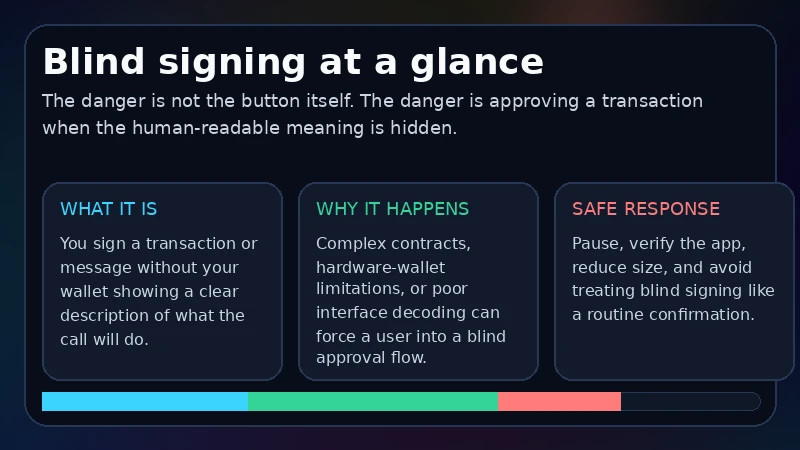
Blind signing in crypto means you are being asked to approve something your wallet cannot clearly decode into plain language. That is the core issue. A normal approval is already a security decision. A blind approval raises the stakes because you are giving consent without seeing the full human-readable meaning of what the contract call will do.
Users often discover the term when a hardware wallet or browser wallet warns them that transaction details are not available. That warning should not be treated like annoying friction. It is the product telling you that the usual readability layer has broken down. In crypto, where one signature can move funds or grant permissions, losing readability is a serious downgrade in safety.
Quick answer
- Blind signing means your wallet cannot fully explain what you are approving.
- It often appears with complex smart-contract interactions, especially in DeFi and on hardware wallets.
- The right response is to verify the app, reduce trust assumptions, and slow down, not to click through automatically.
Intent split
- This page is the blind-signing risk guide: the security problem created when readable transaction details disappear.
- For the general skill of reading a wallet prompt, read How to Read a Wallet Signature Request Before Signing.
- For the scam pattern built around malicious prompts, read What Is Signature Phishing in Crypto?.
What Blind Signing Actually Means
A blind-signing prompt appears when the wallet interface cannot present the action in a clean, human-readable way. Instead of telling you exactly which token approval, swap, bridge, or permission is being requested, the wallet may show raw data or a minimal warning. That changes the nature of the decision. You are no longer judging a transaction mostly by its visible details. You are judging whether you trust the app, the route, the contract, and the context enough to sign without full visibility.
That does not mean every blind-signing request is automatically malicious. Some legitimate applications still produce flows that certain wallets cannot decode well. But it does mean the user should downgrade confidence immediately. A readable approval lets you verify details directly. A blind approval asks you to rely more heavily on reputation, wallet hygiene, contract verification, and your own discipline.
Why blind signing matters more than beginners think
How Blind Signing Differs From Nearby Wallet Risks
Blind signing often gets mixed up with signature phishing, approval transactions, or ordinary message signing. Those are related, but they are not identical. The defining feature here is the loss of readable detail. That is why a clean article on blind signing can rank without cannibalizing the adjacent wallet-safety pages if the scope stays focused on visibility and verification quality.
The easiest way to think about it is this: some pages teach you what the prompt is asking, some pages teach you how scammers abuse prompts, and this page teaches you what changes when the prompt itself stops being legible. That intent split matters for both SEO and the reader.
Where blind signing sits in the wallet-security cluster
How to Handle a Blind-Signing Prompt Safely
The safest workflow starts before the prompt appears. Use known protocol links, keep your wallet environment clean, and do not jump between random tabs right before signing. When the warning shows up, stop and ask whether you understand the exact action you were trying to perform. If the answer is vague, the trade, mint, or bridge is not ready to approve yet.
Then verify the surrounding context. Check the URL, the connected account, and whether the protocol documentation mentions blind signing for that flow. If you still choose to continue, use smaller size and isolate the action. A burner wallet or limited-balance wallet is often a better environment than the wallet that holds your long-term assets.
A safer blind-signing workflow
Common Blind-Signing Mistakes That Lead to Losses
The biggest mistake is psychological, not technical. Users become accustomed to warnings and begin to interpret them as normal interface friction instead of meaningful information. Once that happens, they stop asking whether a prompt is expected and start asking only how fast they can clear it.
Mistakes worth avoiding
Frequently Asked Questions
Is blind signing always a scam?
No. Some legitimate wallet and contract combinations still require it. But the reduced readability means the decision deserves more caution, not less.
Why do hardware wallets mention blind signing so often?
Hardware wallets are conservative by design. They sometimes cannot decode every complex contract interaction into plain language, so they warn the user instead.
What is the safest wallet setup for risky experiments?
A burner wallet or a limited-balance wallet is usually safer than exposing your main holdings to unfamiliar contract flows.
Can I revoke risk after blind signing?
Sometimes you can revoke token approvals afterward, but that depends on what you signed. Prevention is much better than hoping cleanup will be possible later.
What should I check first when a blind-signing warning appears?
Check whether the site, wallet, chain, and intended action all match what you expected before the prompt appeared.
Related reading
Disclaimer: This article is for educational purposes only and not legal, tax, or financial advice. Wallet interfaces and signing flows change often. Always verify live prompts before approving anything.
Related Guides
- What Is Turnkey: Key Management, Signing and Wallet Infrastructure (2026)
- Rabby Wallet Pre-Sign Simulator: Safer EVM Signing Explained (2026)
- How to Read a Wallet Signature Request Before Signing (2026)
- How to Evaluate Yield Farms in Crypto: APY Quality, Risks and Red Flags (2026)
- What Is Wrapped Bitcoin (WBTC)? Uses, Risks and WBTC vs BTC (2026)