What Is a Staking Pool in Crypto? Complete Guide (2026)
— By Tony Rabbit in Tutorials

What is a staking pool in crypto? Compare solo, pooled, and liquid staking, top pools like Lido and Rocket Pool, fees, slashing risk, and how to choose.
Ethereum's transition to proof-of-stake in September 2022 unlocked native yield on the second largest crypto asset in the world, but it came with a catch that priced out almost everyone: you needed exactly 32 ETH, a dedicated machine running 24/7, and the technical skill to operate a validator without getting slashed. At today's prices, that 32 ETH minimum represents roughly $100,000 in capital just to start earning rewards. Staking pools solved that problem by letting anyone with even a fraction of an ETH participate in staking rewards alongside thousands of other users.
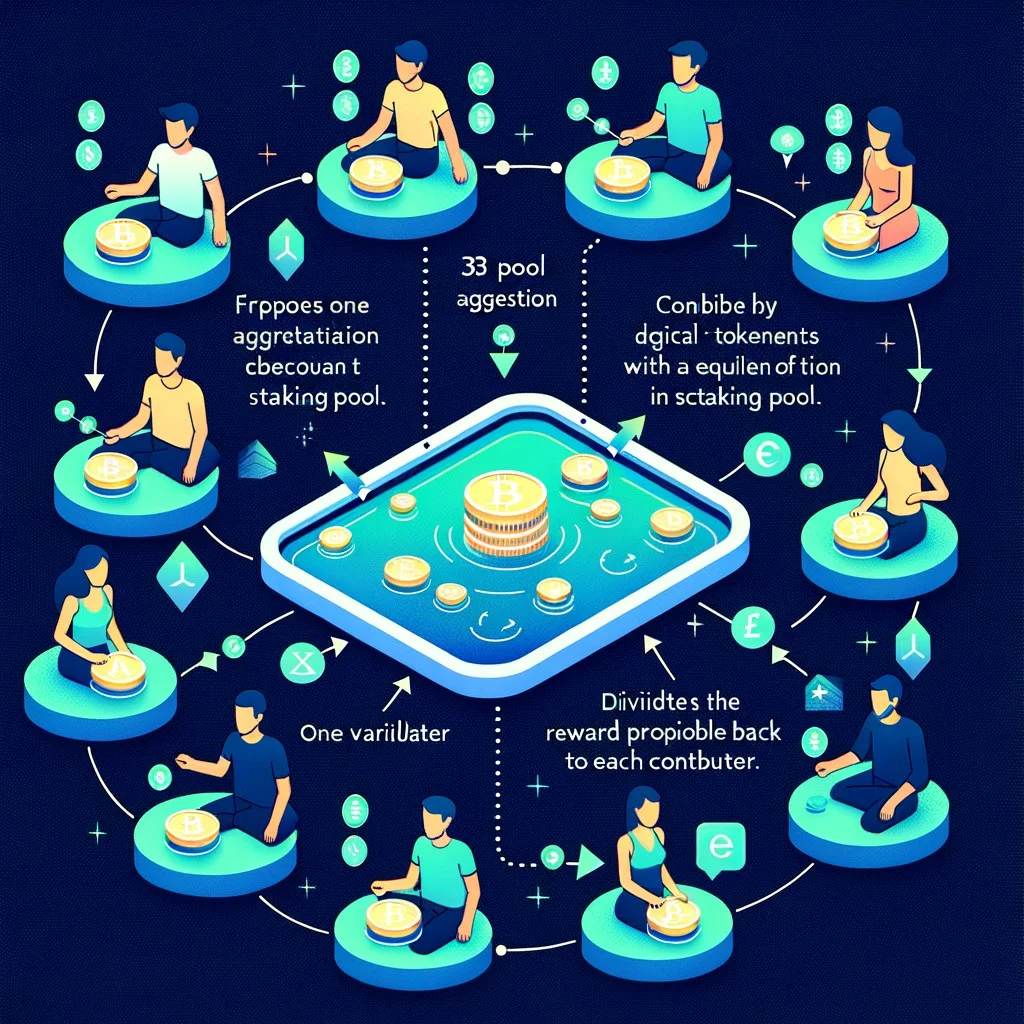
A staking pool aggregates many small deposits into one or more full validators, splits the rewards proportionally to each contributor, and (in the case of liquid staking pools) hands you a tradable token representing your share. The result is that staking, once an activity reserved for whales and technical operators, became a one-click product available to anyone with a wallet. As of 2026, roughly 30% of all circulating ETH sits inside staking pools, with Lido alone controlling more than 9 million ETH on behalf of nearly 500,000 unique depositors.
This guide explains exactly what a staking pool is, how the mechanics work under the hood, and how the three flavors of pooled staking (custodial, decentralized, and liquid) actually differ. You will learn how to compare the major pools (Lido, Rocket Pool, Coinbase, Binance, Frax Ether, and StakeWise V3), how fees and slashing risk are passed on to depositors, what the exit queue means in practice, and how to choose the right pool for your situation. By the end you will be able to walk through a real deposit on Lido and Rocket Pool, understand the LST you receive, and even integrate it with restaking for additional yield.
What Is a Staking Pool?
A staking pool is a service that combines the funds of many individual stakers into a single pool large enough to run one or more validators on a proof-of-stake blockchain. Instead of you operating a validator on your own hardware, you delegate the technical work to a professional operator and pay a small fee out of your rewards. The pool itself is usually managed by a smart contract that handles accounting, deposits, withdrawals, and reward distribution automatically.
The core idea is simple. On Ethereum, the protocol requires exactly 32 ETH per validator to maintain network security and prevent Sybil attacks. If you have less than 32 ETH, you cannot run a solo validator at all. If you have more than 32 ETH but not a multiple of 32, the leftover sits idle. A pool removes both constraints. You deposit any amount, even 0.01 ETH, and the contract pools your deposit with thousands of others until it has enough to spin up a new 32 ETH validator. Rewards then flow back to the pool and get distributed pro-rata.
Different chains and different pool designs implement this differently. On Solana, you delegate SOL to a validator without giving up custody, and the minimum stake is effectively the cost of one rent-exempt account. On Cosmos chains, you bond ATOM (or similar) to a validator with no minimum at all. On Ethereum, where the 32 ETH minimum is rigid, staking pools became dramatically more important than on chains where delegation was native. This guide focuses primarily on Ethereum because that is where the pool ecosystem is most mature and most relevant to DeFi users.
Why Staking Pools Exist: The 32 ETH Problem
To understand why pools are so dominant, you have to understand what running a solo validator actually demands. Ethereum's proof-of-stake design rewards validators for two things: proposing blocks when randomly selected, and attesting to the validity of blocks proposed by others. To do either, your validator must be online and signing messages at all times. If it goes offline, you lose small amounts of ETH as inactivity penalties. If it signs conflicting messages (because of a misconfigured backup, for example), you get slashed, which can mean losing up to 1 ETH outright and being ejected from the network.
Practically, this means a solo staker needs reliable hardware (a 1TB SSD, 16GB of RAM, and a stable internet connection), the willingness to keep that machine running for years, the technical skill to set up two pieces of software (an execution client like Geth or Nethermind plus a consensus client like Lighthouse or Prysm), and the discipline to monitor it and apply security patches. The capital cost alone (32 ETH at current prices) is roughly $100,000, but the ongoing operational burden is what really keeps most people out.
Staking pools eliminate every one of these barriers. The pool's professional operators run the hardware, the smart contract handles the accounting, and you can deposit as little as 0.01 ETH from a regular wallet. In exchange, you give up some yield (typically 5% to 15% of your rewards, depending on the pool) and you take on a new set of risks (smart contract bugs, operator misbehavior, and potential slashing losses). For most users, that trade is overwhelmingly worth it, which is why over 30% of all ETH is now pooled.
How a Staking Pool Works Mechanically
Let us walk through what happens, step by step, when ten different users deposit ETH into a single pool. This is the model that powers Lido, Rocket Pool, and most other major pools, although the details vary.
Each of the ten users sends 3.2 ETH to the pool's deposit contract. The contract holds those funds in a buffer until 32 ETH have accumulated. As soon as the threshold is met, the contract submits a 32 ETH deposit to the Ethereum beacon chain deposit contract along with the operator's public key. The beacon chain activates a new validator on behalf of the operator, who runs the hardware that signs blocks. From this moment on, the validator earns roughly 3% to 4% APR in rewards, which are credited back to the pool's smart contract.
While that 32 ETH is locked inside the validator, each of the ten depositors holds a liquid staking token (LST) that represents 1/10th of the deposit plus their share of the accrued rewards. As more users deposit, the pool spins up more validators, each backed by its own 32 ETH chunk. A pool with $20 billion of deposits like Lido runs roughly 300,000 validators across hundreds of independent operators. Each new deposit just adds to the buffer; each new 32 ETH triggers a new validator activation.
The key piece of infrastructure here is the operator. The pool contract does not run validators directly. It delegates the actual signing duties to professional staking firms, who provide their own hardware and earn a slice of the fee in exchange. On Lido, these operators are curated by the DAO and include firms like Figment, Chorus One, P2P, and dozens more. On Rocket Pool, they are anonymous "node operators" who put up their own 8 or 16 ETH alongside the pool's contribution, creating a permissionless market for validator slots.
The 3 Types of Pooled Staking
Not all staking is the same. Before you can compare specific pools, you need to understand the three structural categories of staking participation. The choice between them depends on how much capital you have, how much trust you are willing to extend, and what you want to do with your staked position afterward.
You run the validator yourself. Maximum control and yield, maximum responsibility.
Exchange holds your ETH. You trust them with custody. Coinbase, Binance, Kraken.
Smart contract pool. You get a token like stETH or rETH. Usable in DeFi.
The third category, liquid staking, is the one that has exploded in 2024 to 2026 and represents the most innovative form of pooled staking. By giving stakers a tradable token in return for their deposit, liquid staking pools effectively eliminate the opportunity cost of locking up capital. Your ETH is staked, but your liquid stake token can be sold, lent, used as collateral, or restaked, all while continuing to accrue staking rewards. That dual utility is why Lido alone now controls roughly a third of all staked ETH.
Custodial Pools: Coinbase, Binance, Kraken
The simplest staking experience is the one offered by centralized exchanges. You buy ETH on Coinbase, click a "Stake" button, and the exchange handles everything else. The minimum deposit is fractions of an ETH, the user experience is identical to any other exchange feature, and rewards land in your account automatically. This convenience comes at a real cost.
First, you are giving the exchange full custody. Your ETH is no longer in your wallet; it is on the exchange's books. If the exchange goes bankrupt, gets hacked, or freezes withdrawals, your staked ETH is at risk along with everything else. Second, custodial pools take a large fee on rewards, typically 25% on Coinbase and 10 to 15% on Binance and Kraken. Third, there is regulatory exposure: the SEC sued Kraken in February 2023 over its staking-as-a-service product, forcing Kraken to shut down US staking. Coinbase has been in similar litigation. The exchanges that still offer staking to US users do so under shifting legal sand.
The upside is simplicity and compliance. If you are an institution that needs a fully KYC'd, regulated, audited custodial relationship, exchange staking is often the only option. For retail users who already store their ETH on Coinbase anyway, the marginal effort to stake is essentially zero. Just understand what you are giving up: roughly a quarter of your yield, plus the custodial risk that defeats the point of holding crypto in the first place.

Decentralized Pools: Rocket Pool's Mini-Pool Model
Rocket Pool deserves a section to itself because its design is structurally different from every other staking pool, and it solves a real problem: how do you keep a pool decentralized when the operators are paid in a token they do not have to put up as collateral? The answer, in Rocket Pool's design, is the "mini-pool."
In the standard Lido model, anyone with the right credentials can become a node operator after being approved by the DAO. Operators put up almost no collateral; their incentive to behave honestly is mostly reputational. In Rocket Pool, the situation is inverted. Anyone can become a node operator permissionlessly, but to do so you must put up 8 or 16 ETH of your own capital. The pool's smart contract then matches your 16 ETH with another 16 ETH from the rETH liquid staking pool, creating a single 32 ETH validator (a "mini-pool") that you operate. If you get slashed, your 16 ETH is the first to be burned, protecting the pool's depositors.
This design has several elegant properties. It creates a permissionless market for validator slots, meaning anyone willing to put up 16 ETH and run a node can join, without DAO gatekeeping. It aligns incentives strongly: operators have real skin in the game, so they have a powerful reason not to misbehave. And it decentralizes the operator set, because Rocket Pool currently has roughly 3,500 unique node operators compared to Lido's roughly 30 to 40 curated operator firms. The trade-off is lower total value locked (Rocket Pool sits around $3 billion compared to Lido's $30 billion) and slightly lower yield for rETH holders because the mini-pool model is less capital efficient.
For a depositor, the choice between Lido and Rocket Pool often comes down to a values question. Lido offers slightly higher yield and far deeper DeFi integration. Rocket Pool offers a more genuinely decentralized validator set and stronger trust-minimization, which appeals to users who care about Ethereum's long-term decentralization. Both are legitimate choices, and many large stakers split their position between them.
Liquid Staking Pools: The 6 Major Options Compared
If you have decided that liquid staking is right for you, the next question is which pool. Here are the six pools that matter in 2026, with the honest numbers on each.
Lido is the dominant pool by a wide margin. It pioneered the liquid staking model in 2020 and now controls roughly $30 billion of ETH. Its stETH token is the most integrated LST in DeFi, accepted as collateral on Aave, Compound, Spark, and dozens of other protocols. The 10% fee on rewards is competitive, and Lido is split evenly between node operators (5%) and the Lido DAO treasury (5%). The main critique of Lido is its market share itself: if Lido controls more than 33% of staked ETH, it could theoretically influence consensus, which is why some Ethereum researchers argue for a self-imposed cap.
Rocket Pool, as described above, is the most decentralized option and the only one with a permissionless operator model. Its rETH token trades at a slight premium to ETH (because rewards accumulate inside the token rather than being rebased), and it has good DeFi integration on Aave and Maker but less than stETH overall.
Frax Ether uses a two-token model. You first receive frxETH, which is non-yield-bearing, and then stake frxETH to get sfrxETH, which accrues all the rewards from both stakers (sfrxETH) and non-stakers (frxETH liquidity providers). This concentrates yield into sfrxETH, often producing the highest APR of any major LST in 2026.
StakeWise V3 represents a newer architecture. Instead of one giant pool, it offers isolated "vaults" where individual operators run validators with their own depositors. This isolates slashing risk per vault and lets users choose exactly which operator they back. osETH is the meta-token that can be minted against any vault position.
The LST You Receive: stETH, rETH, sfrxETH, swETH
The most important innovation of liquid staking pools is the token you receive. When you deposit 1 ETH into Lido, you do not get back a paper claim; you get back 1 stETH. This token is fully transferable, fully tradable, and represents a claim on your underlying ETH plus the accumulated staking rewards. The implications of that are enormous.
First, your stake is no longer locked. Before liquid staking, ETH staked in a pool was effectively illiquid until withdrawals were enabled. With stETH or rETH, you can exit your position instantly by selling the LST on a DEX like Curve or Uniswap, often at near-parity with the underlying ETH. Second, the LST can be used productively in DeFi. You can deposit stETH as collateral on Aave to borrow stablecoins, supply it to Curve's liquidity pools for trading fees, or use it as the base asset for leveraged staking strategies that compound your yield several times over.
The mechanics of how the LST tracks your underlying stake vary. Lido's stETH is a "rebasing" token: your balance literally increases every day as rewards accrue, so 1 stETH today might become 1.001 stETH tomorrow. Rocket Pool's rETH takes the opposite approach: your balance stays at 1 rETH, but each rETH becomes worth more ETH over time. As of 2026, 1 rETH is worth roughly 1.15 ETH. Frax's sfrxETH follows the same value-accrual model as rETH.
Both models work, but they have subtle implications. Rebasing tokens can be incompatible with some DeFi protocols that expect static balances (Uniswap V3, for instance, struggles with stETH directly, which is why most stETH liquidity sits in wrapped wstETH form). Value-accrual tokens are simpler to integrate but require users to understand that the exchange rate is not 1:1 with ETH. When choosing an LST, always check which model it uses and how widely it is supported on the DeFi platforms you plan to use.
Pool Fees Explained: The Actual Math
The single biggest misunderstanding about staking pool fees is that they apply to your principal. They do not. Pool fees apply only to the rewards your stake generates, never to the underlying deposit itself. This matters enormously when you do the math on yield.
Take Lido as the canonical example. Lido charges 10% on rewards. If the underlying validator earns 3.5% APR, Lido takes 0.35 percentage points (10% of 3.5%) and you receive 3.15% net APR on your staked ETH. The principal sits there, generating yield, with no haircut. Compare that to Coinbase, which charges 25%: you would receive 2.625% net APR on the same 3.5% gross. Over 10 years compounded, the difference between a 10% and 25% fee is the difference between roughly 36% total return and 30% total return.
Some pools split the fee further. Lido takes its 10% and splits it 50/50 between node operators (who do the actual work) and the Lido DAO treasury (which funds development and insurance). Rocket Pool's effective fee is higher (around 14%) because the mini-pool operators earn a commission on the pooled half of their validator, but Rocket Pool node operators earn an additional yield from the RPL token rewards that partially offset this. Always check whether the headline fee includes only the pool's cut or also the operator commission.
One subtle cost that often gets overlooked is the spread between the LST price and ETH. Liquid staking tokens usually trade at a small discount to their underlying ETH value (roughly 0.1% to 0.5% for stETH, 0 to 1% for rETH), reflecting the time-and-risk premium for getting out instantly versus waiting for the official withdrawal queue. If you plan to redeem through the official channel, this spread does not affect you. If you plan to swap your LST on Curve to get ETH faster, that spread is essentially an additional fee on your exit.
Slashing Risk in Pools
The risk that few introductory articles explain properly is slashing. A validator gets slashed when it commits a "fault" that threatens network consensus, primarily through double-signing (signing two conflicting messages in the same slot) or surround voting (a similar attack on the consensus mechanism). When this happens, the validator's stake is partially burned, typically 1 ETH initially plus a "correlation penalty" that scales with how many other validators are slashed at the same time. The slashed validator is then forcibly exited from the network.
Pass-through (Lido): If a Lido operator is slashed, the loss is socialized across all stETH holders proportionally. A single slashed validator might lose 1 ETH, which is roughly 0.01% of Lido's total stake. The Lido DAO maintains an insurance fund that can cover some losses, but ultimately stakers bear the risk.
Operator-absorbed (Rocket Pool): Rocket Pool operators put up 8 or 16 ETH of their own capital. If they are slashed, their capital is the first to be burned. Only if losses exceed the operator's collateral do they spill over to rETH holders. This makes rETH structurally safer against slashing than stETH.
Vault-isolated (StakeWise V3): Each StakeWise vault is independent. A slashing event in one vault only affects depositors in that vault. This is the most granular form of risk isolation in pooled staking.
In practice, slashing is rare. Across the entire history of Ethereum proof-of-stake, only a few hundred validators out of more than a million have ever been slashed, and the total ETH burned through slashing is a tiny fraction of total staked ETH. But the risk is non-zero, and it scales with operator quality. Choosing a pool with a strong slashing history is one of the most important due-diligence steps you can take. Lido and Rocket Pool both have excellent track records, with slashing events numbered in the single digits across millions of validator-days.
The other risk often grouped with slashing is "missed attestation" penalties. If a validator is offline, it earns slightly negative yield until it comes back online. These penalties are very small (well under 0.01% per day per offline validator) but they add up in pools with poor operator quality. Top operators maintain uptime above 99.9% and effectively never trigger these penalties.
The Exit Queue: What Happens When You Withdraw
Before April 2023, ETH locked in any staking pool was effectively trapped. There was no native withdrawal mechanism, and you could only "exit" by selling your LST on a secondary market like Curve. The Shanghai and Capella upgrades changed that, introducing two ways for staked ETH to leave the beacon chain: partial withdrawals (which automatically sweep accumulated rewards above 32 ETH back to the operator's withdrawal credentials) and full withdrawals (where the entire 32 ETH validator exits and returns to the deposit address).
For pool depositors, this means you can now redeem your LST for the underlying ETH through the pool's official channel, but you have to wait. Each pool has its own withdrawal queue mechanism. On Lido, you request a withdrawal of your stETH and receive a tradable NFT representing your queue position. When your turn comes (typically 1 to 7 days, occasionally longer during high-demand periods), you can claim the underlying ETH. Rocket Pool's process is similar: you burn your rETH and join a queue.
The Ethereum protocol limits how many validators can exit per epoch (roughly six minutes), with a dynamic exit queue that scales with the total amount of staked ETH. Currently this works out to roughly 1,800 validator exits per day, or about 57,600 ETH. In a normal market, this is plenty of throughput. But in a stress scenario where millions of ETH want to exit at once (because of a major slashing event, a hack, or a market panic), the queue can stretch to weeks or months. This is exactly the kind of tail risk that LSTs are designed to bypass: even if the official exit queue is long, you can usually sell your LST on Curve in seconds at a small discount.
For most depositors in normal conditions, the exit queue is a non-issue. You should know it exists, especially if you plan to stake an institutional-sized position where the discount on LST sales would be material. For small retail positions, just selling stETH on Curve is faster, cheaper, and easier than the official queue.
How to Choose a Staking Pool
With six major pools to choose from and meaningful differences between them, picking the right one for your situation involves trading off several factors. Here is the framework experienced stakers use.
First, operator decentralization. If you care about Ethereum's long-term decentralization (and you should, since centralization is the biggest existential threat to the network), prefer pools with many independent operators. Rocket Pool and StakeWise V3 score highest here. Lido is medium. Custodial exchanges are effectively single-operator.
Second, fee level. Lower fees compound enormously over multi-year holding periods. Lido at 10% and Frax at 10% are the lowest among major liquid staking pools. Rocket Pool is slightly higher at around 14% effective. Custodial exchanges range from 10% (Binance) to 25% (Coinbase).
Third, LST utility in DeFi. If you plan to use your staked position productively (collateral on Aave, leveraged staking, restaking), stETH is the most widely accepted LST in the ecosystem and has the deepest liquidity by a wide margin. rETH is second. sfrxETH and osETH are growing but still niche.
Fourth, regulatory exposure. Custodial staking on US exchanges has been in the SEC's crosshairs since 2023, and the rules continue to shift. If you are a US user, decentralized smart contract pools like Lido and Rocket Pool offer a more durable regulatory posture than CEX staking products.
Fifth, slashing protection model. Rocket Pool's operator-collateral model is structurally safer against slashing than Lido's pass-through. StakeWise V3's vault isolation is the most granular. For very large positions where slashing risk is material, this can be the deciding factor.

Step-by-Step: How to Stake on Lido and Rocket Pool
The actual mechanics of staking on either platform are simpler than they sound. Here is the walkthrough.
Staking on Lido
Go to stake.lido.fi and connect your wallet, ideally MetaMask, Rabby, or any other EIP-1193 compatible wallet. Make sure you are on the Ethereum mainnet (not a layer 2 yet, unless you specifically want Lido on Polygon or another chain). The interface shows a single input field: how much ETH you want to stake.
Enter the amount. Lido has no minimum beyond what gas fees make practical (somewhere around 0.01 ETH). Click "Submit" and your wallet will prompt you to confirm the transaction. The transaction sends your ETH to the Lido staking contract and mints an equivalent amount of stETH to your wallet. Total cost: one transaction's worth of gas, typically $2 to $10 on Ethereum mainnet in 2026.
That is it. From this moment on, your stETH balance will increase daily as rewards accrue (the rebasing model). You can hold stETH, swap it on Curve for ETH at any time, deposit it as collateral on Aave, or wrap it into wstETH for compatibility with other DeFi protocols. To exit through the official channel, return to the Lido site, navigate to "Withdrawals," request a withdrawal of your stETH, wait for your queue position to mature, and claim your ETH. See our Lido tutorial for a full visual walkthrough.
Staking on Rocket Pool
Go to stake.rocketpool.net and connect your wallet. The interface is similar to Lido's. Enter the amount of ETH you want to stake and the contract will show you how many rETH tokens you will receive in return. Because rETH is a value-accrual token rather than a rebasing one, the exchange rate is not 1:1. As of 2026 it is roughly 1 rETH = 1.15 ETH, so depositing 1.15 ETH gives you approximately 1 rETH.
Confirm the transaction in your wallet. Your rETH appears in your balance immediately. From that point on, the rETH exchange rate against ETH increases over time as the underlying validators earn rewards. Holding 1 rETH for a year at 3.5% APR means your 1 rETH is now redeemable for roughly 1.19 ETH instead of 1.15 ETH.
To exit, you can either swap rETH for ETH on a DEX like Balancer or Curve at any time, or use Rocket Pool's official burn function to redeem rETH directly for ETH from the pool's reserves. The burn function only works when the pool has sufficient ETH reserves (which is most of the time but not always); when the pool is fully deployed into validators, you would need to wait for the standard exit queue.
A note on MEV-Boost and rewards
One subtle reward mechanism worth understanding is MEV-Boost. When a validator proposes a block, it can choose to outsource block construction to a market of block builders who compete to assemble the most profitable block. The proposer receives an MEV "tip" from the winning builder. Both Lido and Rocket Pool operators participate in MEV-Boost, and the resulting MEV revenue flows through the same pool accounting as regular staking rewards. This is a meaningful contributor to overall yield, typically adding 0.5 to 1.5 percentage points to base staking APR.
Restaking Integration: Your LST as a Yield Multiplier
One of the most important developments in the staking ecosystem since 2024 is restaking. Protocols like EigenLayer, ether.fi, and Renzo let you "restake" your liquid staking token, which means depositing your stETH (or rETH, or any other LST) into a restaking contract that uses your stake as collateral for additional security services on other networks. In exchange, you earn an additional yield stream on top of your base staking yield.
The mechanics are straightforward. You hold stETH from Lido, earning a base 3% APR from Ethereum staking. You deposit that stETH into ether.fi, receiving eETH in return. ether.fi restakes your underlying via EigenLayer to secure various "actively validated services" (AVSs) that pay fees for the security. You now earn the base 3% Ethereum yield plus an additional 2 to 5% from AVS fees, depending on which AVSs are active.
This is genuinely additive yield, but it comes with new risks. Restaking introduces "slashing condition stacking": if any of the AVSs you secure has a slashing condition and your operator violates it, your underlying stake can be slashed. The risks of LST-only staking (smart contract bugs, operator misbehavior) now stack with restaking-specific risks (AVS misconfiguration, restaking operator slashing, smart contract bugs in EigenLayer itself). For users who already understand and accept the risks of liquid staking, restaking is a reasonable next step. For new stakers, the additional complexity usually is not worth the marginal yield.
Restaking is also where the liquid staking pool ecosystem connects to broader DeFi composability. Restaking yields on stETH or rETH or eETH can themselves be supplied to lending markets, used as collateral, or paired in liquidity pools. The entire stack creates a kind of yield ladder where each rung adds incremental return and incremental risk. This is conceptually similar to liquidity mining in that you are stacking incentives on top of a base asset, but with the difference that restaking is structurally tied to the security properties of Ethereum itself.
FAQs About Staking Pools
What is the minimum amount to stake in a pool?
Most pools have no formal minimum, but practical minimums are set by gas costs. On Lido and Rocket Pool, you can stake any amount, but if you deposit less than roughly 0.01 ETH on Ethereum mainnet, the gas fee for the transaction can be a meaningful percentage of your stake. Layer 2 staking options on Polygon or Arbitrum reduce this to fractions of a cent, making fractional staking truly feasible. Custodial exchange staking has even lower effective minimums, often well under $1 worth of ETH.
Are staking pools safe?
The major pools (Lido, Rocket Pool, Coinbase, Binance, Frax, StakeWise) have strong track records and have collectively secured tens of billions of dollars without major losses. That said, no pool is risk-free. The main risks are smart contract bugs (a vulnerability in the pool contract could theoretically drain funds), operator misbehavior leading to slashing (which is typically a small loss but can be material), and depeg risk on the LST itself (stETH temporarily lost its peg during the May 2022 market panic, falling to roughly 0.93 before recovering). Use audited pools with strong reputations and never put more into staking than you can afford to lose.
What is the difference between Lido and Rocket Pool?
Lido has roughly 10x the TVL ($30B vs $3B), broader DeFi integration, and a slightly lower effective fee (10% vs ~14%). Rocket Pool has a more decentralized operator set (3,500 permissionless operators vs ~40 curated firms), structurally stronger slashing protection (operators put up their own collateral), and a value-accrual LST that integrates more cleanly with some DeFi protocols. Lido optimizes for convenience and yield; Rocket Pool optimizes for decentralization and trust-minimization.
Do staking pools have fees?
Yes, all pools charge fees, but they apply only to rewards, not to your principal. Lido charges 10%, Rocket Pool effectively 14%, Frax 10%, Coinbase 25%, Binance 10 to 15%, StakeWise variable per vault. Over multi-year holding periods, the difference between a 10% fee and a 25% fee compounds significantly: roughly 20% lower net yield over a decade. Always compare fees on rewards, not headline numbers.
Can I lose my staked ETH?
Yes, although the most common outcomes are no loss or very small losses. The most likely loss scenarios are: an operator gets slashed (typically losing less than 1% of validator stake, which is socialized across all pool depositors as a tiny haircut), the pool's smart contract is exploited (rare but catastrophic if it happens), or the LST depegs and you sell at the discount during a panic. The risk of total loss is extremely low for major pools but not zero, which is why diversifying across multiple pools is a reasonable strategy for very large positions.
How much can I earn from staking ETH?
In 2026, base Ethereum staking yields are roughly 3 to 4% APR. After pool fees, net yield to depositors is typically 2.7 to 3.6% APR, varying by pool. MEV-Boost adds another 0.5 to 1.5 percentage points. Restaking can add another 2 to 5 percentage points on top, depending on which AVSs you participate in and the level of risk you are willing to take on. Realistic expectations for a Lido staker in 2026 are roughly 3.0 to 3.5% net APR on stETH alone, potentially 5 to 8% net if you stack restaking via ether.fi or Renzo.
Conclusion
Staking pools transformed Ethereum from a chain where staking was reserved for whales and operators into a chain where anyone with any amount of ETH can earn yield. The three major flavors (solo, custodial, and liquid) each represent different trade-offs between yield, convenience, decentralization, and risk. For most users, liquid staking pools represent the sweet spot: minimal capital requirement, no hardware burden, competitive yield, and a tradable LST that integrates with the rest of DeFi.
If you take one practical lesson from this guide, it should be that the staking pool you choose matters more than people often realize. The difference between Lido and Coinbase is roughly 15 percentage points of fee on rewards, which over five years compounds into meaningfully different total returns. The difference between Lido and Rocket Pool is more philosophical than financial, but it shapes Ethereum's long-term decentralization in a way that small individual choices add up to. And the difference between a base liquid staking position and a restaked position is roughly double the yield but more than double the risk.
The right approach for most people is to start small. Stake 0.1 ETH on Lido to get comfortable with the mechanics, see how the stETH balance grows over time, try swapping it on Curve, and use it as collateral on Aave for a small loan. Once you understand each piece, you can scale up the position with confidence. Stake ETH through whichever pool fits your values, monitor the ecosystem as it evolves, and remember that the entire premise of pooled staking only works because thousands of people made the same choice you are about to make.
Related Guides
- What Is Rocket Pool (rETH): Complete Liquid Staking Guide (2026)
- Lido vs Rocket Pool: Ethereum Liquid Staking Compared (2026)
- Best ETH Staking Platforms in 2026: Coinbase vs Kraken vs Lido vs Rocket Pool
- Aave Credit Markets Explained: Peer-to-Pool Lending, Collateral and GHO (2026)
- What Is a Liquidity Pool in Crypto? Complete Beginner Guide (2026)
Frequently Asked Questions
What is a staking pool in crypto?
A staking pool combines tokens from many participants so they can stake together and share the rewards proportionally. This lets people who do not have enough tokens or technical skill to run a validator still earn staking yield.
What is the difference between solo, pooled, and liquid staking?
Solo staking means running your own validator with the full required stake, while pooled staking lets you combine funds with others. Liquid staking gives you a tradable token representing your staked position so you keep some liquidity while earning rewards.
What is slashing risk in staking pools?
Slashing is a penalty where part of the staked tokens can be lost if a validator misbehaves or goes offline, and pool participants may share that loss. Choosing reputable operators and understanding the rules can help reduce this risk.
How do I choose a staking pool?
Compare fees, the operator's track record and reliability, how rewards are distributed, and any lock up or withdrawal conditions. Lower fees matter, but security and uptime of the validator are just as important.