What Is Validator Slashing in Staked Crypto?
— By Whatsertrade in Tutorials

Validator slashing in crypto is a penalty for rule breaches in proof of stake networks. Learn how it impacts validators and delegators.
Validator slashing is a penalty mechanism used in proof of stake blockchains. It allows the network to punish validators that behave incorrectly, maliciously, or unreliably by taking away part of their staked crypto.
In proof of stake systems, validators help secure the network. They validate transactions, propose blocks, and participate in consensus. To do this, they must lock up tokens as stake. That stake acts as collateral.
Validator slashing exists because proof of stake security depends on economic incentives. Validators are rewarded for honest behavior, but they can lose funds if they violate the rules.
In simple terms, validator slashing means that a validator can be financially punished for putting the network at risk.
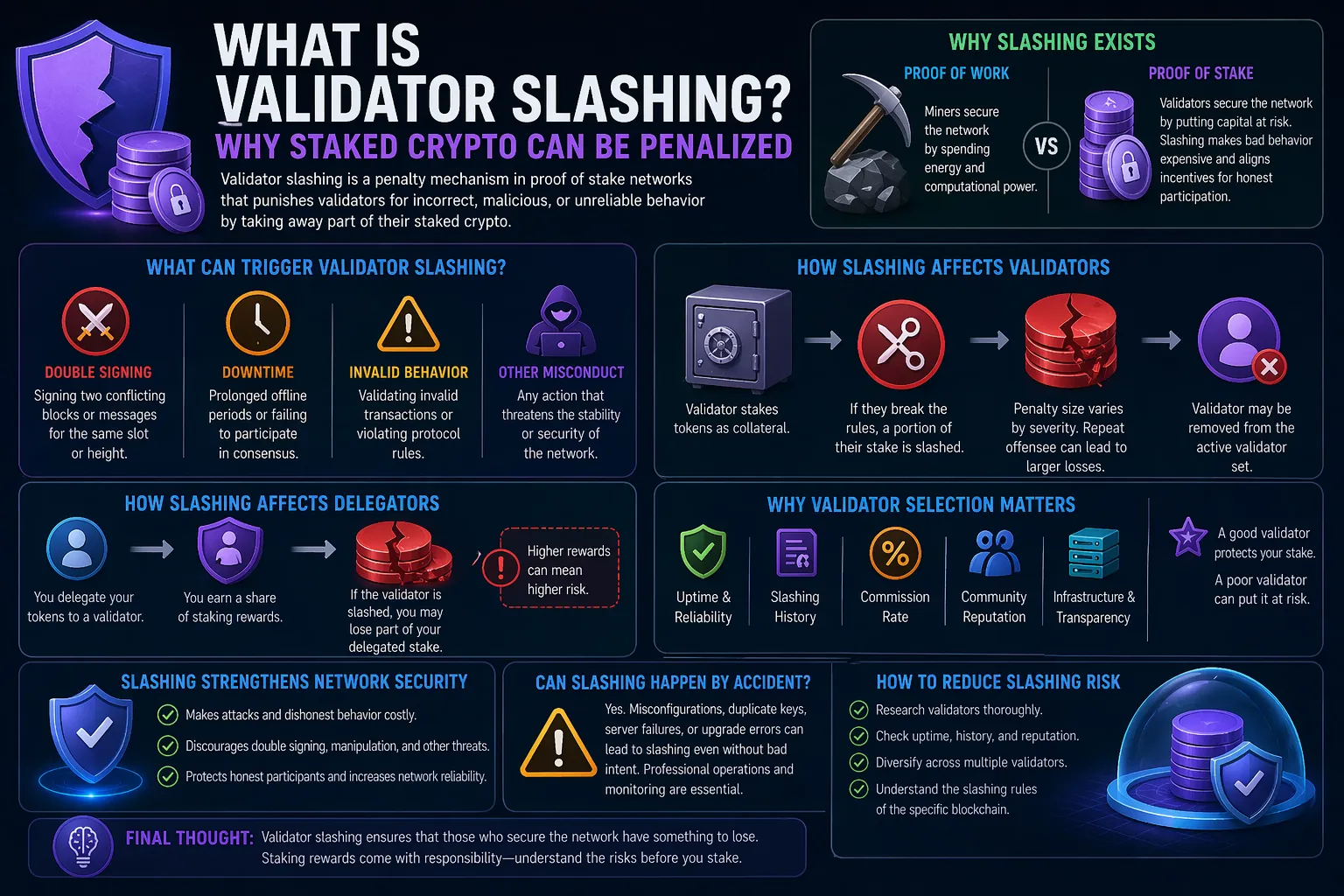
Why Does Validator Slashing Exist?
In proof of work networks, miners secure the blockchain by spending energy and computational power. In proof of stake networks, validators secure the blockchain by putting capital at risk.
This difference is important.
If validators could behave dishonestly without consequences, the network would be vulnerable. They might sign conflicting blocks, validate invalid information, or try to manipulate consensus. Slashing makes that behavior expensive.
The purpose of validator slashing is to align incentives. A validator should earn rewards when it helps the network and lose money when it harms the network.
This creates a simple security principle: the people responsible for consensus must have something to lose.
What Can Trigger Validator Slashing?
The exact rules depend on the blockchain, but validator slashing is usually triggered by serious protocol violations.
One common reason is double signing. This happens when a validator signs two conflicting blocks or messages for the same slot or height. Double signing can threaten consensus because it suggests the validator is supporting two incompatible versions of the chain.
Another reason can be prolonged downtime. Some networks penalize validators that fail to stay online and participate. In these cases, the penalty may be smaller than the penalty for malicious behavior, but it still matters.
Slashing can also occur if a validator attempts to validate invalid transactions, violates consensus rules, or participates in behavior that threatens the stability of the network.
How Does Slashing Affect Validators?
When a validator is slashed, part of its stake is removed. In some networks, the validator may also be removed from the active validator set.
The penalty can vary. A minor infraction may lead to a smaller loss. A serious attack or repeated violation may cause a much larger penalty.
For validators, slashing is one of the biggest operational risks. It means they need strong infrastructure, secure key management, reliable uptime, and careful monitoring.
Running a validator is not just about earning staking rewards. It requires responsibility.
How Does Slashing Affect Delegators?
Many users do not run validators themselves. Instead, they delegate their tokens to a validator and earn a share of staking rewards.
This can make staking easier, but it does not eliminate risk.
If a validator is slashed, delegators may also lose part of their delegated stake, depending on the network's rules. This means users should not choose validators only based on the highest reward rate.
A validator offering unusually high returns may also carry higher risk if its infrastructure, reputation, or operational history is weak.
Why Validator Selection Matters
Choosing a validator is one of the most important decisions for anyone staking crypto.
Users should consider factors such as uptime, history of slashing, commission rate, transparency, community reputation, and technical reliability.
A good validator should be stable, responsive, and consistent. A poor validator may create unnecessary risk for delegators.
In proof of stake, staking is not the same as depositing funds into a passive savings account. There is protocol risk, validator risk, and sometimes liquidity risk.
Validator Slashing and Network Security
Validator slashing strengthens network security by making attacks costly. If validators try to manipulate consensus, they risk losing the capital they locked into the network.
This discourages behavior such as double signing, chain manipulation, and coordinated attacks.
Slashing also protects honest participants. If bad validators are punished, the network becomes more reliable for users, developers, and investors.
This is why slashing is often seen as one of the core pillars of proof of stake security.
Can Slashing Happen by Accident?
Yes. Slashing is not always caused by malicious behavior. Sometimes it happens because of operational mistakes.
A validator may misconfigure servers, run duplicate signing keys, suffer infrastructure failure, or make errors during upgrades. Even if there is no bad intention, the network may still apply penalties.
This is why professional validator operation requires careful key management, redundancy, monitoring, and security procedures.
For delegators, this means trust matters. You are not only trusting a validator's honesty. You are also trusting its competence.
How to Reduce Slashing Risk
Users can reduce slashing risk by choosing validators carefully. It may also help to diversify stake across more than one validator, depending on the network and the user's strategy.
Before delegating, users should check whether the validator has been slashed before, how long it has been active, whether it communicates clearly, and whether it has reliable uptime.
It is also important to understand the rules of the specific blockchain. Not every proof of stake network uses slashing in the same way.
Final Thoughts
Validator slashing is a penalty system that helps proof of stake blockchains remain secure. It ensures that validators have real financial consequences if they act dishonestly or fail to perform their duties properly.
For validators, slashing is a serious operational risk. For delegators, it is a reminder that staking is not risk free.
Before staking, users should understand how slashing works, how validators are chosen, and what could happen if a validator breaks the rules. Staking rewards may be attractive, but responsible staking starts with understanding the risks behind them.
How to Bridge Crypto Between Chains: Complete Cross-Chain Tutorial 2026 How to Use 1inch: Complete DEX Aggregator Swap Tutorial (2026) How to Use OKX Web3 Wallet: Multi-Chain DeFi Hub Guide (2026)Frequently Asked Questions
What is slashing in crypto?
Slashing is a penalty mechanism in Proof of Stake (PoS) blockchains. Validators can lose a portion of their staked cryptocurrency for misbehavior or failing to perform their duties.
Why is slashing necessary?
Slashing incentivizes validators to act honestly and maintain network security. It discourages malicious activities and ensures the integrity of the blockchain.
What actions can lead to slashing?
Common reasons for slashing include double-signing transactions, being offline for extended periods, or proposing invalid blocks. Each blockchain defines its specific slashing conditions.
How much crypto can be slashed?
The amount of crypto slashed varies by blockchain and the severity of the offense. It can range from a small percentage to a significant portion of the validator's stake.
Does slashing affect delegators?
Yes, if a validator is slashed, their delegators also lose a proportional amount of their staked funds. This encourages delegators to choose reputable and reliable validators.