What Is a Bitcoin Mining Pool? Complete Guide
— By Tony Rabbit in Tutorials
Bitcoin mining pool explained: payout schemes like PPS, FPPS, and PPLNS, top pools, Stratum V2, hashrate risk, and how to join your first pool in 2026.
If you have ever wondered how individual miners with a few ASIC machines compete against industrial farms running tens of thousands of units, the answer is almost always the same: they do not compete alone. They pool their hashpower together. In 2026, an estimated 99% of all Bitcoin blocks are mined by coordinated groups of miners rather than lone operators. A Bitcoin mining pool is the invisible infrastructure that holds the entire mining economy together, turning the lottery of solo block discovery into a predictable stream of payouts.
A mining pool aggregates the computing power of many independent miners and distributes the resulting block rewards proportionally among participants. It is one of the most consequential pieces of plumbing in the Bitcoin ecosystem, yet most introductory guides barely scratch the surface. They mention that pools exist, name three or four of them, and move on. This guide goes much deeper. By the end you will understand exactly how a pool measures your contribution, the five major payout schemes and their trade-offs, the Stratum V2 protocol upgrade that is reshaping pool governance, and a head-to-head comparison of the seven biggest pools running in 2026.
We will also confront the uncomfortable side of pool mining: hashrate concentration. When two pools combine for more than 55% of global Bitcoin hashrate, the theoretical security guarantees of Proof of Work get strained. We will look at why Stratum V2 matters here, how solo pools like CKpool give purists a real-but-rare lottery ticket, and we will walk through the practical setup process of pointing a real ASIC at a real pool. If you operate even one miner, or you simply want to understand how Bitcoin actually gets minted today, this is the complete map.
What Is a Mining Pool?
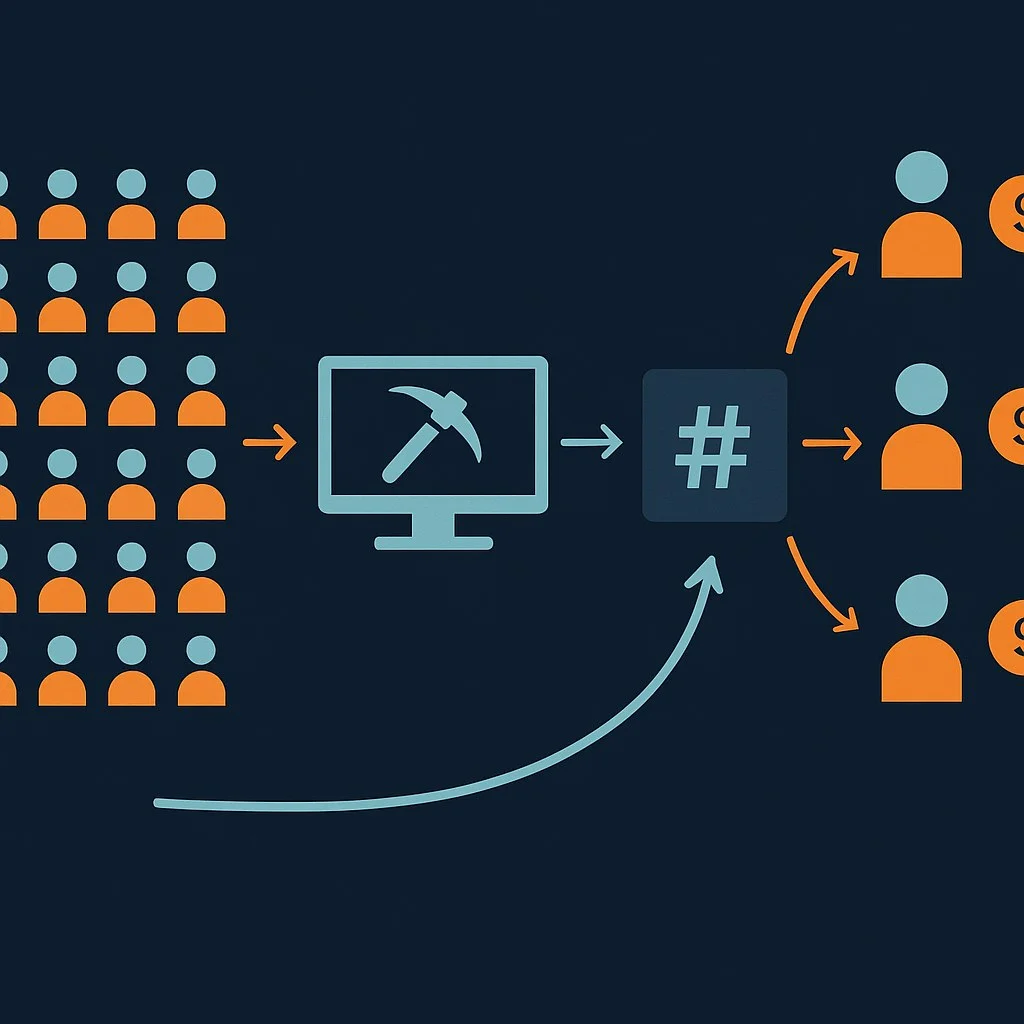
A mining pool is a coordinated group of cryptocurrency miners who combine their computational resources to increase their probability of finding a block and earning the associated reward. Think of it as a lottery syndicate. Instead of one person buying a single ticket and praying, a hundred people pool their money, buy a hundred tickets, and split any winnings proportionally. The expected payout per dollar spent is the same, but the variance, meaning the wildness of your individual outcome, drops dramatically.
In Bitcoin specifically, finding a block requires solving a computational puzzle whose difficulty is automatically tuned so that, on average across the entire network, one block is found every ten minutes. The block reward in 2026, after the April 2024 halving, consists of a 3.125 BTC block subsidy plus all the transaction fees from the block. The puzzle itself is essentially repeated SHA-256 hashing with different nonce values until a hash below a target threshold is found.
A solo miner with a single Antminer S21 doing roughly 200 terahashes per second represents a vanishingly small slice of the network's total hashrate. Statistically, that miner might find one block every six to ten years. The variance is brutal. They could go a decade and find zero blocks, or they could get lucky and find two in a row. A pool flattens this variance. By aggregating thousands of miners, the pool collectively finds blocks regularly. Each participant earns a steady, predictable income proportional to the hashrate they contributed.
Why Pools Exist: The Variance Problem
The core problem mining pools solve is variance. Bitcoin block discovery is, mathematically, a Poisson process. Each hash attempt is an independent trial with an extraordinarily low probability of producing a valid block. With enough hashes per second, you eventually win, but the gap between wins is unpredictable. A miner pulling 0.001% of network hashrate would, on average, find one block every 100,000 blocks. At ten minutes per block, that is around 694 days, or just under two years. But that is an average. The actual distribution has a long tail, with real-world miners sometimes waiting three, four, or five times longer than expected.
This variance is fatal for any serious mining operation. ASIC hardware costs money, electricity costs money, hosting costs money, and all of those bills come due monthly. You cannot pay your power company in "we will be lucky eventually" credit. Mining pools convert lumpy, jackpot-style revenue into smooth daily payouts, which makes mining a viable business rather than a gamble.
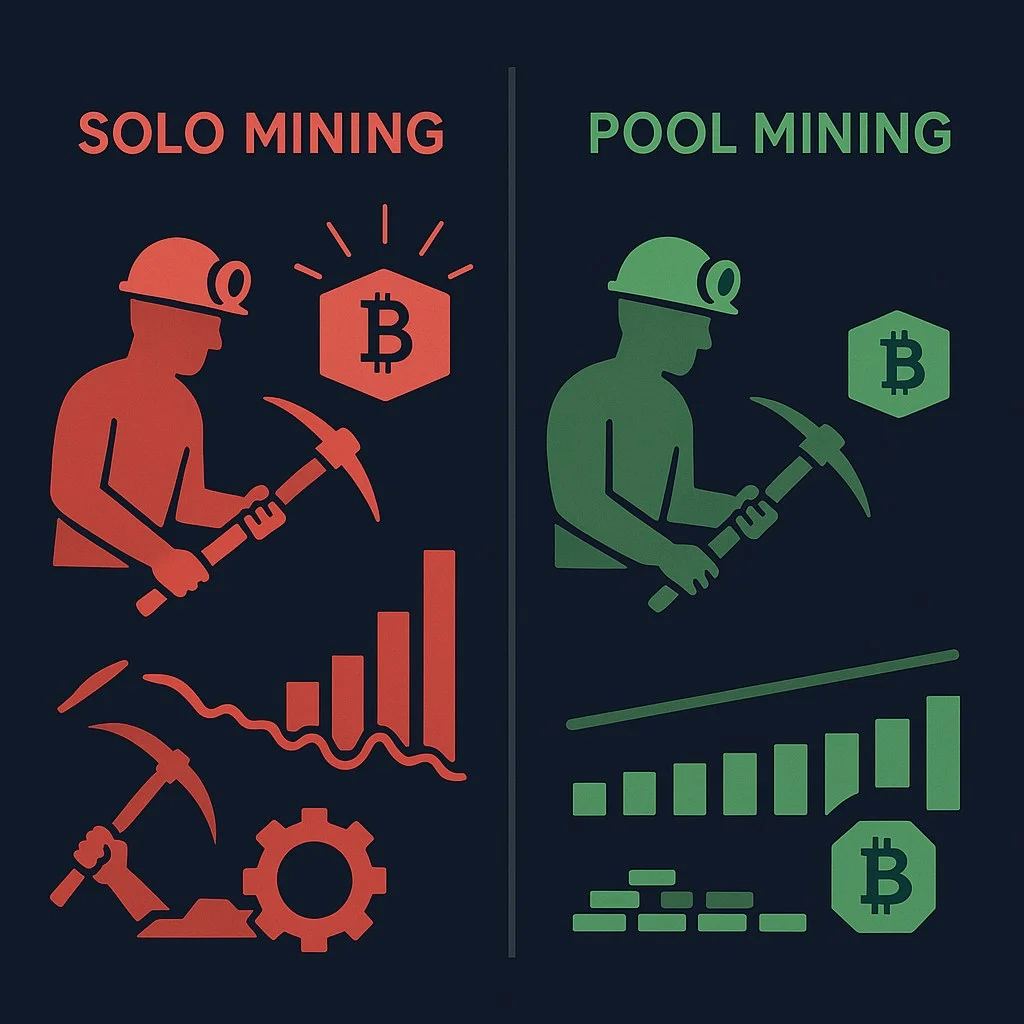
- Rare jackpot payouts (full block reward at once)
- Extremely high variance, can wait years
- No pool fees, you keep 100% of any block found
- Full control over transaction inclusion
- Possible for small miner only as a lottery ticket
- Maximum decentralization contribution
- Steady, predictable daily payouts
- Low variance, smooth income curve
- Pool fees of 1-3% reduce gross earnings
- Pool operator usually selects transactions
- Practical for any operator, big or small
- Contributes to hashrate concentration
The trade-off is captured cleanly above. Solo mining preserves the maximum possible payout, full block reward and full halving-adjusted subsidy plus all transaction fees, but the wait can be ruinous. Pool mining trims a small percentage off the top in exchange for converting Bitcoin mining from a casino into a job. For 99% of miners, the math overwhelmingly favors the pool.
How a Mining Pool Works Mechanically
Let us walk through what actually happens between your ASIC and the pool's coordinator. The pool runs a server that maintains a connection with every participating miner. The server constructs candidate block templates using transactions from the mempool, the block subsidy destination (a pool-controlled address in most setups), and the relevant block header fields. It distributes work to miners, receives proof-of-work submissions, validates them, and when a valid full-difficulty solution comes in, broadcasts the new block to the Bitcoin network.
The communication protocol historically used between miners and pools is called Stratum V1. It is a lightweight, JSON-based protocol that has been the industry default for over a decade. The pool sends a work template consisting of the block header fields, a Merkle branch for transactions, and a target difficulty. The miner iterates through nonces, hashing the header until it produces a hash below the target. When that happens, the miner submits the solution back to the pool.
Critically, miners under Stratum V1 do not select which transactions go into the block. The pool operator does. This is exactly the centralization concern that Stratum V2 is designed to address, which we will get to shortly. For now, the mental model is: many small machines hashing the same template, with the pool operator orchestrating the work and pocketing none, all, or some of the resulting reward depending on the payout scheme.
Shares: How Pools Measure Your Contribution
If the pool is splitting rewards proportional to contribution, it needs a way to measure how much work each miner is doing. The problem is obvious: only a hash that meets the full network difficulty wins a block. Across the entire pool, that might happen once every few hours. Between block discoveries, how do you tell a hard-working miner from someone whose machine is unplugged?
The solution is the concept of a share. The pool sets its own internal difficulty threshold, far below the network difficulty. Miners submit any hash that meets the pool's lower difficulty target. These are called shares. Shares are essentially proof that the miner is actually grinding through the search space rather than sitting idle. Because the share difficulty is much lower than network difficulty, miners produce shares constantly, every few seconds depending on their hashrate.
If the pool's share difficulty is set to 1 in a billion of the network difficulty, then on average each share has a 1 in a billion chance of also being a full block solution. Statistically, the number of shares a miner submits is directly proportional to their hashrate. A miner contributing twice as many shares is contributing twice as much actual work. When the pool eventually finds a block (some lucky share also happens to clear the full network target), the reward is divided based on share counts.
Modern pools use variable difficulty, often called vardiff, where the share target is adjusted per miner based on their hashrate. A small miner pulling 100 GH/s gets an easier share target so they submit shares regularly. A 200 PH/s farm gets a harder share target so the pool is not flooded with submissions. The fairness math works out the same in both cases.
Payout Schemes: PPS vs PPS+ vs FPPS vs PPLNS vs SOLO
This is where mining pool choice gets genuinely consequential, and where most beginner guides give up. The payout scheme determines how a pool converts your shares into Bitcoin. Five major schemes dominate the 2026 landscape, each with different trade-offs in variance, fee level, and who absorbs the risk of bad luck.
Pool pays a fixed amount per share regardless of luck. Pool absorbs all variance. Highest fees (3-4%).
PPS for the block subsidy, plus PPLNS-style share of transaction fees. Lower base fee (2-2.5%).
Pays both subsidy and an average of transaction fees per share. The 2026 industry standard. Fees around 2%.
Pays only when pool finds a block, distributed across last N shares. Rewards loyalty. Higher variance, lower fees (1-2%).
Pool only provides infrastructure. If you find the block, you keep 99%+ of the reward. Pure lottery.
PPS (Pay Per Share) is the simplest scheme to understand. The pool calculates the expected value of each share based on network difficulty and current block reward, and pays the miner that fixed amount per share submitted. It does not matter whether the pool got lucky and found four blocks in an hour or got unlucky and found zero blocks all day. The miner gets paid for every share regardless. This shifts 100% of the variance risk onto the pool operator, who needs deep capital reserves to weather unlucky stretches. That is why PPS pools charge the highest fees, often 3-4%.
PPS+ evolved from PPS by recognizing that transaction fees in a block can be substantial, especially during high-demand periods. Under PPS+, the miner receives PPS-style fixed payment for the block subsidy portion (the 3.125 BTC newly minted coins), plus a share of transaction fees proportional to their contribution under a PPLNS-like calculation. Fees are typically 2-2.5%, lower than pure PPS because the operator no longer takes variance risk on the transaction fee portion.
FPPS (Full Pay Per Share) is the current industry standard among the major pools in 2026. It pays the miner the full expected value of each share, including both the block subsidy and an averaged transaction fee component. The averaging is usually done over a recent window of blocks. The miner enjoys near-zero variance while still benefiting from elevated transaction fee periods (because the average creeps up). Fees usually run 1.5-2%.
PPLNS (Pay Per Last N Shares) works completely differently. There is no per-share payment. Instead, when the pool finds a block, the reward is distributed across the most recent N shares submitted to the pool (where N is typically several blocks worth of shares). Miners who happen to be active during the lucky moment get paid. Miners who quit mining right before a block was found get nothing. This makes PPLNS hostile to pool-hopping (jumping between pools to chase luck) and rewards consistent, loyal miners. Variance is higher than FPPS because the miner shares in the pool's good and bad luck, but fees are typically the lowest in the industry at 1-2%.
SOLO via Pool is a hybrid where the pool provides the work distribution infrastructure and the block validation backbone, but does not aggregate rewards. If a share you submit happens to be the one that wins the block, you keep nearly the entire block reward (minus a small pool fee, often around 1%). If somebody else's share wins, you get nothing. Solo pools are functionally a lottery, but they let hobbyists run small ASICs at home with the dream of catching a full block.
Pool Fees: What You Actually Pay
Pool fees in 2026 typically range from 1% to 3% depending on the payout scheme and the pool's brand power. The fee covers infrastructure costs (servers, bandwidth, devops, security), variance absorption for PPS and FPPS schemes, and the pool's profit margin. Some pools advertise "0% fee" promotions but those usually have hidden costs, such as keeping all transaction fees rather than distributing them, or longer minimum payout thresholds that lock up your earnings.
Beyond the headline fee, pay attention to several practical details. The minimum payout threshold determines how much Bitcoin you must accumulate before the pool actually pays you. Some pools have thresholds as low as 0.0001 BTC, while others require 0.005 BTC or more. If you are a small miner, a high threshold means waiting weeks for your first payout. Withdrawal frequency matters too. Daily payouts give you flexibility, while weekly payouts let funds sit on the pool's hot wallets longer. And withdrawal fees, often a flat satoshi amount, can eat into earnings for small miners.
Top 7 Bitcoin Mining Pools in 2026
Mining pool rankings shift over time as hashrate migrates and new operators emerge, but the top seven in 2026 have been relatively stable for the last two years. Below is the head-to-head with current fee structures, payout schemes, and approximate hashrate share. Note that hashrate share is a rolling estimate based on block discovery proportions over the trailing 30 days.
- Hashrate share: ~30%
- Fee: 0% to 2.5%
- Payout: FPPS
- Region: United States
- Hashrate share: ~22%
- Fee: 2-4% (varies)
- Payout: FPPS, PPLNS, SOLO
- Region: Global
- Hashrate share: ~12%
- Fee: 2% FPPS / 4% PPS+
- Payout: PPS+, FPPS, PPLNS, SOLO
- Region: Global
- Hashrate share: ~10%
- Fee: 2.5%
- Payout: FPPS, PPS+
- Region: Global
- Hashrate share: ~3%
- Fee: 0.7% FPPS
- Payout: FPPS
- Region: North America
- Hashrate share: ~3%
- Fee: Variable (members)
- Payout: FPPS
- Region: United States
A few observations worth pulling out. Foundry USA, owned by Digital Currency Group, became the largest pool partly because it onboarded most North American industrial miners who were nervous about Chinese pool jurisdictions after the 2021 Chinese mining ban. AntPool benefits from being operated by Bitmain, the dominant ASIC manufacturer, so many of its customers default to AntPool when they fire up new hardware. ViaBTC and F2Pool maintain large share by supporting many coins and offering aggressive multi-payout-scheme menus. Luxor punches above its weight in policy influence because it has been the most aggressive in deploying Stratum V2 support.
Stratum V2: The Bigger Shift
If you read only one paragraph in this entire guide, make it this section. Stratum V2 is the most consequential infrastructure upgrade in mining since ASICs themselves. The old Stratum V1 protocol gives the pool operator total control over which transactions go into the block. The pool selects the transactions, builds the template, hands it to the miner, and the miner just hashes whatever was assigned. Miners are effectively rentable hashpower with no say in the contents of the block.
This is the architectural reason behind several of the worst centralization concerns in Bitcoin. If a regulator or government pressured Foundry USA or AntPool to exclude certain transactions, the pool operator could do so unilaterally, and all of the miners pointing hashrate at that pool would be participating in the censorship without even knowing it. Their machines just hash whatever template they receive.
Stratum V2 introduces template negotiation. Under V2, individual miners can construct their own block templates (selecting which transactions they want to include from their own local mempool view) and submit those templates to the pool. The pool's job becomes share verification and reward distribution, but no longer transaction selection. This decentralizes the actual contents of Bitcoin blocks back down to the individual miners, who can be many thousands of independent operators around the world.
V2 also brings other meaningful improvements: encrypted, authenticated connections between miners and pools (V1 traffic was plaintext, vulnerable to hijacking by malicious networks), binary message framing for higher efficiency and lower bandwidth, and better job distribution to reduce wasted hashing on stale work. Adoption has been accelerating through 2025 and 2026, with Braiins (the protocol's original authors) and Luxor leading deployment. Major pools have committed to V2 timelines, although the politics are sensitive because V2 dilutes pool operator power.
How to Choose a Mining Pool
For a new miner picking their first pool, or an existing miner reconsidering their setup, here are the variables that actually matter. Treat them as a checklist rather than a hierarchy, because the right balance depends on your specific operation.
Pool size and reliability. A bigger pool finds blocks more frequently, which means smoother payouts and lower variance for you. The trade-off is that bigger pools contribute to centralization concerns. A good middle ground is a pool in the 5-15% hashrate share range that is large enough to be reliable but not so large that it tips toward dominance.
Fee level relative to payout scheme. A 1% PPLNS pool and a 2.5% FPPS pool are not equivalent. PPLNS shifts variance to you, so the lower fee is partly compensating you for that risk. Compute your expected daily earnings under each scheme using a calculator that accounts for your hashrate, current network difficulty, and current block reward including average transaction fees.
Payout scheme alignment. If you need predictable income to pay monthly bills, FPPS is almost always correct. If you have other income, can stomach variance, and want maximum long-run returns, PPLNS pays better on average because the lower fees compound over time.
Geographic latency. Your miner has to communicate with the pool server. Every share submission travels over the public internet. If you are mining in Indonesia and your pool's servers are in Frankfurt, you will experience higher latency and slightly more stale shares (shares submitted after the pool has already found a block, which are rejected). Most major pools maintain regional stratum endpoints. Pick one near your facility.
Censorship and transparency policy. Some pools openly state which transactions they will or will not include (compliance-filtered pools refuse transactions related to sanctioned addresses, for example). If censorship-resistance matters to you, prefer pools that publicly commit to including all valid transactions and that support Stratum V2.
Hands-On: Configuring Your ASIC to Join a Pool
Let us walk through what setup actually looks like with a real machine. The example uses an Antminer S21, the dominant ASIC family in 2026, but the same fields exist on Whatsminer, MicroBT, and most other hardware. The process takes maybe five minutes.
Step 1: Register at the pool. Go to the pool's website (foundrydigital.com, antpool.com, viabtc.com, etc.) and create an account. You will choose a username, set a password, and configure a Bitcoin payout address. The payout address is the wallet that will receive your mining rewards. Use a wallet you fully control. Never use an exchange address that could be frozen or closed.
Step 2: Find your pool's stratum URL. In your pool's dashboard, locate the configuration page or "miner setup" section. You will see one or more URLs that look like stratum+tcp://btc.viabtc.io:3333 or similar. Different ports are usually offered for different difficulty levels or geographic regions. Copy the URL.
Step 3: Access your miner's web interface. Plug the ASIC into power and ethernet, find its IP address on your local network (most home routers list connected devices), and open that IP in a browser. The default credentials for Antminers are usually root / root or admin / admin. Change these immediately for security.
Step 4: Configure pool settings. In the miner's web UI, navigate to the Miner Configuration or Pool section. You will see three pool slots. Pool 1 is your primary. Paste the stratum URL into the URL field. In the Worker field, enter your pool username followed by a period and a worker name, for example yourusername.rig01. The worker name lets you track multiple miners under one account. Password is usually just "x" or anything (pools rarely check this). Set Pool 2 and Pool 3 to backup pools so the miner fails over if the primary is unreachable.
Step 5: Save and reboot. Click Save and Apply. The miner will restart its mining process and connect to the pool. Within 30 seconds, the miner's status page should show "Working" status and a green indicator. Within a few minutes, your pool dashboard should show the worker as Online with reported hashrate matching your machine's spec.
Step 6: Monitor. Check the pool dashboard daily for the first week. Confirm your hashrate is stable and matches the manufacturer rating (an S21 should report close to 200 TH/s). Look for accepted shares versus rejected shares. Rejection rates above 1-2% suggest a configuration or network problem. Pool dashboards also show estimated daily earnings, accumulated unpaid balance, and historical payouts.
Hashrate Concentration: The Decentralization Concern
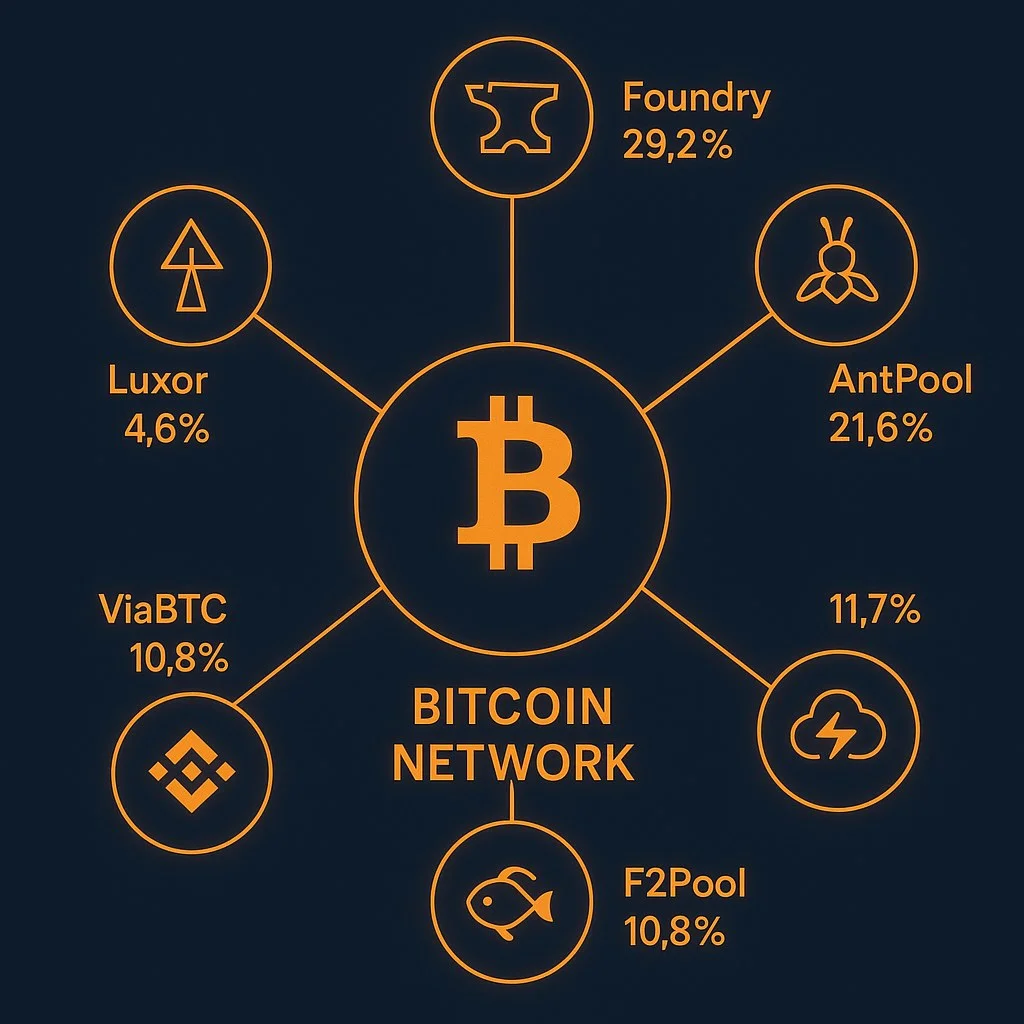
Here is the dirty truth that pool marketing pages tend not to print. In 2026, Foundry USA and AntPool together regularly account for over 55% of Bitcoin's total hashrate. Some weeks they slip below 50%, other weeks they push toward 60%. This is, in theory, the threshold that enables a 51% attack, where a majority hashpower entity could rewrite recent blocks, double-spend, or censor transactions at will.
Foundry USA and AntPool combined have at times exceeded 55% of global Bitcoin hashrate. Under Stratum V1, this gives those two pool operators effective control over which transactions enter blocks and theoretical capacity to coordinate a 51% attack. The miners providing the hashpower mostly do not realize how concentrated the actual decision-making layer has become.
This is the single biggest reason Stratum V2 adoption matters. Under V2, the miners themselves regain control over transaction selection, and the pool's power is reduced to share accounting. If you operate a pool-mining rig, ask your pool when they will support V2 and consider switching to one that already does.
Importantly, the hashrate that pools control is not actually owned by the pool. It is owned by the thousands of individual miners pointing their machines at the pool. If miners moved their hashrate to other pools, the concentration would dissolve in a day. So the centralization is more fragile than it looks. But while miners stay put (which they often do for inertia, brand familiarity, or favorable fees), the operational reality is that two companies effectively coordinate transaction selection for the majority of Bitcoin blocks. That is a security model far weaker than the marketing materials suggest.
The healthiest response from a network point of view is for miners to spread their hashpower across smaller pools, particularly ones that have committed to Stratum V2. Even if the total hashrate distribution stays the same on paper, breaking up control of the template-construction layer dramatically improves censorship resistance and reduces 51% attack feasibility.
Solo Mining Pools
For purists who want a real lottery ticket at finding their own block, solo mining pools exist as a halfway house between true solo mining (running your own Bitcoin node and constructing your own templates) and shared pool mining. The most famous solo pool is CKpool's solo.ckpool.org, run by Bitcoin developer Con Kolivas. It is functionally just a stratum server that distributes work, validates submissions, and notifies you if your share happens to be a winning block.
If you find a block on solo CKpool, you keep approximately 99% of the block reward (CKpool takes 1%, plus a small donation reservation). The block reward at current rates of 3.125 BTC plus transaction fees can mean over $200,000 going to a single small miner. There are real, documented cases of hobbyists with sub-petahash setups winning full blocks. A miner running a single Antminer S21 finding a block on solo CKpool would be a wildly improbable event, but it has happened to comparably small miners several times since 2022.
The expected value of solo mining for a small miner is roughly the same as pool mining (minus any pool fee delta), but the distribution of outcomes is night and day. With 99.99% probability you earn nothing for years. With 0.01% probability you hit a six-figure jackpot in a single block. If you treat it as entertainment rather than business, solo mining is fun. If you need predictable revenue, do not do it.
Other Coins: Litecoin, Dogecoin Merged Mining, Kaspa
Mining pools exist for many coins beyond Bitcoin, though the dynamics differ by algorithm. Litecoin uses the Scrypt algorithm and has its own ecosystem of pools (LitecoinPool, ViaBTC LTC, AntPool LTC). The interesting wrinkle is merged mining: Litecoin and Dogecoin both use Scrypt, and miners can submit work that simultaneously contributes to both chains. A single share can earn both LTC and DOGE rewards. ViaBTC and other Litecoin pools have offered merged mining for years, and the practice meaningfully increases miner economics, especially during meme-driven Dogecoin transaction fee spikes.
Kaspa, the BlockDAG-based Proof of Work network using the kHeavyHash algorithm, has its own pool ecosystem (HeroMiners, F2Pool Kaspa, ViaBTC Kaspa) and many of the same payout scheme dynamics apply. The block time on Kaspa is much faster than Bitcoin (one block per second), so the variance math is different, but the share-based accounting framework is essentially identical. If you are choosing what to mine, our breakdown of the best cryptocurrencies to mine covers profitability by hardware type.
Ethereum Classic, Ergo, Ravencoin, and other GPU-mineable Proof of Work coins have their own pools. The fundamental mechanics of share-based reward distribution carry over, but the algorithms, payout schemes available, and fee structures vary widely. If you are crossing over from Bitcoin pool mining, expect a learning curve in each new ecosystem.
Mining Pool Taxation
Tax treatment of mining pool earnings is jurisdiction-specific and changes regularly, so consult a local accountant for definitive guidance. That said, a few generalizations hold in most major jurisdictions. Mining rewards are typically treated as ordinary income at fair market value on the day the reward is received. When you later sell the Bitcoin, you also owe capital gains or losses based on the price difference between when you received it and when you sold it. This creates a two-stage tax exposure that catches new miners off guard.
An important nuance with pool mining is whether each share payout is its own taxable event or whether the entire daily total is one event. Most tax authorities take the position that income accrues whenever you have a legal claim on the funds, which usually means as the unpaid balance grows in your pool account, not just at withdrawal time. Practically, miners often summarize this as daily total fair market value at end-of-day pricing for the entire daily earnings, but the formal position can be more granular.
If you are operating at meaningful scale, keep detailed records: timestamp of each payout, BTC amount, USD fair market value at the time, pool name, worker. Major mining accounting tools (Koinly, CoinTracker, ZenLedger) integrate directly with most large pools and can export tax-ready reports. The IRS has specifically targeted crypto miners in recent guidance, so do not assume the audit risk is low.
Frequently Asked Questions
What is the biggest Bitcoin mining pool?
As of 2026, Foundry USA is the largest Bitcoin mining pool, regularly accounting for around 30% of total network hashrate. AntPool, operated by Bitmain, sits in second place at roughly 22%. Combined, these two pools sometimes exceed 55% of global Bitcoin hashrate, which is a significant decentralization concern.
How do mining pools split rewards?
Mining pools split rewards based on each miner's measured contribution, which is tracked through a system of shares. A share is a partial proof of work submitted to the pool at a lower difficulty than the network requires. The pool counts shares per miner and pays out proportionally according to the chosen payout scheme such as FPPS, PPS+, or PPLNS.
What is FPPS payout?
FPPS stands for Full Pay Per Share. Under FPPS, the pool pays each miner a fixed amount per share submitted, calculated to reflect both the block subsidy (currently 3.125 BTC after the 2024 halving) and an average of recent transaction fees. The pool absorbs all variance, so miners receive predictable income whether the pool got lucky or unlucky in any given period. FPPS is the dominant scheme in 2026.
Is solo mining better than pool mining?
For 99% of miners, pool mining is dramatically better in practice. Solo mining preserves the full block reward (no pool fees), but the variance is extreme. A small miner pulling a fraction of a percent of network hashrate might wait years between blocks under solo mining. Pool mining converts this gambling-style payoff into smooth daily income. Solo mining only makes sense at very large scale or as a deliberate lottery ticket via a solo pool like CKpool.
How much does a mining pool charge?
Mining pool fees in 2026 typically range from 1% to 3% of mining rewards. PPLNS pools often charge 1-2% because they shift variance to miners. FPPS pools usually charge 1.5-2.5% because the pool absorbs variance. Premium PPS pools can charge up to 4%. Solo pools like CKpool charge around 1%. Beyond the headline fee, watch for hidden costs like high minimum payout thresholds or withheld transaction fees.
Can a mining pool steal your Bitcoin?
A mining pool cannot directly steal Bitcoin from miners' wallets, because miners never give the pool access to their wallets. Miners only receive payouts to their own address. However, a pool can hypothetically withhold earnings, freeze accounts, or simply shut down with miners' unpaid balances. To mitigate this risk, use reputable pools with long track records, set the lowest practical minimum payout threshold so balances are withdrawn frequently, and consider splitting hashrate across multiple pools.
What is Stratum V2 and why does it matter?
Stratum V2 is the next-generation mining protocol replacing the long-standing Stratum V1. Its most important feature is template negotiation, which lets individual miners construct their own block templates and choose which transactions to include, rather than blindly hashing whatever the pool assigns. This decentralizes transaction selection back to the miners and significantly reduces the censorship power of pool operators. V2 also brings encrypted connections and lower bandwidth usage. Adoption is accelerating in 2026.
Conclusion
Bitcoin mining pools are the invisible coordination layer that makes industrial-scale crypto mining economically viable. They convert the high-variance lottery of solo block discovery into the smooth daily revenue stream that lets miners pay power bills and amortize hardware costs. Understanding pools, their payout schemes, their fee structures, and especially the deep technical shift from Stratum V1 to Stratum V2 is essential context for anyone operating mining hardware or even just trying to understand how Bitcoin actually functions.
The choice of pool matters more than most beginner guides suggest. The payout scheme alone (PPS, PPS+, FPPS, PPLNS, or solo) determines who absorbs variance and how predictable your income will be. Fee differences of one to two percent compound substantially over time. Geographic latency affects rejected share rates. And the censorship and Stratum V2 stance of your pool determines whether your hashrate is contributing to Bitcoin's decentralization or to its concentration around a small number of dominant operators.
For most readers, the practical playbook is straightforward. Pick a mid-sized FPPS pool with a 1.5-2% fee and a strong reputation. Configure your machines with proper worker names and a payout address you fully control. Monitor the dashboard for the first week to confirm stable hashrate and reasonable rejection rates. Ask your pool when they will support Stratum V2, and if the answer is "never" or "no plan", consider moving to one that has already deployed it. The structural health of the Bitcoin network depends, more than people realize, on miners making thoughtful choices about which pools deserve their hashpower.