Best Cryptocurrencies to Mine in 2026 (Profitability Ranked)
— By Tony Rabbit in Tutorials
The most profitable cryptocurrencies to mine in 2026, ranked by ROI, hardware and difficulty. Compare GPU and ASIC coins before you start mining.
The most profitable cryptocurrencies to mine in 2026 include Bitcoin (SHA-256, ASIC), Kaspa (kHeavyHash, GPU), Ravencoin (KAWPOW), and Monero (RandomX, CPU). Profitability depends on hardware, electricity costs, and market conditions, with daily estimates ranging from $0.80 to $22 per unit at $0.08/kWh.
- Bitcoin (BTC, SHA-256) with ASIC miners
- Kaspa (KAS, kHeavyHash) with modern GPUs
- Ravencoin (RVN, KAWPOW) with modern GPUs
- Monero (XMR, RandomX) with CPU mining
Cryptocurrency mining remains one of the most reliable ways to earn digital assets in 2026, but profitability depends heavily on which coin you mine, what hardware you use, and how much you pay for electricity. Whether you are running a GPU rig in your garage or deploying ASIC machines in a dedicated facility, choosing the right coin can mean the difference between steady profits and burning money on power bills.
This guide ranks the 10 best cryptocurrencies to mine in 2026 based on real-world profitability data, breaks down the hardware and electricity costs involved, and gives you the tools to calculate your own potential returns. If you are new to the concept, start with our primer on what crypto mining is and how it works before diving into the rankings below.
How We Ranked the Most Profitable Coins to Mine
Every coin on this list was evaluated using five criteria: daily revenue per unit of hashrate, network difficulty trend over the past 12 months, hardware accessibility, liquidity on major exchanges, and long-term project viability. We pulled profitability figures from WhatToMine, MinerStat, and direct pool dashboards, then normalized them against a baseline electricity cost of $0.08/kWh to keep comparisons fair.
Mining profitability is a moving target. Prices swing, difficulty adjusts, and new hardware launches can reshape the landscape overnight. The numbers in this guide reflect Q2 2026 conditions and should be rechecked monthly using the calculator method we outline later in this article.
Mining Profitability at $0.10/kWh
Based on S21 Pro (BTC) and RTX 4090 (GPU coins). Profits vary with difficulty and price.
Top 10 Most Profitable Cryptocurrencies to Mine in 2026

1. Bitcoin (BTC) - ASIC Mining
Bitcoin is still the king of mining in 2026. The fourth halving in April 2024 cut block rewards to 3.125 BTC, which pushed out inefficient miners and consolidated hashrate among operations running next-generation ASIC hardware. For those with access to cheap electricity and modern machines, BTC mining remains the most dollar-profitable option available.
- Algorithm: SHA-256
- Hardware needed: ASIC miners (Bitmain Antminer S21 Pro, MicroBT WhatsMiner M60S, Canaan Avalon A15 series)
- Daily profit estimate: $12 to $22 per machine at $0.08/kWh (varies with BTC price and difficulty)
- Difficulty trend: Steadily increasing, up roughly 35% year-over-year as institutional miners continue expanding capacity
- Network hashrate: Approximately 850 to 950 EH/s, the highest of any proof-of-work network
The barrier to entry is high. A single competitive ASIC unit runs $3,000 to $8,000, and you need dedicated 240V power infrastructure. But if you understand proof of work vs proof of stake and have access to electricity below $0.06/kWh, Bitcoin mining offers the most predictable long-term returns due to BTC's deep liquidity and store-of-value narrative.

2. Kaspa (KAS) - GPU Mining
Kaspa has emerged as the top GPU-mineable coin by profitability in 2026. Its blockDAG architecture enables rapid block times (one block per second), and the kHeavyHash algorithm runs efficiently on modern GPUs. Kaspa's price appreciation over the past year has kept mining margins healthy even as difficulty climbs.
- Algorithm: kHeavyHash
- Hardware needed: Modern GPUs (NVIDIA RTX 4070 and above, AMD RX 7800 XT and above)
- Daily profit estimate: $1.50 to $3.50 per GPU at $0.08/kWh
- Difficulty trend: Rising sharply as more GPU miners migrate from other chains, up approximately 60% year-over-year
- Network hashrate: Approximately 1.2 to 1.5 PH/s
Kaspa's ASIC transition has been gradual, and GPU miners still hold a meaningful share of the network. That said, dedicated Kaspa ASICs from IceRiver and Bitmain are shipping in larger volumes, so the GPU mining window may narrow over the next 12 months. If you already own capable GPUs, Kaspa should be your first consideration.

3. Alephium (ALPH) - GPU Mining
Alephium uses a sharded UTXO model with its custom Blake3 mining algorithm, which is particularly efficient on NVIDIA GPUs. The project's focus on scalability and smart contracts gives it stronger fundamentals than many pure mining plays, and the token has maintained solid exchange volume throughout 2026.
- Algorithm: Blake3 (Proof of Less Work)
- Hardware needed: NVIDIA GPUs preferred (RTX 3060 Ti and above), AMD GPUs supported but less efficient
- Daily profit estimate: $1.00 to $2.80 per GPU at $0.08/kWh
- Difficulty trend: Moderate growth, up about 25% year-over-year
- Network hashrate: Approximately 80 to 120 TH/s
Alephium's "Proof of Less Work" design means lower energy consumption per hash compared to traditional PoW algorithms. This translates to better profit margins when electricity costs are a concern. The project's smaller market cap also means higher upside potential if adoption accelerates, though that cuts both ways in terms of risk.
4. Ravencoin (RVN) - GPU Mining
Ravencoin has been a GPU mining staple since its launch, and 2026 is no different. The KAWPOW algorithm is ASIC-resistant by design, which keeps the network accessible to home miners running consumer graphics cards. RVN's asset tokenization use case continues to attract a loyal community.
- Algorithm: KAWPOW
- Hardware needed: Most modern GPUs with 4GB+ VRAM (RTX 3060, RTX 4060, RX 6700 XT and above)
- Daily profit estimate: $0.80 to $2.20 per GPU at $0.08/kWh
- Difficulty trend: Cyclical, tends to spike when RVN price rallies then stabilize as less profitable miners drop off
- Network hashrate: Approximately 8 to 14 TH/s
The KAWPOW algorithm is memory-intensive, so GPUs with higher VRAM and memory bandwidth have a significant advantage. Ravencoin's block reward is 2,500 RVN per block with a halving schedule similar to Bitcoin's. The next halving is expected in early 2027, which historically triggers price speculation and increased mining interest.
5. Ergo (ERG) - GPU Mining
Ergo is a research-driven blockchain that uses the Autolykos v2 algorithm, designed specifically to be GPU-friendly and ASIC-resistant. The project's strong ties to academic cryptography research and its extended UTXO model make it one of the more technically sophisticated mineable chains.
- Algorithm: Autolykos v2
- Hardware needed: GPUs with 4GB+ VRAM (NVIDIA and AMD both perform well)
- Daily profit estimate: $0.70 to $2.00 per GPU at $0.08/kWh
- Difficulty trend: Moderate and relatively stable, up about 15% year-over-year
- Network hashrate: Approximately 45 to 70 TH/s
Ergo's emission schedule reduces block rewards over time through a smooth curve rather than sharp halvings. The storage rent mechanism, which reclaims lost coins from inactive addresses, is unique in the PoW space and helps maintain a healthier token economy. For miners who value project fundamentals alongside daily profit numbers, Ergo is a strong pick.
6. Flux (FLUX) - GPU Mining
Flux powers a decentralized cloud computing infrastructure, giving the token real utility beyond speculation. The ZelHash algorithm (a modified Equihash variant) runs well on GPUs, and Flux's node ecosystem creates additional earning opportunities beyond basic mining.
- Algorithm: ZelHash (Equihash 125,4)
- Hardware needed: GPUs with 3GB+ VRAM, performs best on NVIDIA cards
- Daily profit estimate: $0.60 to $1.80 per GPU at $0.08/kWh
- Difficulty trend: Gradually increasing, up approximately 20% year-over-year
- Network hashrate: Approximately 3.5 to 5.5 GH/s (sol/s)
What sets Flux apart is the option to run FluxNodes alongside mining. Node operators earn additional FLUX rewards for providing computational resources to the network. This dual-income model can significantly boost total returns, though it requires locking a collateral stake. Learn more about similar earning models in our guide to crypto passive income strategies.
7. Ethereum Classic (ETC) - GPU Mining
After Ethereum moved to proof of stake in 2022, a massive wave of GPU hashrate migrated to Ethereum Classic. The initial overcrowding has since normalized, and ETC mining profitability in 2026 sits at reasonable levels. ETC's ETCHash algorithm is a modified version of Ethereum's original Ethash, making it familiar to anyone who mined ETH before the Merge.
- Algorithm: ETCHash (modified Ethash, reduced DAG)
- Hardware needed: GPUs with 4GB+ VRAM (the reduced DAG size keeps older cards viable)
- Daily profit estimate: $0.50 to $1.60 per GPU at $0.08/kWh
- Difficulty trend: Stable with occasional spikes, up about 10% year-over-year
- Network hashrate: Approximately 180 to 250 TH/s
The main advantage of ETC mining is liquidity. Ethereum Classic is listed on every major exchange, which means selling your mining rewards is straightforward and slippage is minimal. If you want to understand the broader context of why Ethereum shifted away from mining, read our breakdown of proof of work vs proof of stake. For those interested in Ethereum's current staking model, check out how to stake Ethereum.
8. Conflux (CFX) - GPU Mining
Conflux uses a tree-graph consensus mechanism that achieves high throughput without sacrificing decentralization. The Octopus algorithm is GPU-optimized and performs particularly well on NVIDIA 30-series and 40-series cards. Conflux's strong presence in the Asian market, especially China, provides a unique demand profile for mined tokens.
- Algorithm: Octopus
- Hardware needed: GPUs with 6GB+ VRAM, NVIDIA cards preferred
- Daily profit estimate: $0.50 to $1.50 per GPU at $0.08/kWh
- Difficulty trend: Moderate growth, up approximately 18% year-over-year
- Network hashrate: Approximately 2.5 to 4 TH/s
Conflux benefits from regulatory clarity in China, where it operates as one of the few blockchain projects with government cooperation. This gives CFX a built-in market advantage that most GPU-mineable coins lack. The downside is that a significant portion of trading volume is concentrated on Asian exchanges, which can make selling less convenient for Western miners.
9. Monero (XMR) - CPU Mining
Monero stands alone on this list as the only coin where CPU mining is the optimal approach. The RandomX algorithm is specifically designed to run best on consumer CPUs and actively resists GPU and ASIC optimization. This makes XMR mining accessible to anyone with a modern desktop or laptop computer.
- Algorithm: RandomX
- Hardware needed: Modern CPUs with large L3 cache (AMD Ryzen 7/9 series, Intel 12th gen and above)
- Daily profit estimate: $0.30 to $1.20 per CPU at $0.08/kWh
- Difficulty trend: Stable and slow-growing, up about 8% year-over-year
- Network hashrate: Approximately 2.8 to 3.5 GH/s
Monero's privacy features (ring signatures, stealth addresses, and RingCT) make it the leading privacy coin by market cap and mining participation. AMD Ryzen processors significantly outperform Intel chips for RandomX due to their larger L3 cache sizes. A single Ryzen 9 7950X can produce competitive hashrates, making Monero an excellent option for miners who want to start with minimal hardware investment.
10. Zcash (ZEC) - ASIC Mining
Zcash rounds out the list as the second ASIC-mineable coin in our rankings. The Equihash algorithm initially ran well on GPUs, but dedicated ASIC miners now dominate the network. ZEC's optional privacy features (shielded transactions using zk-SNARKs) give it a clear use case, and major exchange listings ensure strong liquidity.
- Algorithm: Equihash (200,9)
- Hardware needed: ASIC miners (Bitmain Antminer Z15 Pro, Innosilicon A9++ ZMaster)
- Daily profit estimate: $3.00 to $7.00 per ASIC at $0.08/kWh
- Difficulty trend: Slowly declining as some older ASICs go offline, down about 5% year-over-year
- Network hashrate: Approximately 8 to 11 GH/s (sol/s)
Zcash's development fund allocation changed after the Canopy upgrade, directing a portion of block rewards to development grants. This means miners receive a slightly smaller share of total emissions compared to fully miner-rewarded chains. Despite this, ZEC ASIC mining remains profitable due to relatively stable difficulty and the coin's consistent trading volume.
Mining Profitability Calculator: How to Estimate Your Earnings

Before investing a single dollar in mining hardware, you need to calculate your expected return. The profitability formula is straightforward, though the variables change constantly. Here is how to run the numbers yourself.
The Basic Profitability Formula
Daily Profit = (Daily Mining Revenue) - (Daily Electricity Cost)
To calculate daily mining revenue, you need three inputs: your hashrate, the current network difficulty, and the coin's price. To calculate daily electricity cost, you need your hardware's power consumption (in watts) and your local electricity rate (in $/kWh).
Daily Electricity Cost = (Watts / 1000) x 24 x ($/kWh)
For example, an NVIDIA RTX 4070 Ti mining Kaspa at 750 MH/s while drawing 200W at $0.08/kWh:
- Daily electricity cost: (200 / 1000) x 24 x $0.08 = $0.384 per day
- Daily KAS revenue at current difficulty: approximately $2.50
- Daily profit: $2.50 - $0.384 = $2.116 per day
Online Calculator Tools
Rather than computing everything manually, use these dedicated mining calculators:
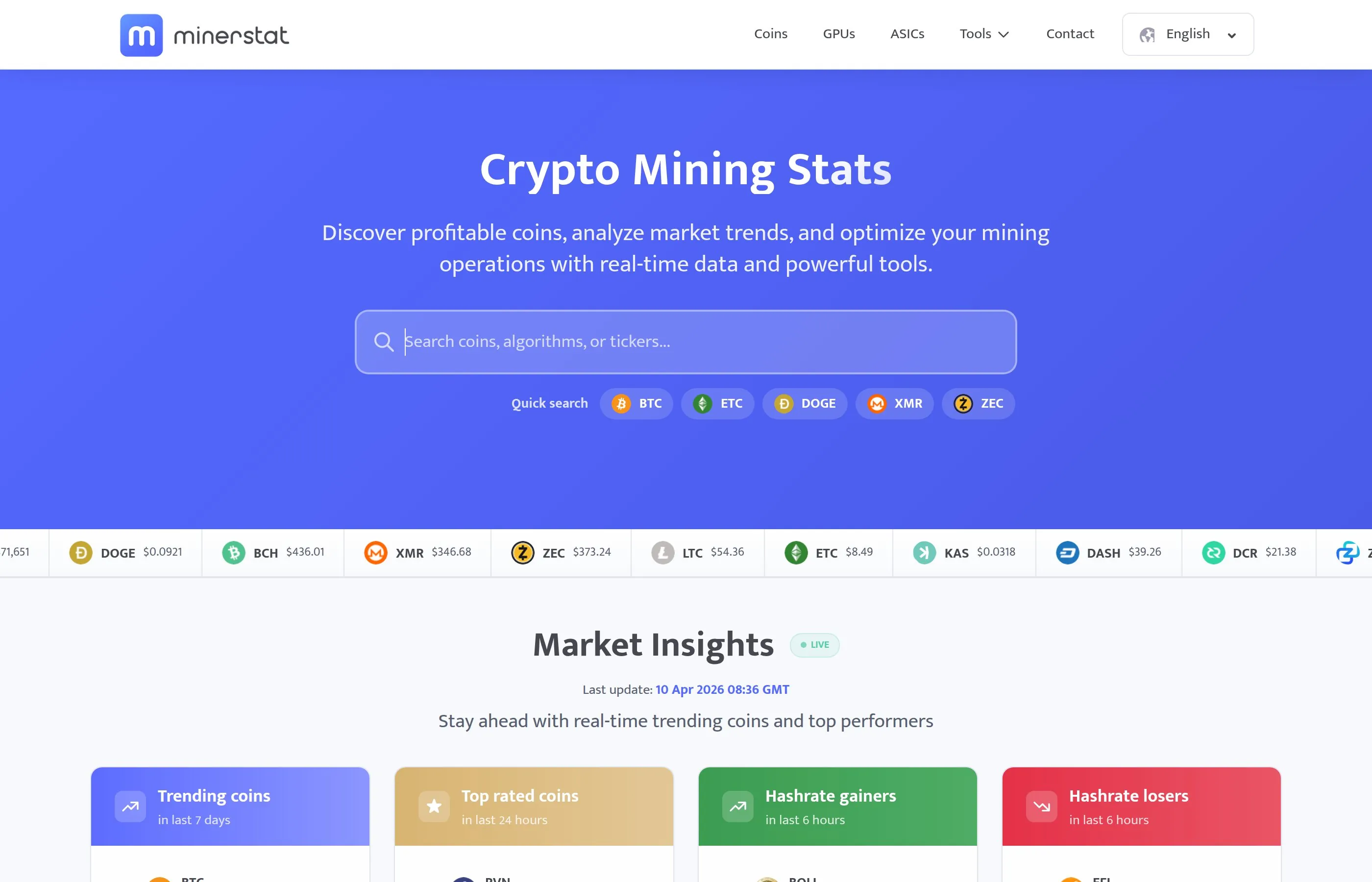
- WhatToMine - The industry standard. Input your GPU model or ASIC specs and electricity rate, and it compares profitability across dozens of coins simultaneously.
- MinerStat - Offers real-time profitability tracking, profit switching recommendations, and historical profitability charts.
- NiceHash Calculator - Useful for estimating earnings if you plan to sell your hashrate on the NiceHash marketplace rather than mining directly.
- CryptoCompare Mining Calculator - A simpler tool that works well for quick single-coin estimates.
For tracking coin prices and making selling decisions, TradingView is an essential tool. Setting up price alerts helps you time your reward conversions for maximum value.
Electricity Cost Breakpoints: When Mining Becomes Unprofitable
Electricity is the single largest ongoing expense in any mining operation. The table below shows the approximate electricity rate at which mining each coin becomes unprofitable (breakeven point) using standard hardware in Q2 2026.
| Coin | Hardware Type | Reference Hardware | Power Draw | Breakeven Electricity Rate |
|---|---|---|---|---|
| Bitcoin (BTC) | ASIC | Antminer S21 Pro | 3,500W | $0.12 - $0.15/kWh |
| Kaspa (KAS) | GPU | RTX 4070 Ti | 200W | $0.18 - $0.25/kWh |
| Alephium (ALPH) | GPU | RTX 4070 Ti | 200W | $0.14 - $0.20/kWh |
| Ravencoin (RVN) | GPU | RTX 4060 Ti | 165W | $0.10 - $0.16/kWh |
| Ergo (ERG) | GPU | RTX 3060 Ti | 130W | $0.12 - $0.18/kWh |
| Flux (FLUX) | GPU | RTX 3070 | 150W | $0.10 - $0.15/kWh |
| Ethereum Classic (ETC) | GPU | RTX 3060 Ti | 130W | $0.09 - $0.14/kWh |
| Conflux (CFX) | GPU | RTX 4060 | 150W | $0.08 - $0.13/kWh |
| Monero (XMR) | CPU | Ryzen 9 7950X | 170W | $0.06 - $0.10/kWh |
| Zcash (ZEC) | ASIC | Antminer Z15 Pro | 1,500W | $0.09 - $0.13/kWh |
Key takeaway: If you pay more than $0.10/kWh, several coins on this list become marginal or unprofitable. Miners in regions with cheap hydroelectric or solar power (parts of Canada, Scandinavia, or the US Pacific Northwest) have a structural advantage. If your electricity rate exceeds $0.15/kWh, focus exclusively on Kaspa or Alephium for GPU mining, or Bitcoin with the latest-generation ASICs.
ASIC vs GPU Mining: Complete Comparison
One of the biggest decisions new miners face is whether to invest in ASICs or GPUs. Each approach has distinct advantages and trade-offs. If you are learning how to mine cryptocurrency for the first time, this comparison will help you choose the right path.
| Factor | ASIC Mining | GPU Mining |
|---|---|---|
| Upfront cost | $2,000 - $8,000+ per unit | $300 - $800 per GPU |
| Performance per watt | Superior for supported algorithms | Good, but lower than ASIC equivalents |
| Algorithm flexibility | Single algorithm only | Can mine dozens of different coins |
| Resale value | Drops quickly as newer models launch | Retains value for gaming/AI workloads |
| Noise level | Very loud (70-80+ dB) | Moderate (manageable with good fans) |
| Heat output | Extreme (requires dedicated ventilation) | Moderate (can be managed with room AC) |
| Setup complexity | Plug and play (connect to pool and power) | More complex (build rig, configure OS, tune each card) |
| Lifespan | 2-4 years before obsolescence | 4-6+ years with proper maintenance |
| Best for | BTC, ZEC, and high-volume single-coin operations | KAS, ALPH, RVN, ERG, FLUX, ETC, CFX, and flexible miners |
| ROI timeline | 8-18 months typical | 10-24 months typical |
The verdict: ASICs are better for miners who want maximum hashrate on a single coin and have the infrastructure to handle noise and heat. GPUs are better for miners who want flexibility, lower entry costs, and the ability to switch coins as profitability shifts. Most home miners should start with GPUs.
Hardware Investment ROI Timeline
Understanding when your mining hardware pays for itself is critical for making smart investment decisions. Below are estimated ROI timelines for common setups at $0.08/kWh, based on Q2 2026 conditions.
GPU Mining Rigs
| Setup | Total Cost | Monthly Profit (est.) | ROI Timeline |
|---|---|---|---|
| Single RTX 4070 Ti (mining KAS) | $850 | $55 - $65 | 13 - 16 months |
| 6x RTX 4060 Ti rig (mining RVN) | $4,200 | $180 - $240 | 18 - 24 months |
| 6x RTX 4070 Ti rig (mining KAS) | $6,500 | $330 - $390 | 17 - 20 months |
| 8x RTX 3060 Ti rig (mining ERG) | $4,000 | $150 - $220 | 18 - 27 months |
ASIC Miners
| Setup | Total Cost | Monthly Profit (est.) | ROI Timeline |
|---|---|---|---|
| Antminer S21 Pro (BTC) | $6,500 | $420 - $600 | 11 - 16 months |
| WhatsMiner M60S (BTC) | $5,800 | $380 - $540 | 11 - 15 months |
| Antminer Z15 Pro (ZEC) | $4,200 | $150 - $210 | 20 - 28 months |
These timelines assume relatively stable coin prices and difficulty levels. In reality, a bull market can slash ROI time in half, while a prolonged bear market can double it. Always build in a buffer and avoid investing money you cannot afford to tie up for 12 to 24 months.
Best Mining Pools for Each Coin
Solo mining is impractical for most coins due to high network difficulty. Mining pools let you combine hashrate with other miners and receive proportional payouts. Here are the top pool recommendations for each coin on our list.
| Coin | Recommended Pools | Fee | Payout Method |
|---|---|---|---|
| Bitcoin (BTC) | Foundry USA, F2Pool, Braiins Pool | 0% - 2.5% | FPPS / PPS+ |
| Kaspa (KAS) | Kaspa Pool (official), acc-pool, HeroMiners | 0.5% - 1% | PPLNS |
| Alephium (ALPH) | HeroMiners, Woolypooly, MetaPool | 0.9% - 1% | PPLNS |
| Ravencoin (RVN) | 2Miners, Flypool, Ravenminer | 1% | PPLNS |
| Ergo (ERG) | HeroMiners, 2Miners, Woolypooly | 0.9% - 1% | PPLNS |
| Flux (FLUX) | MinerPool, 2Miners, Zpool | 1% | PPLNS |
| Ethereum Classic (ETC) | 2Miners, F2Pool, Nanopool | 1% | PPLNS / PPS |
| Conflux (CFX) | F2Pool, Woolypooly, BeePool | 1% - 2% | PPS+ |
| Monero (XMR) | P2Pool (decentralized), MoneroOcean, SupportXMR | 0% - 0.6% | PPLNS |
| Zcash (ZEC) | Flypool, 2Miners, F2Pool | 1% | PPLNS |
Pool selection tips: Choose a pool with servers geographically close to you for lower latency. Avoid pools that control more than 40% of a coin's total hashrate, as concentration threatens network decentralization. PPLNS (Pay Per Last N Shares) rewards consistent miners, while PPS (Pay Per Share) provides more predictable payouts but charges higher fees.
Storing Your Mining Rewards Safely
Once you start accumulating mining rewards, proper storage becomes essential. Leaving coins on exchange wallets or pool accounts exposes you to exchange hacks and custodial risk. We strongly recommend transferring rewards to a cold wallet once balances reach a meaningful threshold.
For miners who want to convert rewards to Bitcoin or stablecoins regularly, learning how to buy and sell Bitcoin through major exchanges will help you execute conversions efficiently with minimal fees.
Tax Implications of Cryptocurrency Mining
Mining income is taxable in most jurisdictions, and failing to report it properly can result in significant penalties. The tax treatment varies by country, but here are the general principles that apply in the United States and most Western nations. For a detailed walkthrough, see our crypto tax guide.
How Mining Income Is Taxed
- Income tax at receipt: When you receive mining rewards, their fair market value at the time of receipt is treated as ordinary income. This applies whether you mine as a hobby or a business.
- Capital gains on sale: When you later sell or trade mined coins, any gain or loss relative to the cost basis (the value at time of receipt) is treated as a capital gain or loss.
- Business deductions: If you mine as a business (not a hobby), you can deduct expenses including electricity, hardware depreciation, internet costs, rent for mining space, and pool fees.
- Self-employment tax: In the US, mining income reported as business income is also subject to self-employment tax (15.3% on net earnings).
Record-Keeping Best Practices
- Log every mining payout with date, amount, and fair market value at time of receipt
- Track all hardware purchases, electricity bills, and operational expenses
- Use crypto tax software (Koinly, CoinTracker, or TaxBit) to automate calculations
- Keep records for at least 7 years in case of audit
- Consider quarterly estimated tax payments if mining income is significant
Many miners overlook the deduction side of the equation. Hardware depreciation alone can offset a substantial portion of mining income. In the US, Section 179 allows you to deduct the full cost of mining equipment in the year of purchase rather than depreciating it over multiple years, which can significantly reduce your tax burden.
Pros and Cons of Cryptocurrency Mining in 2026
Pros
- Earn crypto without buying it: Mining lets you accumulate coins at a cost basis below market price when your operation is profitable.
- Passive income potential: Once configured, mining rigs run 24/7 with minimal intervention, generating ongoing revenue.
- Hardware retains value: GPUs can be resold to gamers or AI workload operators. Even aging ASIC hardware has a secondary market.
- Hedge against inflation: Mining Bitcoin or other fixed-supply coins acts as a productive inflation hedge, generating new coins while holding existing ones.
- Tax deduction opportunities: Business miners can deduct electricity, hardware, and operational costs against mining income.
- Network participation: Miners actively secure blockchain networks, contributing to decentralization and censorship resistance.
- Scalable operation: You can start with a single GPU and scale up gradually as you reinvest profits.
Cons
- High upfront investment: Competitive mining requires significant capital for hardware, power infrastructure, and cooling.
- Electricity costs eat margins: In regions with expensive power, mining can be unprofitable regardless of which coin you choose.
- Price volatility risk: A market crash can make your operation unprofitable overnight, and hardware value drops alongside coin prices.
- Increasing difficulty: Most networks see rising difficulty over time, which means the same hardware produces less coin each month.
- Noise and heat: Mining rigs generate substantial noise and heat, which limits where you can operate them.
- Hardware obsolescence: ASIC miners become unprofitable within 2-4 years as more efficient models launch. GPUs last longer but still face diminishing returns.
- Regulatory uncertainty: Some jurisdictions have imposed or are considering restrictions on energy-intensive mining operations.
- Technical knowledge required: Optimal mining requires ongoing tuning, monitoring, and troubleshooting that can be time-consuming for beginners.
How to Get Started: Step-by-Step Mining Setup
If you have decided to start mining, here is a condensed roadmap to get your operation running. Our full how to mine cryptocurrency guide covers each step in much greater detail.
- Choose your coin and hardware. Use the profitability rankings and calculator section above to identify the best coin for your situation. Factor in your electricity rate, budget, and available space.
- Purchase hardware. Buy from authorized resellers or reputable secondary market platforms. Avoid suspiciously cheap listings, as scams are common in the mining hardware market.
- Set up your mining environment. Ensure adequate power delivery (dedicated circuits, appropriate breakers), ventilation or cooling, and stable internet connectivity.
- Install mining software. For GPU mining, popular options include T-Rex, lolMiner, NBMiner, and TeamRedMiner (AMD). For ASIC miners, firmware comes pre-installed but can be upgraded with custom firmware like Braiins OS for better efficiency.
- Join a mining pool. Register with your chosen pool, configure your miner with the pool's stratum address, and set your wallet address as the payout destination.
- Monitor and optimize. Use tools like HiveOS, MinerStat, or Awesome Miner to monitor hashrate, temperatures, and power consumption remotely. Tune GPU memory clocks and core voltages for optimal efficiency.
- Secure your rewards. Set up a dedicated wallet for mining payouts. Transfer accumulated rewards to a hardware wallet periodically for long-term storage.
- Track everything for taxes. Log payouts, expenses, and hardware purchases from day one. Retroactively reconstructing records is far more painful than maintaining them as you go.
Advanced Strategies for Maximizing Mining Profit
Profit Switching
Profit switching means automatically changing which coin your GPU rigs mine based on real-time profitability. Services like NiceHash and mining software with built-in switching (such as Awesome Miner) can rotate between coins every few minutes to maximize daily revenue. This works best for GPU miners since one rig can mine any compatible algorithm.
Dual Mining
Some mining software supports dual mining, where your GPU mines two different coins simultaneously. For example, you can mine Ethereum Classic as the primary coin while also mining Alephium as a secondary coin, using GPU resources that would otherwise sit idle. Dual mining increases power consumption by 10-20% but can boost total revenue by 15-30%.
Overclocking and Undervolting
The biggest efficiency gains in GPU mining come from undervolting (reducing core voltage) while overclocking memory speeds. This combination reduces power consumption while maintaining or even increasing hashrate. Each GPU model has a sweet spot, and community resources like the r/gpumining subreddit maintain databases of optimal settings for popular cards and algorithms.
Off-Peak Electricity
If your utility offers time-of-use (TOU) rates, mining during off-peak hours (typically nights and weekends) at reduced rates can improve margins by 20-40%. Some miners run their rigs only during off-peak periods and shut down during expensive peak hours. Smart plug controllers and mining software scheduling features make this automation straightforward.
Solar and Renewable Integration
Pairing mining rigs with solar panels can dramatically reduce or eliminate electricity costs. A typical 6-GPU mining rig drawing 900W requires roughly 3.5 to 4 kW of solar capacity (accounting for panel efficiency and sunlight hours). While the upfront investment in solar is significant, the combined ROI of solar panels plus mining hardware can be attractive over a 3 to 5 year horizon.
Video Explainer
Watch this video for a visual walkthrough of the concepts covered above.

Best GPUs for Mining in 2026
As we look towards 2026, the landscape for GPU mining continues to evolve, with efficiency remaining a critical factor for profitability. While specific models rise and fall in popularity, the NVIDIA RTX 4070 is cited as a top mining GPU, demonstrating impressive performance metrics. This card is noted for delivering approximately 7 to 8 MH per second per watt when mining Kaspa, highlighting its strong efficiency in a competitive market.
The key to successful GPU mining isn't just raw power, but the delicate balance between hardware cost, operational efficiency, and electricity expenses. Miners must constantly evaluate the efficiency-to-cost ratio of their equipment to maximize returns. Profitability, however, is highly dynamic and depends significantly on current market conditions, the specific hardware in use, and the local electricity cost.
Daily profitability estimates for a single mining unit can vary widely, ranging from about $0.80 to $22 per unit, assuming an electricity cost of $0.08 per kWh. These figures underscore the importance of careful planning and continuous monitoring of both energy prices and cryptocurrency market fluctuations to maintain a profitable mining operation.
GPU vs ASIC vs CPU: Matching Coin to Hardware
The world of cryptocurrency mining is diverse, with different digital assets requiring specific types of hardware to be mined efficiently and effectively. Understanding which hardware is best suited for a particular coin is crucial for any miner looking to optimize their operations and maximize their potential returns. This specialization ensures that mining resources are allocated appropriately, aligning with the coin's underlying consensus mechanism and hashing algorithm.
For instance, Bitcoin, the pioneering cryptocurrency, cannot be mined with a GPU. Its SHA-256 algorithm demands specialized ASIC (Application-Specific Integrated Circuit) hardware, which is designed exclusively for this purpose. In contrast, many altcoins are designed to be more accessible to a broader range of miners, utilizing hardware like GPUs or even CPUs.
Kaspa, for example, has been a prominent coin for GPU miners, particularly noted for its profitability with the kHeavyHash algorithm. However, the mining landscape is ever-changing; ASICs have begun to enter the Kaspa network, leading to a decline in GPU profitability from its peak levels. For those new to GPU mining, Ethereum Classic (ETC) is often cited as a clean default GPU coin and a good beginner pick, while Ravencoin (RVN) with its KAWPOW algorithm also enjoys wide support on consumer GPUs. On the other hand, Monero (XMR) stands out as a CPU-mined coin, utilizing the RandomX algorithm, making it accessible to individuals with standard computer processors.
Frequently Asked Questions
Is cryptocurrency mining still profitable in 2026?
Yes, but profitability depends heavily on your electricity rate, hardware choice, and which coin you mine. Miners paying under $0.08/kWh with modern equipment can earn healthy returns on Bitcoin (ASIC), Kaspa, and Alephium (GPU). Those paying above $0.12/kWh will find fewer profitable options and should focus only on coins with the highest revenue-to-power ratios.
What is the most profitable coin to mine with a GPU in 2026?
Kaspa (KAS) is the most profitable GPU-mineable coin for most miners in Q2 2026, followed closely by Alephium (ALPH). Profitability shifts constantly, so use WhatToMine to check current numbers for your specific GPU model before committing to any single coin.
Can I mine Bitcoin with a GPU?
Technically yes, but practically no. Bitcoin's SHA-256 algorithm is dominated by ASIC miners that are millions of times more efficient per watt than GPUs. Mining BTC with a GPU would cost far more in electricity than the tiny fraction of Bitcoin you would earn. If you want to mine with GPUs, focus on coins like Kaspa, Alephium, or Ravencoin instead.
How much does it cost to start mining cryptocurrency?
You can start CPU mining Monero for essentially zero additional cost if you already own a modern computer. A single-GPU mining setup costs $500 to $1,000 including the GPU and basic components. A dedicated 6-GPU mining rig costs $3,500 to $7,000 depending on the cards chosen. ASIC mining starts at $2,000 for entry-level machines and goes up to $8,000+ for top-tier Bitcoin miners.
How long does it take to break even on mining hardware?
Typical breakeven timelines range from 10 to 24 months depending on hardware type, coin mined, electricity cost, and market conditions. GPU rigs generally take 12 to 20 months, while ASIC miners can break even in 8 to 16 months during favorable market conditions. Bear markets can extend these timelines significantly.
Is it better to mine or buy cryptocurrency?
Mining is better if you have access to cheap electricity (under $0.08/kWh), enjoy the technical aspects, and want to accumulate coins at below-market cost. Buying is better if electricity is expensive in your area, you want immediate exposure without hardware setup, or you prefer a simpler approach. Many experienced crypto participants do both. If buying appeals to you more, check out our guide on how to buy Bitcoin.
What happens when a coin I am mining gets delisted or loses value?
This is a real risk, especially with smaller-cap coins. Mitigation strategies include mining only coins with strong liquidity (listed on multiple major exchanges), converting mining rewards to BTC or stablecoins regularly, and diversifying across multiple coins using profit-switching software. GPU miners have an advantage here since they can pivot to a different coin immediately.
Do I need to run my mining rig 24/7?
You do not need to, but profitability is directly proportional to uptime. Running 24/7 maximizes returns. If electricity costs vary by time of day, running only during off-peak hours can improve margins. Mining software can be scheduled to start and stop automatically based on electricity rate windows.
Is mining bad for the environment?
Mining consumes significant electricity, and the environmental impact depends entirely on the energy source. Mining powered by hydroelectric, solar, or wind energy has a minimal carbon footprint. Mining powered by coal or natural gas does have environmental consequences. The industry is increasingly shifting toward renewable energy sources, partly driven by economics (cheap renewables improve mining margins) and partly by regulatory and social pressure.
Can I mine cryptocurrency on my laptop?
You can mine Monero (XMR) on a laptop using the CPU, but we strongly advise against it. Laptops have limited cooling capacity, and sustained mining workloads will throttle performance, degrade the battery, and potentially shorten the laptop's lifespan. If you want to experiment, use a desktop PC with proper cooling instead.
What is the difference between solo mining and pool mining?
Solo mining means your hardware competes independently to find blocks. If you find a block, you get the entire reward. However, with today's network difficulties, a single GPU or even a single ASIC might wait months or years between block finds. Pool mining combines your hashrate with thousands of other miners, and rewards are distributed proportionally based on your contributed work. Pool mining provides steady, predictable income and is recommended for virtually all miners.
How do I reduce noise from my mining rig?
For GPU rigs, replace stock coolers with aftermarket solutions, use fan speed curves that balance noise and temperature, and place rigs in a garage, basement, or dedicated room with sound insulation. For ASIC miners, immersion cooling (submerging the machine in dielectric fluid) eliminates fan noise entirely but requires significant additional investment. Alternatively, enclosures with sound-dampening panels can reduce noise by 15-25 dB.
Should I mine and hold or mine and sell immediately?
This depends on your financial situation and market outlook. Mining and holding works well if you believe the coin's price will appreciate and you can cover electricity costs from other income. Mining and selling immediately locks in profits and reduces exposure to price drops. A hybrid approach, selling enough to cover electricity and operational costs while holding the rest, is the most common strategy among profitable miners.
Final Thoughts
Cryptocurrency mining in 2026 is more competitive than ever, but the opportunities for profit are real for miners who do their homework. The combination of rising coin prices, improving hardware efficiency, and expanding GPU mining options means there has never been a wider selection of viable mining targets.
Start by calculating your electricity costs and realistic profitability using the methods outlined above. Choose a coin that matches your hardware and budget. Join a reputable pool, secure your rewards properly, and track everything for tax purposes. If you are ready to go deeper, our complete cryptocurrency mining tutorial walks through every step of the hardware and software setup process.
Mining is not a get-rich-quick scheme. It is a capital-intensive operation that rewards patience, technical knowledge, and access to affordable electricity. But for those willing to put in the work, it remains one of the most direct and productive ways to participate in the cryptocurrency economy.