What Is Hashrate in Crypto? Mining Power Explained
— By Tony Rabbit in Tutorials

What is hashrate in crypto? Learn Bitcoin mining power: the unit ladder, ASIC vs GPU, mining pools, profitability, and why it secures the network (2026).
If you have ever watched the Bitcoin network process billions of dollars in transactions every single day without a central authority, you have witnessed the result of hashrate at work. Hashrate is the raw computational firepower that secures Bitcoin and most other proof-of-work cryptocurrencies, and it has become the single most important security metric in the entire industry. When traders, miners, regulators, and analysts want to know how healthy the Bitcoin network is, the first number they check is the global hashrate.
In simple terms, hashrate measures how many cryptographic guesses the network performs every second to find the next valid block. Each guess is called a hash, and modern Bitcoin mining farms collectively produce hundreds of quintillions of these guesses every second. This number is so large it requires its own scientific notation, and in 2026 it has pushed beyond EH/s levels that would have seemed impossible just a few years ago.
In this complete guide, you will learn what hashrate actually means, how it is measured along the H/s to ZH/s unit ladder, why it powers Bitcoin mining through nonce search and difficulty adjustment, how it ties directly to network security and 51% attack costs, how ASICs replaced GPUs and CPUs, which mining pools dominate the landscape, and how hashrate behaves as a market indicator during halvings and miner capitulation events. By the end, you will read hashrate charts the way professional analysts and miners read them.
What Is Hashrate in Crypto?
Hashrate, sometimes written as hash rate, is the speed at which a computer or network performs cryptographic hash operations. In the context of Bitcoin and other proof-of-work coins, a hash is the output of running a piece of data through the SHA-256 hashing algorithm. Miners take a candidate block, attach a random number called a nonce, run the whole thing through SHA-256 twice, and check whether the result is below the network's current target. If it is not, they change the nonce and try again. Each one of those attempts is a hash, and the rate at which a machine performs them is its hashrate.
The unit is straightforward: hashes per second, abbreviated H/s. A laptop CPU might produce a few million hashes per second when mining Bitcoin, which is laughably small for today's network. A high-end ASIC produces over 200 trillion hashes per second. The Bitcoin network as a whole, summing every miner on the planet, regularly exceeds 700 exahashes per second in 2026, which is 700,000,000,000,000,000,000 attempts every single second. That is roughly 90 billion guesses for every human being on Earth, every second of every day.
Hashrate is simultaneously a measurement of computational work, a proxy for energy consumption, and a security metric. The higher the hashrate, the more electricity and hardware an attacker would need to overpower the honest network. This is why hashrate growth is often called the heartbeat of Bitcoin. When it rises, the network becomes more secure and more expensive to attack. When it falls, miners are unplugging machines, usually because the price of bitcoin has dropped below their breakeven cost.
It is important to understand that hashrate is not a count of physical machines or chips. It is a measurement of effective work done. Two miners with very different hardware can produce the same hashrate, but one might use far more electricity than the other. That is why efficiency, measured in joules per terahash (J/TH), is the second number every serious miner watches alongside raw hashrate.
The Hashrate Unit Ladder
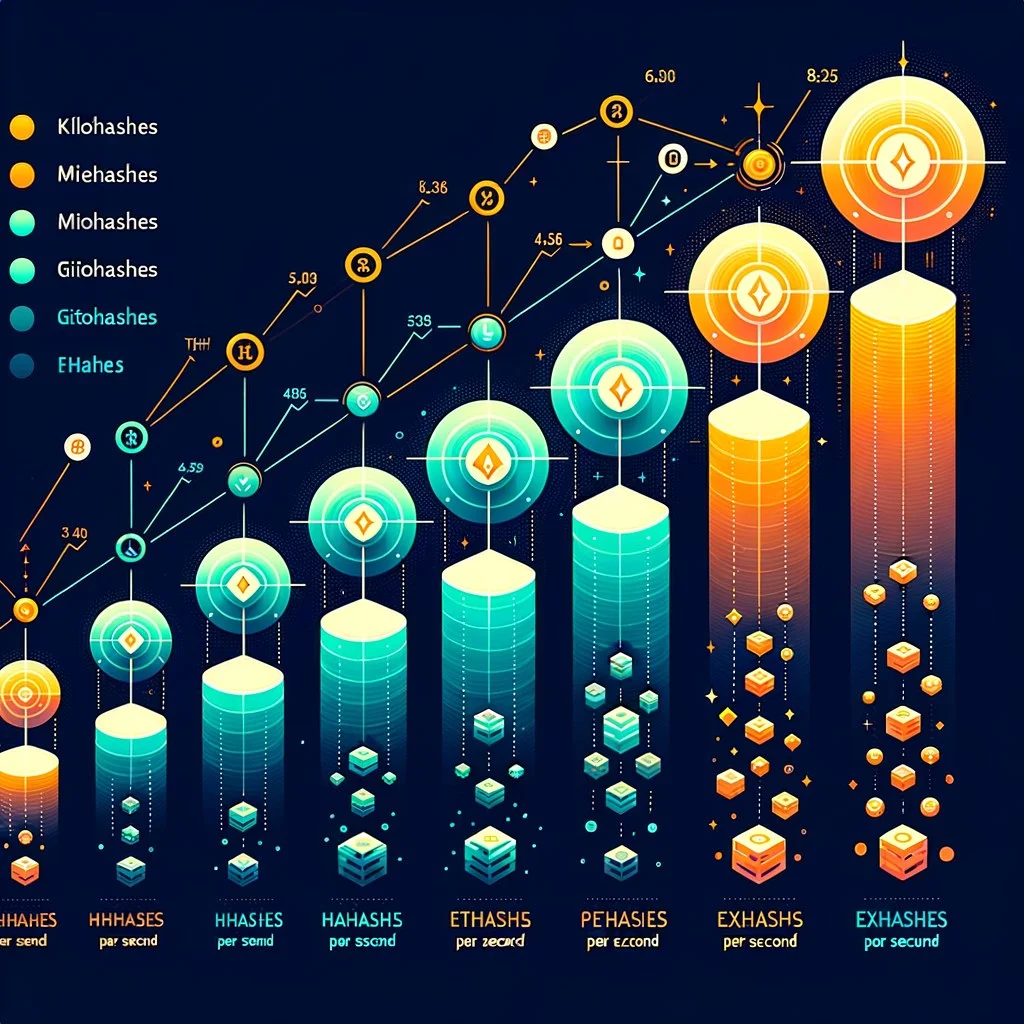
Because hashrate values span more than 20 orders of magnitude, the industry uses metric prefixes to keep the numbers readable. A single home computer mines in the megahash range. A serious ASIC mines in terahashes. The entire Bitcoin network operates in the exahash range. The ladder below shows each step, with examples of what kind of device or network typically operates at that level.
To put the scale in perspective: when Bitcoin launched in January 2009, the entire network hashrate was around 7 MH/s. Today, a single Antminer S21 Pro outpaces that early network by a factor of over 30 million. The growth from megahashes to exahashes in 17 years is one of the most dramatic increases in computational deployment in human history, comparable only to the rise of cloud computing.
How Hashrate Powers Bitcoin Mining
To understand why hashrate matters, you need to understand what a miner is actually doing. The Bitcoin protocol is in many ways a giant lottery in which the prize is a block reward and the only way to buy tickets is by burning electricity. Each ticket is a hash attempt, and the more hashes per second you produce, the more tickets you hold in any given 10-minute window.
A miner assembles a candidate block containing pending transactions, the previous block's hash, a timestamp, and a nonce. The miner then runs this block header through SHA-256 twice (Bitcoin uses double SHA-256). The output is a 256-bit number. To win the right to add this block to the chain, that output must be less than or equal to a specific target value set by the network. If the hash is too large, the miner increments the nonce and tries again. This is the entire job of a miner. Try a nonce, hash, check, fail, repeat, billions of times per second.
The current target in Bitcoin is so strict that only about 1 in every ~10^23 hashes succeeds. That is why the network needs to perform hundreds of quintillions of hashes per second to find one block every ten minutes on average. If you mine alone with a single Antminer producing 200 TH/s, your chance of finding a block in any given 10-minute window is roughly 200,000,000,000,000 divided by 800,000,000,000,000,000,000, or about 1 in 4 million. You would on average wait around 76 years to find a single block. That is why miners join pools.
Hashrate is therefore a direct measure of how many lottery tickets you hold per second. Double your hashrate, double your expected revenue. Triple the network hashrate without increasing your own, and your share of the rewards drops by two-thirds. This zero-sum dynamic is a fundamental feature of proof-of-work consensus.
Importantly, no shortcut exists. SHA-256 is designed to be a one-way function with no exploitable structure. You cannot calculate a winning nonce; you can only guess and check. This brute-force property is what gives Bitcoin its security, because finding a valid hash requires real-world energy expenditure that cannot be faked or shortcut.
Difficulty Adjustment: How the Network Self-Regulates
If hashrate keeps growing, why does Bitcoin still produce a block every ten minutes? The answer is the difficulty adjustment, one of Satoshi Nakamoto's most elegant inventions. Every 2,016 blocks, which is approximately every two weeks, the network automatically retargets the difficulty to keep block times near the 10-minute average.
The logic is simple. The network looks at how long the last 2,016 blocks took. If the total time was less than 20,160 minutes (14 days), it means hashrate has risen and blocks are coming too fast, so difficulty increases. If the total time was more than 14 days, hashrate has fallen and the target relaxes, making it easier to find a block. The adjustment is capped at a 4x increase or 0.25x decrease per period to prevent extreme jumps.
This feedback loop is what makes Bitcoin self-regulating. Whether the global hashrate is 5 MH/s in 2009 or 800 EH/s in 2026, blocks still arrive every ten minutes on average. Miners who turn machines on or off do not change the supply schedule; they only change how the rewards are distributed.
The difficulty adjustment is also why the Bitcoin issuance schedule is so predictable. New supply is locked to time, not to hashrate. This is one of the properties that makes Bitcoin different from gold, where rising prices can trigger new mining and increased supply. With Bitcoin, no amount of hashrate growth speeds up issuance, because difficulty rises in lockstep.
Why Hashrate Matters for Security
Hashrate is not just a mining metric. It is the cornerstone of Bitcoin's security model. The fundamental security promise of a blockchain like Bitcoin is that the longest valid chain wins. To rewrite history, an attacker must produce a chain longer than the honest network's chain. That requires controlling more than half of all hashrate, which is why this kind of attack is called a 51% attack.
With Bitcoin's hashrate sitting at 700 EH/s in 2026, an attacker would need to acquire and run hardware capable of producing roughly 350 EH/s, plus the electricity to power it. At current efficiencies of around 15 J/TH for the latest ASICs, that is approximately 5.25 gigawatts of continuous electrical draw, the output of about five large nuclear reactors. Acquiring the chips alone, assuming you could buy them all, would cost tens of billions of dollars, and that ignores logistics, real estate, cooling, and the political impossibility of moving that much hardware without being noticed.
Lower-hashrate proof-of-work chains do not have this luxury. Chains like Bitcoin Gold, Ethereum Classic, and Vertcoin have all been successfully 51% attacked because their hashrate is low enough that an attacker can rent the needed compute on services like NiceHash for a few thousand dollars an hour. The takeaway is simple: hashrate is the price tag on attacking a network. The bigger the number, the higher the price.
This is also why hashrate growth makes long-term holders more confident. A network that is more expensive to attack today than it was last year is, by definition, more secure today than it was last year. Bitcoin's hashrate has trended upward almost monotonically since 2009, with only brief dips during major price crashes and the 2021 China mining ban.

ASIC vs GPU vs CPU Mining
Not all hashing hardware is created equal. The history of Bitcoin mining is the history of specialized hardware crushing general-purpose hardware. The Bitcoin whitepaper imagined one CPU, one vote, but in practice, the SHA-256 algorithm turned out to be exceptionally well suited to custom silicon. Within a few years, CPUs were obsolete, then GPUs, then FPGAs, and finally ASICs took over completely.
The reason ASICs dominate is purely physics and economics. An ASIC chip is laid out in silicon to do exactly one thing: SHA-256. Every transistor on the die is dedicated to that operation. A general-purpose CPU spends most of its area on cache, branch prediction, instruction decoding, and other circuitry irrelevant to hashing. A GPU does better than a CPU because it has thousands of parallel arithmetic units, but it still wastes power on graphics-specific hardware. For an algorithm like SHA-256 that lends itself to repeated parallel hashing, dedicated silicon wins by factors of thousands to one.
Some cryptocurrencies deliberately use ASIC-resistant algorithms to keep mining accessible to hobbyists. Monero's RandomX, for example, is designed to favor general-purpose CPUs. The previous Ethereum proof-of-work algorithm, Ethash, was designed to favor GPUs and made manufacturing ASICs uneconomical for years. Bitcoin's SHA-256, by contrast, has always embraced ASIC specialization as a feature rather than a bug.
Top Mining Hardware in 2026
The current generation of Bitcoin ASICs is dominated by a handful of manufacturers, mostly headquartered in or near China. Bitmain, MicroBT, and Canaan together produce the overwhelming majority of all SHA-256 mining hardware in operation today. The two flagship machines of the 2025-2026 generation are the Bitmain Antminer S21 series and the MicroBT Whatsminer M60 series.
The Antminer S21 Pro produces around 234 TH/s at roughly 15 J/TH, consuming about 3,510 watts. That is more than 30 times the entire Bitcoin network hashrate at launch in 2009, packed into a single 1U-style box that fits on a rack shelf. The Antminer S21 Hyd uses water cooling instead of air to push higher densities, reaching above 350 TH/s with a slightly worse joule-per-terahash figure. Hydro miners shed heat better and are popular in immersion cooling deployments.
The Whatsminer M60S series from MicroBT competes directly with the S21 Pro, offering around 226 TH/s at similar efficiencies. MicroBT machines are often praised for build quality and stability, while Bitmain machines are often easier to source in volume and have wider firmware support. The choice between them usually comes down to procurement relationships, warranty terms, and electricity contracts rather than performance differences.
Efficiency, not raw hashrate, is the metric that decides whether a miner survives the next halving. A 200 TH/s machine that draws 4,000 watts produces 20 J/TH and costs roughly twice as much per hash to run as a 200 TH/s machine that draws 2,000 watts at 10 J/TH. After the 2024 halving cut the block reward to 3.125 BTC, older inefficient hardware became uneconomical at most electricity prices, accelerating the upgrade cycle to newer-generation ASICs.
Mining Pools and Hashrate Concentration
Because the probability of finding a block alone is so low, virtually every miner today joins a mining pool. A pool aggregates hashrate from thousands of participants and pays them in proportion to the shares of work they submit. Pools smooth out the lumpy nature of mining rewards and let small operators receive steady income.
Pools are also the primary source of hashrate concentration concerns. While the actual hashing happens on machines scattered around the world, the decision of which transactions to include in blocks is made at the pool level. If a small group of pools controls a majority of hashrate, they could in principle censor transactions or coordinate other behaviors. This is why pool distribution charts are watched almost as closely as the total hashrate itself.
An emerging trend in 2026 is the rise of decentralized mining pools. Stratum V2 is a new mining protocol that lets individual miners choose the transactions they want to include rather than delegating that choice to the pool operator. Pools like Demand and Ocean already operate on these principles, addressing the censorship-resistance concerns raised by pool concentration without forcing miners to abandon pooled payouts.
Global Hashrate Distribution and Geopolitics
Where hashrate lives geographically is one of the most consequential questions in crypto mining. Before May 2021, China hosted more than 65% of global Bitcoin hashrate, with miners scattered across hydroelectric Sichuan and coal-powered Xinjiang. The Chinese government's blanket ban in 2021 forced an unprecedented migration, with miners packing up containers of ASICs and shipping them worldwide.
The United States absorbed the largest share of displaced hashrate and has since become the dominant mining jurisdiction. As of 2026, the US hosts roughly 35-40% of global Bitcoin hashrate, with Texas, Georgia, New York, and Kentucky leading in capacity. Cheap stranded power, friendly regulators in many states, and access to capital markets through publicly traded miners like Marathon, Riot, and CleanSpark have all contributed.
Kazakhstan briefly surged to second place but lost share after grid instability and stricter taxes. Russia has become a major destination thanks to abundant gas, particularly in Siberia where flared associated gas is captured for mining. Other significant jurisdictions include Canada, Paraguay, Oman, Ethiopia, and Bhutan, all attracting miners with cheap hydro, geothermal, or stranded fossil resources.
This geographic diversification is itself a security benefit. A globally distributed hashrate is harder to ban, harder to coerce, and harder to coordinate maliciously than one concentrated in a single political jurisdiction. The 2021 China ban, painful in the short term, ultimately made Bitcoin's hashrate more decentralized than at any point since 2013.
Hashrate as a Bullish or Bearish Indicator
Traders and analysts watch hashrate not just as a security metric but as a market signal. The general logic is straightforward. Miners cannot fake hashrate. To produce hashes you must spend real money on hardware and electricity. So changes in hashrate reflect changes in miners' beliefs about future profitability. Rising hashrate means miners are voting with their wallets in favor of higher prices ahead. Falling hashrate means miners are surrendering.
Miner capitulation events occur when bitcoin's price drops below the breakeven cost of meaningful chunks of the global fleet. Older, less efficient machines get unplugged first, and the network hashrate declines noticeably. Historically, these capitulation lows have coincided with cycle bottoms in price, because by the time inefficient miners are forced to capitulate, weak hands have already sold and accumulation tends to dominate. The 2018 bear market, the 2020 March crash, and the 2022 LUNA-FTX double crash all featured prominent hashrate drawdowns followed by price recoveries.
Post-halving periods show the same pattern in reverse. The 2024 halving cut block subsidies from 6.25 BTC to 3.125 BTC, instantly halving every miner's revenue per terahash. The least efficient machines were unplugged within weeks, the network hashrate dropped briefly, and difficulty adjusted downward, restoring some margin for the survivors. Within months, hashrate had recovered and exceeded prior highs as cheaper, more efficient hardware came online. The cycle repeats every four years.
The hashrate ribbon is a popular technical indicator combining a fast and slow moving average of hashrate. When the fast crosses above the slow after a deep drawdown, it has historically marked excellent long-term buying opportunities for bitcoin. It is not infallible, and reasonable people disagree about its predictive power, but it remains one of the few on-chain metrics that survives every market regime.
Hashprice and Mining Profitability
If hashrate is how much work the network does, hashprice is how much that work earns. Hashprice is usually quoted in dollars per terahash per day, and it tells you how much daily revenue a 1 TH/s machine generates given current price, fees, and difficulty. In 2026, with Bitcoin trading in a broad range above $80,000 and post-2024-halving block subsidies, hashprice has fluctuated between roughly $0.05 and $0.10 per TH/s per day.
A modern Antminer S21 Pro at 234 TH/s would therefore earn between $12 and $23 per day in gross revenue. At an electricity cost of $0.05 per kWh, the same machine drawing 3.5 kW consumes about $4.20 worth of power per day. Net margin is healthy at the top end of hashprice and uncomfortable at the bottom. Older S19 series machines drawing more watts per terahash struggle at the bottom end of the range and become unprofitable below it.
Hashprice is mechanically coupled to three variables: the price of bitcoin, the network difficulty, and the transaction fee market. When bitcoin price rises, hashprice rises proportionally. When difficulty rises faster than price, hashprice falls. Transaction fees usually contribute a small share of mining revenue but can spike during congestion events, briefly boosting hashprice. After the next halving, base subsidy revenue will halve again, and fee revenue is expected to become a much larger share of total miner income.
Public miners report hashprice and J/TH efficiency as core operating metrics in their quarterly filings. Traders watching mining stocks often check these numbers alongside price. A miner with low J/TH at scale can survive hashprice compression that wipes out less efficient competitors. This is why the market values hashrate growth at the firm level only when it comes with corresponding efficiency improvements.
Hashrate of Other Networks
Bitcoin dominates global SHA-256 hashrate, but other proof-of-work networks have meaningful hashrate of their own, denominated in their own algorithms. Bitcoin Cash and Bitcoin SV use the same SHA-256, which means their security is essentially a leftover sliver of the Bitcoin miner ecosystem. Their hashrate combined sits below 5% of Bitcoin's, making them theoretically vulnerable to a Bitcoin miner deciding to spend a few hours attacking them.
Litecoin uses Scrypt and is merge-mined with Dogecoin, which means the same hashing work secures both chains. Combined Scrypt hashrate has grown into the petahash range, with dedicated Scrypt ASICs dominating just as SHA-256 ASICs dominate Bitcoin. Merge mining has been transformative for Dogecoin's security since 2014, since it lets DOGE inherit Litecoin's hashrate without incentivizing duplicate energy expenditure.
Ethereum Classic remained on proof-of-work after Ethereum's 2022 merge to proof-of-stake and now uses the Etchash algorithm. Its hashrate is measured in terahashes per second and is composed largely of GPU farms that did not switch to other coins after the merge. ETC remains a target for occasional 51% attacks because of its relatively modest hashrate. Monero uses RandomX and is intentionally ASIC-resistant, keeping the network friendly to CPU miners. Its hashrate is much smaller in absolute terms but represents a more decentralized hardware base.
The diversity of hashrate denominations matters. You cannot compare 800 EH/s of SHA-256 with 1 TH/s of RandomX, because the algorithms perform different work and the underlying hardware is incomparable. The right comparison is dollars-of-cost-to-attack, not hashes-per-second.

The Future of Hashrate
Hashrate has grown roughly five orders of magnitude in the last decade, and the trend is not slowing. Three forces shape what comes next: ASIC efficiency improvements, the energy mix powering miners, and the long-tail risk of quantum computing.
On the efficiency side, the move from 5 nanometer to 3 nanometer process nodes and eventually to 2 nm and below is steadily pushing J/TH downward. The S21 generation operates around 15 J/TH. Next-generation machines from Bitmain, MicroBT, and Canaan are targeting under 10 J/TH, which would double miner economics overnight at the same electricity price. Beyond that, physics imposes hard limits, but we are still well above the Landauer limit for irreversible computation, so there is room to run for at least another decade.
On the energy side, miners have become opportunistic buyers of the worst, cheapest, most stranded electrons on the planet. Flared gas in the Permian, curtailed hydro in Paraguay, geothermal in Iceland, and overbuilt wind in Texas all power large fleets today. Studies from the Bitcoin Mining Council and independent researchers consistently estimate that more than half of Bitcoin's energy mix in 2026 is from non-fossil sources, a share that continues to grow because economics, not politics, push miners toward the lowest marginal-cost generation, which is increasingly renewable plus stranded gas.
On the quantum side, a sufficiently powerful quantum computer running Grover's algorithm could theoretically square-root the work needed to find a SHA-256 preimage, halving the effective security margin against pre-image attacks. In practical terms, this means a network with 700 EH/s of classical hashrate would offer security roughly equivalent to a much smaller classical network in a quantum world. However, the gap between today's noisy intermediate-scale quantum machines and a cryptographically relevant quantum computer remains massive. Most cryptographers expect Bitcoin will migrate to post-quantum signature schemes long before quantum hashing attacks become practical, but the topic is actively debated.
One thing is clear: as long as proof-of-work secures Bitcoin and similar networks, hashrate will remain the most important number in crypto security. Watch it the way equity investors watch the S&P, the way commodity traders watch oil inventories, and the way central banks watch CPI. It tells you the cost of attacking the network, the conviction of miners, and the underlying health of the system.
Frequently Asked Questions
What is a good hashrate for mining Bitcoin?
For solo mining Bitcoin in 2026, there is no realistic "good" hashrate at the household level. Even 1 PH/s of personal hashrate gives you only a tiny fraction of the network and weeks or months between expected blocks. Most home miners join a pool with a single 200-300 TH/s ASIC like an Antminer S21 Pro or Whatsminer M60S and earn proportional pool payouts. For a profitable individual mining operation, the focus should be on electricity price below $0.05 per kWh and modern hardware below 18 J/TH rather than chasing a specific hashrate target.
How is hashrate measured?
Hashrate is measured in hashes per second, abbreviated H/s. Larger amounts use metric prefixes: KH/s (thousand), MH/s (million), GH/s (billion), TH/s (trillion), PH/s (quadrillion), EH/s (quintillion), and ZH/s (sextillion). The Bitcoin network's total hashrate cannot be measured directly. It is estimated from block production rate and current difficulty using statistical formulas. Sites like mempool.space, Hashrate Index, and CoinWarz publish ongoing estimates.
What is the difference between hashrate and difficulty?
Hashrate is the amount of computational work miners actually perform per second. Difficulty is a target value set by the protocol that determines how hard it is to find a valid block. The two are mathematically linked: higher hashrate causes blocks to come faster, which triggers difficulty to rise at the next 2,016-block retarget, which brings block times back to ten minutes. Hashrate measures effort; difficulty calibrates the lottery so that effort produces blocks on schedule.
Can hashrate ever drop to zero?
In theory yes, in practice extraordinarily unlikely for Bitcoin. If hashrate dropped to zero, blocks would simply stop being found. The chain would freeze until either some miner came back online or the difficulty adjusted downward enough for any remaining hashrate to start producing blocks again. The system is self-healing: any miner who plugs in even one machine into a frozen network would eventually find a block, regardless of how small their hashrate, once difficulty retargets to the lower level. For smaller proof-of-work chains, very low hashrate periods are a real risk that have happened before.
What is the current Bitcoin hashrate in 2026?
As of mid-2026, Bitcoin's network hashrate fluctuates around 700-800 EH/s on a 7-day moving average, with daily readings occasionally spiking above 900 EH/s during periods of strong miner expansion. That is more than five times the level at the previous 2024 halving and roughly 100,000 times the level a decade ago. The number changes constantly; check mempool.space or Hashrate Index for live figures.
Why does hashrate go up after every halving instead of down?
In the short term, hashrate often drops after a halving as the least efficient miners are squeezed out. But over the following months, several forces push hashrate back to new highs. Difficulty adjusts downward, improving margins for survivors. The bitcoin price historically rises in the year after each halving, restoring profitability. New, more efficient hardware comes online to capture the surviving margin. The net effect across every halving so far has been a brief dip followed by a sustained rally to new all-time highs in hashrate.
Can I mine Bitcoin with my home computer?
Technically yes, practically no. A modern CPU produces tens of megahashes per second of SHA-256, which is about one quadrillionth of the network. Your expected revenue from mining Bitcoin on a household PC is essentially zero, and you would spend more on electricity than you ever earn. If you want to mine at home, the realistic options are either buying a single ASIC (the noise and heat are significant) or mining a different algorithm like Monero's RandomX that is friendly to CPU mining.
Conclusion
Hashrate is the most important security and health metric in proof-of-work cryptocurrency. It measures the raw cryptographic work performed by miners every second, scaling from a handful of hashes on a calculator to nearly one quintillion hashes per second across the entire Bitcoin network in 2026. It determines how expensive a 51% attack would be, how miners share rewards, how quickly difficulty must adjust, and how confidently long-term holders can rely on Bitcoin's settlement guarantees.
Understanding hashrate gives you a lens on the entire mining industry. It tells you when miners are surrendering versus expanding, which jurisdictions and hardware vendors are gaining or losing share, and how secure each network is relative to its market cap. Traders use it to spot capitulation lows. Security researchers use it to estimate attack costs. Miners use it to plan capacity. Regulators increasingly use it to study energy markets and grid stability.
The story of Bitcoin so far has been a one-way climb from 7 MH/s in 2009 to more than 700 EH/s today, driven by ASIC innovation, halving cycles, geographic migration, and an ever-larger pool of capital betting on the network's future. Whether the next decade brings ZH/s networks, post-quantum signature upgrades, or surprises nobody has yet imagined, hashrate will remain the number to watch. It is the heartbeat of Bitcoin, and it is unlikely to slow down any time soon.