What Is a Block Reward: Complete Bitcoin Mining Reward Guide (2026)
— By Tony Rabbit in Tutorials
What is a block reward? Complete guide to Bitcoin mining rewards: coinbase transactions, halvings, fee evolution, mining economics and reward schedules across chains (2026).
Every ten minutes, somewhere in the world, a Bitcoin miner solves a cryptographic puzzle and is rewarded with newly minted coins plus a bundle of transaction fees. That payment is called the block reward, and it is the single most important economic mechanism in Bitcoin. Without it, the network has no incentive structure, no security budget, and ultimately no functioning monetary system. The block reward is what convinces miners around the planet to spend billions of dollars on specialized hardware and electricity to keep Bitcoin secure.
The block reward is far more than a payment. It is the monetary policy of Bitcoin written directly into code. Every aspect of how new bitcoins enter circulation, when they enter, who receives them, and when the issuance stops is dictated by the protocol's rules around the block reward. This is what makes Bitcoin a predictable, auditable, and decentralized monetary system. Compare that with central banks that decide on monetary expansion behind closed doors, and you start to understand why people care so much about this seemingly technical concept.
In this complete guide, you will learn exactly what a block reward is, how the coinbase transaction creates new bitcoin out of nothing according to protocol rules, how the halving schedule shrinks the issuance every four years, what miners actually earn in 2026, how transaction fees are taking over as the dominant share of miner revenue, and what the post-2140 era looks like when the last satoshi has been mined. Whether you are a miner trying to forecast profitability, an investor trying to understand Bitcoin's supply mechanics, or simply someone curious about how this system really works, this guide will give you the full picture.
What Is a Block Reward?
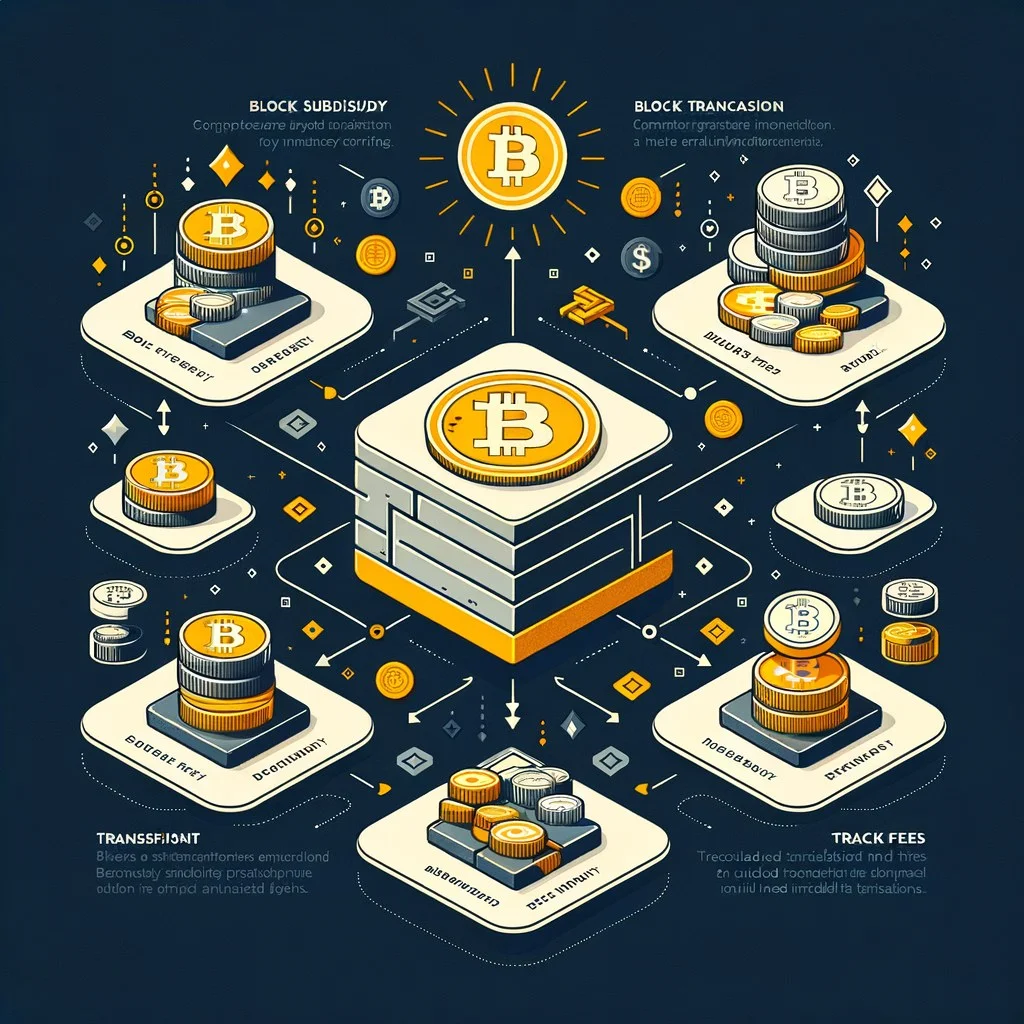
A block reward is the total amount of cryptocurrency a miner receives for successfully adding a new block to the blockchain. In Bitcoin, the block reward has two distinct components: the block subsidy, which is newly created bitcoin minted by the protocol, and the sum of all transaction fees paid by users whose transactions were included in that block. Both parts are sent to the miner in a single, special transaction at the very top of the block called the coinbase transaction.
The block reward serves three critical purposes simultaneously. First, it pays for the security of the network. Crypto mining is expensive, and without rewards there would be no economic reason for anyone to spend resources securing the chain. Second, it is the mechanism by which new bitcoin enters circulation. Every bitcoin that exists today was originally created as part of a block reward at some point in the past. Third, it acts as a distributed lottery that determines who gets to extend the chain next, anchoring Bitcoin's proof-of-work consensus mechanism.
It is important to understand that the block reward is not paid by any single party. The subsidy portion is created out of thin air according to protocol rules, much like a central bank prints money, except the schedule is fixed and immutable. The fee portion comes from the users of the network who voluntarily attach fees to their transactions to incentivize miners to include them. Together, these two streams of value form the entire revenue base of the Bitcoin mining industry.
The Two Components: Block Subsidy + Transaction Fees
Every Bitcoin block reward can be broken down into a simple formula. The total reward equals the block subsidy plus the sum of all transaction fees in the block. The subsidy is fixed by protocol and known in advance, halving roughly every four years. The fees are variable and depend entirely on network demand at the time the block is mined. When the network is congested, fees skyrocket. When traffic is calm, fees can be just a few satoshis per byte.
This dual structure is intentional and elegant. In the early years of Bitcoin, when the network had little usage, the subsidy was huge (50 BTC per block at launch) which paid miners enough to secure the chain even though almost no one was sending transactions. As Bitcoin adoption grew and block space became valuable, transaction fees naturally rose to fill the gap left by each halving of the subsidy. The system was designed to transition smoothly from subsidy-funded security to fee-funded security over the course of more than a century.
For miners, both components matter, but the math behind them is very different. The subsidy can be modeled with a simple spreadsheet because the schedule is public and immutable. Fees, on the other hand, require careful market analysis. A miner who can predict fee spikes (such as during NFT mints, memecoin launches, or Ordinals inscriptions on Bitcoin) can substantially improve their revenue per block.
The Coinbase Transaction
The coinbase transaction is the very first transaction in every Bitcoin block. It is unique in that it does not spend any existing bitcoin. Instead, it creates new bitcoin from thin air, according to the rules of the protocol, and assigns those coins to whatever address the miner specifies. The coinbase transaction also collects all the transaction fees from every other transaction in the block and adds them to the same output. This is how the miner receives their entire block reward in a single payment.
The word coinbase here has nothing to do with the Coinbase exchange. It is an older term in Bitcoin that refers to the special input of the first transaction in a block. Where regular transactions reference previous transaction outputs as their inputs, the coinbase input has no source. It is a placeholder that contains the block height (since BIP 34), some optional arbitrary data, and the cryptographic plumbing needed to make the transaction valid. Miners often use the optional data field to embed messages, advertise their pool, or record political statements. The very first Bitcoin block, mined by Satoshi Nakamoto in January 2009, famously included the text "The Times 03/Jan/2009 Chancellor on brink of second bailout for banks" in its coinbase transaction.
One critical rule about the coinbase transaction is the maturity period. Bitcoin requires that any bitcoin received as a block reward cannot be spent for 100 blocks (roughly 16-17 hours). This rule prevents miners from immediately spending coins they have just minted in case a chain reorganization invalidates their block. If a competing chain wins the race, the orphaned block's coinbase transaction is undone, and any coins from it disappear. The maturity rule simply makes sure those coins cannot be moved before that race has been definitively settled.
Block Subsidy and the Halving Schedule
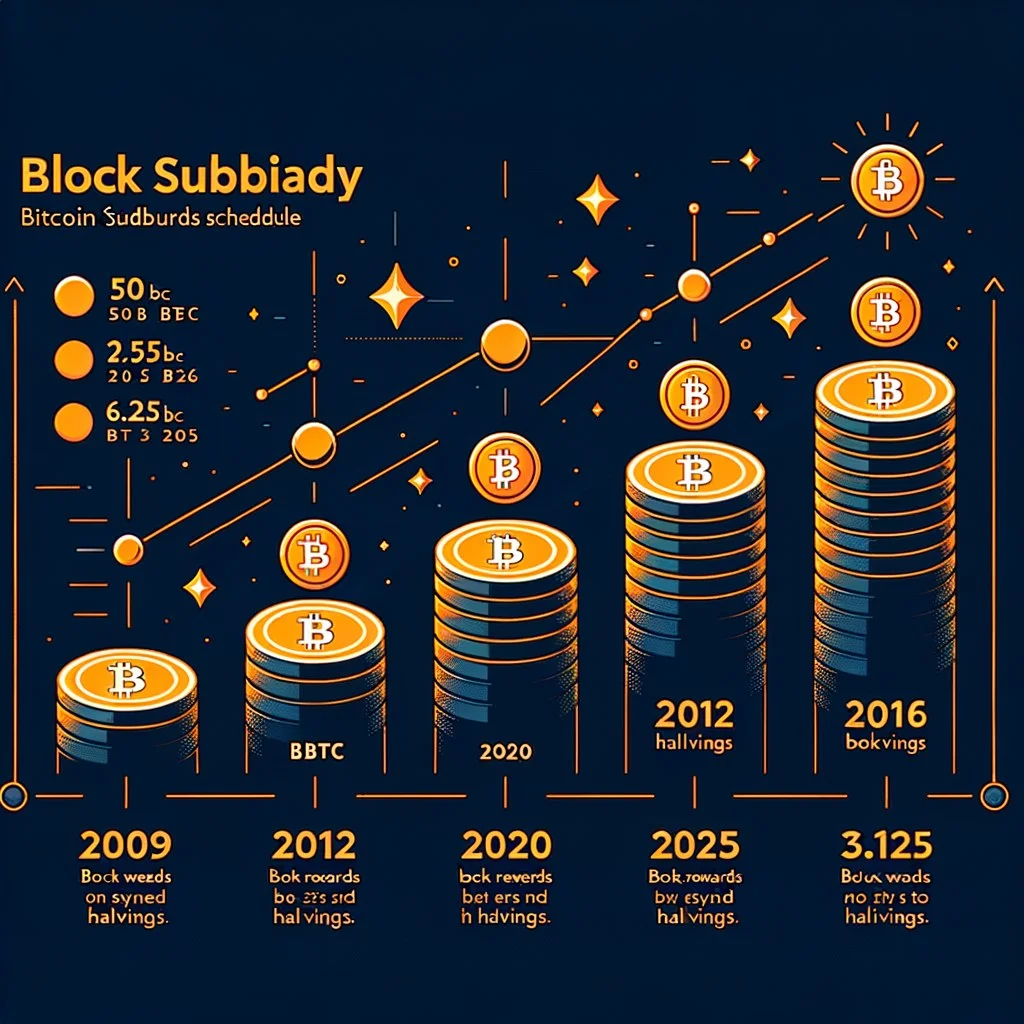
The block subsidy started at 50 BTC per block when Bitcoin launched in January 2009. Every 210,000 blocks, which works out to approximately four years given the target of one block every ten minutes, the subsidy is cut in half. This event is known as a Bitcoin halving, and it is one of the most important economic events in the crypto world. Halvings ensure that Bitcoin's monetary expansion slows over time, eventually approaching zero as the total supply asymptotically approaches 21 million coins.
The halving schedule is the heart of Bitcoin's monetary policy. It creates a hard cap of 21 million bitcoins that will ever exist, with new supply released on a tightly controlled, decreasing curve. Roughly 87.5% of all bitcoins were already mined by the end of 2024. The remaining 12.5% will be issued slowly over the next 116 years through ever-smaller subsidies. This stands in stark contrast to fiat currencies, where central banks expand the money supply at the discretion of policymakers and there is no upper bound.
What makes the halving so impactful is the supply shock it creates. The daily new supply of bitcoin is cut in half overnight, but demand does not change. Historically, this has been followed by significant price appreciation in the months and years after a halving, though correlation is not causation and there are many other macro factors at play. For miners, however, the halving is brutal: their revenue per block is instantly halved, while their operational costs (electricity, hardware depreciation, cooling, staff) remain unchanged.
Current Block Reward in 2026
As of 2026, the Bitcoin block subsidy is 3.125 BTC/block. This is the result of the fourth halving, which occurred at block 840,000 in April 2024, reducing the subsidy from 6.25 BTC to 3.125 BTC. Combined with transaction fees, which in 2026 typically add anywhere from 0.05 BTC to 0.5 BTC per block depending on network demand, the total reward per block usually ranges between 3.2 and 3.7 BTC. During fee spikes triggered by mempool congestion or popular Ordinals mints, this can briefly climb much higher.
The next halving is scheduled for approximately April 2028 at block 1,050,000, when the subsidy will drop to 1.5625 BTC per block. This means that current miners have just under two years of relatively generous subsidies before the next squeeze on issuance. After 2028, the subsidy will fall to 0.78125 BTC in 2032, and so on, getting cut in half every four years until it effectively reaches zero shortly before 2140.
For context, with a Bitcoin price of around $100,000, the current block reward of approximately 3.2 BTC translates to about $320,000 in revenue per block at the network level. With 144 blocks mined per day on average, that is roughly $46 million in total daily mining revenue. This revenue is split across all miners worldwide in rough proportion to their share of total hashrate. A miner controlling 1% of global hashrate would earn approximately $460,000 per day.
Transaction Fees: The Future of Miner Revenue
For most of Bitcoin's history, transaction fees have been a relatively minor share of total block reward. In 2013, fees averaged less than 1% of total miner revenue. Even in 2020, fees were typically 5-10% of total rewards. But that picture has shifted dramatically in recent years. The launch of Ordinals in early 2023, followed by BRC-20 tokens, Runes, and various other Bitcoin-native asset protocols, fundamentally changed how block space is used and valued.
Transaction fees are determined by a competitive auction for block space. Users specify how much they are willing to pay per byte of transaction data, measured in sat/byte. Miners, being rational economic actors, prioritize the transactions with the highest fees per byte and pack them into their blocks. When demand for block space is high, fees spike. When the mempool is empty, fees fall to near zero. This market mechanism elegantly allocates the scarce resource of bitcoin block size, which is hard-capped at roughly 4 megabytes of weight units per block.
The growing importance of transaction fees is a feature, not a bug. Bitcoin's designers knew that one day the block subsidy would dwindle to nothing, and the network would need to be supported entirely by fees. By developing a robust fee market early, Bitcoin is building the muscle it will need to survive in the post-subsidy era. The Ordinals era, controversial though it has been, has actually accelerated this transition by creating sustained demand for block space that goes beyond simple value transfers.
In 2026, fees regularly account for 15-30% of total miner revenue on a monthly basis, with spike days where fees can be 80% or more of the reward. This trend is expected to continue as Bitcoin adoption deepens, as more Layer 2 networks (like Lightning, RGB, and various rollups) settle on the base layer, and as new types of Bitcoin-native applications emerge.
How Difficulty Adjustment Maintains the 10-Minute Block Time
One critical feature of Bitcoin that interacts directly with the block reward system is the difficulty adjustment. Bitcoin targets one new block every 10 minutes on average, but the actual time it takes to mine a block depends on the total hashrate of the network. If hashrate doubles, blocks would be found twice as fast, which would mess with the issuance schedule and the security model. To prevent this, Bitcoin recalibrates the difficulty of the proof-of-work puzzle every 2,016 blocks (approximately every two weeks).
The math is simple: if the past 2,016 blocks took less than two weeks to mine, the difficulty goes up. If they took longer than two weeks, the difficulty goes down. The maximum adjustment in either direction is 4x per period, which prevents catastrophic changes during sudden hashrate swings. This elegant feedback loop has kept Bitcoin's block production almost perfectly on schedule since 2009, even as total hashrate has grown by trillions of times since the early days.
Why does this matter for the block reward? Because the issuance schedule, the halving schedule, and the eventual 21M cap all assume that blocks come at roughly 10-minute intervals. Without the difficulty adjustment, halvings would happen at unpredictable times, and the supply curve would no longer match the protocol's mathematical promise. SHA-256 hashing combined with the difficulty adjustment is what makes Bitcoin's monetary policy genuinely automatic and resistant to manipulation.
Mining Economics: Profitability After Halving
Every halving forces a brutal reset of the mining industry's economics. When the subsidy is cut in half overnight, revenue per terahash per day is also cut in half (assuming fees stay constant). This metric, known as hashprice, is the most important number for miners. It tells you how much you can expect to earn per unit of computing power per day. Miners with high electricity costs or old, inefficient ASICs get squeezed out, while operators with cheap power and modern hardware capture market share.
To break this down with real numbers, consider a typical modern ASIC like the Bitmain S21 Pro or similar, which delivers around 234 TH/s at roughly 15 J/TH. At a 2026 hashprice of about $50 per PH/day, that miner generates approximately $11-12 per day in gross revenue. If electricity costs $0.05/kWh, that same miner consumes around 3.5 kW of power, costing approximately $4.20 per day in electricity. The gross margin per machine is therefore around $7-8 per day, before accounting for hardware depreciation, cooling, networking, and overhead. Whether this is profitable depends on the upfront cost of the ASIC, the ambient temperature of the facility, and whether the operator has access to renewable or subsidized energy.
The harshest reality of mining economics is that the industry is fundamentally a race to the bottom on energy costs. Whoever has the cheapest electricity wins, full stop. This is why mining concentrates in regions with hydroelectric, geothermal, flared natural gas, nuclear, or otherwise stranded energy. After each halving, miners with electricity costs above a certain threshold (currently around $0.08/kWh for the latest ASICs) are forced to shut down or relocate. The marginal cost of production rises, weak hands capitulate, and the industry consolidates.
Block Reward in Other Cryptocurrencies
Bitcoin is far from the only cryptocurrency that uses block rewards to incentivize blockchain participants. Every proof-of-work coin has some version of a block reward, and many proof-of-stake networks have analogous mechanisms even though they technically use validator rewards rather than mining rewards. The specific economics, however, vary wildly from chain to chain.
Ethereum is the most interesting comparison. After the Merge in September 2022, Ethereum moved from proof-of-work to proof-of-stake and stopped paying block rewards to miners. Validators now receive much smaller staking rewards instead, and a significant portion of every transaction fee is burned via EIP-1559. Combined, these mechanics have made ETH issuance hover near zero and often go negative (deflationary). This is a radically different model from Bitcoin, where new coins continue to be minted on a predictable schedule for over a century to come.
Dogecoin offers another fascinating contrast. After its early halvings, DOGE settled on a fixed perpetual block reward of 10,000 DOGE per block, with no supply cap. This means roughly 5 billion new DOGE enter circulation every year, forever. The inflation rate is high in percentage terms today but will decrease over time as the total supply grows. This perpetual emission is one form of tail emission, the same concept Monero uses.
The Tail Emission Debate
One of the most contentious debates in cryptocurrency monetary theory revolves around the long-term security of fee-only blockchains. Bitcoin's security budget shrinks every four years as the subsidy halves. Eventually, all security must come from transaction fees. Critics argue this is dangerous because fees are volatile and may not be enough to deter a determined attacker. Defenders argue that fee markets will mature and that transaction throughput growth, plus Layer 2 settlement, will produce ample fees to keep the network secure.
Monero takes the opposite approach. After its main emission curve ran out in May 2022, Monero implemented a tail emission of 0.6 XMR per block, forever. This guarantees a permanent floor on miner revenue regardless of fee market conditions. The trade-off is that Monero has no supply cap and will continue to inflate forever, though at an ever-decreasing percentage rate. Proponents call this a feature: predictable, modest inflation in exchange for permanent security guarantees.
Bitcoin has so far refused to consider tail emission. The 21 million cap is treated as sacrosanct, both for cultural and monetary reasons. Whether this turns out to be the right call will not be known for at least another century. For now, Bitcoin is betting that fee revenue will scale enough to fund security as the subsidy fades, and that the immutability of the supply schedule is more valuable than the certainty of a tail-funded security budget.
Block Reward and Network Security
The block reward is the foundation of Bitcoin's security model. Every minute the network is running, miners are spending real-world resources (electricity, hardware, labor) in exchange for the chance to win the next block reward. The total cost of all this spending is the network's security budget. Any attacker who wants to rewrite the chain or execute a 51% attack must spend more than the honest miners are spending to maintain that majority.
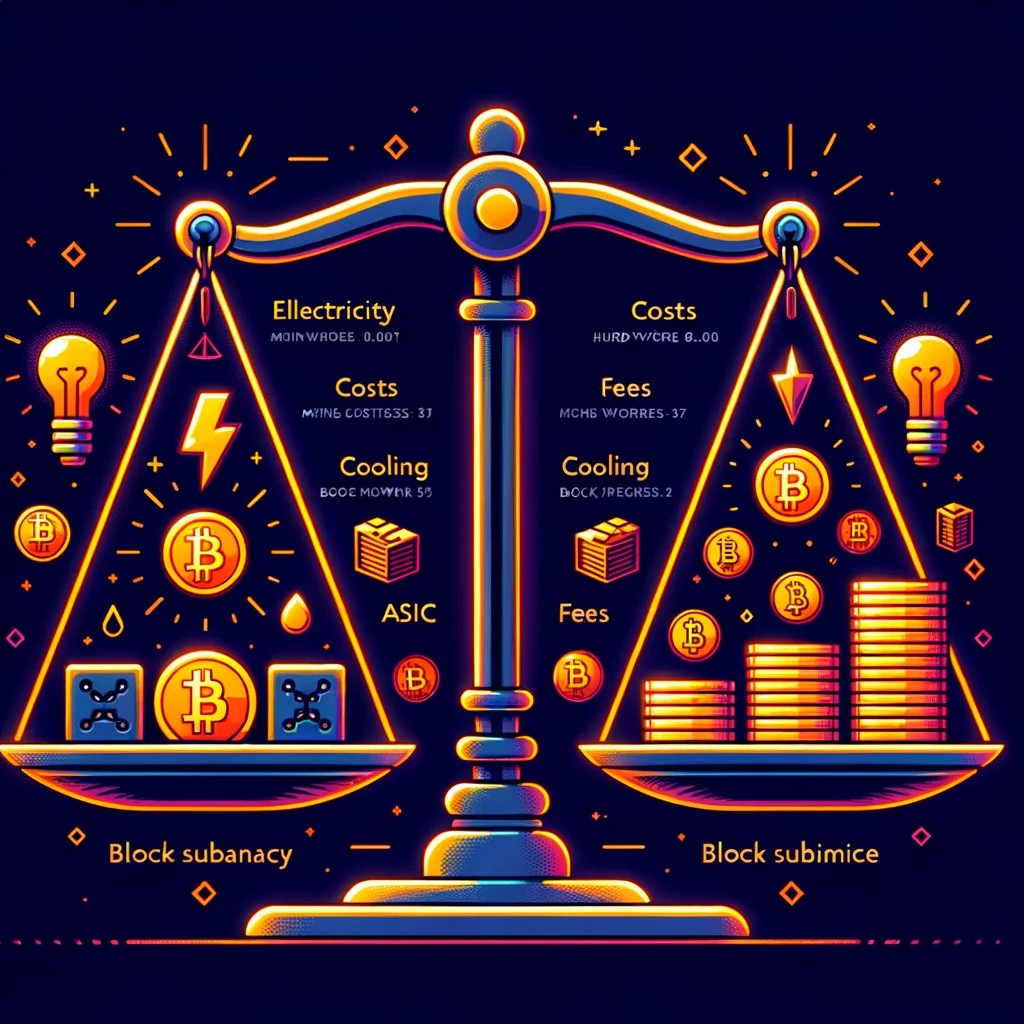
The math is roughly: if total daily block rewards equal X dollars, then the cost to maintain 51% of hashrate for one day is approximately X dollars too. To carry out a sustained attack, an adversary must spend that amount day after day until they achieve their objective, while also handling the falling Bitcoin price that such an attack would inevitably trigger. With current daily mining revenue at roughly $46 million, the daily cost of a 51% attack on Bitcoin is well over $20 million in electricity alone, plus the colossal capital cost of acquiring enough ASICs to compete with the existing global fleet (in the tens of billions of dollars).
This is why high block rewards equal high security. As the subsidy halves and fees grow to take its place, the absolute dollar value of the block reward (and hence the security budget) depends entirely on the price of bitcoin and the level of fee demand. If both grow over time, the security budget can grow even as the subsidy in BTC terms shrinks. If they stagnate, the security budget could in theory contract, which is the source of the long-term security concern that motivates tail emission proponents.
Famous Lost and Reorged Block Rewards
Bitcoin's history is dotted with notable cases of lost or invalidated block rewards. The most famous is the very first block of all: the genesis block, mined by Satoshi Nakamoto on January 3, 2009. This block contains a coinbase output of 50 BTC, but due to a quirk in the original Bitcoin code, that specific output is not actually included in the UTXO set. Those 50 bitcoins are completely unspendable, and they will remain so forever. Whether this was intentional or a bug is one of the great minor mysteries of Bitcoin.
Beyond the genesis block, Bitcoin has experienced numerous chain reorganizations over the years. When a reorg occurs, blocks that were previously part of the longest chain get displaced by a competing chain that grew longer. The displaced blocks become orphaned (or stale), and their coinbase transactions are erased from history. Miners who thought they had earned rewards from those blocks lose them entirely. This is rare on Bitcoin today because of how concentrated hashrate is and how reliable mining pools have become, but in the early years orphan rates were higher.
The largest known accidental coin destruction tied to a block reward issue was the value overflow incident in August 2010, when a bug allowed someone to create a transaction generating 184 billion BTC. The bug was patched within hours, a soft fork was deployed, and the offending transaction was removed via a manual chain reorganization. This is the only time in Bitcoin's history that a deliberate chain rewrite was performed by the developer community. It is a historic reminder that even seemingly perfect systems can have bugs related to the most basic concept: the block reward.
Block Reward and Long-Term Bitcoin Security
What does Bitcoin look like in 2140, when the last fraction of a bitcoin has been mined and the block subsidy is permanently zero? At that point, miners will be paid entirely from transaction fees. Whether this works depends on a series of assumptions: that Bitcoin still exists and is widely used, that block space remains valuable enough to generate competitive fees, that Layer 2 networks have not absorbed so much activity that base-layer demand has collapsed, and that price has appreciated enough over the century to compensate for the disappearing subsidy.
Many smart people believe this will work fine. They point to several trends already visible today. Block space is increasingly valuable as more applications compete for it. Layer 2 networks like Lightning, despite settling many transactions off-chain, actually generate base-layer demand for opening and closing channels, plus dispute resolution. Institutional adoption is locking up large amounts of BTC for long periods, reducing velocity and increasing transaction value per byte. Stablecoin issuance on Bitcoin via protocols like RGB or sidechains could become an enormous fee generator.
Other observers are less optimistic. They argue that mature fee markets are inherently lumpy. Sometimes fees are huge, sometimes they are tiny. A miner cannot rely on irregular fee spikes the way they can rely on a steady subsidy. If fees alone are insufficient to fund security during quiet periods, the network could become vulnerable. This is the heart of the tail emission debate that continues to bubble up in Bitcoin development circles every few years.
Either way, the issue is not pressing. The current subsidy will not approach insignificance until at least the 2050s or 2060s. Bitcoin has decades to develop the fee markets, Layer 2 infrastructure, and economic activity needed to support a fee-only model. The block reward, in some form, will continue to be the heartbeat of the network for many generations to come.
Frequently Asked Questions
What is the current Bitcoin block reward in 2026?
The current Bitcoin block reward in 2026 consists of a 3.125 BTC block subsidy plus all transaction fees included in that block. Total fees typically add between 0.05 and 0.5 BTC depending on network demand, so total block rewards usually range from 3.2 to 3.7 BTC. The next halving in April 2028 will cut the subsidy to 1.5625 BTC.
When will the Bitcoin block subsidy reach zero?
The Bitcoin block subsidy will reach effectively zero around the year 2140, after the 33rd halving. At that point, all 21 million bitcoins will have been mined, and miners will be paid exclusively from transaction fees. The subsidy decreases by half every 210,000 blocks, which is approximately four years.
Why do miners get a block reward?
Miners receive the block reward as compensation for the work and resources they spend securing the network. They pay for electricity, ASICs, cooling, and infrastructure. The block reward incentivizes them to behave honestly because trying to cheat would invalidate their block and forfeit the reward. It is also the mechanism by which new bitcoins enter circulation according to the protocol's fixed schedule.
Are transaction fees part of the block reward?
Yes. The total block reward in Bitcoin equals the block subsidy plus the sum of all transaction fees from every transaction included in the block. Both components are paid to the miner through the same coinbase transaction. In 2026, transaction fees regularly represent 15-30% of total miner revenue, and this share is expected to grow as the subsidy continues to halve.
What is a coinbase transaction?
A coinbase transaction is the first transaction in every Bitcoin block. It is unique because it creates new bitcoin out of nothing according to protocol rules, rather than spending existing coins. It pays the miner the entire block reward (subsidy plus fees) in one output. Coinbase coins cannot be spent for 100 blocks (about 16-17 hours) to protect against chain reorganizations. The name has nothing to do with the Coinbase exchange.
Why does the block reward halve every four years?
The halving every 210,000 blocks (approximately four years) is hard-coded into the Bitcoin protocol to enforce a predictable and decreasing rate of new supply. This creates the 21 million coin cap and ensures Bitcoin behaves as a disinflationary, scarce asset. Halvings tighten the new supply hitting the market, which has historically preceded major price appreciations, though there are many other factors at play.
Can the Bitcoin block reward ever be changed?
Technically yes, but only through a hard fork that the vast majority of nodes, miners, exchanges, and users would have to adopt. The 21 million supply cap and the halving schedule are considered sacrosanct by most of the Bitcoin community. Any proposal to change them, including introducing a tail emission, would face overwhelming opposition. So while it is possible in theory, it is essentially impossible in practice.
Conclusion
The block reward is the engine that drives Bitcoin. It funds the network's security, controls the issuance of new coins, and aligns the incentives of every miner on the planet with the long-term health of the protocol. By combining a predictable, decreasing subsidy with a market-driven fee component, Bitcoin has built a monetary system that is simultaneously rigid in its rules and flexible in its economic reality. Whether you are a miner trying to forecast your next quarter, an investor sizing up your conviction, or a developer building on top of Bitcoin, understanding the block reward is foundational.
The most important takeaways: today the block reward equals 3.125 BTC of subsidy plus a variable amount of fees, the next halving in April 2028 will cut the subsidy to 1.5625 BTC, and the subsidy will continue halving every four years until it reaches zero around 2140. Transaction fees, accelerated by Ordinals and similar activity, are taking on an increasing share of miner revenue and will eventually be the entire revenue source. The tail emission debate remains open but is unlikely to change anything in Bitcoin proper for decades to come.
The genius of Bitcoin's design is that nobody controls the block reward. It is set by code, enforced by nodes, and competed for by miners. No central bank can debase it. No politician can vote on it. No emergency can suspend it. In a world full of money systems that depend on trusting institutions to behave well, Bitcoin's block reward is a refreshing reminder that mathematics and economics can sometimes do a better job than committees. Every ten minutes, a new block is mined, a new reward is paid, and the system rolls on, unstoppable.
Related Guides
- What Is Hashrate in Crypto: Bitcoin Mining Power Explained (2026)
- What Is a Bitcoin Mining Pool? Complete Guide
- Risk-Reward Ratio in Crypto Explained 2026
- What Is Block Time in Crypto? Speed Explained 2026
- Understanding Block Reorgs: Temporary Blockchain Changes
- What is a Nonce in Crypto? Wallet, Block and Mining Nonces