XRP mining? The Truth behind the myth.
Uncover why XRP cannot be mined and understand the system that drives the XRP Ledger, including how its Consensus Protocol operates.
The Truth Behind the XRP Ledger's "Missing" Miners
It is Thursday, April 9, 2026. Ethereum is comfortably holding its ground at $2,136.21, and XRP is showing a steady pulse at $1.38. As the market matures and institutional ETFs bring a new wave of investors into the fold, one question continues to surface in search bars and forums: "How do I start mining XRP?"
If you are looking for an XRP mining rig or a "Cloud Mining" contract for the XRP Ledger, I have a bit of a reality check for you: one that might save you a lot of money and a few malware infections.
Is XRP mining possible?
The short answer: No, you cannot mine XRP. You never could, and you never will.
But the why behind that answer is what makes XRP one of the most efficient and unique assets in the digital economy of 2026. Let’s debunk the myths and look at the engine that powers the XRP Ledger (XRPL).
1. The Death of the XRP Mining Myth
In the world of Bitcoin, "mining" is the process of using powerful computers to solve complex mathematical puzzles. The first miner to solve the puzzle gets to add a block to the chain and receives a "block reward" in newly created Bitcoin. This is called Proof-of-Work (PoW).
XRP operates on a completely different philosophy.
All Coins Were Born at Once
Unlike Bitcoin, which is "discovered" over time, all 100 billion XRP tokens were created (or "minted") at the inception of the ledger in 2012. There are no new XRP tokens being created today. Every XRP you see in the market (including the one currently trading at $1.38) has existed since day one.
Warning: If you find a website or app claiming to "mine XRP" on your laptop or phone, close it immediately. Since the ledger doesn't support mining, these sites are usually "faucet" scams that pay you tiny fractions of XRP in exchange for watching ads, or worse, they are using your hardware to mine other coins (like Monero) for themselves while giving you a pittance.
2. If Not Mining, Then What? (The XRPL Consensus)
If there are no miners to verify transactions, how does the network ensure that Alice isn't spending the same XRP twice? The answer lies in the XRP Ledger Consensus Protocol.
Instead of a "race" to solve a puzzle, the XRPL uses a voting system.
How it Works: The 5-Second Agreement
Validators: Instead of traditional “miners,” XRP mining relies on Validators: servers operated by universities, exchanges, businesses, and individuals.
The Proposal: Every 3 to 5 seconds, validators bundle up a set of transactions they’ve seen and propose them to the network.
The Vote: They compare their lists. If a transaction appears on the majority of lists, it moves to the next round.
Consensus: Once at least 80% of the trusted validators agree that a set of transactions is valid, the ledger is "closed," and the transactions are finalized.
This process is why XRP is incredibly fast. While Bitcoin might take 10 to 60 minutes to finalize, the XRPL does it in the time it takes you to take a sip of coffee.
3. Comparison: Proof-of-Work vs. XRPL Consensus
To help you understand the technical gap, let’s look at the metrics as they stand in April 2026:
| Feature | Bitcoin (Proof-of-Work) | XRP (Consensus) |
| New Supply | Created via mining rewards. | None (Pre-mined). |
| Transaction Speed | 10+ minutes. | 3 - 5 seconds. |
| Energy Consumption | Equivalent to a small country. | Equivalent to a few dozen lightbulbs. |
| Main "Worker" | Miners (Hardware heavy). | Validators (Software heavy). |
| Rewards | Miners get paid in BTC. | Validators get paid $0. |
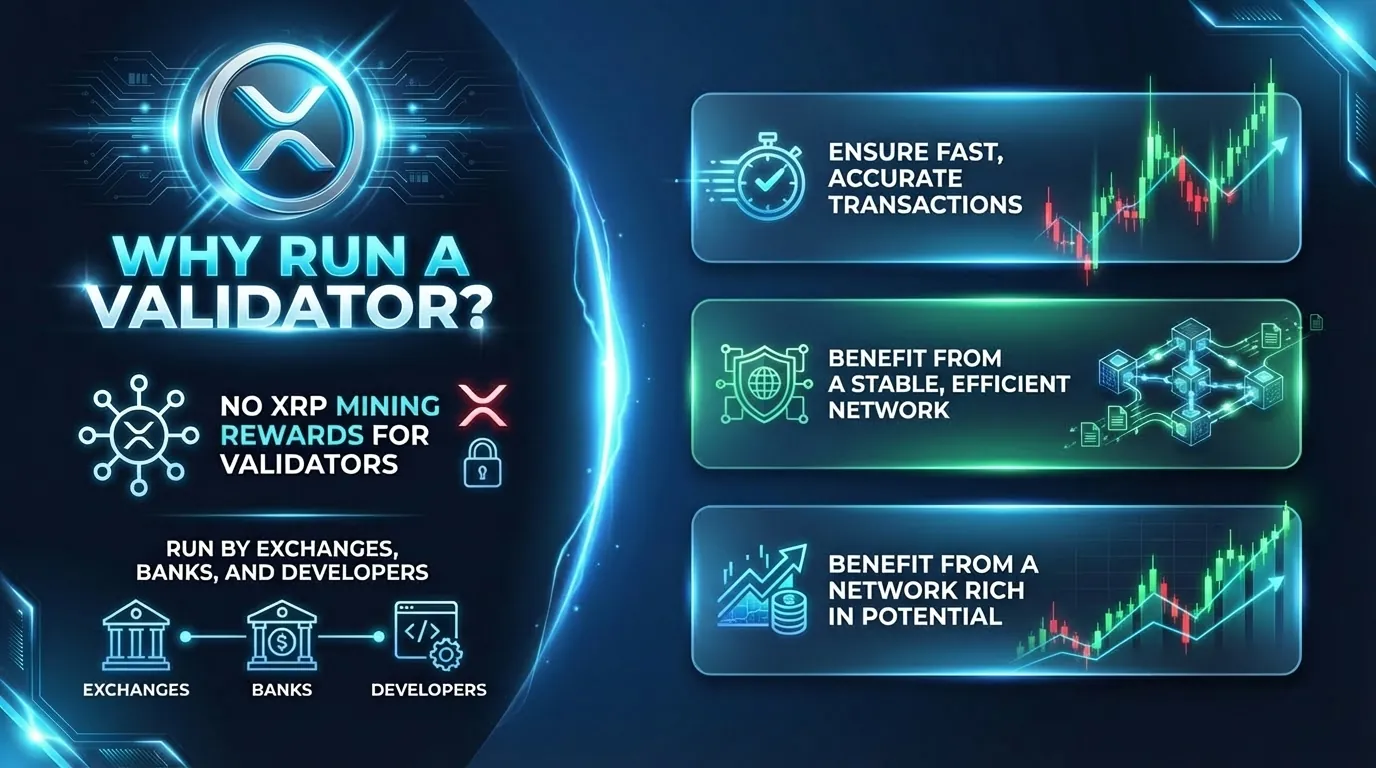
4. The "Free" Paradox: Why Run a Validator?
Wait, if validators don’t get a "block reward" like Bitcoin miners do, why would anyone spend money to run a server for the XRP Ledger?
This is a common point of confusion. In 2026, there are over 150 active validators on the XRPL. They don't do it for XRP rewards; they do it for the health of the ecosystem.
Exchanges run validators to ensure their deposits and withdrawals are processed accurately.
Banks and Payment Providers run them to guarantee their cross-border transfers settle in seconds.
Developers run them to support the apps and DeFi protocols they’ve built on the chain.
The reward isn't a new coin; the reward is a stable, fast, and free-to-use financial network.
5. The "Burn" Mechanism: Where Do the Fees Go?
In Bitcoin or Ethereum, when you pay a transaction fee, that money goes to the miner or the staker. On the XRP Ledger, something much more radical happens: The fee is destroyed.
Every time a transaction is sent, a tiny amount of XRP (the minimum is 0.00001 XRP) is "burned." This means it is removed from the total supply forever.
The Goal: To prevent "spam" attacks where someone tries to clog the network with millions of tiny transactions.
The Result: XRP is slightly deflationary. While the burn rate is slow, the total supply of XRP is lower today than it was in 2012, and it will be lower tomorrow than it is today.
6. Conclusion: A Greener, Faster Standard
As we navigate this April 9, 2026, the "Mining vs. Consensus" debate has largely been settled by the market. While Bitcoin’s PoW serves its purpose as digital gold, XRP’s consensus mechanism has proven to be the superior choice for high-frequency global payments.
By removing the “mining” race, the XRP Ledger eliminates the massive energy waste and high fees tied to older blockchains. Rather than relying on XRP mining, it operates as a utility network, not a “discovery” network.
So, the next time someone asks you about mining XRP, you can tell them the truth: You don't mine it: you use it.
Keypoints
Mining Status: XRP cannot be mined. All 100 billion tokens were created at launch.
Consensus Mechanism: It uses a Federated Consensus voting system instead of Proof-of-Work.
Transaction Time: Settlements are finalized in 3-5 seconds, regardless of global distance.
Energy Efficiency: The XRPL is thousands of times more energy-efficient than Bitcoin.
Validator Motivation: Validators are not paid in XRP; they run nodes to secure the network they use for their own businesses.
The Burn: Transaction fees are destroyed (burned), making the asset naturally deflationary over time.
Market Update: As of April 9, 2026, XRP trades at $1.38 with a market cap of $84B.
Track the XRPL's Deflationary Pulse on DEXTools
Want to see the "Burn" in action or track the liquidity of the latest projects launching on the XRP Ledger?
The DEXTools App dashboard provides real-time data on the XRPL ecosystem. Monitor the supply dynamics, check the health of liquidity pools, and see how the market reacts to the latest institutional integrations. Don't follow the myths: follow the real-time on-chain data.
Explore the future of finance on DEXTools today!
Disclaimer: This article is for informational purposes only and does not constitute investment advice, financial advice, trading advice, or any other kind of advice. DEXTools does not recommend buying, selling, or holding any cryptocurrency or token. Users should conduct their own research and consult with a qualified financial advisor before making any investment decisions. Cryptocurrency investments are volatile and high-risk. DEXTools is not responsible for any losses incurred.
Related Guides
- How XRP Ledger Powers Global Finance in 2026
- What Is Kaito AI? The InfoFi Platform Behind Yaps Explained in 2026
- What Is Goatseus Maximus (GOAT)? Truth Terminal AI Memecoin Guide 2026
- What Is Fartcoin? The AI-Generated Solana Memecoin Born from Truth Terminal Explained in 2026
- Is ETH Dead? The Truth About Ethereum’s 2026 Metamorphosis
Frequently Asked Questions
Can you mine XRP?
No, you cannot mine XRP. All 100 billion XRP tokens were created at the inception of the ledger in 2012, and there are no new tokens being generated.
What is the XRP Ledger Consensus Protocol?
The XRP Ledger Consensus Protocol uses a voting system among validators to verify transactions instead of mining, allowing transactions to be finalized in just 3 to 5 seconds.
Why are there no miners in the XRP network?
XRP does not use a mining process like Bitcoin; instead, it relies on validators to reach consensus on transactions, making it a more efficient system.
What are validators in the XRP Ledger?
Validators are servers run by various entities, including universities and exchanges, that propose and vote on transactions to ensure the integrity of the XRP Ledger.
How does XRP compare to Bitcoin in terms of transaction speed?
XRP transactions are finalized in 3 to 5 seconds, while Bitcoin transactions can take 10 minutes to over an hour.