Whale Buy or Exit Liquidity? How to Read Big Swaps Without Blindly Copying Whales
— By Whatsertrade in Tutorials
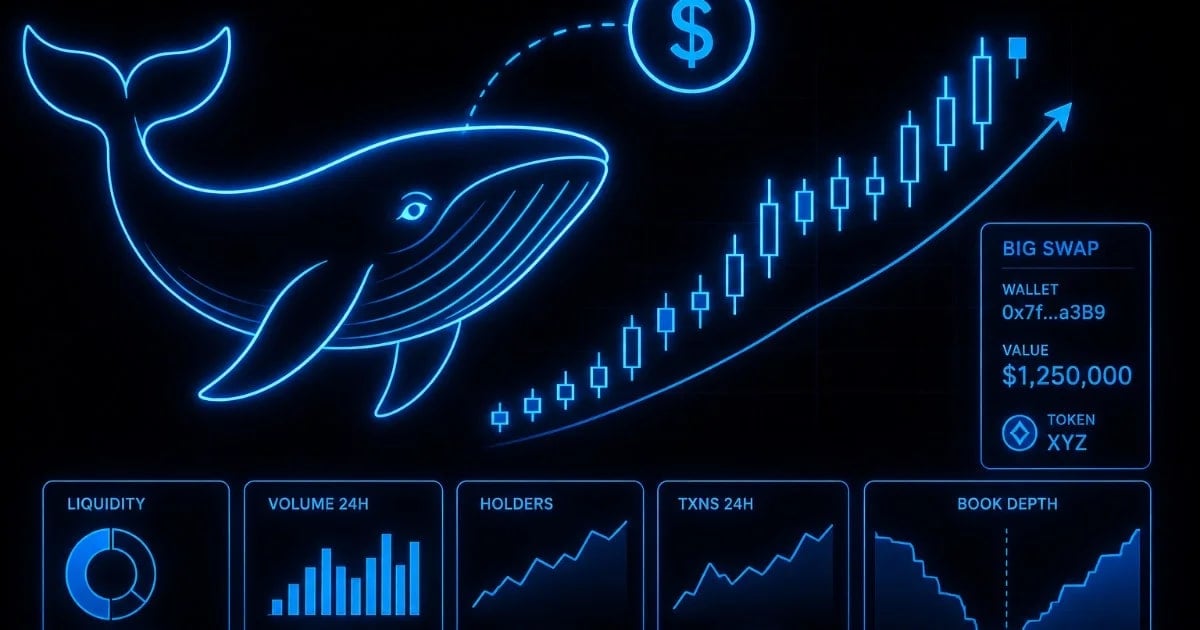
A large buy can make any low-cap token look exciting. One big green candle, one whale wallet entering, and suddenly social media starts calling it the next brea
A large buy can make any low-cap token look exciting. One big green candle, one whale wallet entering, and suddenly social media starts calling it the next breakout. But in decentralized trading, a whale buy is not always a bullish signal.
Sometimes it is real conviction. Sometimes it is a trap. Sometimes it is designed to attract retail buyers before early wallets start selling into the hype.
That is why traders should not blindly copy whale activity. Instead, they should learn how to read big swaps in context using DEXTools.
What Is a Whale Buy?
A whale buy is a large purchase made by a wallet with enough capital to move the market or influence trader behavior. In small liquidity pools, even one buy can create a dramatic candle and trigger attention.
On DEXTools, traders can use charts, transaction data, liquidity metrics, volume, holders, and tools like Big Swap Explorer to analyze whether a large buy is meaningful or misleading.
The key question is simple: did the whale buy because the token has strength, or did the whale buy to create the appearance of strength?
Why Blindly Copying Whales Is Risky
Many traders see a big buy and assume someone knows something. That assumption can be dangerous.
Whales can enter before retail, create momentum, and then sell once enough traders follow. In low liquidity tokens, this can happen very quickly. A large buy can push the price up, attract new buyers, and create a perfect exit opportunity for wallets that entered earlier.
Copying whales without analysis means you are reacting to someone else’s move without understanding their plan.
A whale may have a better entry than you. A whale may be trading with insider information. A whale may be part of the team, a market maker, or an early wallet. A whale may be testing liquidity before selling later.
The size of the buy matters, but the context matters more.
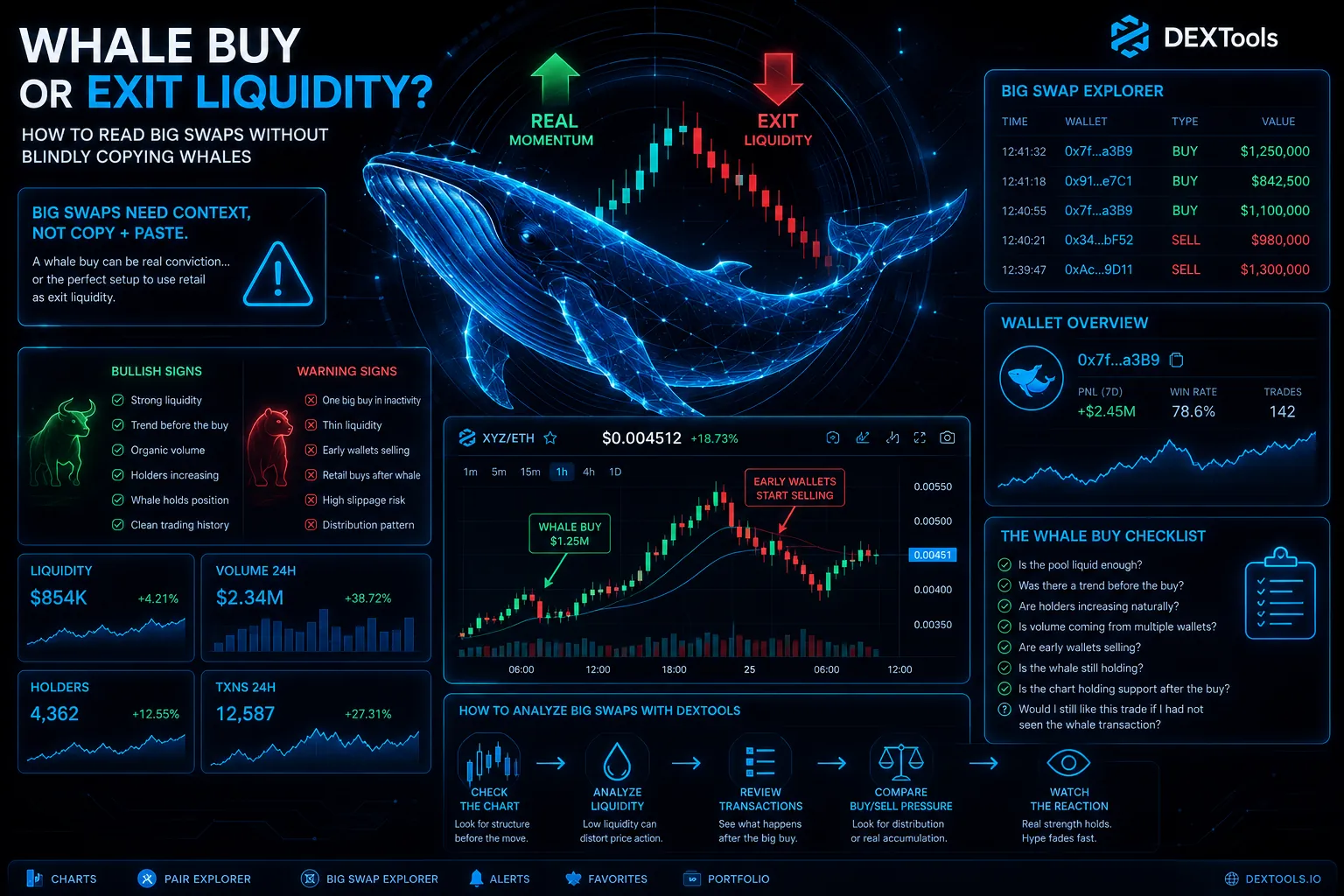
Signs a Whale Buy May Be Bullish
A whale buy can be a positive signal when it appears alongside healthy market behavior.
Look for these signs on DEXTools:
- Liquidity is strong enough to support large trades.
- The chart was already forming a stable structure before the buy.
- Volume is increasing gradually, not only from one transaction.
- The buy is followed by organic buying from different wallets.
- Holders are increasing in a natural way.
- The whale does not sell immediately after the price moves.
- The pool has enough depth to reduce extreme slippage.
- The token has a clean trading history without repeated pump and dump patterns.
A strong whale buy should support an existing trend, not be the only reason the chart looks interesting.
Signs It Could Be Exit Liquidity
A whale buy becomes suspicious when it creates hype without support from other data.
Be careful when you see:
- One large buy after a long period of no activity.
- A sudden green candle in a very thin liquidity pool.
- Early wallets selling after the whale buy.
- Many small retail buys following one large transaction.
- Low liquidity compared to market cap.
- High slippage risk.
- A chart that has already pumped hard before the whale entered.
- Repeated big buys followed by slow distribution.
The most dangerous setup is a token that looks active only because a few large wallets are controlling the chart.
If the whale buy is the entire story, it may not be a strong story.
How to Analyze Big Swaps With DEXTools
When you see a big swap, do not rush. Open the token page on DEXTools and check the full picture.
Start with the chart. Ask whether the price was already trending or if the whale buy created the entire move. A healthy chart usually has structure before the breakout. A risky chart often has one sudden candle with no base.
Then check liquidity. A big buy in a small pool can distort price action. If liquidity is low, the chart may look more bullish than it really is.
Next, review transactions. Look at what happens after the whale buy. Are more buyers entering, or are early wallets selling into the move? A strong token should not depend on one wallet.
Then compare buy and sell pressure. If the large buy is followed by many smaller buys and then several large sells, retail traders may be providing exit liquidity.
Finally, watch how the token behaves after the first reaction. Real strength often holds. Manufactured hype often fades fast.
The Whale Buy Checklist
Before copying a whale, ask:
- Is the pool liquid enough?
- Was there a trend before the buy?
- Are holders increasing naturally?
- Is volume coming from multiple wallets?
- Are early wallets selling?
- Is the whale still holding?
- Is the chart holding support after the buy?
- Would I still like this trade if I had not seen the whale transaction?
That last question is the most important. If the only reason you want to buy is because a whale bought, you may not have a real setup.
Final Thoughts
Whale activity can be useful, but it should never be your only signal. A big buy can show confidence, but it can also create a trap.
DEXTools gives traders the data needed to look beyond the candle. By checking liquidity, transaction flow, holder behavior, and chart structure, you can decide whether a whale buy is real momentum or possible exit liquidity.
In DeFi trading, the goal is not to follow whales blindly. The goal is to understand what they may be doing before you risk your own capital.
How to Read Liquidity Pool Data Before Buying a Token (2026) Median Trade Size vs Trade Count: Why Small Swaps Can Inflate DEX Activity How to Check Buy and Sell Tax Before Buying a Token (2026) The Market Cap Mirage: Why Token Valuation Means Little Without DepthThe Silent Signals: Decoding Order Book Depth and Slippage
Beyond the immediate transaction size, a whale's true intent can often be gleaned from the subtle ripples they create in the order book. Large buys or sells, even when broken into smaller chunks, inevitably impact market depth and execution slippage. Observing these secondary effects provides a deeper layer of insight into whether a whale is strategically accumulating or aggressively exiting, rather than merely making a opportunistic trade.
A whale genuinely committed to an accumulation phase will often prioritize minimal market disruption, even if it means slower execution. Conversely, a whale seeking to offload a position quickly, perhaps due to impending news or a shift in sentiment, will show less concern for price impact, indicating a more urgent exit. The interplay between trade size, execution speed, and the resultant order book changes is a critical, often overlooked, data point.
Analyzing Slippage and Depth Impact
- Monitor the delta in bid-ask spread immediately following a large aggregated trade. A rapidly widening spread, even if temporary, can suggest significant absorption of liquidity.
- Track the depth of the top 5 to 10 price levels before and after whale activity. A substantial reduction in available liquidity on one side of the book points to forceful buying or selling.
- Observe the average slippage experienced by the whale's aggregated orders. Lower slippage for a large volume indicates a market with ample depth, potentially absorbing the trade without significant price movement. Higher slippage suggests a more illiquid market or a whale prioritizing speed over price.
- Look for "iceberg orders" - large orders broken into smaller, visible components. These are often accumulation or distribution tactics designed to obscure the true size of the position and minimize immediate market impact.
Related Guides
- Exit Liquidity Mapping: Who Might Sell Into You Before You Buy?
- Micro-Exit Planning: How to Leave a Thin Pool Without Destroying Your Own Price
- What Is a Whale in Crypto? How Big Holders Move It
- Exit Liquidity Signals: Spot Late Entry Risks
- How to Use Raydium on Solana: Swaps, Liquidity Pools and CLMM Guide (2026)
Frequently Asked Questions
What is the difference between a whale buy and exit liquidity?
A whale buy indicates a large investor is accumulating a crypto asset, potentially signaling future price appreciation. Exit liquidity, conversely, means a large investor is selling a significant portion of their holdings, often to realize profits or cut losses, which can lead to downward price pressure.
How can I identify a whale's intent when I see a large transaction?
Analyzing transaction patterns is key. Look at the wallet's history: Is it a new wallet buying for the first time, or an existing holder adding to their position? Also, consider the asset's price action around the transaction. A large buy during a dip might be accumulation, while a large sell after a pump could be profit-taking.
What tools help in tracking whale activity?
Blockchain explorers like Etherscan or BscScan allow you to view individual transactions and wallet balances. On-chain analytics platforms (e.g., Nansen, Arkham Intelligence) provide more sophisticated insights by clustering addresses and visualizing whale movements, often with labels for known entities.
Should I always copy whale trades?
No, blindly copying whales is risky. Whales have different financial goals, risk tolerances, and information access than most retail investors. Their large moves can also be part of complex strategies (e.g., OTC deals, market manipulation) that are not apparent to observers.