How to Check a Liquidity Pool Before Buying a Token 2026
— By Tony Rabbit in Tutorials

Learn how to read liquidity pool depth, pair quality, concentration and route quality before buying a token so you can spot thin or fragile markets fast.
Intent check: This page owns the tradability check: pool depth, pair quality, and how realistic execution will be. If you specifically want to verify whether LP tokens are time-locked and when they can unlock, read How to Check Liquidity Lock Before Buying a Token.
Reading liquidity pool data is different from checking whether liquidity is merely locked. A lock can reduce one type of risk, but it does not tell you whether the pool is deep enough, active enough, and healthy enough to support a real trade. Before buying a DEX pair, the practical question is not only whether liquidity exists. It is whether the pool can handle your entry and your exit without turning ugly.
This is where a lot of retail traders get trapped. They see a fast candle, a rising market cap, or a loud feed, and they stop at the lock badge or headline liquidity number. But a pair can still be weak underneath if the pool is shallow, volume quality is bad, holders are concentrated, or the exit profile is poor. By the time those problems show up, the entry already feels like a mistake.
Quick answer
- Check liquidity depth first. A small pool means higher price impact and uglier exits.
- Look at 24h volume and its quality, not just one sudden spike.
- Compare liquidity with valuation, pool age, and holder concentration to spot weak structure.
- Before buying, ask whether you could still exit cleanly if the move stalls or reverses.
What a Liquidity Pool Actually Tells You
A liquidity pool is the trading inventory sitting behind the pair. On an automated market maker, that pool is what allows buyers and sellers to swap without a traditional order book. For a trader, the key idea is simple: the stronger the pool and the cleaner the activity around it, the better the chance that your entry and exit behave like a real market instead of a trap.
This is also why liquidity pool analysis is different from a broad economics article about how pools power DeFi. The trading question is more immediate. You want to know whether the pair can absorb real size, whether volume looks organic, and whether a sharp reversal would leave you with a manageable exit or a terrible one.
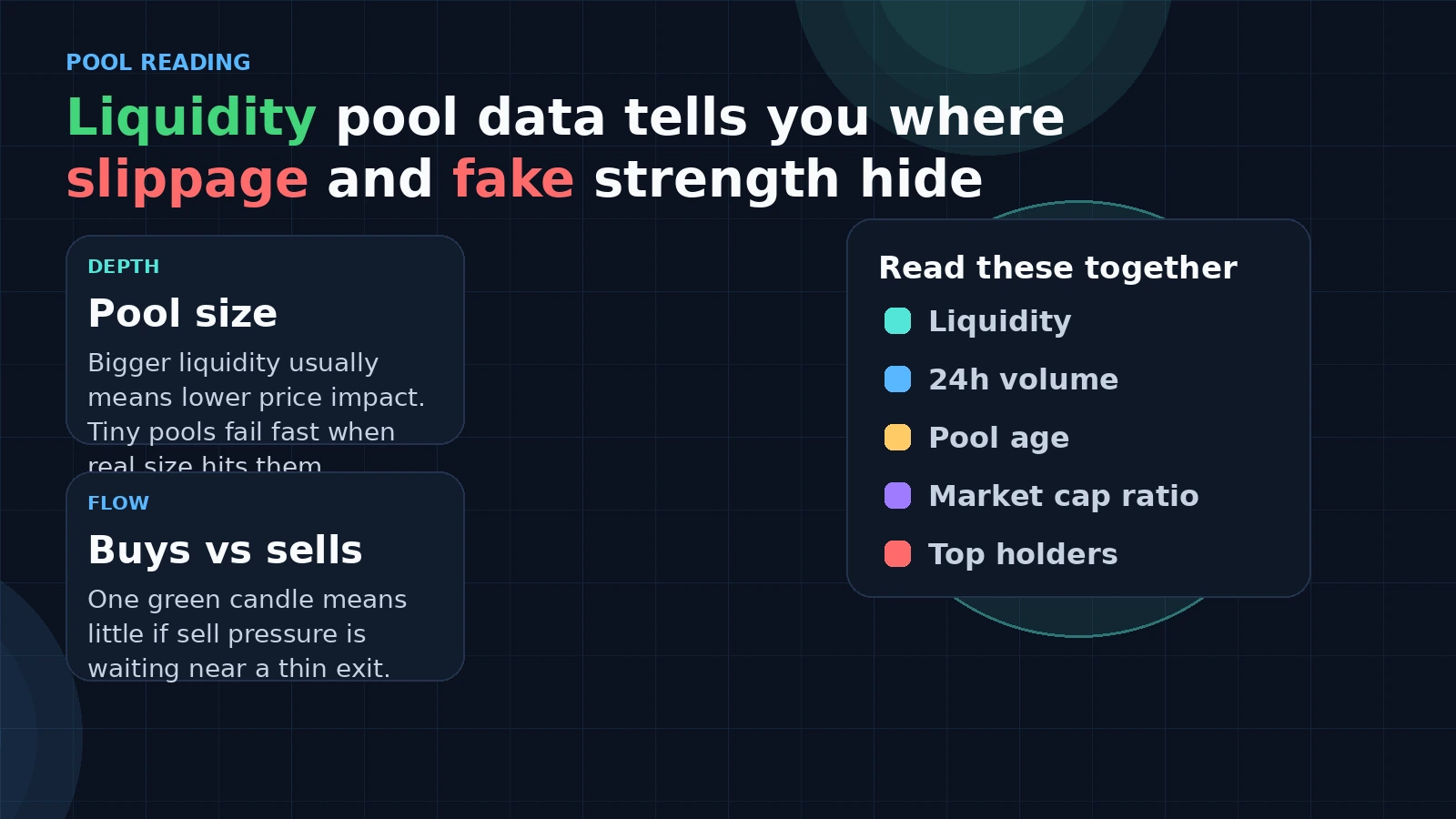
The pool is telling you three things at once
1. Start With Liquidity Depth
The first filter is the simplest one. If the pool is small, price impact grows fast as order size grows. That does not only matter for whales. It matters for ordinary retail size too when the pool is weak enough.
Traders sometimes fall in love with percentage moves and forget that thin liquidity exaggerates everything. A tiny pool can print impressive candles because it does not take much capital to push the price around. The same weakness shows up on the way out. If the pair cannot absorb sellers, a normal exit can turn into ugly slippage very quickly.
There is no perfect universal liquidity number because context matters. But the mindset is consistent: deeper pools usually give cleaner execution. If a pair has tiny liquidity relative to the attention it is getting, treat that as risk, not as hype.
2. Volume Matters, but Volume Quality Matters More
A 24-hour volume number looks impressive until you ask how it was built. Was it steady, organic participation across the session, or one short burst that faded immediately? Was the pair actively two-way traded, or did it print a spike that now has no real follow-through?
High volume can be healthy, but only if it behaves like real market activity. Thin volume means the pair can trap late buyers. Artificial-looking bursts can create a false sense of demand. When evaluating a pool, the better question is not simply, "Is the volume high?" It is, "Would I still trust this market if I had to sell after momentum cools off?"
Healthy volume usually looks like
3. Compare Liquidity With Market Cap, Not Just With Hope
One of the easiest sanity checks is comparing liquidity with the pair's headline valuation. If the market cap looks huge but the usable liquidity is tiny, the market can still be dangerously fragile. A high headline number does not automatically mean tradability.
This is especially useful in memecoin and lower-cap DeFi environments, where a pair can look large on paper while remaining structurally weak. If modest size can move the pair hard, the valuation is less impressive than it first appears.
4. Pool Age and Holder Shape Matter More Than People Admit
A brand-new pool is not automatically bad, but it does deserve more caution. New pools can move violently, change character fast, and rely heavily on the behavior of a small number of holders. If the holder base looks concentrated, the risk of sudden supply hitting the pool is higher.
This does not mean every new pair is untradable. It means new pools deserve stricter standards. Smaller size, faster risk management, and tougher selectivity are reasonable responses. The older and more stable the pool, the more evidence you have that the market can survive beyond its launch excitement.
5. Route the Exit Before You Buy
This is the habit that separates curious traders from serious ones. Before entering, ask a brutal question: if I needed to sell this position quickly, would the market still work for me?
Most losses feel manageable on the way in because entries happen during optimism. Exits happen during uncertainty. If the pool is thin, if volume is shallow, or if sellers are likely to arrive together, your exit quality can degrade exactly when you need it most. That is why good pool analysis is really exit analysis in disguise.
Common Red Flags in Liquidity Pool Analysis
A Simple Checklist Before Buying a DEX Pair
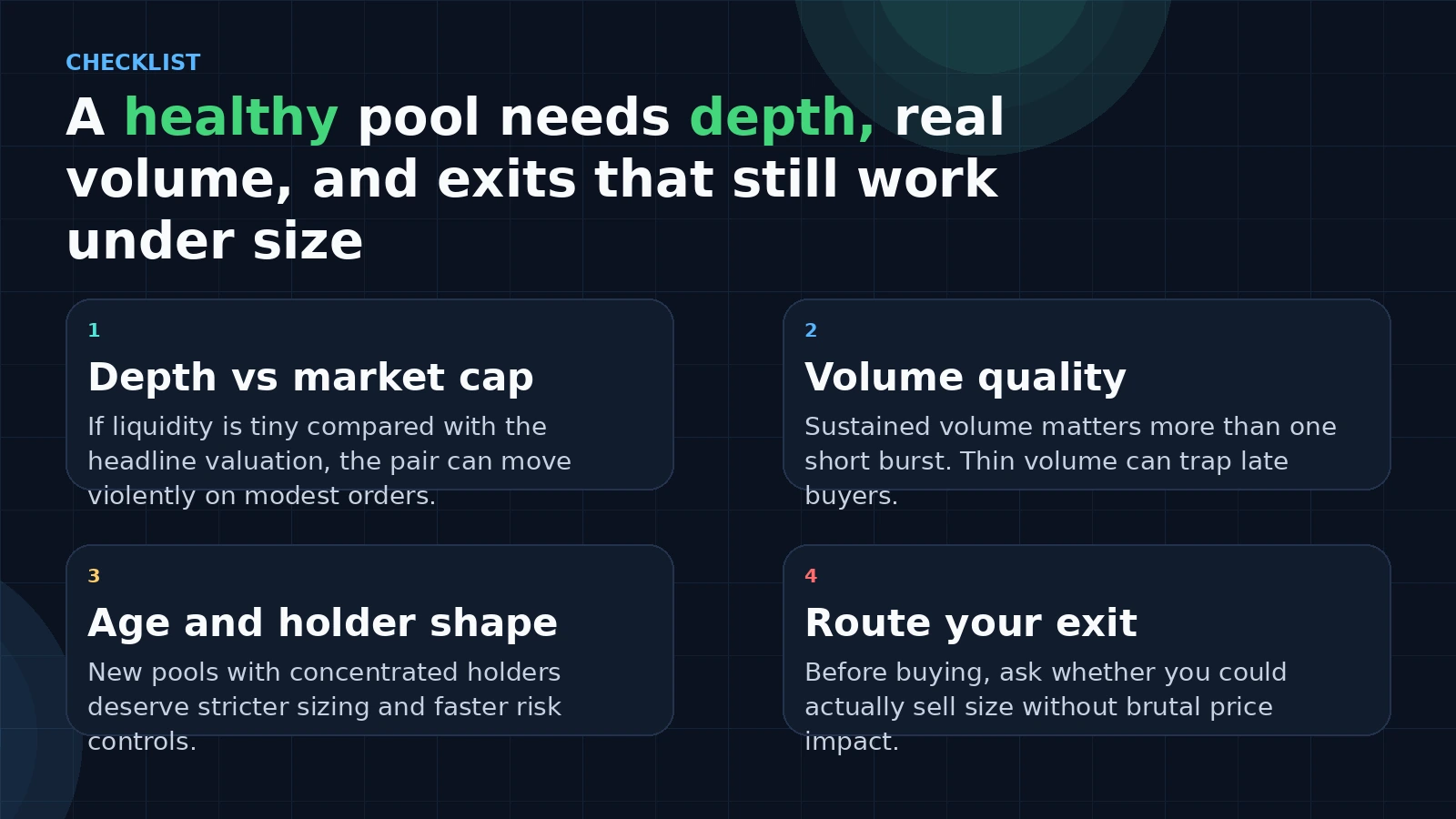
- How much liquidity is actually available?
- Is 24-hour volume consistent or just one burst?
- Does the liquidity level make sense relative to valuation?
- How old is the pool, and how concentrated are holders?
- Could you exit your real size without brutal slippage?
- If the answer feels uncertain, should the size be smaller or the trade skipped?
Frequently Asked Questions
Q Why is liquidity pool size important for traders?
Because pool size affects price impact and exit quality. A deeper pool usually means cleaner execution, while a tiny pool can move sharply on relatively small orders.
Q What should I check besides liquidity in a pool?
Check 24-hour volume, pool age, holder concentration, and whether liquidity makes sense relative to the pair's valuation. Together, those clues help show whether the market is durable or fragile.
Q Can high volume hide a weak liquidity pool?
Yes. A short volume spike can make a pair look healthier than it is. Volume quality matters more than one burst if you care about sustainable tradability.
Q How do I know if a pool is too risky to trade?
If liquidity is tiny, exits look thin, holders are concentrated, or the pair only showed one short burst of activity, the safer answer may be smaller size or no trade at all.
Q What is the main mistake beginners make with liquidity pools?
They focus on the chart and ignore the exit. A pair can look strong on the way up while still being structurally weak when it is time to sell.
Related Guides
- How to Check Liquidity Lock Before Buying a Token: Unlock Risk and Locker Verification (2026)
- How to Check if a Token Can Be Sold (2026)
- How to Check Buy and Sell Tax Before Buying a Token (2026)
- How to Read Token Unlocks Before Buying in 2026
- How to Verify Token Safety Before Buying: A Pre-Buy Crypto Checklist
- The Silent LP Exit
- Avoid Buying Old Token Contracts Post