Median Trade Size vs Trade Count: Why Small Swaps Can Inflate DEX Activity
— By Whatsertrade in Tutorials

DEX activity is often measured by trade count. If a token or pool has thousands of trades in a short period, it may look active, popular and liquid. Traders may
DEX activity is often measured by trade count. If a token or pool has thousands of trades in a short period, it may look active, popular and liquid. Traders may assume that high trade count means strong demand.
But trade count alone can be misleading.
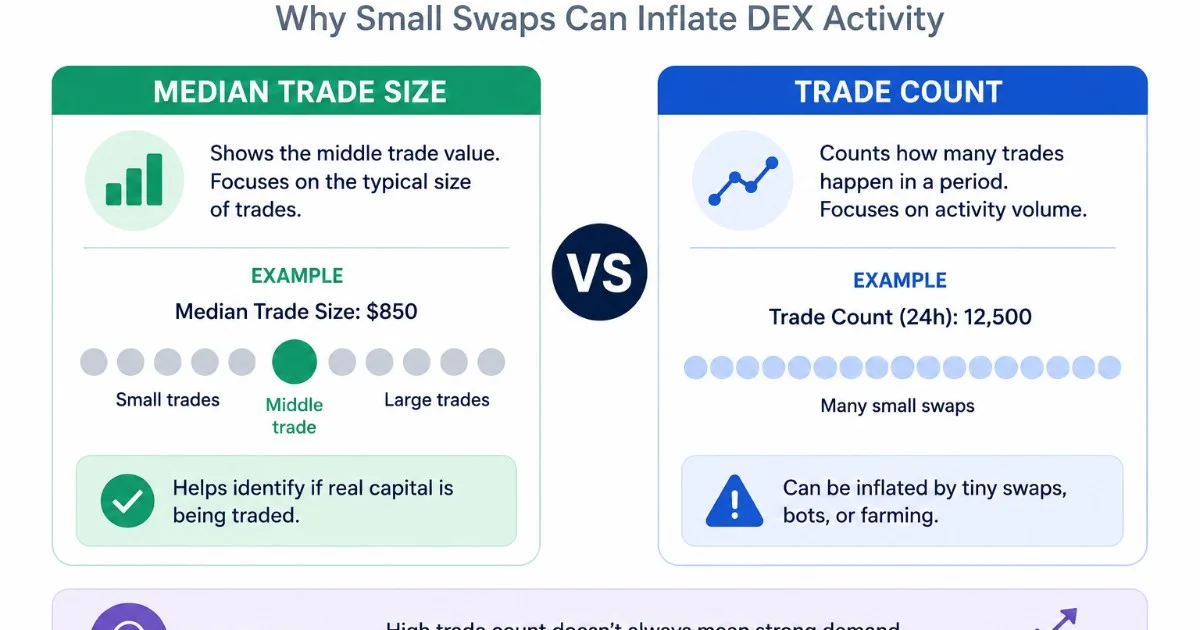
A token can have many small swaps without meaningful capital entering the market. Bots, airdrop farmers, reward hunters and low value traders can create high transaction activity while real economic demand remains weak.
This is why median trade size matters. It helps traders understand whether activity comes from meaningful trades or from many tiny swaps.
Understanding median trade size vs trade count can help traders avoid overestimating DEX activity.
What Is Trade Count?
Trade count measures the number of swaps or trades executed over a period.
For example, if a token has 5,000 swaps in 24 hours, its trade count is high. This may suggest interest, visibility and active market participation.
Trade count is useful because it shows how often users interact with a token pair.
However, it does not show the size of those trades.
A market with 5,000 tiny swaps may be less meaningful than a market with 500 larger trades.
What Is Median Trade Size?
Median trade size shows the middle trade value in a set of trades.
If half of the trades are larger and half are smaller, the median gives a better sense of typical trading behavior.
Median trade size can be more useful than average trade size because a few very large trades can distort the average.
For DEX analysis, median trade size helps traders understand what a normal trade looks like in that market.
Median Trade Size vs Trade Count: The Key Difference
The key difference is quality vs quantity.
Trade count shows how many trades happened. Median trade size shows the typical value of those trades.
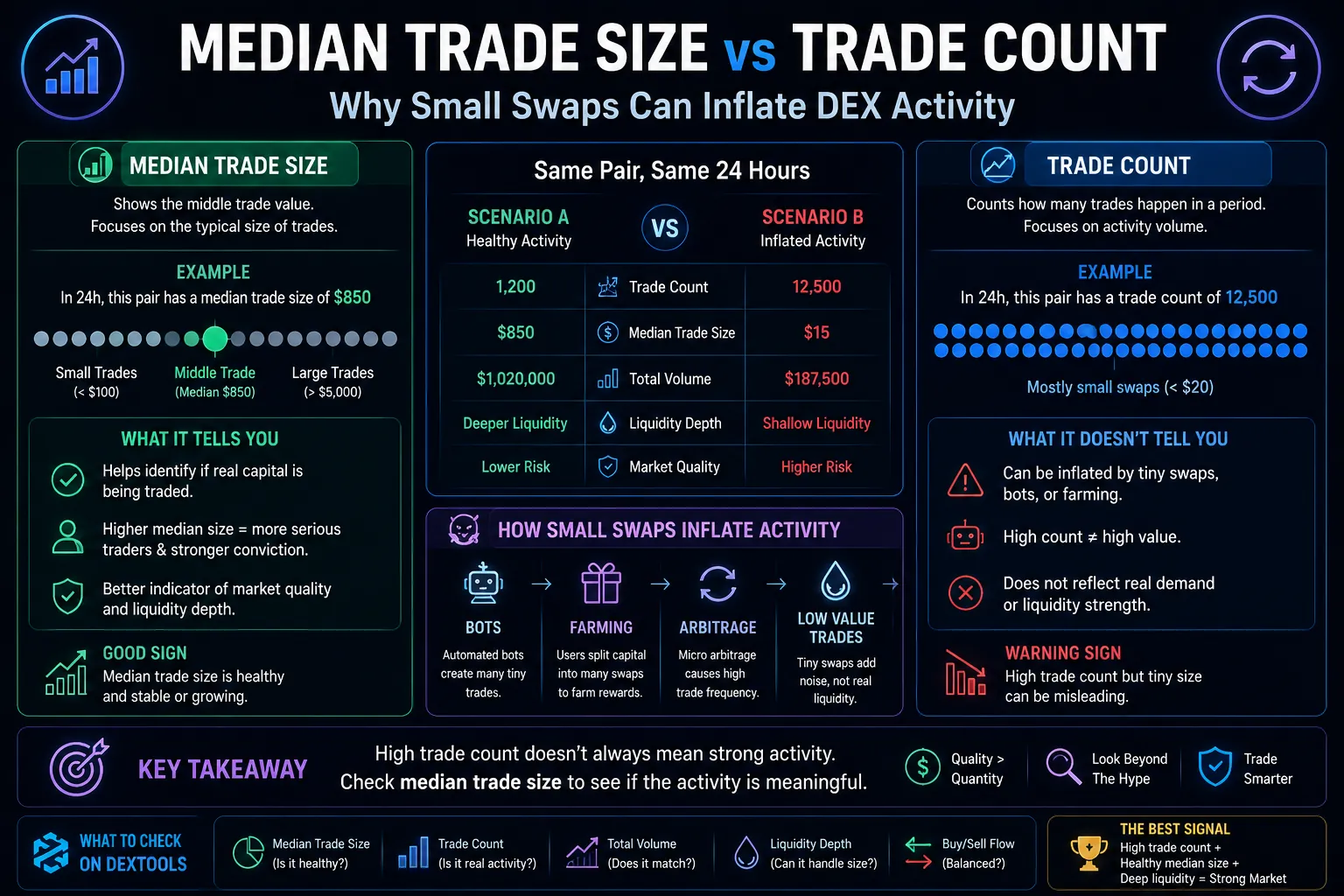
High trade count can indicate activity, but it does not always mean strong demand. High median trade size can suggest that users are trading with meaningful capital.
The strongest signal usually appears when both metrics are healthy.
Why High Trade Count Can Be Misleading
High trade count can be inflated by small swaps.
Some users may make many tiny trades to qualify for rewards, airdrops or ranking systems. Bots may create repeated transactions to simulate activity. Low value arbitrage can also increase trade count without showing real trader conviction.
This can make a token look more active than it really is.
If trade count is high but median trade size is extremely low, traders should be cautious.
Why Median Trade Size Matters
Median trade size gives context to DEX activity.
If a token has many trades and a healthy median trade size, it suggests that real capital is moving through the market. Traders are not only clicking or farming. They are placing meaningful orders.
If the median trade size is low, activity may be shallow.
This matters because real demand is usually reflected in both transaction frequency and trade value.
Small Swaps Are Not Always Bad
Small swaps are not automatically negative.
They can reflect retail participation, testing, wallet onboarding or early community activity. A token with many small trades may still be gaining attention.
The problem is when small swaps dominate the entire market and create a false impression of depth.
A healthy market can have small and large trades. A fragile market may have mostly tiny swaps and little serious capital.
What Healthy DEX Activity Looks Like
Healthy DEX activity may include:
Consistent trade count.
Reasonable median trade size.
Balanced buy and sell activity.
Growing liquidity.
Low slippage for normal trades.
Organic volume across time.
A mix of retail and larger participants.
If trade count rises while median trade size also grows, the market may be attracting stronger demand.
If trade count rises while median trade size falls, activity may be becoming lower quality.
Why This Matters for Token Traders
Traders often use activity metrics to decide whether a token is gaining traction.
A token with high trade count can appear popular, but if trades are tiny, the market may not support larger entries or exits.
This can lead to poor execution, high slippage and sudden volatility.
Before entering a position, traders should ask whether the activity is meaningful enough to support real liquidity.
How DEXTools Can Help
DEXTools can help traders review live token activity, liquidity, volume, pair data and transaction flow.
Instead of looking only at the number of swaps, traders can study the size and quality of recent trades.
This helps separate real market participation from inflated activity.
Final Thoughts
Median trade size and trade count reveal different parts of DEX activity.
Trade count shows how busy a market is. Median trade size shows how meaningful the typical trade may be.
For traders, high activity is not enough. The better question is whether that activity represents real capital, real demand and real liquidity.
In DEX trading, many small swaps can create noise. Meaningful trade size creates stronger signals.
How to Bridge Crypto Between Chains: Complete Cross-Chain Tutorial 2026 How to Use 1inch for Swaps: Classic, Fusion and Limit Orders (2026) OKX Web3 Wallet Tutorial 2026: Multi-Chain Setup GuideBeyond the Metrics: Decoding "Wash Trading" and Its Impact
While an abundance of small trades might simply reflect a highly divisible token or a community of micro-investors, it can also be a red flag for more manipulative practices. One such practice is "wash trading," where a single entity or a coordinated group of entities repeatedly buys and sells the same asset to themselves. This creates an illusion of high trading volume and liquidity, attempting to entice legitimate traders and investors.
The motivation behind wash trading is often to manipulate price or to attract attention to a less-known asset. By artificially inflating volume, bad actors hope to create a "fear of missing out" (FOMO) effect, prompting others to buy in. Once enough genuine interest is generated and the price rises, the manipulators can then unload their holdings at a profit, leaving later investors with potentially devalued assets.
Practical Steps for Due Diligence
As a DEXTools user, you have powerful tools at your disposal to identify potential wash trading and make more informed decisions. Here are some actionable steps:
- Examine the "Top Traders" or "Whales" section for a pool. A disproportionate number of trades originating from a very small set of wallets might indicate coordination.
- Look at the average trade size over time. A sudden and sustained drop in median trade size, especially when coupled with a massive increase in trade count, warrants scrutiny.
- Observe the spread between buy and sell orders. In truly liquid markets, this spread is usually tight. An artificially high volume from wash trading might still exhibit a wide spread if genuine demand is low.
- Cross-reference DEXTools data with other on-chain analytics tools to look for unusual wallet behavior, such as rapid transfers between a small number of addresses.
- Consider the token's fundamentals. Is there genuine utility, a strong community, and ongoing development? Or does the trading activity seem to be the primary narrative?
Related Guides
- Position Size vs Pool Size: How Much Is Too Much to Trade on a DEX?
- How to Trade on Raydium: Solana Swaps, Entries and Execution Guide (2026)
- Dark AMMs and Hidden Liquidity: Why Some DEX Activity Is Harder to Read
- How to Use Raydium on Solana: Swaps, Liquidity Pools and CLMM Guide (2026)
- How to Use 1inch for Swaps: Classic, Fusion and Limit Orders (2026)
Frequently Asked Questions
Why can a high trade count be misleading on a DEX?
A large number of trades can come from many tiny swaps that move very little value, so the count alone can make a pool look more active than it really is. Looking at trade size alongside count gives a clearer picture of genuine activity.
What does median trade size tell you about a token?
Median trade size shows the typical value of a swap and is less distorted by a few very large or very small trades than an average. A low median paired with a high count can suggest activity is driven by small or automated transactions.
Can small swaps be used to fake activity?
Yes, repeated small swaps can be generated to inflate trade counts and create an impression of demand, which is one form of wash style or artificial activity. Combining several metrics makes this harder to disguise.
How should traders combine trade count with other metrics?
It helps to read trade count together with trade size, total volume, unique wallets, and liquidity, since no single number tells the whole story. Cross checking metrics reduces the chance of being misled by inflated activity.