What Is a Whale in Crypto? How Big Holders Move It
— By Tony Rabbit in Tutorials

Whales in crypto explained: how large holders move markets, the tracking tools traders use like Arkham and Nansen, and how to protect yourself.
If you have spent any time in crypto, you have probably heard someone say "the whales are moving." But what is a whale in crypto, and why should you care? In short, a crypto whale is any individual or entity holding a massive amount of a given cryptocurrency, typically worth $10 million or more. These big holders have the power to shift prices, trigger liquidation cascades, and reshape entire markets with a single transaction.
Understanding whale behavior is one of the most important skills you can develop as a trader. Whether you are trading Bitcoin, Ethereum, or the latest memecoin, whale activity directly impacts the price action you see on your charts. In this guide, we will break down everything you need to know about crypto whales in 2026: who they are, how they operate, and most importantly, how you can track and defend against their market-moving plays.

What Is a Whale in Crypto?
A crypto whale is a wallet or entity that holds enough of a cryptocurrency to influence its market price through buying or selling. While the exact threshold varies depending on the asset, the general consensus in 2026 is:
- Bitcoin whales: Wallets holding 1,000+ BTC (roughly $70M+ at current prices)
- Ethereum whales: Wallets holding 10,000+ ETH
- Altcoin/memecoin whales: Any wallet holding enough tokens to move the price significantly, often just $100K-$1M for low-cap tokens
- General definition: Any entity with $10M+ in a single cryptocurrency
The term comes from traditional finance, where large institutional investors were called whales because their trades created waves that smaller fish (retail traders) had to navigate. In crypto, the effect is amplified because markets are smaller, more volatile, and operate 24/7 with no circuit breakers.
Crypto Holder Classification
To truly understand whale impact, you need to grasp how liquidity works in crypto markets. Thin order books mean that a single large order can move price far more dramatically than in traditional stock markets.
Types of Crypto Whales
Not all whales are the same. Understanding the different types helps you interpret on-chain data more accurately and predict how each type might behave.
Individual Whales (OG Holders)
These are early adopters who accumulated massive positions when prices were low. They include early Bitcoin miners, ICO participants from 2017, and DeFi farmers from 2020-2021. Individual whales tend to be less predictable than institutional whales because their decisions are personal and can be emotional. Some hold for years without moving a single token, while others actively trade their positions.
🔑 Key Point
Understanding this concept is fundamental to navigating the crypto ecosystem. Take your time with each section before moving on.
🔑 Key Point
Understanding this concept is fundamental to navigating the crypto ecosystem. Take your time with each section before moving on.
Institutional Whales
Hedge funds, venture capital firms, family offices, and publicly traded companies that hold large crypto positions. In 2026, institutional whales include firms like MicroStrategy, various Bitcoin ETF providers, and crypto-native funds. These whales tend to follow structured strategies: dollar-cost averaging in, rebalancing quarterly, or hedging with derivatives. Their moves are often more predictable if you know where to look.
Exchange Whales
Centralized exchanges like Binance, Coinbase, and Kraken hold enormous amounts of crypto in their hot and cold wallets on behalf of users. While these are custodial holdings rather than proprietary positions, massive movements from exchange wallets often signal incoming sell pressure (users depositing to sell) or accumulation (users withdrawing to hold). Learning to read blockchain explorers like Etherscan and Solscan is essential for tracking exchange flows.
Dormant Whales
These are wallets that have not moved their holdings in years. When a dormant whale suddenly becomes active, it can send shockwaves through the market. For example, when a wallet that has been inactive since 2013 suddenly moves 5,000 BTC to an exchange, traders panic because it often signals an intent to sell. Tracking dormant whale awakening is a key part of on-chain analysis.
Protocol and DAO Treasuries
Many DeFi protocols and DAOs hold massive treasuries in their native tokens. The Ethereum Foundation, for instance, periodically sells ETH to fund operations. These treasury wallets are often publicly known, making their movements easier to track but no less impactful on price.
Famous Crypto Whales
Several whales have become legendary in the crypto space, and their holdings are closely watched by the entire market.
Satoshi Nakamoto is the biggest whale of all, with an estimated 1.1 million BTC mined in Bitcoin's earliest days. These coins have never moved, and any transaction from a Satoshi-era wallet makes global headlines. The sheer size of this dormant holding, worth tens of billions of dollars, creates a permanent overhang of potential supply.
Vitalik Buterin, co-founder of Ethereum, holds significant ETH and is known for occasionally moving tokens, often to donate to charitable causes or to burn memecoins sent to his wallet. His on-chain activity is watched by millions.
Michael Saylor and MicroStrategy represent the most famous institutional whale. As of 2026, MicroStrategy holds over 400,000 BTC, making it the largest publicly traded corporate holder. Saylor's purchase announcements routinely move Bitcoin's price, and tracking MicroStrategy's SEC filings has become a whale-watching strategy in itself.
Exchange cold wallets from Binance, Coinbase, and Bitfinex collectively hold millions of BTC and ETH. These are the largest single wallets on most blockchains, and their inflows/outflows are tracked in real time by analytics platforms.
You can verify many of these holdings yourself by learning to do your own research (DYOR) on crypto tokens using public blockchain data.
How Whales Move Markets
This is where things get critical for your trading. Whales do not just passively hold crypto. They actively move markets through several mechanisms, and understanding these is essential if you want to day trade crypto effectively.
Large Market Orders
The most direct method. When a whale places a massive buy or sell order, it eats through the order book, moving the price significantly. A single $50M market sell order on a token with $200M daily volume can crash the price 10-20% in minutes. This is why understanding market cap and its relationship to liquidity matters so much.
🔑 Key Point
This is where most people stop reading. If you made it this far, you understand more than 90% of crypto users. The next step is to actually try it with a small amount.
Spoofing and Layering
Some whales place large limit orders they never intend to fill. A whale might place a $20M buy wall at a key support level to create confidence, encouraging retail traders to buy. Once the price rises, the whale cancels the buy wall and sells into the rally. This is illegal in traditional markets but remains common in largely unregulated crypto markets.
Accumulation and Distribution
Smart whales rarely buy or sell all at once. Instead, they accumulate slowly over weeks or months, using algorithms to break large orders into thousands of smaller trades to avoid detection. Distribution works the same way in reverse: selling gradually to avoid crashing the price before their entire position is liquidated. Learning to read crypto charts can help you spot accumulation and distribution patterns over time.
🔑 Key Point
This is where most people stop reading. If you made it this far, you understand more than 90% of crypto users. The next step is to actually try it with a small amount.
OTC (Over-the-Counter) Deals
Many whale transactions happen off-exchange through OTC desks. These trades do not directly impact the order book, but they signal that large players are entering or exiting positions. When OTC premiums increase, it often means whales are aggressively accumulating, which typically precedes a price move up.
Liquidity Manipulation
Whales can pull liquidity from decentralized exchanges, add or remove liquidity at strategic price levels, or even manipulate the price of tokens used as collateral on lending platforms to trigger cascading liquidations. This is particularly dangerous in DeFi, where smart contracts execute automatically based on price feeds.

How to Track Crypto Whales
The beauty of blockchain technology is that most transactions are publicly visible. While whales can try to hide their activity through multiple wallets, the right tools make it possible to follow the money. Using whale tracking tools is no longer optional for serious traders in 2026.
Arkham Intelligence
Arkham is one of the most powerful whale-tracking platforms available. It uses AI and machine learning to de-anonymize blockchain wallets, connecting on-chain addresses to real-world entities. You can set up alerts for specific wallets, track fund flows between entities, and see historical transaction patterns. Arkham's entity labeling makes it easy to see when a known fund or individual moves large amounts.
Nansen
Nansen labels millions of wallets with "Smart Money" tags, identifying wallets that have historically been profitable. Their whale tracking dashboards show you what the biggest and smartest wallets are buying and selling in real time. Nansen is particularly useful for tracking DeFi whale activity, including LP positions, governance votes, and token approvals.
DeBank
DeBank provides a comprehensive portfolio view of any wallet address across multiple chains. It is particularly useful for tracking whale DeFi positions, seeing their yield farming strategies, and understanding their cross-chain exposure. If you want to see exactly what positions a whale holds and where their capital is deployed, DeBank is the go-to tool.
Whale Alert
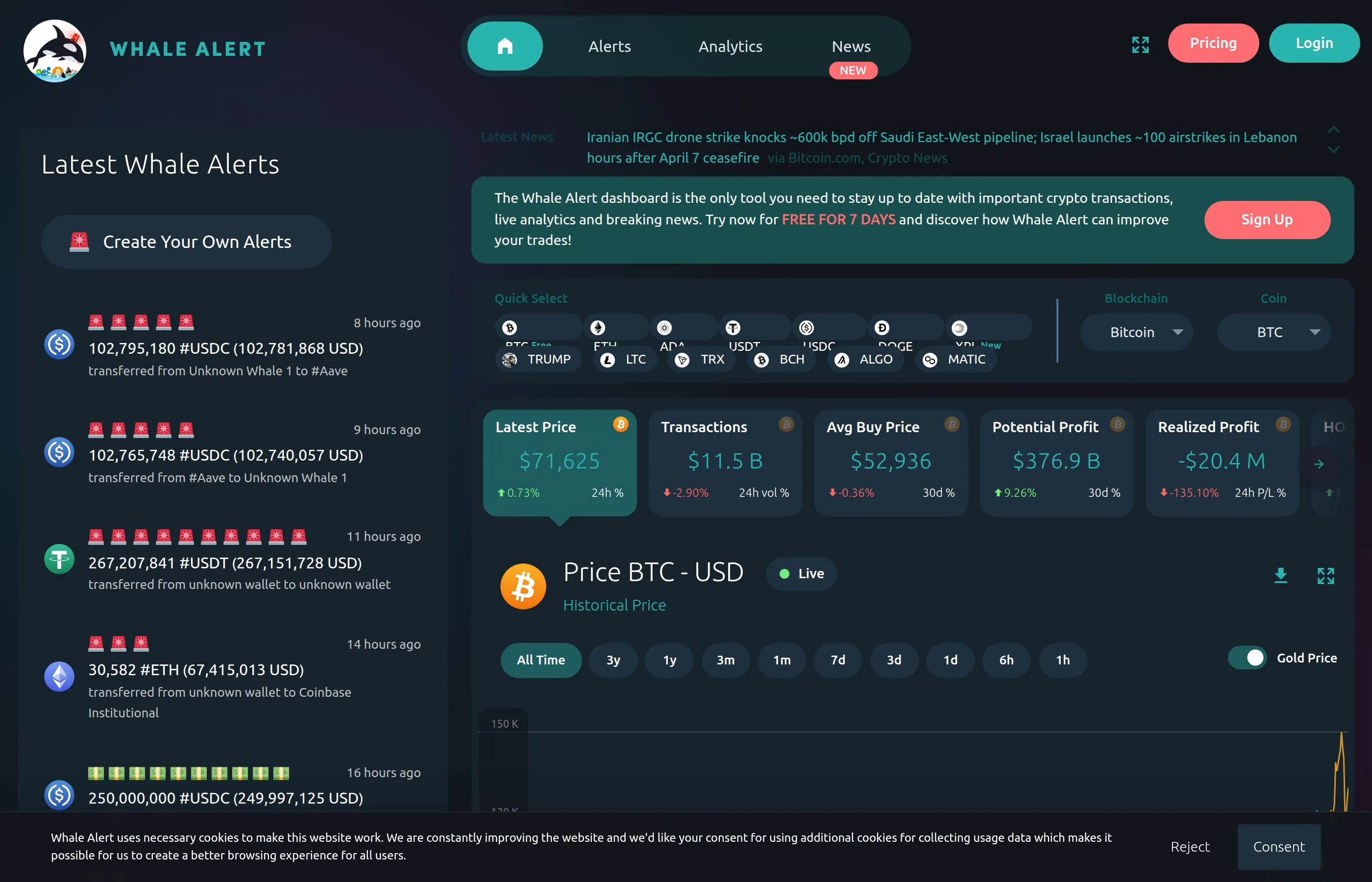
Whale Alert is the most well-known real-time whale tracking service. It monitors major blockchains and tweets whenever a large transaction occurs (typically $1M+). While it provides less context than Arkham or Nansen, its real-time alerts are invaluable for catching whale moves as they happen. Many traders use Whale Alert notifications as an early warning system.
On-Chain Analysis with DEXTools and Bubblemaps
For memecoin and altcoin traders, DEXTools provides real-time trade data showing the largest buys and sells on decentralized exchanges. You can see exactly when a whale enters or exits a position on a DEX. Combine this with Bubblemaps to visualize token holder distribution and detect whether multiple wallets are controlled by the same entity. This combination is extremely powerful for spotting potential rug pulls and pump-and-dump schemes.
Whale Wallet Watching Strategy
Simply knowing that whales exist is not enough. Here is a practical strategy for incorporating whale tracking into your trading approach. Understanding how smart money wallet tracking works will give you a significant edge.
Step 1: Build Your Whale Watch List
Start by identifying 10-20 whale wallets that are relevant to the tokens you trade. Use Arkham or Nansen to find wallets with strong historical performance. Focus on wallets that are actively trading (not dormant) and that trade in the same market segments you do.
Step 2: Set Up Real-Time Alerts
Configure alerts on Arkham, Nansen, or Whale Alert for your watch list. You want to know immediately when a tracked whale makes a significant move. Most platforms offer Telegram and Discord notifications, which provide faster alerts than email.
Step 3: Analyze the Context
When a whale alert triggers, do not react immediately. Instead, ask yourself: What is the whale doing? Are they moving tokens to an exchange (potentially bearish) or withdrawing from an exchange (potentially bullish)? Are they interacting with a DeFi protocol? Are they splitting tokens across multiple wallets (potentially trying to hide distribution)?
Step 4: Cross-Reference Multiple Signals
A single whale move is just one data point. Look for confluence: Are multiple whales making similar moves? Does the on-chain activity align with the technical chart pattern? Are there any upcoming catalysts (token unlocks, protocol upgrades, regulatory announcements) that explain the whale behavior?
Step 5: Size Your Response Appropriately
Even confirmed whale activity does not guarantee a particular price outcome. Use whale signals as one input in your decision-making process, not as a standalone trading strategy. Adjust your position size based on your conviction level and always manage your risk.
Whale Manipulation Tactics to Watch For
Not all whale activity is straightforward buying and selling. Some whales deliberately manipulate markets for profit, and recognizing these tactics can save you from becoming exit liquidity.
Pump and Dump
The classic manipulation scheme. A whale (or coordinated group) accumulates a large position in a low-liquidity token, then promotes it aggressively through social media, paid influencers, and fake news. As retail traders pile in, the whale sells their entire position at inflated prices, crashing the token. This is extremely common with memecoins and microcap altcoins.
Wash Trading
Whales trade between their own wallets to create the illusion of high volume and interest. This makes a token appear more active and liquid than it actually is, attracting unsuspecting traders. On decentralized exchanges, wash trading is easier to execute because there are no KYC requirements.
Bear Raids
A whale deliberately crashes the price by dumping a large position, triggering stop losses and liquidations from leveraged traders. Once the cascade of forced selling is complete and the price has cratered, the whale buys back at much lower prices. The whale ends up with more tokens than they started with, at the expense of leveraged traders who got liquidated.
Front-Running
In DeFi, whales with technical knowledge can see pending transactions in the mempool and place their own transactions ahead of them, profiting from the expected price impact. MEV (Maximal Extractable Value) bots operated by whale-level entities extract billions from regular DeFi users annually through sandwich attacks and front-running.
Coordinated Wallet Splitting
To avoid detection, sophisticated whales distribute their holdings across dozens or even hundreds of wallets. They accumulate through many small wallets and then sell from different wallets, making it harder for whale trackers to identify the coordinated activity. This is where tools like Bubblemaps become invaluable, as they can visualize connections between seemingly unrelated wallets.
How Whales Affect Memecoins vs Blue Chips
Whale impact varies dramatically depending on the type of cryptocurrency. The difference between how a whale moves a memecoin versus how they move Bitcoin is night and day.
Memecoins and Microcaps
In the memecoin world, a single whale can control the entire market. A token with $5M in liquidity can be completely destroyed by one wallet selling $500K. Whale concentration in memecoins is typically extreme, with the top 10 wallets often holding 50-80% of the supply. Before trading any memecoin, you should check holder distribution using tools like DEXTools and Bubblemaps. Understanding liquidity in memecoin trading is non-negotiable.
Common memecoin whale patterns include: deployers holding large percentages through multiple wallets, coordinated buys at launch to create FOMO, and slow distribution through dozens of wallets to avoid triggering sell alerts. The vast majority of memecoin "rugs" are simply whale distribution events.
Blue Chips (BTC, ETH, SOL)
For large-cap cryptocurrencies, individual whale impact is diluted but still significant. A single Bitcoin whale cannot crash BTC the way a memecoin whale can crash a microcap, but coordinated whale activity absolutely moves the price. Bitcoin whale behavior tends to follow macro cycles: accumulation during bear markets, distribution during euphoric bull markets. The key difference is that blue chip whale activity takes longer to play out, often over weeks or months rather than minutes or hours.
Mid-Caps and DeFi Tokens
Mid-cap tokens sit in a dangerous middle ground. They have enough liquidity that small retail traders cannot move the price, but not enough that whales cannot dominate. Many of the most profitable whale manipulation strategies target mid-cap DeFi tokens, where the whale can accumulate a controlling position without it being immediately obvious, then use governance votes or large trades to profit.
Defending Against Whale Manipulation
You cannot prevent whales from moving markets, but you can protect yourself from being exploited by their activity.
Always Check Token Distribution
Before buying any token, check the holder concentration. If the top 10 wallets hold more than 40-50% of the supply (excluding known exchange and contract wallets), the token is vulnerable to whale manipulation. Use Bubblemaps and block explorers to verify that large wallets are not connected to each other.
Use Limit Orders, Not Market Orders
Market orders in thin liquidity give whales the power to front-run and sandwich attack you. Use limit orders to control your entry and exit prices, especially on decentralized exchanges where MEV exploitation is common.
Set Reasonable Stop Losses
Do not place stop losses at obvious round numbers or well-known support levels. Whales specifically target these levels to trigger cascading liquidations. Place your stops at less predictable levels, or use mental stops instead of on-chain stop loss orders.
Avoid FOMO During Sudden Pumps
When a token suddenly pumps 50-100% on high volume, be cautious. This is often the distribution phase of a whale play, where the whale is selling into the retail FOMO they have created. Wait for a pullback and consolidation before entering, or skip the trade entirely.
Monitor Exchange Inflows
Rising exchange inflows for a token you hold is one of the most reliable bearish signals. When whales move large amounts of crypto to exchanges, they are usually preparing to sell. Set up alerts for exchange inflow spikes on the tokens in your portfolio.
Diversify Across Liquidity Tiers
Do not put your entire portfolio in low-liquidity memecoins where one whale can wipe you out. Balance your portfolio across different liquidity tiers, with a core in large-cap assets that are harder for individual whales to manipulate.
Whale Metrics: Measuring Concentration and Risk
Several quantitative metrics help you assess whale risk for any given cryptocurrency. Incorporating these into your DYOR process will sharpen your analysis.
Concentration Ratio
The concentration ratio measures what percentage of total supply is held by the top N wallets. A CR10 (top 10 wallets) above 50% is a red flag for most tokens. For Bitcoin, the CR10 is relatively low because the largest wallets are exchange custodial wallets holding funds for millions of users. For memecoins, a high CR10 almost always means whale dominance.
Gini Coefficient
Borrowed from economics, the Gini coefficient measures wealth inequality in token distribution on a scale from 0 (perfectly equal) to 1 (one entity holds everything). Most cryptocurrencies have Gini coefficients above 0.9, indicating extreme concentration. Lower Gini coefficients generally indicate healthier distribution and less whale risk.
Whale Transaction Count
Platforms like Glassnode and IntoTheBlock track the number of transactions above $100K or $1M for major cryptocurrencies. Spikes in whale transaction count often precede major price moves. A sudden increase in large transactions during a period of low retail activity is a strong signal that smart money is positioning.
Exchange Whale Ratio
This metric compares the size of the top 10 exchange inflows to total exchange inflows. When the exchange whale ratio rises above 0.85-0.90, it suggests that a few large players are dominating exchange deposits, which historically precedes sell pressure.
Realized Cap HODL Waves
This metric breaks down Bitcoin's realized capitalization by the age of coins. When old coins (held 1-2+ years) start moving, it indicates long-term whale holders are becoming active. Historically, increased movement of old coins has coincided with market cycle tops.
Pros and Cons of Whale Activity
Whale activity is not inherently good or bad. Like most things in crypto, it has both positive and negative effects on the market.
Pros of Whale Activity
- Liquidity provision: Whale buy and sell orders add depth to order books, making it easier for everyone to trade with less slippage
- Price discovery: Whales often have superior research and information, and their buying/selling helps the market reach fair value faster
- Market confidence: Visible accumulation by known smart money whales can boost confidence in a project and attract additional investment
- Ecosystem funding: Whale investors often provide early funding for DeFi protocols, infrastructure projects, and ecosystem development
- Stability during crashes: During extreme sell-offs, whale accumulation can provide a floor for prices and prevent further panic selling
Cons of Whale Activity
- Market manipulation: Whales can and do manipulate prices for personal gain, especially in unregulated or low-liquidity markets
- Retail exploitation: Many whale strategies directly profit from retail traders through front-running, sandwich attacks, and pump-and-dump schemes
- Centralization risk: High whale concentration undermines the decentralization ethos of cryptocurrency and creates single points of failure
- Governance capture: In token-based governance systems, whales can dominate votes and direct protocol development to benefit themselves
- Flash crashes: A single whale sell order can trigger cascading liquidations that wipe out leveraged traders in seconds
Whale Activity in 2026: Current Trends
The whale landscape in 2026 has evolved significantly from earlier years. Here are the key trends shaping whale behavior right now.
ETF-driven institutional whales have become the dominant force in Bitcoin and Ethereum markets. The spot Bitcoin and Ethereum ETFs approved in 2024 brought massive institutional capital into crypto through regulated vehicles. These ETF flows are now among the most important whale signals to track.
Cross-chain whale strategies are more sophisticated than ever. Whales routinely move capital between Ethereum, Solana, Base, and other chains to capture yield and arbitrage opportunities. Tracking a whale on just one chain gives you an incomplete picture in 2026.
AI-powered whale bots execute complex strategies across multiple exchanges and DEXs simultaneously. These algorithmic whales can accumulate or distribute positions across hundreds of wallets and dozens of venues, making them significantly harder to track with traditional tools.
Regulatory pressure is increasing on whale activity. Several jurisdictions have implemented large transaction reporting requirements, and on-chain analytics firms now work with law enforcement to identify market manipulation by whale entities.
Building Your Whale Tracking Toolkit
To effectively monitor whale activity, you need a combination of tools working together. Here is the recommended stack for 2026.
Start with the top whale tracking tools for real-time alerts and entity identification. Layer in DEXTools for DEX-level whale trade monitoring and Bubblemaps for visual holder analysis. Use blockchain explorers to verify individual transactions and wallet histories. And always cross-reference what you see on-chain with technical chart analysis to get the complete picture.
The combination of on-chain whale data with traditional technical analysis is what separates good traders from great ones. Neither approach works perfectly alone, but together they provide a comprehensive view of market dynamics.
Video Explainer
Watch this video for a visual walkthrough of the concepts covered above.

Frequently Asked Questions
What is a whale in crypto?
A crypto whale is any individual, institution, or entity that holds a large enough amount of a cryptocurrency to influence its market price. The general threshold is $10 million or more in a single asset, though for smaller tokens, wallets holding as little as $100K can have whale-level market impact.
How much crypto do you need to be considered a whale?
For Bitcoin, the commonly accepted threshold is 1,000+ BTC. For Ethereum, it is 10,000+ ETH. For altcoins and memecoins, the threshold depends on the token's market cap and liquidity. In general, holding enough to move the price by 1-2% with a single trade makes you a whale in that market.
Can whales crash the crypto market?
Yes. Large coordinated selling by whales can trigger cascading liquidations in the derivatives market, amplifying the sell-off far beyond the initial trade. In 2022 and subsequent market downturns, whale selling was a primary catalyst for major crashes. However, it is rare for a single whale to crash the entire market; usually it takes multiple large sellers or a triggering event.
How do I track crypto whale wallets?
Use platforms like Arkham Intelligence, Nansen, Whale Alert, and DeBank to monitor large wallet movements. These platforms label known wallets and provide real-time alerts when significant transactions occur. For DEX activity, tools like DEXTools and Bubblemaps are essential. Learn more with our guide on how smart money wallet tracking works.
Are whale movements bullish or bearish?
It depends on the direction and context. Whales moving crypto from exchanges to private wallets is generally bullish (they are holding, not selling). Whales depositing crypto to exchanges is generally bearish (they may be preparing to sell). However, you must analyze each movement in context. A whale depositing ETH to an exchange might be preparing to short, provide liquidity, or use it as collateral, not necessarily sell.
Do Bitcoin whales control the market?
Bitcoin whales have significant influence but do not fully control the market. Bitcoin has the most distributed ownership of any cryptocurrency, and the introduction of ETFs has further diversified the holder base. However, large whale movements still cause short-term price swings, and coordinated whale activity can define the direction of major market cycles.
What is whale manipulation in crypto?
Whale manipulation refers to tactics used by large holders to artificially influence prices for profit. Common methods include spoofing (placing fake orders to mislead traders), wash trading (trading between own wallets to fake volume), pump-and-dump schemes (inflating prices then selling), and bear raids (crashing prices to trigger liquidations and buy back cheaper).
How do whales hide their trades?
Whales use several techniques to obscure their activity: splitting holdings across many wallets, using OTC desks for off-exchange trades, utilizing privacy protocols and mixers, breaking large orders into thousands of small trades via algorithms, and routing through multiple DEXs across different chains. This is why sophisticated tracking tools are necessary.
Can I copy-trade crypto whales?
You can attempt to follow whale trades, but proceed with caution. By the time you see a whale's transaction on-chain, the price may have already moved. Whales also have different time horizons, risk tolerances, and capital sizes than retail traders. What works for a whale with $50M may not work for a retail trader with $5K. Use whale data as one signal among many, not as a direct copy-trading strategy.
What is the difference between a whale and a shark in crypto?
In the informal crypto hierarchy, a "whale" holds $10M+, a "shark" holds $1M-$10M, a "dolphin" holds $100K-$1M, and a "fish" holds $10K-$100K. These are not official designations but are widely used in the community and by analytics platforms to categorize wallet sizes.
Do whales affect memecoins more than Bitcoin?
Absolutely. Memecoins typically have far less liquidity and much higher holder concentration than Bitcoin. A whale with $500K can completely control a memecoin with $2M liquidity, while the same amount would have zero noticeable impact on Bitcoin. This is why memecoin trading requires extra diligence in checking holder distribution before entering a position.
What are whale alerts and should I follow them?
Whale alerts are real-time notifications of large cryptocurrency transactions, typically from services like Whale Alert on X (Twitter). While useful as an early warning system, raw whale alerts lack context. A $50M transfer might be an exchange rebalancing cold wallets (non-event) or a major investor preparing to sell (very bearish). Always investigate the source and destination of the transfer before reacting.
How do institutional whales differ from individual whales?
Institutional whales tend to trade more systematically, following structured strategies with predefined risk parameters. They often accumulate through DCA, rebalance on schedules, and hedge with derivatives. Individual whales may be more emotional and unpredictable. Institutional whales are also subject to regulatory reporting, making their activity somewhat more transparent through SEC filings and fund disclosures.
Is it legal for whales to manipulate crypto markets?
In most jurisdictions, the regulatory framework for crypto market manipulation is still evolving. While spoofing and wash trading are explicitly illegal in traditional securities markets, enforcement in crypto varies widely by country. In the United States, the CFTC and SEC have brought cases against crypto market manipulators, but enforcement remains inconsistent. As regulation tightens in 2026, more whale manipulation tactics are being classified as illegal.
Bottom line: Crypto whales are a permanent feature of the market, and their influence is not going away. Rather than fearing whales, educate yourself on their tactics, arm yourself with the right tracking tools, and develop strategies that account for their presence. The traders who succeed long-term in crypto are not the ones who ignore whale activity. They are the ones who understand it, monitor it, and use it to their advantage.