Exit Liquidity Signals: Spot Late Entry Risks
— By Whatsertrade in Tutorials

Learn to spot exit liquidity signals in crypto tokens using market data, liquidity analysis, wallet monitoring, and social media trends.
Every trader wants to find the next breakout before the crowd. But in crypto, many traders enter only after the easiest gains have already happened. By the time a token is trending everywhere, early buyers may already be preparing to sell.
That is when late buyers become exit liquidity.
Exit liquidity means you are buying from people who entered earlier and now want to leave. They need new buyers to absorb their sells. If you enter too late, you may provide the liquidity they need to take profit.
This guide explains how to spot exit liquidity signals using market behavior, wallet activity, volume, liquidity pools, and DEXTools data.
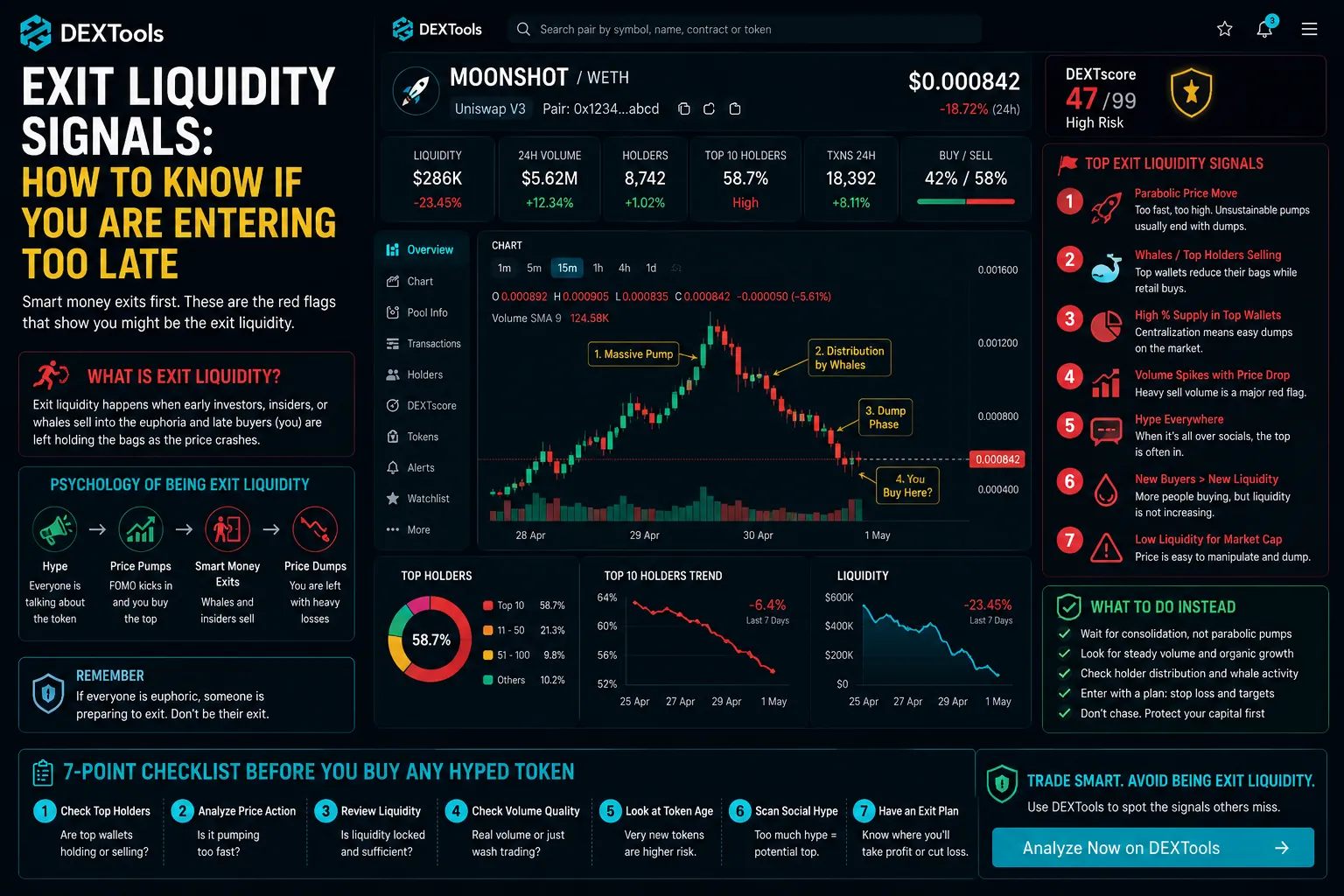
What Does Exit Liquidity Mean?
Exit liquidity refers to buyers who enter a market late and allow earlier holders to sell. It is not always a scam. Every market needs buyers and sellers. But the term becomes negative when late buyers are attracted by hype while insiders, whales, or early traders quietly exit.
In practical terms, you may be exit liquidity if:
- You buy after a large pump
- You enter because of influencer hype
- Top wallets are selling into strength
- Volume is rising but the price is struggling
- The token narrative is already overextended
- Liquidity is not deep enough for a safe exit
The goal is not to avoid every late trade. The goal is to recognize when reward no longer justifies risk.
Why Traders Enter Too Late
Late entries usually happen because of emotion. Traders see a token moving fast and fear missing out. Social media amplifies the pressure. Influencers post charts. Communities raid comment sections. Price screenshots spread quickly.
By the time retail attention peaks, early buyers may already have large unrealized gains.
Common reasons traders enter too late include:
- Fear of missing out
- Blind trust in influencers
- Trending list chasing
- Lack of wallet analysis
- Ignoring liquidity pools
- Buying after vertical candles
- Confusing popularity with opportunity
The market often feels safest when it is most crowded. That is the danger.
Signal 1: The Token Is Everywhere at Once
When a token suddenly appears across social media, chat groups, trending pages, and influencer feeds, it may already be late.
Attention is useful, but excessive attention can signal a crowded trade. The more people already know about the opportunity, the less early it may be.
Ask:
- Who is still left to buy?
- Are new buyers entering for research or hype?
- Did the token already move before the promotion?
- Are influencers early or late?
- Is the chart supporting the narrative?
A token can keep running after going viral, but risk increases as attention becomes saturated.
Signal 2: Influencers Promote After a Major Pump
Influencer promotion is not automatically bad. Some influencers share useful research. The problem starts when promotions arrive after the token has already made a large move.
Be careful when:
- Influencers post after a large green candle
- Multiple accounts use similar wording
- Posts focus on extreme price targets
- Risk is ignored
- Contract and liquidity details are missing
- Early wallets are already in profit
Late promotion can create demand for early holders to exit.
Before buying from influencer hype, check the chart first. If the token has already multiplied before the post, you may not be early.
Signal 3: Volume Rises but Price Stops Moving Up
Healthy buying pressure usually pushes price higher. If volume is increasing but price cannot continue upward, sellers may be absorbing demand.
This can be a major exit liquidity signal.
Look for:
- Large volume near resistance
- Repeated failed breakouts
- Big buys that do not move price much
- Price stalling despite hype
- Long upper wicks on candles
- Strong selling after every push
This pattern suggests that buyers are arriving, but sellers are using that demand to exit.
Signal 4: Top Wallets Start Selling
Wallet behavior is one of the strongest signals. If top holders are reducing positions while social media is becoming more bullish, be cautious.
Watch for:
- Large holders selling into pumps
- Tokens moving from top wallets to fresh wallets
- Transfers before marketing pushes
- Gradual distribution across many trades
- Wallets that bought early now taking profit
Not every whale sale means disaster. Profit taking is normal. But if multiple large holders are selling while retail hype increases, risk rises.
Signal 5: Liquidity Cannot Support the Hype
A token may have a large market cap on paper but weak liquidity in the pool. This creates a dangerous situation where many people think they can exit, but the pool cannot support them.
Check liquidity before entering. Ask:
- How much liquidity is available?
- Can large holders sell without crashing price?
- Is liquidity locked or unstable?
- Is most trading happening in one pair?
- Would your own exit create major price impact?
If liquidity is thin, you may be able to buy easily during hype, but exiting later can be much harder.
Signal 6: The Narrative Is Too Perfect
Late stage hype often comes with simple, emotional narratives. The token is described as the next major meme, the next 100x, the next community takeover, or the next sector leader.
Narratives can drive markets, but they also attract exit liquidity when they become too obvious.
Be careful with narratives that:
- Promise unrealistic upside
- Ignore current valuation
- Depend only on memes
- Lack product or community depth
- Are repeated by many accounts at once
- Push urgency over analysis
Good trades do not need panic. If the message is "buy now or miss forever," slow down.
Signal 7: The Chart Has Gone Vertical
Vertical charts create excitement, but they also create fragile structures. When price rises too fast without consolidation, early buyers often sit on large profits.
A vertical chart means:
- Risk reward may be worse
- Pullbacks can be violent
- Support levels may be far below
- Late entries depend on continued hype
- Early holders have strong selling incentives
Instead of chasing a vertical candle, wait for structure. Look for consolidation, support, healthy volume, and reduced volatility.
Signal 8: Community Growth Feels Artificial
Community activity can be real or manufactured. Bots, paid comments, coordinated raids, and fake engagement can make a token appear stronger than it is.
Warning signs include:
- Repetitive comments
- Overuse of price targets
- New accounts promoting aggressively
- No technical discussion
- No criticism allowed
- Engagement that appears suddenly after a pump
A real community can support a token. A fake community can disappear as soon as price drops.
A 10 Minute Exit Liquidity Checklist
Before entering a hyped token, run this checklist:
- Has the token already pumped significantly?
- Are influencers posting after the move?
- Is volume rising while price stalls?
- Are top wallets selling?
- Is liquidity deep enough for safe exits?
- Is holder growth organic or suspicious?
- Is the narrative realistic?
- Is the chart overextended?
- Are buyers entering from research or FOMO?
- Would you still buy if social media were silent?
If several answers concern you, you may be entering too late.
How to Avoid Becoming Exit Liquidity
You do not need to catch every trade. The goal is to protect capital and enter only when the setup makes sense.
Use these habits:
- Do not buy only because a token is trending
- Check the chart before reading hype
- Review wallet behavior
- Compare volume with price action
- Analyze liquidity depth
- Avoid oversized entries
- Wait for consolidation after pumps
- Set a clear invalidation level
- Accept that missing a trade is better than chasing a bad one
The best traders are not the fastest buyers. They are the most selective buyers.
Exit Liquidity Traps: A Caution for Traders
Exit liquidity traps are built on emotion. They appear when hype is high, charts are extended, and early holders need new buyers to absorb selling.
DEXTools gives traders the data needed to slow down and ask better questions. Is volume healthy? Is liquidity strong? Are top wallets holding or selling? Is price confirming the hype, or is demand being absorbed?
Before buying any viral token, remember that popularity is not the same as opportunity. Sometimes the crowd is early. Sometimes the crowd is the exit.
FAQ
What does exit liquidity mean in crypto?
Exit liquidity refers to late buyers who allow earlier holders to sell their positions, often after a major price increase or hype cycle.
How do I know if I am entering too late?
You may be entering too late if the token has already pumped, influencers are promoting after the move, top wallets are selling, and price is stalling despite high volume.
Is every hyped token a bad trade?
No. Some hyped tokens continue higher. The key is to analyze whether the hype is supported by liquidity, holder growth, wallet behavior, and healthy price action.
Why is liquidity important for exit risk?
Liquidity determines how easily buyers and sellers can enter or exit without moving price too much. Thin liquidity makes late entries more dangerous.
How can DEXTools help avoid exit liquidity traps?
DEXTools provides charts, liquidity data, transaction flow, and market information that help traders evaluate whether a token is healthy or overextended.
CTA: Before buying a viral token, use DEXTools to check the chart, liquidity, transactions, and wallet behavior. Do not become someone else's exit plan.
How to Bridge Crypto Between Chains: Complete Cross-Chain Tutorial 2026 How to Use 1inch: Complete DEX Aggregator Swap Tutorial (2026) How to Use OKX Web3 Wallet: Multi-Chain DeFi Hub Guide (2026)Frequently Asked Questions
What is exit liquidity in crypto?
Exit liquidity refers to the ability of investors to sell their holdings in a cryptocurrency or project. It represents the available capital from new buyers willing to purchase assets.
What are common exit liquidity signals?
Common signals include a rapid increase in new token listings, celebrity endorsements without clear fundamentals, and a surge in social media mentions for previously obscure projects.
How does market cap relate to exit liquidity?
A project with a small market cap but high trading volume might indicate a lack of genuine demand, making it difficult for large holders to exit without significantly impacting the price.
Why is late entry risky regarding exit liquidity?
Late entrants often buy at inflated prices, potentially becoming the 'exit liquidity' for early investors. If demand dries up, they may struggle to sell their assets without substantial losses.
What are some red flags for exit liquidity?
Red flags include a project with an unclear use case, tokenomics heavily favoring early investors, and a development team that remains anonymous or has a history of failed projects.
Related Guides
- The First 72 Hours of a Token Launch: How to Spot Real Survival Signals After the Hype
- Whale Buy or Exit Liquidity? How to Read Big Swaps Without Blindly Copying Whales
- Liquidity Pull vs Slow Rug: On-Chain Warning Signs (2026)
- Exit Liquidity Mapping: Who Might Sell Into You Before You Buy?
- Apparent Liquidity vs Executable Liquidity: Why a Large Pool Can Still Give You a Bad Entry