The Market Cap Mirage: Why Token Valuation Means Little Without Depth
— By Whatsertrade in Tutorials

Market cap is one of the most quoted numbers in crypto. Traders use it to compare tokens, search for upside, and decide whether a project looks undervalued. A l
Market cap is one of the most quoted numbers in crypto. Traders use it to compare tokens, search for upside, and decide whether a project looks undervalued. A low market cap can make a token seem early. A high market cap can make it seem established.
But market cap can create a mirage. A token may look cheap based on valuation while being extremely difficult to trade. If there is not enough liquidity depth, the market cap may not represent a realistic opportunity.
In decentralized exchange trading, valuation without depth can be misleading.
What Is the Market Cap Mirage?
The market cap mirage happens when traders focus on token valuation without considering whether the market can support real buying and selling. A token may show a market cap of $1 million, $10 million, or even more, but the available liquidity may be too thin for meaningful trades.
Market cap is usually calculated from token price and supply. It does not show how much capital can actually enter or exit the market at that price. A small trade in a thin pool can move the price and inflate the apparent valuation.
This creates a dangerous illusion. The token may look valuable, but that value may not be easy to realize.
Why Liquidity Depth Matters More Than Headline Valuation
Liquidity depth shows how much trading the pool can absorb near the current price. This matters because traders do not buy or sell the market cap. They buy or sell through liquidity.
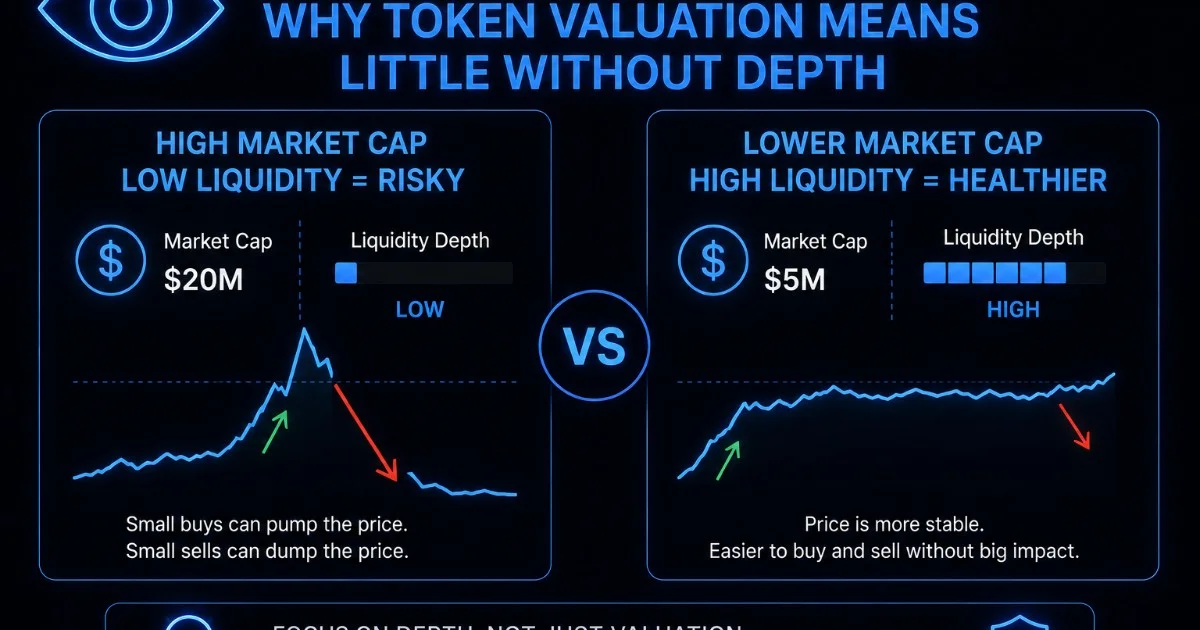
A token with a $20 million market cap and weak liquidity may be harder to trade than a token with a smaller market cap and deeper pool. If selling even a modest amount creates heavy price impact, the displayed valuation is less meaningful.
Depth determines whether the market cap is supported by real tradability.
How Low Liquidity Can Inflate Market Cap
In thin pools, small buys can push price sharply upward. Since market cap is based on price, a small amount of buying can create a large increase in displayed valuation. This can attract traders who believe the token is breaking out.
The problem appears when those traders try to exit. If the same pool cannot absorb sells, the price may fall quickly. The market cap that looked impressive may disappear with only a small amount of selling.
This is common in new launches, microcaps, and narrative tokens where attention moves faster than liquidity.
The Difference Between Paper Value and Real Value
Paper value is what a position appears to be worth based on the current chart price. Real value is what the trader can actually receive after selling.
In deep markets, the difference may be small. In thin markets, the difference can be large. A wallet may show a large unrealized gain, but selling the full amount could move the price down dramatically.
This is why market cap should always be compared with liquidity and volume. A valuation is stronger when the market can support real transactions.
How DEXTools Can Help Traders Avoid the Mirage
DEXTools helps traders evaluate whether a token’s valuation is supported by market conditions. Start by reviewing liquidity, volume, price action, and recent transactions. Then compare these signals with market cap.
If market cap is rising while liquidity remains thin, the move may be fragile. If volume is strong but price impact is extreme, the valuation may be unstable. If liquidity and volume grow alongside price, the market cap may have stronger support.
Traders should also check whether multiple pools exist. Sometimes the displayed valuation may be influenced by a pool that is not the main trading market.
Questions to Ask Before Trusting Market Cap
Before buying a token based on market cap, traders should ask whether the pool can support their trade size. They should check how much price moves after recent buys and sells. They should consider whether volume is consistent or concentrated in a short spike.
They should also ask whether the token has real liquidity depth or just a high displayed valuation. A low market cap opportunity is only useful if traders can enter and exit without destroying their own price.
A cheap token is not always a good trade.
Common Mistakes
One mistake is comparing market caps across tokens without comparing liquidity. Another is assuming that a low market cap automatically means high upside. Some traders buy because they think a token can reach the valuation of a larger project, but they ignore whether the market has enough depth to support that move.
Another mistake is treating unrealized gains as guaranteed profit. A position is only worth what the market can pay when the trader exits.
Conclusion
The market cap mirage can make tokens look more attractive than they really are. Valuation matters, but only when supported by liquidity depth, volume, and healthy market activity.
DEXTools gives traders the data needed to compare market cap with tradability. By reviewing liquidity, transactions, volume, and price behavior, traders can avoid being misled by inflated valuations.
In crypto, market cap tells you what a token appears to be worth. Liquidity depth tells you whether that value can actually be traded.
How to Bridge Crypto Between Chains: Complete Cross-Chain Tutorial 2026 How to Use 1inch for Swaps: Classic, Fusion and Limit Orders (2026) OKX Web3 Wallet Tutorial 2026: Multi-Chain Setup GuideThe Illiquidity Trap: When Market Cap Lies Most Profoundly
While market cap offers a superficial glance, its true deception often emerges in the context of illiquidity. A token's reported market capitalization is derived from its total supply multiplied by its last traded price. However, if only a minuscule fraction of that supply is actively traded on a limited number of exchanges, that "last traded price" becomes a highly unreliable anchor for the entire valuation. This is the illiquidity trap: a scenario where a small buy or sell order can drastically swing the price, creating a market cap figure that is utterly unattainable for anyone attempting to exit a significant position.
Consider a token with a large total supply, but where 90% is locked in vesting schedules, held by the team, or concentrated in a few whale wallets. The "circulating supply" might be small, but even that can be further constrained by limited exchange listings and shallow order books. In such cases, the reported market cap does not reflect the actual capital required to move the price, nor does it represent the amount of capital that could realistically be extracted from the market without crashing the price.
Navigating Illiquid Waters
- Always examine a token's trading volume in relation to its market cap. High market cap, low volume is a red flag.
- Scrutinize the distribution of the token. Concentrated holdings by a few entities can create artificial scarcity and inflate price.
- Look at the depth of order books on various exchanges. Thin order books mean even small trades have a big impact.
- Understand vesting schedules and unlock dates. Future supply shocks can rapidly deflate an illiquid market.
- Be wary of projects with a high fully diluted valuation (FDV) but a very low circulating supply. This suggests a potentially massive future sell pressure.
Related Guides
- Market Cap vs FDV in Crypto: What the Gap Really Means (2026)
- What Drives XRP Price? Market Cap, Supply and Valuation
- What Is XRP Market Cap? Complete 2026 Guide
- What Is Market Cap in Crypto? Full Guide 2026
- FDV vs Market Cap in Crypto Explained (2026)
Frequently Asked Questions
What is market cap and how is it calculated in crypto?
Market capitalization in crypto is the total value of all circulating tokens of a particular cryptocurrency. It is calculated by multiplying the current price of a single token by the total number of tokens currently in circulation. This metric provides a snapshot of a project's overall size in the market.
Why is market cap often considered a key metric by traders?
Traders often use market cap as a primary indicator to gauge a project's size and potential. They might compare market caps to identify projects they perceive as undervalued or overvalued relative to their peers. It can also influence perceptions of a project's stability or maturity.
What are the limitations of relying solely on market cap for valuation?
Solely relying on market cap can be misleading because it doesn't account for liquidity, trading volume, or the distribution of tokens. A high market cap with low liquidity can create an illusion of value that is difficult to realize. It also doesn't reflect the project's fundamental technology, adoption, or future potential.
How can token distribution impact the true valuation behind a market cap?
Token distribution significantly impacts true valuation. If a large percentage of tokens are held by a few insiders or locked up, the circulating supply used for market cap calculation may not reflect the actual tradable supply. This can lead to a higher reported market cap than what the market can actually support or absorb, creating a mirage of value.