The First 60 Minutes After a Token Launch: What to Watch on DEXTools
— By Whatsertrade in Tutorials

The first hour after a token launch can be chaotic. Prices move fast, buyers rush in, liquidity changes, and social media can turn a small launch into a viral e
The first hour after a token launch can be chaotic. Prices move fast, buyers rush in, liquidity changes, and social media can turn a small launch into a viral event within minutes.
But the first 60 minutes can also reveal important information. If you know what to watch, DEXTools can help you separate promising launches from dangerous ones.
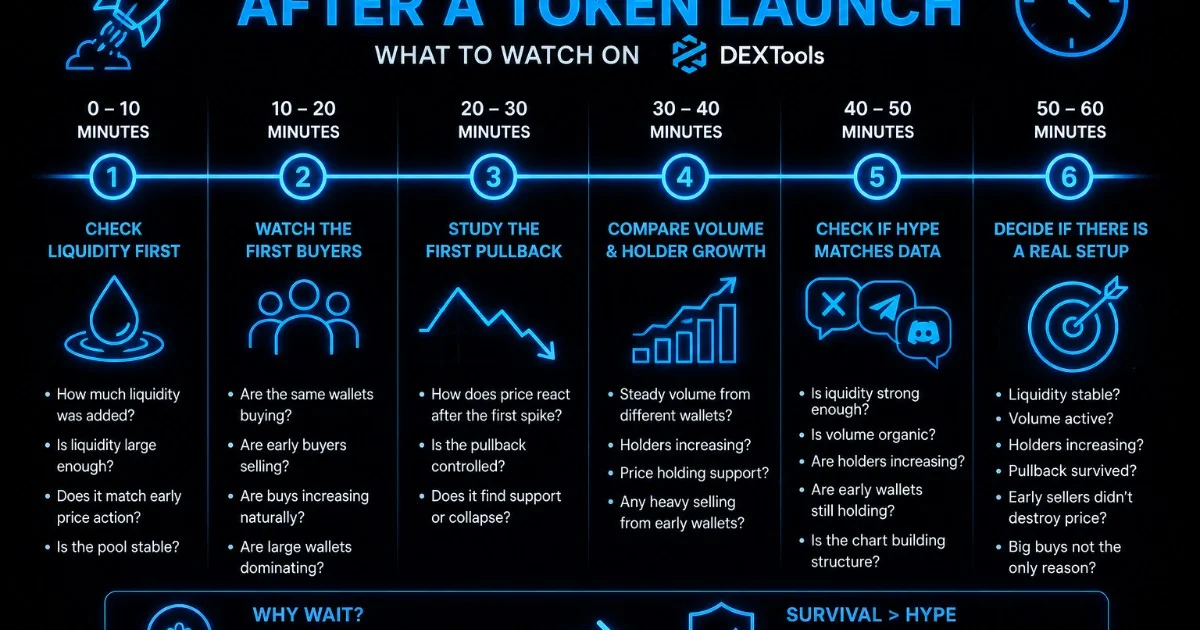
This guide explains how to analyze a new token launch step by step during the first hour.
Minutes 0 to 10: Check Liquidity First
Before looking at the chart, check liquidity.
Liquidity tells you whether traders can enter and exit without extreme slippage. A token with very low liquidity can move dramatically from small buys, but that does not mean it is strong.
During the first 10 minutes, ask:
- How much liquidity was added?
- Is liquidity large enough for real trading?
- Does liquidity match the size of the early price movement?
- Is the pool stable, or is liquidity changing quickly?
A new token with low liquidity and aggressive buying can produce a huge candle, but the move may not be sustainable.
Minutes 10 to 20: Watch the First Buyers
The first buyers are important because they show how the market is forming.
Use DEXTools transaction data to see whether early activity comes from many wallets or only a small group. A launch with broad participation is usually healthier than a launch controlled by a few wallets.
Look for patterns:
- Are the same wallets buying repeatedly?
- Are early buyers already selling?
- Are buys increasing naturally?
- Are large wallets dominating the chart?
If a few wallets control the launch, the risk is higher.
Minutes 20 to 30: Study the First Pullback
Almost every launch has a first pullback. That pullback is often more important than the first pump.
A healthy launch may pull back, find support, and continue building. A weak launch may collapse as early buyers take profit and new buyers disappear.
On the DEXTools chart, watch how price reacts after the first spike.
If the first pullback is controlled, the token may have real demand. If the chart drops sharply with heavy sells, the launch may already be losing strength.
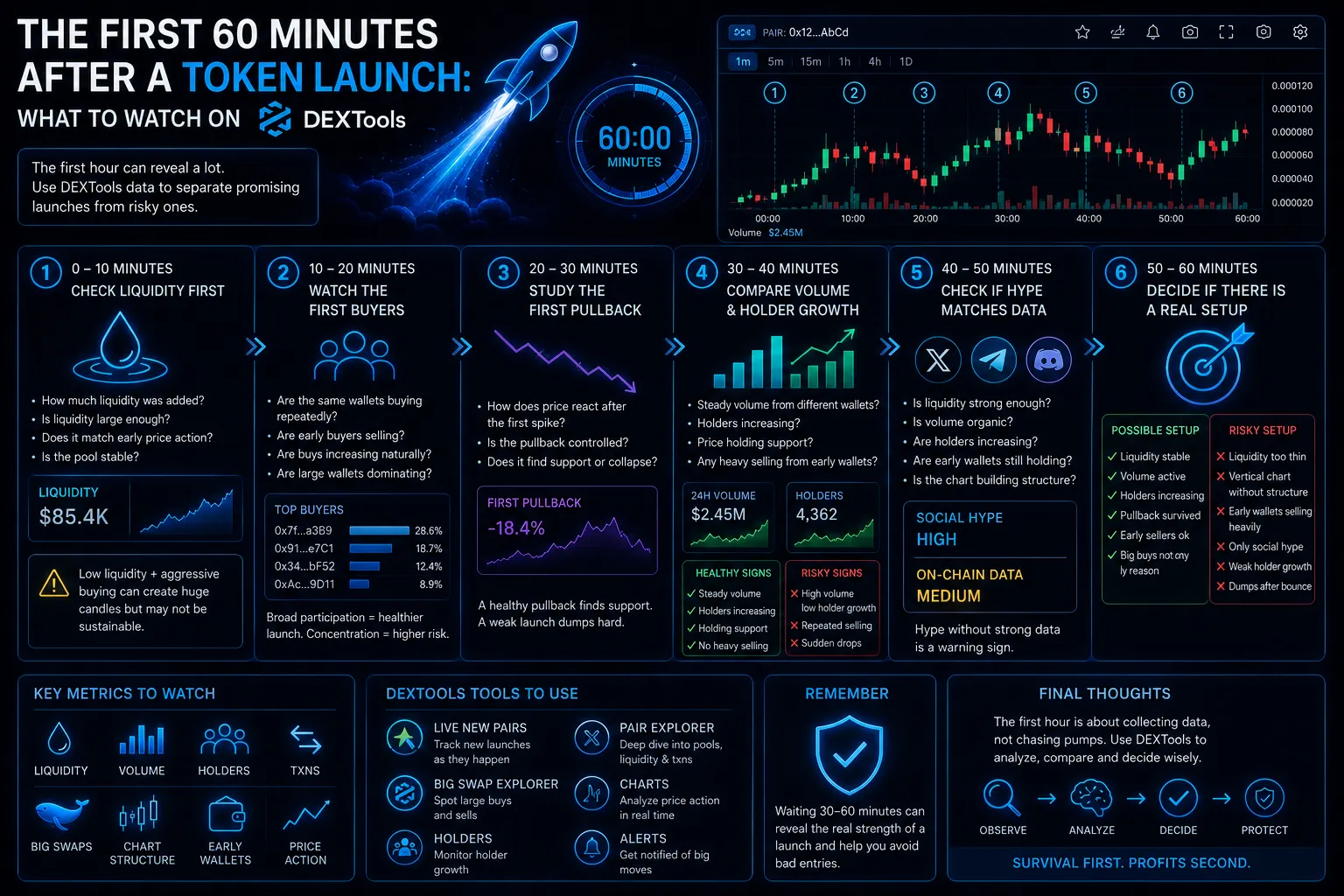
Minutes 30 to 40: Compare Volume and Holder Growth
Volume alone is not enough.
A token can have high volume without real holder growth. This may happen when a few wallets trade heavily or when activity is manufactured to attract attention.
During this stage, compare trading volume with holder behavior.
Healthy signs include:
- Steady volume from different wallets.
- Growing number of holders.
- Price holding above early support.
- No immediate heavy selling from early wallets.
Risky signs include:
- High volume with little holder growth.
- Repeated sells from early wallets.
- Price depending on one or two large buys.
- Sudden drops after every bounce.
A strong launch should show more than noise. It should show real participation.
Minutes 40 to 50: Check If Hype Matches the Data
By this point, social media may already be talking about the token.
This is when traders need to stay objective. A launch can sound strong on X, Telegram, or Discord while the chart shows something very different.
Use DEXTools to verify the hype.
Ask:
- Is liquidity strong enough?
- Is volume organic?
- Are holders increasing?
- Are early wallets still holding?
- Is the chart building structure?
If the social hype is strong but the on-chain data is weak, be careful.
Minutes 50 to 60: Decide Whether There Is a Real Setup
The final 10 minutes of the first hour are about decision making.
At this point, you should have enough information to decide whether the token deserves more attention or should be avoided.
A possible setup may exist if:
- Liquidity is stable.
- Volume is active but not suspicious.
- Holders are increasing.
- The chart has survived its first pullback.
- Early sellers did not destroy the price.
- Big buys are not the only reason for the move.
A risky setup may exist if:
- Liquidity is too thin.
- The chart went vertical without structure.
- Early wallets are selling heavily.
- The token depends only on social hype.
- Holder growth is weak.
- Price collapses after each bounce.
The first hour is not about rushing into every launch. It is about collecting enough data to avoid bad entries.
Why Waiting Can Be Powerful
Many traders think they need to buy immediately after launch to catch the best price. Sometimes that works, but it also increases risk.
Waiting even 30 to 60 minutes can reveal important information. You may miss the first candle, but you may avoid entering a token that collapses after the first wave of buyers.
In DeFi trading, survival matters. Missing one pump is better than getting trapped in a bad launch.
Final Thoughts
The first 60 minutes after a token launch can tell you a lot.
DEXTools helps traders watch liquidity, volume, holders, transactions, chart structure, and early wallet behavior in real time. These signals can help you decide whether a launch has real strength or is only temporary hype.
A good launch does not need only a big green candle. It needs liquidity, organic volume, holder growth, and price stability after the first pullback.
Before buying a new token, use the first hour wisely. The data is often there before the crowd understands it.
When Not to Trade: 12 Red Flags Every DeFi Trader Should Know Liquidity Velocity: Why Fast LP Changes Matter More Than Total Liquidity The First 72 Hours of a Token Launch: How to Spot Real Survival Signals After the Hype How to Read Liquidity Pool Data Before Buying a Token (2026)Beyond the Candlesticks: Deciphering Wallet Behavior
While price action and volume are the immediate signals on DEXTools, savvy traders look deeper, analyzing the on-chain footprints left by key wallets. This involves understanding the flow of tokens beyond simple buys and sells, identifying potential whale movements, and recognizing patterns that often precede significant price shifts. Observing the interactions of large holders can provide invaluable context to the unfolding narrative of a new token.
The "Top Holders" section on DEXTools is your window into this world. It's not just about who holds the most, but how they acquire and distribute those tokens. A sudden influx of tokens into a previously dormant wallet, or a series of small, strategic distributions from a large holder, can be far more telling than a single green candle. These movements paint a picture of sentiment and potential future direction that raw price data alone cannot convey.
Identifying Smart Money and Red Flags
- Track initial liquidity providers (LPs) and their subsequent actions. Are they holding, adding, or slowly divesting?
- Monitor the top 5 to 10 non-exchange wallets. Look for consistent accumulation or large, sudden sells.
- Observe wallet age and activity. Older, less active wallets suddenly engaging can signal a shift in sentiment.
- Watch for "wash trading" patterns among smaller wallets, where tokens are rapidly moved between a few addresses to inflate volume.
- Identify potential "presale" or "team" wallets and analyze their distribution patterns.
Related Guides
- The First 30 Minutes After a Token Starts Trending: A DeFi Trader's Playbook
- The First 72 Hours of a Token Launch: How to Spot Real Survival Signals After the Hype
- Spot Rug Pulls Fast: Use DEXTools in 3 Minutes
- How Token Teams Can Prepare for Their First Week on DEXTools
- DEXTools Beginner Tutorial: Setup, Navigation and First Trade Checks (2026)
- What Happens 24 Hours After a Token Enters Trending?
- Healthy vs Toxic Token Launch
Frequently Asked Questions
What is DEXTools and why is it important for new token launches?
DEXTools is a popular platform for real-time cryptocurrency price charts, trading data, and analytics. It's crucial for new token launches because it provides immediate visibility into a token's performance, liquidity, and community sentiment right after it goes live.
What key metrics should I monitor on DEXTools immediately after a launch?
Focus on the price chart for initial volatility, liquidity to ensure healthy trading, and the number of holders to gauge early adoption. Also, watch the buy/sell pressure and transaction history to understand market dynamics.
How can I identify potential 'rug pulls' or scams using DEXTools?
Look for a sudden, massive sell-off by developers, extremely low liquidity, or a continuously plummeting price with no buyers. A high percentage of tokens held by a few wallets, especially if not locked, can also be a red flag. Always cross-reference with the project's official channels and community sentiment.
What is 'liquidity' and why is it vital for a new token?
Liquidity refers to the ease with which a token can be bought or sold without significantly affecting its price. For a new token, high liquidity is vital because it ensures smooth trading, prevents large price swings from small trades, and demonstrates the project's stability and trustworthiness to potential investors.