Spot Rug Pulls Fast: Use DEXTools in 3 Minutes
— By Whatsertrade in Tutorials
Learn to identify rug pulls in crypto using DEXTools. Analyze liquidity, transactions, and holder metrics to avoid scams in just minutes.
Rug pulls are still one of the fastest ways for traders to lose money in crypto. A token looks hot, volume starts exploding, the chart goes vertical, social media is full of hype, and then liquidity disappears or insiders dump into retail buyers. By the time most people realize what happened, it is already too late.
The good news is that many rug pulls leave clues before they collapse. If you know where to look, you can filter out a huge amount of bad tokens in just a few minutes. That is where DEXTools becomes useful. It gives traders a fast view of pair data, liquidity, price action, transactions, and wallet behavior, all in one place.
If you want a simple method that works under pressure, here is how to spot a rug pull in 3 minutes using DEXTools.
Why DEXTools is useful for rug pull detection
Most traders lose money on bad tokens because they buy emotion before they check data. DEXTools helps reverse that process. Instead of chasing a green candle, you can inspect whether the token has enough liquidity, whether buys and sells look natural, whether a few wallets control too much supply, and whether the chart structure looks organic or manipulated.
That matters because most rug pulls are not random. They usually follow a pattern. The project launches fast, marketing is aggressive, the token attracts early momentum, and then a hidden weakness gets exposed. Sometimes liquidity is too low. Sometimes the top holders are too concentrated. Sometimes the token only looks active because insider wallets are creating fake excitement.
Your job is not to prove a token is good. Your job is to find reasons not to touch it.
The 3 minute rug pull check
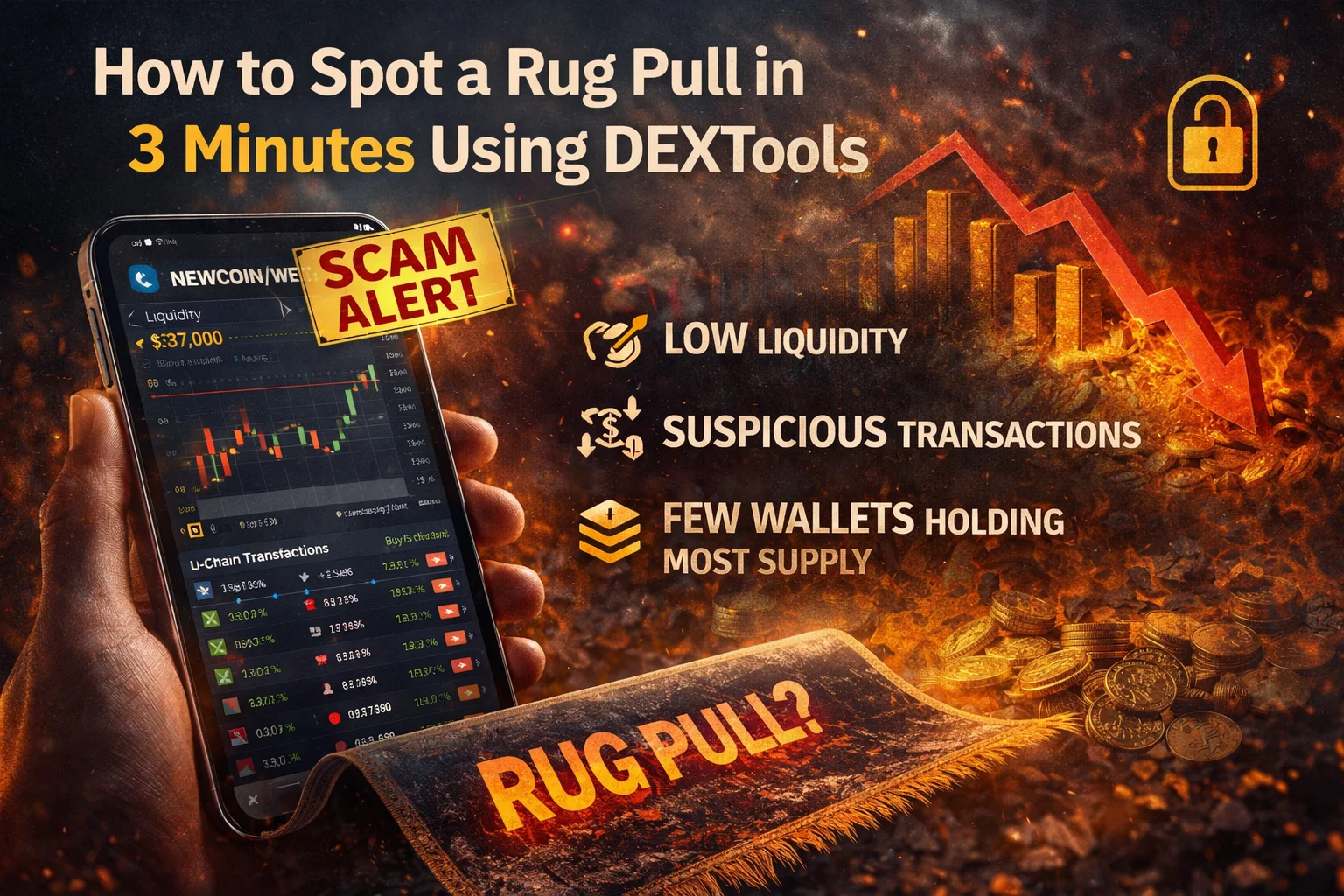
The easiest way to think about this process is in three one minute checks.
Minute one is liquidity and chart structure.
Minute two is transactions and wallet behavior.
Minute three is holder concentration and pair quality.
If a token fails badly in any of these areas, you should slow down or avoid it completely.
Minute 1: Check liquidity before you check hype
The first thing to review on DEXTools is the pair itself. Open the token pair and look at the liquidity. This is one of the most important filters because liquidity tells you whether the market has enough depth to support real trading.
If liquidity is extremely small relative to the token's market buzz, that is a red flag. A token can look exciting with a tiny amount of money behind it. That means the price can be pushed up easily, but it also means the floor can disappear just as fast.
When you look at liquidity, ask yourself three questions.
First, is the liquidity amount meaningful for the size of the move? If the chart is exploding but liquidity is thin, the move may be fragile.
Second, does the liquidity look stable or suspiciously small for a token claiming big momentum?
Third, does the chart look organic or does it look engineered?
A healthy early chart often has volatility, but it still shows a believable rhythm of buying and selling. A dangerous chart often looks like a straight line up with sharp spikes and almost no natural pullbacks. That kind of move can be driven by insiders, bots, or artificial buying pressure.
If the liquidity is weak and the chart looks too perfect, that is your first warning.
Minute 2: Read the transaction flow like a story
After liquidity, move to the live transactions. This is where DEXTools becomes especially helpful because it lets you see whether the token's activity feels real.
Look at the buy and sell flow. A token with healthy interest usually shows mixed activity. You will see buyers entering, some people taking profits, and a normal rhythm of market participation. A suspicious token often shows one of two extremes.
The first extreme is endless buys with almost no meaningful sells. That can look bullish, but it is often a trap. In some cases, sellers are blocked, taxed heavily, or discouraged by mechanics that favor insiders.
The second extreme is repeated small buys followed by sudden larger sells. That often suggests a setup where early wallets are feeding the hype and then unloading into retail demand.
Watch for repeated wallet behavior. If similar sized buys keep appearing over a short period, the activity may be coordinated. If a few wallets dominate the flow, you may be looking at artificial momentum rather than genuine market interest.
This part is less about one single trade and more about the overall pattern. Ask yourself whether the tape feels natural. If it feels staged, it probably is.
Minute 3: Check holder concentration before you buy
This is the step that saves many traders from disaster.
Open the holder view and look at token distribution. If a small number of wallets control a large share of supply, the risk rises sharply. A token does not need to be perfectly decentralized on day one, but it should not look like a private club pretending to be a community.
Concentrated ownership creates a simple problem. Even if the chart looks strong, a few wallets can crush the price whenever they want. That is how many rug pulls and insider dumps play out. Retail thinks momentum is building, but the top wallets are already sitting on the exit.
Pay close attention to the top holders beyond the obvious pool or exchange related wallets. If several non liquidity wallets hold unusually large positions, be careful. If the distribution is extremely uneven, be even more careful.
A strong token can survive volatility. A weak token with concentrated ownership can collapse in minutes.
The red flags you should never ignore
When using DEXTools to spot a rug pull, some warning signs matter more than others.
Low liquidity combined with aggressive hype is dangerous.
A vertical chart with no healthy pullbacks is suspicious.
Transaction flow that looks repetitive or one sided should make you pause.
A few wallets holding too much supply is one of the biggest risks.
Large sells from early wallets during a hype phase often signal insider distribution.
A token that depends more on excitement than actual structure is usually not worth the risk.
The biggest mistake traders make is treating red flags as optional. They are not optional. If you see several of them at once, the best trade is often no trade.
What a safer token usually looks like
No token is risk free, especially in early stage crypto. But safer setups usually share a few traits.
Liquidity is meaningful enough to support real trading.
The chart shows volatility, but not pure manipulation.
Buy and sell activity looks natural.
Holder distribution is not dominated by a handful of wallets.
The pair data tells a believable story instead of a fantasy.
This does not guarantee success, but it improves your odds. In meme coin and low cap trading, survival is part of the edge.
The biggest mindset shift for traders
The real goal is not finding the next 100x token in three minutes. The real goal is avoiding obvious traps in three minutes.
That mindset changes everything. Instead of asking, "How high can this go?" ask, "What can go wrong here?" That one shift will instantly make you a better trader.
DEXTools is powerful because it gives you enough information to slow down your impulse. The market rewards speed in some moments, but it punishes careless speed almost every time. If you can spend three focused minutes checking the basics, you will avoid many of the worst decisions traders make when FOMO takes over.
Learning how to spot a rug pull in 3 minutes using DEXTools is one of the most practical skills any crypto trader can build. You do not need a perfect system. You need a reliable routine.
Start with liquidity.
Check the chart structure.
Read the transaction flow.
Review holder concentration.
Look for patterns that feel manipulated, shallow, or overly dependent on hype.
The best traders are not just good at finding winners. They are good at rejecting bad setups early. In a market full of fast launches and short attention spans, that skill matters more than ever.
How to Bridge Crypto Between Chains: Complete Cross-Chain Tutorial 2026 How to Use 1inch: Complete DEX Aggregator Swap Tutorial (2026) How to Use OKX Web3 Wallet: Complete Multi-Chain Wallet Tutorial (2026)Frequently Asked Questions
What is a rug pull in cryptocurrency?
A rug pull is a malicious maneuver in the cryptocurrency industry where developers abandon a project and run away with investors' funds.
How can DEXTools help identify potential rug pulls?
DEXTools provides real-time data, including liquidity, transaction history, and token holder information, which can indicate suspicious activity.
What are some red flags to look for on DEXTools?
Low liquidity, a high concentration of tokens in a few wallets, and a sudden drop in price without clear reasons are potential red flags.
Can DEXTools guarantee protection from rug pulls?
While DEXTools offers valuable insights, it cannot guarantee complete protection. It is a tool for due diligence, not a definitive safeguard.
What other steps should I take besides using DEXTools?
Always research the project team, their whitepaper, and community sentiment. Diversify investments and only invest what you can afford to lose.
Related Guides
- How to Avoid Rug Pulls on Solana: Red Flags Every Trader Should Know
- How to Avoid Rug Pulls: Solana, Ethereum & Base Guide 2026
- Rug Pull Checklist: 10 Pair Explorer Checks to Avoid Scams
- The First 60 Minutes After a Token Launch: What to Watch on DEXTools
- How to Spot a Rug Pull 2026: 12-Point Free Detection Checklist