When Not to Trade: 12 Red Flags Every DeFi Trader Should Know
— By Whatsertrade in Tutorials

Most trading content focuses on when to enter. But knowing when not to trade is just as important.In DeFi, opportunities appear every minute. New tokens launch,
Most trading content focuses on when to enter. But knowing when not to trade is just as important.
In DeFi, opportunities appear every minute. New tokens launch, pairs start trending, charts move quickly and social hype creates pressure to act. But not every active token deserves your capital.
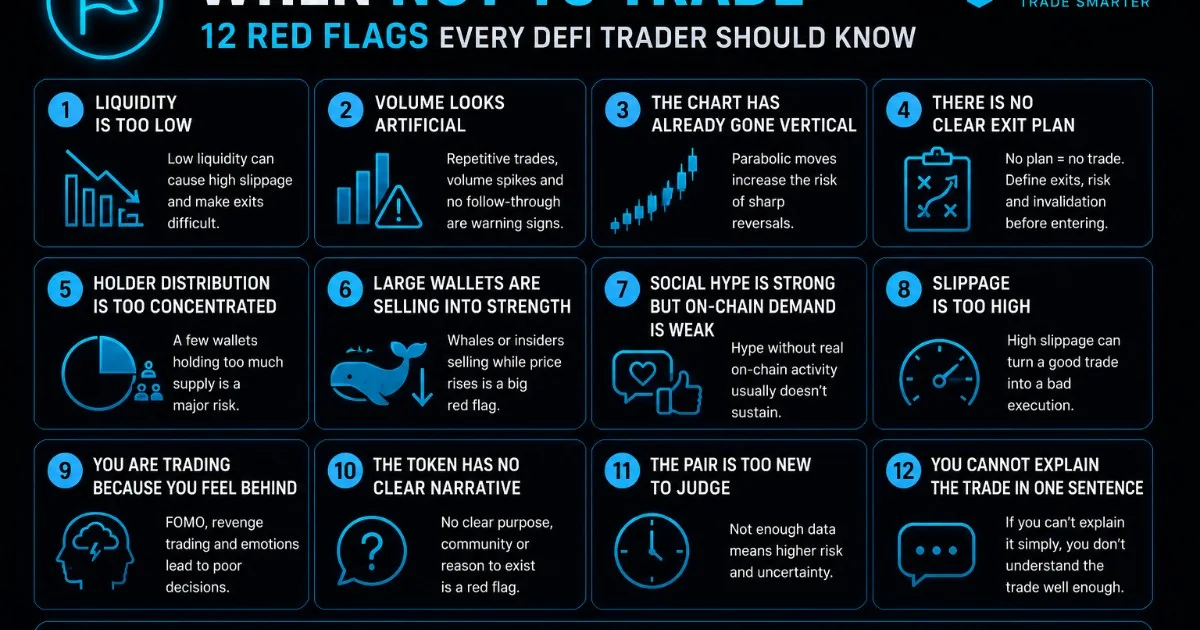
The best traders are not the ones who click the most. They are the ones who filter better.
Here are 12 red flags that may mean the best decision is to wait, watch or walk away.
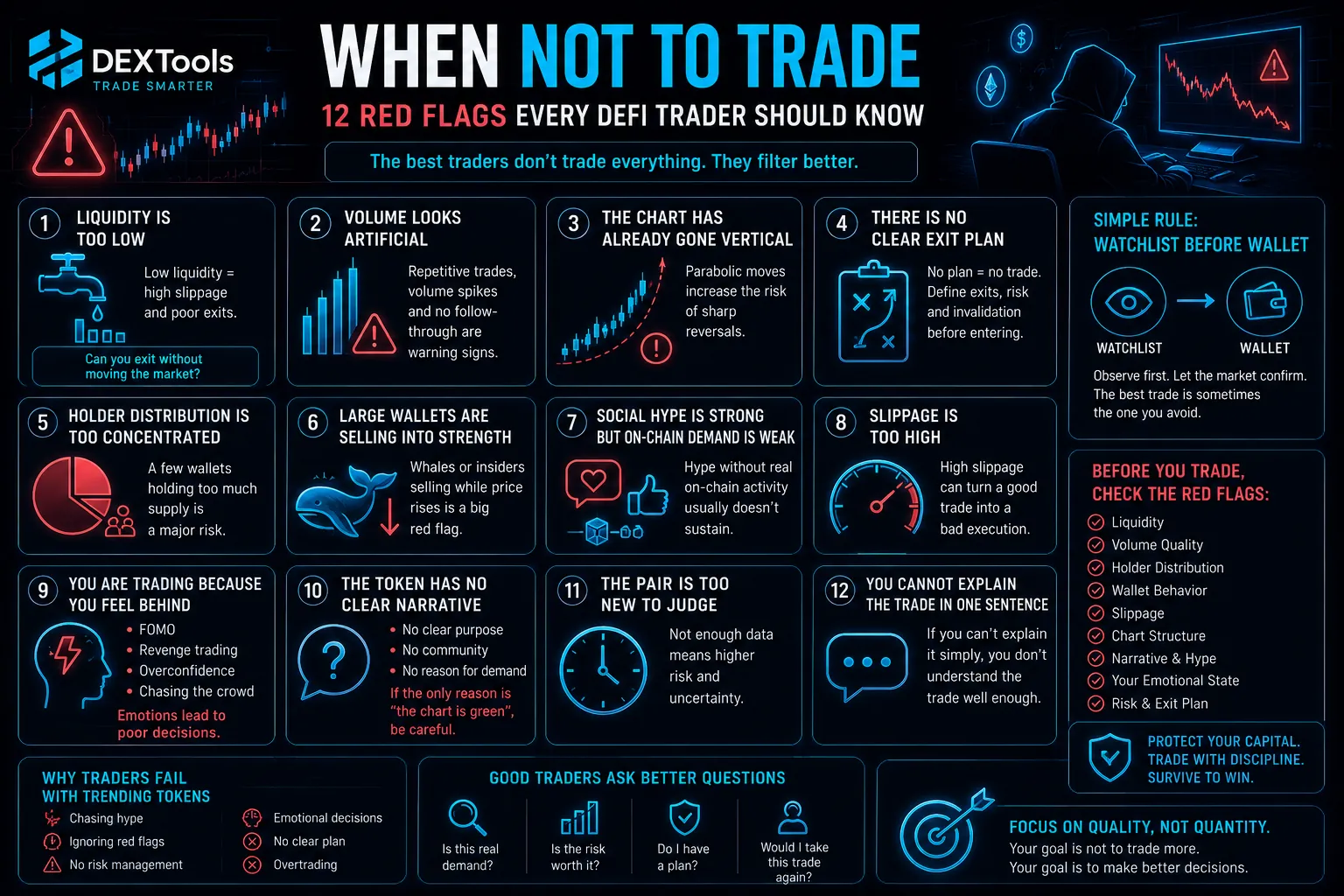
1. Liquidity Is Too Low
Low liquidity can make a token dangerous to trade. Even a small buy or sell can move the price sharply, creating high slippage and poor execution.
If liquidity is too thin for your position size, the trade may look profitable on the chart but fail when you try to exit.
Before entering, ask:
Can I exit without moving the market too much?
Is slippage acceptable?
Has liquidity been stable?
If the answer is unclear, do not force the trade.
2. Volume Looks Artificial
High volume can attract attention, but not all volume is real demand.
Be careful when you see repeated transactions with similar sizes, sudden bursts of activity with no follow-through or volume that does not match price movement.
Artificial volume can create the illusion of momentum. Once that activity disappears, the token may lose attention quickly.
3. The Chart Has Already Gone Vertical
A vertical chart creates fear of missing out. But buying after a huge move can be risky because early buyers may already be preparing to take profit.
Strong tokens can continue moving, but late entries need extra caution.
Ask:
Am I entering a plan or chasing a candle?
Where is my invalidation?
What happens if price pulls back 30 percent?
If you cannot answer those questions, wait.
4. There Is No Clear Exit Plan
A trade without an exit plan is not a trade. It is a hope.
Before entering, define:
Where you take profit
Where you exit if wrong
How much you are willing to risk
What signal invalidates your idea
If your only plan is "I will see what happens," the setup is not ready.
5. Holder Distribution Is Too Concentrated
If a small number of wallets control a large portion of the supply, the token can be vulnerable to sudden sell pressure.
Concentrated ownership does not always mean immediate danger, but it increases risk. Large holders can create strong price impact if they decide to sell.
A healthier token usually has broader distribution and less dependence on a few wallets.
6. Large Wallets Are Selling Into Strength
A token may look strong while insiders, early buyers or whales sell into new demand.
This is one of the most important red flags. If price rises but large wallets are consistently reducing exposure, the trend may be weaker than it looks.
Watch whether sells are normal profit-taking or aggressive distribution.
7. Social Hype Is Strong but On-Chain Demand Is Weak
Social media can make a token look popular. But hype should be confirmed by on-chain behavior.
If everyone is talking about a token but liquidity is weak, holders are not growing and transaction quality is poor, the hype may not be converting into real demand.
A strong narrative needs market confirmation.
8. Slippage Is Too High
High slippage means you may not get the price you expect. This can turn a good-looking trade into a bad execution.
Slippage becomes especially dangerous in volatile tokens with low liquidity.
If the trade requires accepting uncomfortable slippage, reconsider the position size or skip the trade.
9. You Are Trading Because You Feel Behind
Emotional urgency is a warning sign.
If your reason for entering is "everyone else is already in," you may be reacting to pressure rather than analyzing the setup.
Common emotional entries include:
Fear of missing out
Revenge trading
Trying to recover a previous loss
Buying because a chart already moved
Following a group without personal analysis
If your nervous system is driving the trade, pause.
10. The Token Has No Clear Narrative
Not every token needs a complex story, but there should be some reason for attention.
A token with no clear narrative, no community, no recognizable theme and no visible reason for demand may struggle to maintain interest.
Ask:
Why would new buyers care?
What is driving attention?
Is there a community forming?
Is there a reason for momentum to continue?
If the only answer is "the chart is green," be careful.
11. The Pair Is Too New to Judge
Some traders specialize in very early entries, but new pairs carry higher risk.
When a pair has only a few minutes of history, there may not be enough data to evaluate liquidity behavior, holder growth, sell pressure or chart structure.
If the token is too new and you do not have a clear edge, waiting for more information can be smarter than guessing.
12. You Cannot Explain the Trade in One Sentence
A strong trade idea should be simple to explain.
For example:
"I am entering because liquidity is stable, buyers are diverse, price reclaimed support and sell pressure is being absorbed."
A weak idea sounds like:
"It is trending and might go higher."
If you cannot explain the trade clearly, you may not understand it well enough.
A Simple Rule: Watchlist Before Wallet
Before buying, consider adding the token to a watchlist first. This gives you time to observe whether demand continues, liquidity improves and price builds structure.
Not every opportunity requires immediate action.
Sometimes the best trade is the one you avoid.
Final Thoughts
Knowing when not to trade protects capital, confidence and discipline.
DeFi rewards speed, but it punishes carelessness. Traders who avoid weak setups have more energy and capital available for better opportunities.
Before entering any token, check the red flags: liquidity, volume quality, holder distribution, sell pressure, slippage, social confirmation and your own emotional state.
A good trader does not need to trade everything.
A good trader knows when to wait.
FAQ
Why is knowing when not to trade important?
Avoiding weak setups helps protect capital and reduces emotional decision-making. Not every active token is a good opportunity.
What is the biggest red flag in DeFi trading?
Weak liquidity is one of the biggest red flags because it can create high slippage, poor exits and extreme price movement.
Is high volume always a good sign?
No. High volume can be artificial or driven by heavy selling. It should always be analyzed with liquidity, price movement and transaction quality.
How can I avoid emotional trading?
Use a checklist before entering, define risk in advance and avoid trades based only on fear of missing out.
Should I skip a trade if I am unsure?
Often, yes. If the setup is unclear and risk cannot be defined, waiting is usually better than forcing an entry.
How to Check Buy and Sell Tax Before Buying a Token (2026) Fake Volume vs Real Demand: How to Spot Artificial Momentum in DeFi Trading Token Taxes in 2026: Identifying Buy/Sell Tax Red Flags How to Find New Tokens on DEXTools Before They TrendThe Illusion of Impermanent Loss as a Trading Signal
While often discussed in the context of liquidity provision, the very concept of impermanent loss (IL) can subtly influence trading decisions in a detrimental way, particularly when misinterpreted as a direct red flag for market conditions. Traders sometimes observe significant IL in certain pools and mistakenly extrapolate this as a broader market indicator of instability or impending downturn, leading to premature exits or missed opportunities. It's crucial to understand that IL is a function of price divergence in a specific liquidity pair, not necessarily a universal market sentiment indicator.
The trap lies in conflating a pool's specific price action with the overall market. A volatile asset in a liquidity pool might experience high IL even as the broader market remains robust or other assets are performing well. Conversely, a stable market might still see IL in pairs involving newly launched or highly speculative tokens. Over-reliance on IL as a trading signal can lead to reactive, rather than strategic, decisions, causing traders to misjudge entry or exit points.
Deciphering Impermanent Loss Beyond the Surface
- Isolate the Impact: Understand that IL is specific to a token pair and its price correlation, not a general market health metric.
- Consider the Time Horizon: Short-term IL can be significant during volatility, but often diminishes or reverses over longer periods.
- Analyze Underlying Fundamentals: Evaluate the reasons for price divergence in the IL pair. Is it a project-specific issue or a broader market trend?
- Compare Across Protocols: Observe IL trends in similar asset pairs across different DEXs. Is the behavior localized or systemic?
- Focus on Opportunity Cost: While IL might be present, assess if the potential for future gains from holding the assets outweighs the temporary loss.
Related Guides
- How to Avoid Rug Pulls on Solana: Red Flags Every Trader Should Know
- Top 5 Crypto Wallets in 2026: Best Wallets for Every Trader
- How to Evaluate Yield Farms in Crypto: APY Quality, Risks and Red Flags (2026)
- Wash Trading in Crypto: Red Flags Explained
- What Is an Admin Wallet in Crypto? Red Flags
- Centralized vs Shared Sequencers
Frequently Asked Questions
What are some common emotional red flags that indicate it's not a good time to trade?
Trading when feeling overly emotional, such as euphoric after a big win or desperate after a loss, is a major red flag. These states can lead to impulsive decisions, overleveraging, or chasing pumps without proper research. It's crucial to maintain a calm and rational mindset to execute your trading strategy effectively.
When should I avoid trading due to external market conditions?
Avoid trading during periods of extreme market volatility without a clear understanding of the underlying causes, or when major macroeconomic news with uncertain impacts is about to be released. Sudden, unexplained price movements or a lack of liquidity can make entering or exiting positions difficult and increase risk. It's often better to sit on the sidelines and observe until market conditions stabilize or become clearer.
What technical analysis indicators might signal a bad time to trade?
A lack of clear trend direction, conflicting signals across multiple indicators, or extremely low trading volume can indicate a poor trading environment. When charts show choppy, sideways movement without strong support or resistance levels, it's often difficult to predict future price action. Waiting for clearer technical setups can improve your trade success rate.
Why is it important to have a clear trading plan and when should I avoid trading without one?
A clear trading plan outlines your entry and exit strategies, risk management, and overall goals. You should absolutely avoid trading if you haven't defined these parameters, or if you find yourself deviating significantly from your established plan. Trading without a plan is akin to gambling and significantly increases your exposure to unnecessary risks and potential losses.