Position Size vs Pool Size: How Much Is Too Much to Trade on a DEX?
— By Whatsertrade in Tutorials

Many traders focus on finding the right token, but they ignore one of the most important questions in decentralized trading: how big should the trade be compare
Many traders focus on finding the right token, but they ignore one of the most important questions in decentralized trading: how big should the trade be compared to the pool?
A good entry can become a bad trade if your position is too large for the available liquidity. This is especially true in low-cap tokens, where a small pool can create high slippage, difficult exits, and unstable price action.
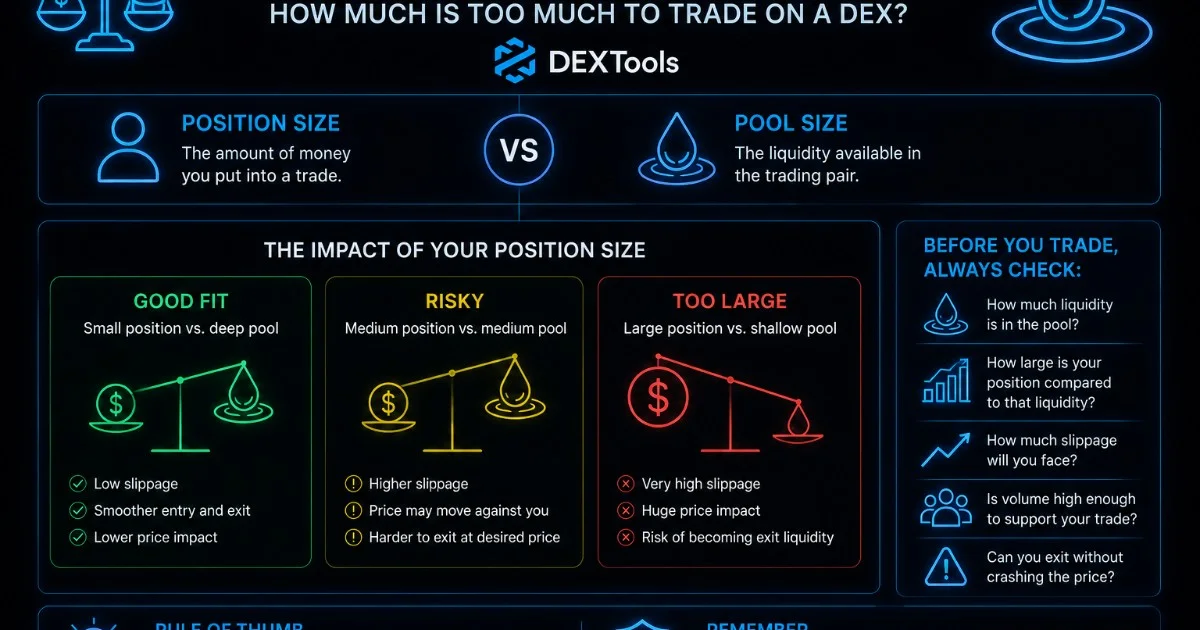
Before buying any token on a decentralized exchange, traders should compare position size with pool size. DEXTools can help you understand whether your trade fits the market or whether you may become trapped by your own size.
What Is Pool Size?
Pool size refers to the liquidity available in a trading pair. In simple terms, it shows how much capital is available for buyers and sellers to trade against.
A deeper pool usually allows smoother entries and exits. A smaller pool can move sharply from a single trade.
If a token has low liquidity, even a modest buy can move the price. That may feel exciting when entering, but it can become a problem when trying to exit.
What Is Position Size?
Position size is the amount of money you put into a trade.
For example, buying $100 of a token in a pool with $500,000 of liquidity is very different from buying $100 in a pool with $5,000 of liquidity.
The same position can be low risk in one pool and high risk in another.
That is why traders should not decide position size only based on account balance. They should also consider pool depth.
Why Position Size vs Pool Size Matters
In centralized markets, many traders are used to entering and exiting without thinking much about liquidity. In DeFi, liquidity is often much thinner.
If your trade is too large compared to the pool, you may face:
- High slippage.
- Poor entry price.
- Difficult exit.
- Large price impact.
- Increased risk of becoming exit liquidity.
- Emotional decision making after price moves against you.
A chart may show a 20 percent gain, but if liquidity is thin, your actual exit may be much worse than expected.
The Hidden Risk of Small Pools
Small pools can create the illusion of opportunity.
A token with low liquidity can pump fast because it takes less capital to move the price. This attracts traders looking for quick gains. But the same mechanism works in reverse.
If a few sellers exit, the price can fall quickly. If you are holding a position that is too large for the pool, selling may push the price down against yourself.
This is why low liquidity tokens require smaller positions and stricter risk management.
How to Use DEXTools Before Entering
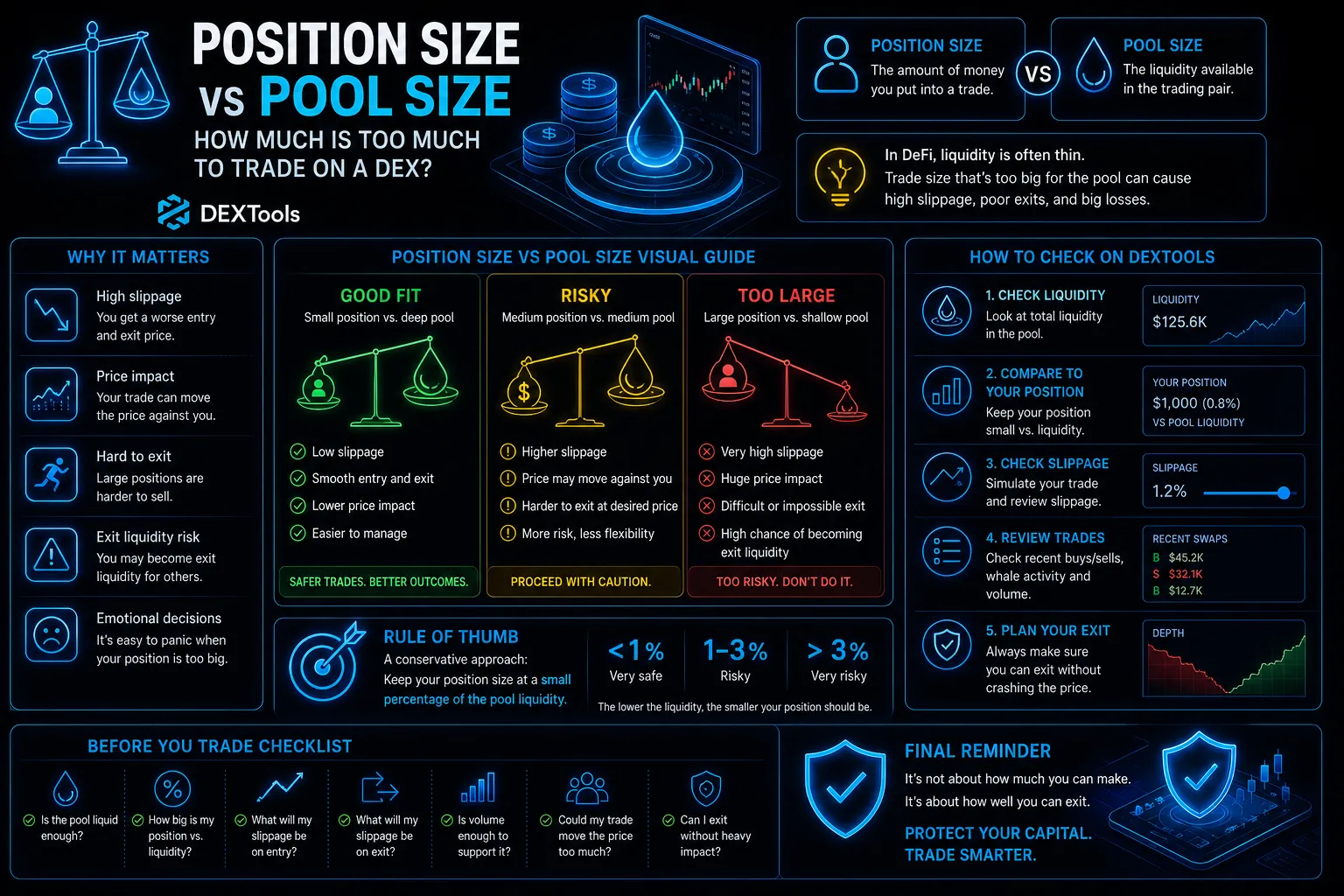
Before placing a trade, open the token page on DEXTools and check liquidity, recent transactions, volume, and chart behavior.
Ask these questions:
- How much liquidity is in the pool?
- How large is my planned position compared to that liquidity?
- How much slippage would I need to enter?
- How much slippage might I face when exiting?
- Are recent sells causing large price drops?
- Is volume healthy enough to support my trade size?
If your trade would noticeably move the chart, your position may be too large.
A Practical Rule of Thumb
There is no perfect number for every trader, but a conservative approach is to keep your position small compared to available liquidity.
For very risky low-cap tokens, many traders prefer to keep position size at a tiny percentage of pool liquidity. The lower the liquidity, the smaller the position should be.
If you are unsure whether your position is too large, reduce it.
In DeFi, being able to exit is more important than entering big.
Position Size and Slippage
Slippage is the difference between the expected price and the actual executed price.
Higher slippage can happen when liquidity is low, volatility is high, or trade size is large compared to the pool.
If you need to set high slippage to enter, that is already a warning sign. It may mean the pool is too thin or the token mechanics are not friendly to traders.
A trade that requires aggressive slippage should be treated as high risk.
Why Big Gains Can Be Misleading
Low liquidity tokens can show huge percentage gains on the chart. But percentage gains do not matter if you cannot exit at a good price.
A trader may see the token up 100 percent and assume the position doubled. But if the pool is thin, selling may cause heavy price impact.
That is why you should always think in terms of executable profit, not only chart profit.
The Exit Test
Before entering, imagine you need to exit immediately.
Would the pool support your sell?
Would your position create a large red candle?
Would you need high slippage?
Would there be enough buyers?
If the answer is uncomfortable, your position is probably too large.
The best time to think about your exit is before you enter.
Final Thoughts
Position size is not only about how much money you are willing to risk. In DeFi trading, it is also about how much liquidity the market can handle.
DEXTools helps traders analyze pool size, volume, recent swaps, and price impact before entering. This data can help you avoid oversized positions, high slippage, and difficult exits.
A token can be interesting, but your position still needs to fit the pool.
In decentralized trading, smart risk management starts with one question: can I exit this trade without hurting myself?
How to Read Liquidity Pool Data Before Buying a Token (2026) How to Check Buy and Sell Tax Before Buying a Token (2026) When Not to Trade: 12 Red Flags Every DeFi Trader Should Know Apparent Liquidity vs Executable Liquidity: Why a Large Pool Can Still Give You a Bad EntryThe Slippage Spectrum: Beyond Price Impact
While often conflated, price impact and slippage are distinct but related concepts crucial for understanding the true cost of a large trade on a DEX. Price impact is the direct effect your trade has on the asset's spot price within the liquidity pool. Slippage, however, encompasses a broader range of factors, including network congestion, miner extractable value (MEV) bots, and the inherent volatility of the asset during the transaction's lifecycle.
A high position size, especially relative to the pool's depth, amplifies the potential for both. The larger your trade, the more pronounced the price impact becomes. Furthermore, a significant order provides a more enticing target for front-running bots and increases the likelihood that market conditions shift unfavorably between the time you submit your transaction and its final confirmation on the blockchain.
Mitigating Slippage in Large Orders
- Utilize DEX aggregators: These tools scan multiple liquidity sources to find the best execution path, potentially reducing overall slippage.
- Break down large orders: Splitting a single large trade into several smaller ones can minimize the immediate price impact on a single pool.
- Adjust slippage tolerance: While a higher tolerance allows the transaction to succeed even with significant price movement, it also exposes you to greater risk. A lower tolerance protects you but may lead to failed transactions.
- Monitor gas fees and network congestion: Execute large trades during periods of lower network activity to reduce the chance of delays and front-running.
- Consider limit orders on supported DEXs: If available, a limit order allows you to specify the maximum price you are willing to accept, providing more control than a market order.
Related Guides
- Median Trade Size vs Trade Count: Why Small Swaps Can Inflate DEX Activity
- How Much XRP Should You Own? Position Sizing and Risk Management (2026)
- Meme Coin Position Size Calculator: Profit, Risk and Market Cap Scenarios (2026)
- How to Calculate Position Size in Crypto Trading
- Where to Trade New Meme Coins Early: DEX vs CEX Entry Map (2026)
Frequently Asked Questions
Why does position size matter when trading on a DEX?
On a decentralized exchange, your trade interacts directly with a liquidity pool, so a large order relative to the pool can move the price significantly. Position size affects how much slippage and price impact you experience.
What is price impact in a liquidity pool?
Price impact is the change in price caused by your own trade as it consumes liquidity from the pool. The larger your trade is compared to the pool, the bigger the price impact tends to be.
How much is too much to trade on a DEX?
A trade becomes risky when it is large relative to the pool's liquidity, since this causes high slippage and worse execution. Comparing your position size to the pool size helps you judge whether a trade is reasonable.
How can traders reduce slippage on a DEX?
Traders can split large orders into smaller pieces, trade in deeper pools, and set slippage tolerance carefully. Choosing pairs with more liquidity generally results in better execution.