Apparent Liquidity vs Executable Liquidity: Why a Large Pool Can Still Give You a Bad Entry
— By Whatsertrade in Tutorials

Liquidity is one of the first numbers traders check before entering a token. A large pool can look safe, professional, and easy to trade. But in decentralized m
Liquidity is one of the first numbers traders check before entering a token. A large pool can look safe, professional, and easy to trade. But in decentralized markets, the headline liquidity number does not always tell the full story. A token may appear to have enough liquidity while still producing poor entries, heavy slippage, or difficult exits.
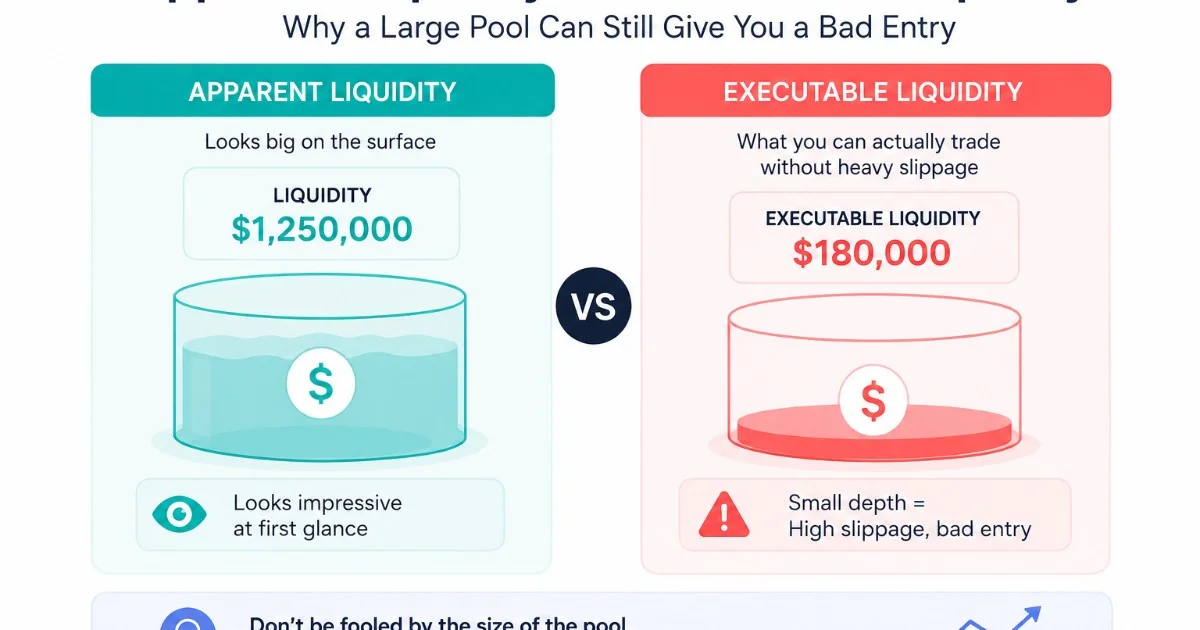
This is why traders need to understand the difference between apparent liquidity and executable liquidity. Apparent liquidity is what the market seems to offer at first glance. Executable liquidity is what you can actually use when you place a trade.
DEXTools helps traders look beyond the surface by showing liquidity, volume, pair activity, price movement, and trading behavior in one environment. When used correctly, these signals can help you avoid situations where a pool looks deep but trades poorly.
What Apparent Liquidity Means
Apparent liquidity is the visible amount of liquidity in a trading pool. When traders open a token pair and see a large liquidity figure, they often assume that buying or selling will be easy. In many cases, higher liquidity does reduce trading risk. But the number alone can be misleading.
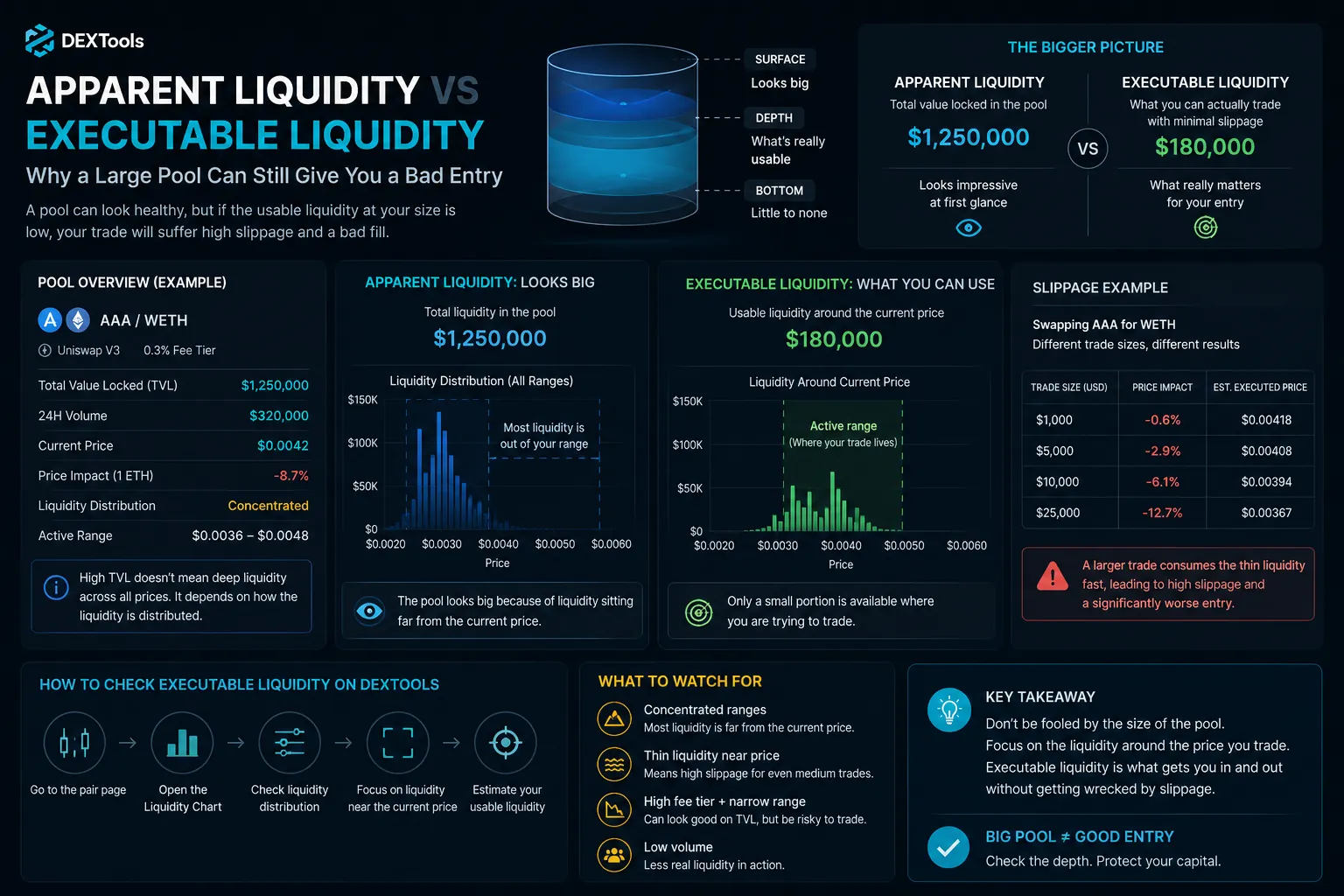
A pool may show a large liquidity value because of token price movement, uneven asset distribution, or liquidity that is not positioned in a way that supports your trade size. In some market structures, only part of the displayed liquidity is useful at the current price. The rest may sit too far away from the area where you want to trade.
This matters because a trader does not interact with the total liquidity number in a simple way. A trade moves through the pool according to its structure. The larger the trade compared with usable liquidity near the current price, the worse the execution can become.
What Executable Liquidity Means
Executable liquidity is the amount of liquidity that can absorb your trade with acceptable price impact. It answers a more practical question: if you buy or sell now, how much will the market move against you?
A token with strong executable liquidity allows traders to enter and exit with limited slippage relative to their trade size. A token with weak executable liquidity may punish even moderate trades. This can happen even when the pool appears large.
For active traders, executable liquidity is often more important than apparent liquidity. You do not need to know only whether money exists in the pool. You need to know whether your trade can be executed without damaging your own entry or exit.
Why a Large Pool Can Still Produce Bad Execution
A large pool can still create poor execution for several reasons. The liquidity may not be balanced. The pool may have low active depth near the current price. The token may be moving too quickly for the available liquidity. There may be large wallets selling into buys. Volume may be high, but the market may be unstable.
Another issue is trade size. A small buy may execute well, while a larger buy may push the price sharply. A trader looking only at the liquidity number may not realize that their own order is too large for the current market.
This is especially important in smaller tokens, new launches, memecoins, and volatile narrative plays. These markets can show exciting charts, but the difference between visible liquidity and usable liquidity can be extreme.
How Slippage Reveals the Truth
Slippage is one of the clearest ways to understand executable liquidity. Slippage is the difference between the expected price and the executed price of a trade. In decentralized exchange trading, slippage can increase when liquidity is thin, volatility is high, or the trade size is large compared with the pool.
High slippage is not always a scam signal. Sometimes it simply means the market is too small for the trade. However, consistently poor execution can make a token much harder to trade profitably.
Before entering a position, traders should consider how much price impact their trade may create. If a buy order moves the price significantly, the trader starts at a disadvantage. If selling later creates even more impact, the exit may be worse than expected.
Using DEXTools to Evaluate Liquidity Quality
DEXTools gives traders several ways to evaluate liquidity quality. The liquidity figure is only the starting point. Traders should also examine volume, recent transactions, price movement, pair age, and whether liquidity appears stable over time.
A pool with stable liquidity, steady trading activity, and moderate price reactions may offer better conditions than a pool with a large number but chaotic candles. Volume is useful, but it should be interpreted carefully. Strong volume with stable liquidity can be healthy. Strong volume with extreme volatility and constant large sells may signal a more difficult market.
Recent transactions can also help. If many trades are small but price moves sharply, executable liquidity may be weak. If larger trades occur without extreme price movement, the pool may have better depth.
The Relationship Between Liquidity and Position Size
Liquidity analysis is personal because it depends on your position size. A pool that works for a small trader may not work for a larger trader. A token can be tradable for one wallet and dangerous for another.
This is why traders should avoid asking only whether a token has enough liquidity. The better question is whether it has enough liquidity for the trade you want to make. The same pool can be acceptable for a small entry and unsuitable for a larger position.
Position sizing should respect the market. When traders force large orders into thin pools, they create their own slippage problem. A better approach is to scale entries, observe execution, and avoid assuming that a visible liquidity number guarantees a smooth trade.
Warning Signs of Weak Executable Liquidity
Some warning signs appear repeatedly in weak liquidity environments. The chart may jump sharply on small buys. Sells may create larger drops than expected. Price may not recover after moderate exits. The pool may show liquidity, but the trading experience feels unstable.
Another warning sign is a mismatch between promotion and market depth. If a token is being heavily promoted but its pool cannot handle new demand, buyers may face poor entries and late participants may carry most of the risk.
Traders should also be careful when liquidity changes suddenly. If liquidity is removed or added in unusual ways, execution conditions can change quickly.
Why Executable Liquidity Matters for Exits
Many traders focus on buying conditions and forget about exits. But the exit is where liquidity becomes even more important. A trader may enter a position during a quiet period, watch the price rise, and then discover that selling creates heavy price impact.
This is especially dangerous when many holders try to exit at the same time. If executable liquidity is weak, the first sellers may receive better prices, while later sellers face sharper declines. In thin markets, unrealized gains can disappear quickly when traders attempt to convert them into real value.
A good entry is incomplete without a realistic exit plan.
Conclusion
Apparent liquidity can make a token look safer than it is. Executable liquidity shows whether the market can actually support your trade. The difference matters because trading is not based on what a pool displays in theory. It is based on what happens when your order hits the market.
DEXTools helps traders analyze liquidity in context by combining pool data, volume, transactions, and price action. By looking beyond the headline number, traders can better understand slippage risk, position size limits, and exit conditions.
In decentralized exchange trading, liquidity is not just a number. It is the quality of the market you are about to enter.
How to Bridge Crypto Between Chains: Complete Cross-Chain Tutorial 2026 How to Use 1inch for Swaps: Classic, Fusion and Limit Orders (2026) How to Use OKX Web3 Wallet: Multi-Chain DeFi Hub Guide (2026)Related Guides
- RWA Liquidity Quality: Why Tokenized Assets Can Be Real but Still Hard to Trade
- Exit Liquidity Signals: Spot Late Entry Risks
- What Is a Liquidity Pool in Crypto? Complete Beginner Guide (2026)
- Liquidity Turnover vs TVL: How to Know If a DeFi Pool Is Active or Idle
- Liquidity Pool Economics: Fees, Slippage and Impermanent Loss
Frequently Asked Questions
What is the difference between apparent and executable liquidity?
Apparent liquidity is the total size a pool or order book appears to hold, while executable liquidity is how much you can actually trade at a reasonable price. A large pool can still give poor fills if depth near the current price is thin.
Why can a large liquidity pool still give a bad entry?
Liquidity may be spread across wide price ranges or concentrated away from the current price, so a single order can move the price more than expected. The headline pool size does not show how much can trade without heavy slippage.
What is slippage in crypto trading?
Slippage is the difference between the price you expect and the price you actually get when a trade executes. It tends to grow with larger orders and thinner executable liquidity.
How can I check real liquidity before trading a token?
Look beyond the total pool value at how depth is distributed near the current price and estimate the price impact of your intended order size. Testing with a smaller trade can also reveal how much slippage to expect.