Meme Coin Calculator: How to Estimate Position Size & Returns
The extreme volatility of the 2026 speculative market is a double-edged sword. While the allure of 100x gains is stronger than ever, the speed at which a portfolio can be depleted has also accelerated. For any serious trader, a meme coin calculator is the most vital piece of equipment in their arsenal. It transforms emotional "ape-ins" into calculated financial moves by providing a clear picture of risk versus reward before a single dollar is committed.
Relying on "gut feeling" is no longer a viable strategy on chains like Solana or Base. To survive and thrive, you must understand how to determine your entry size based on your total bankroll and how to set realistic exit targets. In this guide, we will explore the math behind a professional meme coin calculator and how to apply it to your daily trading workflow.
Why You Need a Dedicated Position Sizing Strategy
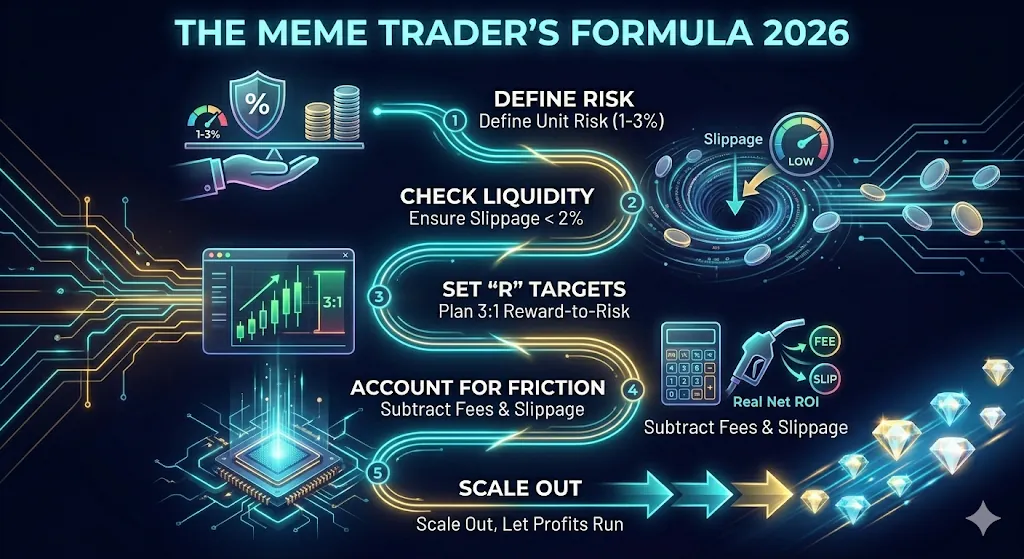
Most retail traders make the mistake of "all-inning" on a single narrative. In 2026, where "rug-pulls" and "soft rugs" are still prevalent, this approach is statistical suicide. Using a specialized risk tool helps you implement a fixed-risk model, where you only risk a small percentage of your total portfolio (usually 1% to 3%) on any individual trade.
By defining your "risk unit" with a mathematical approach, you ensure that even a string of five or ten losses won't wipe you out. This allows you to stay in the game long enough to hit the massive winners that the speculative sector is famous for.
The Math Behind Position Sizing
To calculate the ideal size for your next trade, a professional meme coin calculator typically uses the following formula:
Position Size = (Total Portfolio x Risk Percentage) / Distance to Stop Loss
For example, if your total portfolio is $10,000 and you are willing to risk 2% ($200) on a new Solana gem, your meme coin calculator will determine your entry size based on where you place your stop-loss. If your stop-loss is 20% below your entry price, your position size would be $1,000. If the price hits your stop, you lose exactly $200, or 2% of your total account.
Estimating Returns and ROI
While managing the downside is paramount, a return estimator is also used to evaluate potential upside. In 2026, we use "R-multiples" to evaluate trades. An R-multiple represents the return relative to the amount risked.
1R Return: You made a profit equal to the amount you risked (e.g., you risked $200 and made $200).
5R Return: A "home run" where you made five times your risk (e.g., you risked $200 and made $1,000).
Visualizing these targets on a chart helps you resist the urge to sell too early. If the data shows that a token has the liquidity and community strength to hit a 10R target, the calculation gives you the conviction to hold through the inevitable minor corrections.
The Impact of Gas Fees and Slippage
A common oversight when using a basic meme coin calculator is failing to account for "trading friction." In 2026, especially on Ethereum mainnet, gas fees can significantly eat into your margins.
Slippage: In low-liquidity pools, your buy order might push the price up by 2% or 3% instantly.
Fees: Priority fees on Solana or high gas on ETH must be deducted from your "Net Profit."
A professional-grade profit tool should always include a field for these costs. If your estimated profit is $100 but the round-trip fees are $40, your "Real ROI" is only $60. This insight might lead you to skip the trade entirely or move to a lower-fee chain like Base.
How to Use DEXTools to Feed Your Calculator
DEXTools provides the raw data that makes your risk assessment accurate. You cannot estimate returns without knowing the current state of the pool. Before running your numbers in a meme coin calculator, check the following on DEXTools:
Liquidity Depth: Use our "Liquidity" metric to see if the pool can handle your desired position size without excessive slippage.
Volume Trends: High volume often precedes the "volatility expansion" that hits your profit targets.
DEXT Score: If the score is low, you should increase your "Risk Premium," meaning you should probably reduce your position size to account for a higher probability of failure.
Calculating Market Cap Milestones
Because speculative assets are driven by narratives, their price action often hits psychological barriers at specific valuation milestones. When using your meme coin calculator, look at the Market Cap rather than just the price:
The $1M Barrier: Often the first major resistance.
The $10M Barrier: Where "mid-cap" status begins and CEX rumors start.
The $100M+ Milestone: "Blue-chip" territory.
Setting your take-profit levels based on these market cap milestones is a much more effective strategy than picking random price points.
Managing "Moon Bags" with Quantitative Data
In 2026, the most successful strategy involves "scaling out." A meme coin calculator helps you plan this:
Initial Goal: Take out your initial investment at 2x (100% gain).
Milestone 1: Sell 25% at a $5M Market Cap.
Milestone 2: Sell another 25% at a $20M Market Cap.
The Moon Bag: Leave the remaining 50% for a potential $100M+ run.
By running these scenarios through a profit estimator, you remove the stress of decision-making during the heat of a pump.
The Psychological Advantage of Math
The greatest benefit of using a meme coin calculator is psychological. Fear and greed are the two primary reasons traders fail. When you have a mathematical plan, you are less likely to panic-sell during a 20% dip or FOMO-buy at the absolute peak.
The software gives you the "permission" to lose small and the "strategy" to win big. In a market as irrational as the meme economy, being the only person in the room with a plan is a massive competitive advantage.
Final Verdict: Calculate Before You Buy
In 2026, the "degen" who survives is the one who treats their portfolio like a business. A meme coin calculator is the essential accounting tool for that business. Whether you are trading micro-caps on a bonding curve or swing-trading established giants, never enter a position without knowing your "R," your "Risk," and your "Exit."
Use DEXTools to get the most accurate, real-time data for your calculations. Remember: the market can stay irrational longer than you can stay solvent, but with a proper analytical setup, you'll have the mathematical edge to outlast the volatility.
Disclaimer: This article is for informational purposes only and does not constitute investment advice, financial advice, trading advice, or any other kind of advice. DEXTools does not recommend buying, selling, or holding any cryptocurrency or token. Users should conduct their own research and consult with a qualified financial advisor before making any investment decisions. Cryptocurrency investments are volatile and high-risk. DEXTools is not responsible for any losses incurred.
A meme coin calculator is a tool that helps traders estimate their position size and potential returns by calculating risk versus reward based on their total bankroll and stop-loss placement.
How do I calculate my position size for meme coin trading?
To calculate your position size, use the formula: Position Size = (Total Portfolio x Risk Percentage) / Distance to Stop Loss, which helps you determine how much to invest based on your risk tolerance.
What are R-multiples in trading?
R-multiples represent the return relative to the amount risked; for example, a 1R return means you made a profit equal to your risk, while a 5R return indicates you made five times your risk.
Why is it important to account for gas fees and slippage?
Gas fees and slippage can significantly reduce your profit margins, so it's crucial to factor these costs into your calculations to determine your 'Real ROI' before executing trades.
How can DEXTools assist in using a meme coin calculator?
DEXTools provides essential data such as liquidity depth and volume trends, which are necessary for accurate risk assessments and effective use of a meme coin calculator.