LP Behavior: Insights from Liquidity Providers
— By Whatsertrade in Tutorials
Discover how liquidity provider trends offer insights into market security, volatility, and trust within decentralized finance. Analyze their impact today.
In decentralized markets, the behavior of liquidity providers (LPs) offers more clues than one might expect. Their actions directly influence price stability, trader confidence, and safe exits. When liquidity is added, removed, or moved, it sends a clear message to the market.
Traders often prioritize price and volume metrics, but the significance of LP behavior shouldn't be overlooked. While charts might suggest one thing, liquidity providers might be quietly reducing their exposure. Conversely, a token that appears weak could be backed by improving liquidity.
Understanding LP behavior empowers traders to interpret market signals that go beyond mere candlesticks.
The Role of Liquidity Providers in DeFi
Liquidity providers play a pivotal role in decentralized exchanges (DEXs). They supply the assets that facilitate transactions between buyers and sellers. Insufficient liquidity makes trading expensive, increases slippage, and leaves prices vulnerable to manipulation.
For market participants, liquidity is more than a technical element; it's a measure of market health. Robust liquidity supports smooth trading experiences, whereas weak liquidity can transform normal sell orders into episodes of extreme price swings.
Liquidity Additions: A Signal of Confidence
Adding liquidity often indicates market support. It might suggest the involvement of the project team, community, or external providers committed to sustaining the market.
However, liquidity additions vary in significance. A minor addition after significant price shifts might be superficial, whereas a substantial addition during consolidation could offer genuine support. It's crucial to assess the timing, scale, and context to determine their impact.
Key to consider is whether fresh liquidity improves token tradability or merely enhances its appearance.
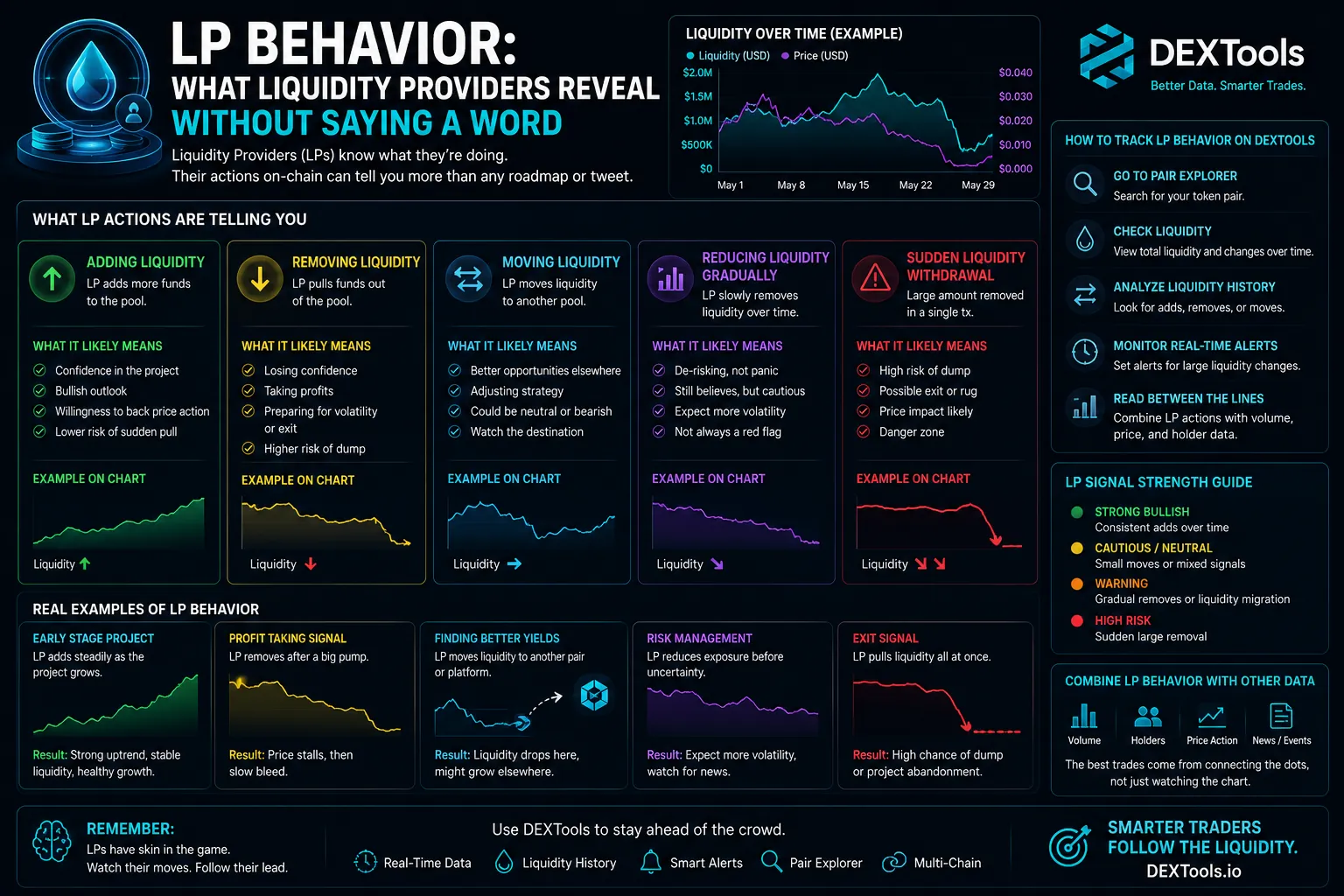
Liquidity Removals: A Telltale Warning
The removal of liquidity is a potential red flag, especially if sudden or amid market turmoil. Diminished liquidity exacerbates price impacts, complicating exits and increasing the risk of sudden declines.
Not every withdrawal has malicious intent. LPs may rebalance, migrate to other pools, or adjust strategies. Nevertheless, traders should scrutinize liquidity reductions carefully.
Essential Questions:
- How much liquidity was withdrawn?
- Did the removal occur before or after a sell-off?
- Did it lead to increased price volatility?
- Was the liquidity transferred elsewhere?
- Did the team provide a rationale for the withdrawal?
If liquidity vanishes without explanation, traders should exercise caution.
Stable vs. Nervous LP Behavior
Stable LP behavior fosters market confidence. Here, liquidity remains constant, with additions made judiciously and withdrawals either explained or minimised.
Nervous LP behavior, however, is characterized by erratic liquidity shifts. Pools may thin out during sell-offs, and providers might reduce their exposure when the token requires support the most.
This erratic behavior contributes to trader anxiety. When market participants suspect that exiting may become challenging, selling pressure is likely to intensify.
The Timing of Liquidity Matters
A liquidity event's significance fluctuates based on timing.
Liquidity added before a major announcement might indicate preparation for increased trading activity. Adding liquidity after a spike might aim to stabilize the market. Conversely, a removal before a downturn can be concerning, while one after prolonged inactivity might merely reflect diminished interest.
Context is key. LP behavior should be evaluated in conjunction with price trends, trading volume, and holder activity.
Trust and Liquidity
In DeFi, trust hinges on observable actions. A team that sustains liquidity during challenging periods sends a vastly different signal than one that retracts support amid volatility.
For emerging tokens, liquidity behavior can significantly influence initial perceptions. Traders seek assurance of the market's capacity to support smooth entry and exit.
A token doesn't require infinite liquidity, but it does need liquidity proportional to its activity and market size.
Leveraging LP Behavior for Trading Decisions
By understanding LP behavior, traders can make more informed decisions. Robust liquidity can enhance confidence in a market setup, while weak or unstable liquidity might prompt caution regarding position sizes or trades altogether.
Before entry, assess whether liquidity is stable, improving, or deteriorating. During a trade, monitor any liquidity shifts that could impact your exit strategy.
Remember, liquidity is more than a mere statistic; it's a dynamic factor influencing the market.
How to Bridge Crypto Between Chains: Complete Cross-Chain Tutorial 2026 How to Use 1inch: Complete DEX Aggregator Swap Tutorial (2026) How to Use OKX Web3 Wallet: Multi-Chain DeFi Hub Guide (2026)Frequently Asked Questions
What motivates individuals to become liquidity providers in DeFi?
LPs are often motivated by the potential to earn trading fees and rewards from providing capital to decentralized exchanges. They aim to profit from market activity and protocol incentives.
How do liquidity providers manage impermanent loss?
LPs manage impermanent loss by understanding its mechanics and choosing pools with lower volatility or stablecoin pairs. Some also utilize strategies like single sided liquidity provision or actively rebalancing positions.
What are the typical risks associated with being a liquidity provider?
Key risks include impermanent loss, smart contract vulnerabilities, and potential for reduced trading volume leading to lower fee generation. Market downturns can also impact the value of provided assets.
How do liquidity providers choose which pools to participate in?
LPs typically evaluate factors such as expected annual percentage yield (APY), trading volume, token volatility, and the reputation of the decentralized exchange or protocol. They seek a balance of risk and reward.
What role do incentives play in attracting liquidity providers?
Incentives, often in the form of native tokens or boosted rewards, are crucial for attracting and retaining LPs, especially for new protocols. These incentives aim to bootstrap liquidity and encourage participation.
Related Guides
- What Is a Liquidity Provider in Crypto? Guide
- Collateral Risks in DeFi Lending: A Crucial Insight
- What Is Liquidity Mining? DeFi Rewards Guide
- Impermanent Loss in DeFi Liquidity Pools: Worked LP Math, Break-Even and Trade-Offs (2026)
- Liquidity Turnover vs TVL: How to Know If a DeFi Pool Is Active or Idle