Crypto Bug Bounty Program: How to Launch One Properly
— By Whatsertrade in Tutorials
Learn how to launch a crypto bug bounty program with clear scope, severity tiers, rewards, disclosure rules, response workflows, and platform choices.
This guide is about launching a crypto bug bounty program as an operational security process. For adjacent topics, pair it with Smart Contract Permissions and Best Free Smart Contract Analysis Tools.
Key Takeaways
- Importance of Security in Crypto Projects
- Fundamentals of a Bug Bounty Program
- Internal Processes and Platform Choices
- Integrating Bug Bounties into Security Strategy
- Frequently Asked Questions
- Related Guides
Importance of Security in Crypto Projects
Security is one of the most important parts of any crypto project. In Web3, a single vulnerability can put user funds, protocol reputation, and long-term trust at risk. Smart contract bugs, bridge issues, oracle manipulation, access control mistakes, and front-end attacks can all create serious damage.
Fundamentals of a Bug Bounty Program
Role and Importance
A crypto bug bounty program gives ethical hackers a safe, structured way to report vulnerabilities before malicious attackers exploit them. It also shows users, investors, and partners that the project takes security seriously.
Beyond Audits
A bug bounty program is not a replacement for an audit. Audits are important but usually happen at specific moments. A bug bounty program can remain open over time, which gives researchers a continuous incentive to review your contracts, applications, and infrastructure.
Readiness for Launch
The first step in launching a crypto bug bounty program is deciding whether your project is ready. Many teams make the mistake of launching a public program too early. If your codebase is changing every day, your documentation is incomplete, or your team cannot respond quickly to reports, a public bounty may create more problems than it solves.
Essential Preparations
A project is ready for a bug bounty when it has a technical team capable of reviewing submissions, a clear communication owner, a budget for rewards, and a process for fixing vulnerabilities. If these elements are missing, it may be better to begin with a private program or invite a small group of trusted researchers.
Scope Definition
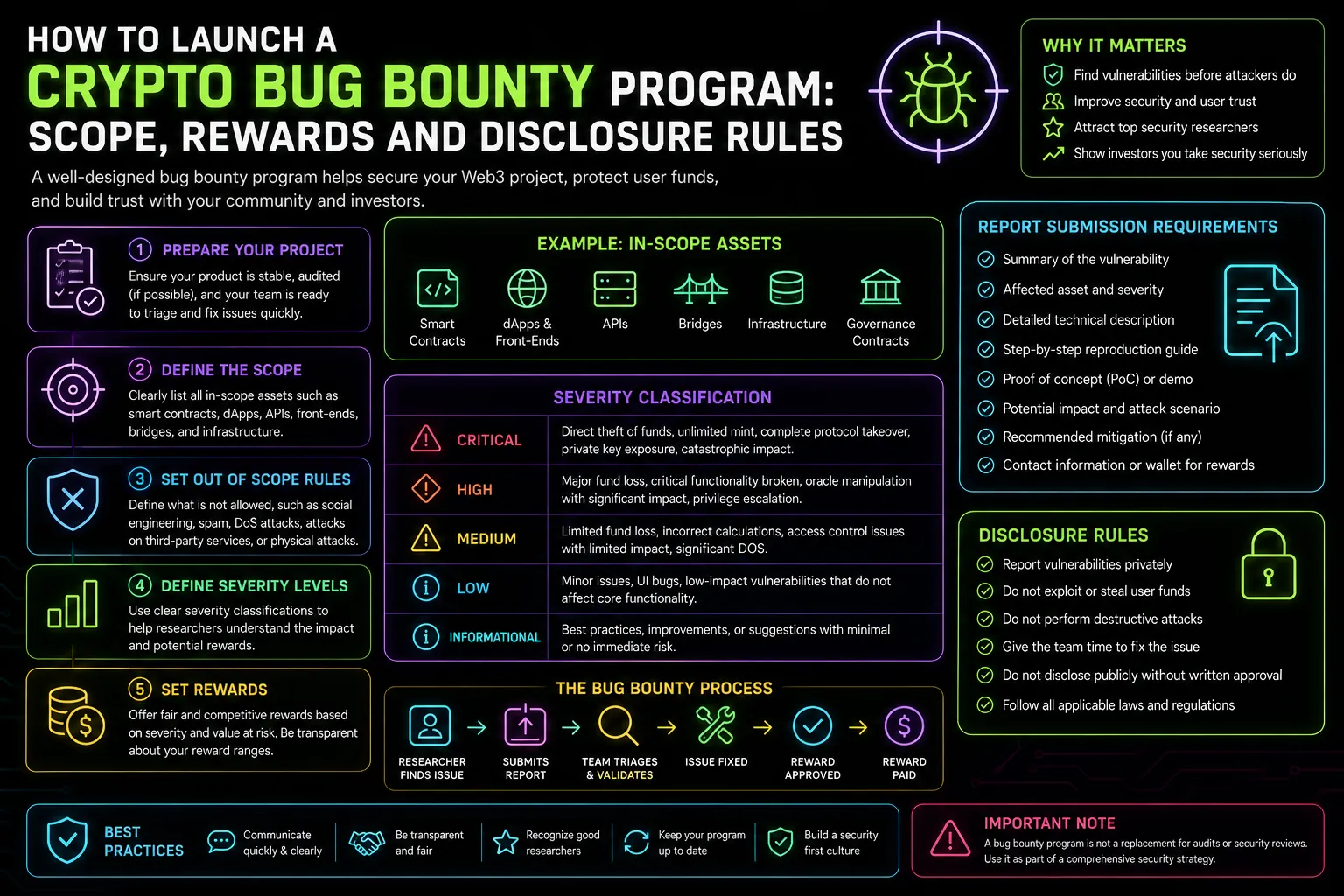
Scope is the foundation of any bug bounty program. It defines what researchers are allowed to test. In crypto, the scope usually includes smart contracts, staking systems, vaults, bridges, governance contracts, front-end applications, APIs, and infrastructure components.
The more specific the scope is, the better the reports will be. Researchers should not have to guess which contracts or systems are eligible. A vague scope can lead to confusion, duplicate reports, and disputes over rewards. A clear scope helps everyone understand what matters most.
Out of Scope Clarifications
It is also important to explain what is out of scope. Not every issue deserves a reward. A missing security header with no real impact is not the same as a vulnerability that can drain funds. Social engineering, spam, denial of service attacks, physical attacks, and issues involving third-party services are often excluded. These rules protect both the project and the researchers.
Severity Classification and Rewards
Severity classification is another key part of the program. A crypto bug bounty should explain how vulnerabilities are ranked. Critical issues may include direct theft of user funds, permanent freezing of funds, unauthorized minting, governance takeover, or private key exposure. High severity issues may involve major accounting errors, oracle manipulation, or unauthorized access to important functions. Medium and low severity issues may involve limited impact, configuration problems, or smaller technical weaknesses.
Reward amounts should match the value at risk. If a protocol controls significant user funds, the rewards need to be meaningful. A project that offers a very small reward for a critical vulnerability may struggle to attract serious researchers. Fair rewards show that the team respects the time and skill required to find real security issues.
Crafting a Valid Report
A good bug bounty program should also explain what a valid report looks like. Researchers should be asked to provide a clear summary, affected asset, technical explanation, steps to reproduce the issue, potential impact, and proof of concept when appropriate. The more complete the report is, the faster the team can validate and fix the problem.
Importance of Disclosure Rules
Disclosure rules are essential. Researchers need to know how to report issues responsibly, and projects need time to fix vulnerabilities before they become public. A strong disclosure policy should require private reporting, prohibit exploitation beyond what is necessary for proof, prevent researchers from moving user funds, and explain when public disclosure is allowed.
The Role of Communication
Communication matters more than many teams realize. If a researcher submits a serious report and receives no response for weeks, trust breaks down. Even when a fix takes time, regular updates help maintain a professional relationship. A good program should acknowledge reports quickly, review them within a reasonable period, and explain reward decisions clearly.
Internal Processes and Platform Choices
Internal Response Protocol
The project also needs an internal response process. A bug bounty is not useful if the team does not know what to do when a critical report arrives. There should be a security lead, technical reviewers, a communication owner, and an emergency process. If a vulnerability affects live contracts, the team may need to pause certain functions, prepare a patch, notify partners, or coordinate a safe fix.
Platform vs. Self-Hosting
Some projects choose to run their bug bounty through a specialized platform. This can help with visibility, triage, researcher management, and payment workflows. Other teams prefer a self-hosted process, especially in the early stages. Both approaches can work, but the team must be prepared to manage submissions professionally.
Common Mistakes to Avoid
One common mistake is making the program too broad without enough internal capacity. Another mistake is promising large rewards without a real budget. Some teams also fail to define economic attacks clearly, which can be a major issue in DeFi. If your protocol depends on liquidity, price feeds, or complex incentives, you need to explain how those risks are evaluated.
Integrating Bug Bounties into Security Strategy
A Broader Security Plan
A crypto bug bounty program should be treated as part of a broader security strategy. It works best alongside audits, internal reviews, monitoring, incident response planning, and secure development practices. No single tool can guarantee safety, but each layer reduces risk.
For Web3 projects, trust is difficult to earn and easy to lose. Users want to know that a team is serious about protecting funds. Investors want to see mature security processes. Developers want clear rules before they spend time reviewing a protocol. A well-designed bug bounty program helps answer all of these concerns.
Launching a crypto bug bounty program is not only about paying hackers. It is about building a responsible security culture. When scope, rewards, and disclosure rules are clear, ethical researchers can help strengthen the project before attackers find the same weaknesses.
How to Bridge Crypto Between Chains: Complete Cross-Chain Tutorial 2026 How to Use 1inch: Complete DEX Aggregator Swap Tutorial (2026) How to Use OKX Web3 Wallet: Multi-Chain DeFi Hub Guide (2026)Frequently Asked Questions
What is a crypto bug bounty program?
A crypto bug bounty program incentivizes security researchers to find vulnerabilities in blockchain projects. It rewards them for responsibly disclosing flaws before malicious actors can exploit them.
Why are crypto bug bounty programs important?
They enhance the security of decentralized applications and smart contracts. Proactive vulnerability discovery helps prevent hacks and protects user assets.
How do crypto bug bounty programs work?
Projects define scope, rules, and reward tiers for different types of vulnerabilities. Researchers submit findings, which are then validated and compensated based on severity.
What kind of vulnerabilities do these programs target?
They target smart contract bugs, protocol flaws, cryptographic issues, and web application vulnerabilities. The goal is to identify any weakness that could lead to loss of funds or system compromise.
Who typically participates in crypto bug bounty programs?
Security researchers, white-hat hackers, and blockchain developers participate. They often have expertise in cryptography, smart contract auditing, and penetration testing.
Related Guides
- The Open League (TOL): TON Ecosystem Program Guide
- What Is a TON Memo Tag and When Do You Need One? Guide (2026)
- What Is a Blockchain Explorer? How to Use One (2026)
- Top 5 Crypto Exchanges in 2026: Which One Should You Use?
- Revenue Concentration vs Revenue Diversity: Why One Income Stream Can Make Protocols Fragile